
Blog

Cut EU Latency with Amsterdam Dedicated Servers
Digital purchase flows live or die on latency. In 2025, web.dev reported that Ray-Ban improved Largest Contentful Paint by roughly 43% on product pages and increased PDP conversion rates by 101.47% on mobile and 156.16% on desktop [1], while T-Mobile saw a 60% improvement in prospect visit-to-order rate after Core Web Vitals work that included API caching and response-time improvements. [2] If your European traffic still hops the Atlantic or waits on under-spec hardware, every click costs money. A practical cure is a dedicated server in Amsterdam equipped with flash storage and modern multi-core CPUs, sitting a few fibre hops from one of the world’s largest internet exchanges.
Choose Melbicom— 450+ ready-to-go server configs — Tier IV & III DCs in Amsterdam — 55+ CDN PoPs across 6 continents |
 |
This article explains why that combination—plus edge caching, DNS routing and compute offload in the Amsterdam metro—lets performance-critical platforms treat continental Europe as a “local” audience and leaves HDD-era tuning folklore in the past.
Amsterdam’s Short Routes and Big Pipes
Amsterdam’s AMS-IX platform now tops 15 Tb/s of peak traffic [3] and reports 900+ total connected ASNs. [4] That peering density keeps paths short across European metros: the practical target is to keep API front ends, auth brokers and risk engines inside the Amsterdam or European network path instead of hairpinning to North America. Shifting those services onto a Netherlands server dedicated to your tenancy therefore removes much of the network delay European customers usually feel.
Melbicom’s Amsterdam footprint spans Tier III/Tier IV data centers with 1–200 Gbps network capacity per server. Because unmetered options are available—exactly what unmetered dedicated-hosting customers want—teams can plan seasonal peaks without metered-egress surprises.
How Do Anycast DNS and Edge Caching Speed Up Amsterdam Dedicated Servers?
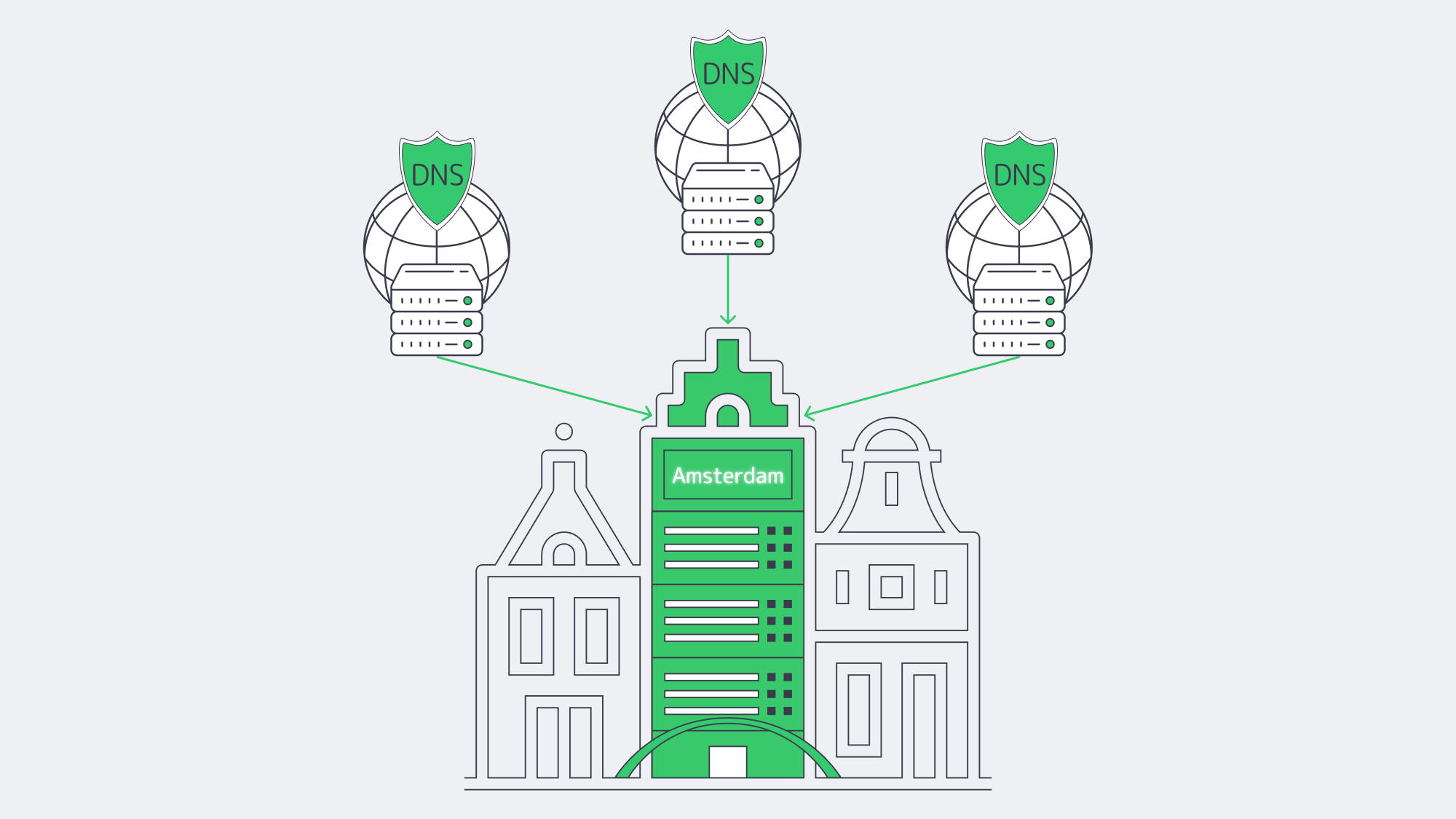
Latency is more than distance; it is also handshakes. Anycast DNS, when used in front of your stack, lets the same resolver IP be announced from multiple points of presence, so the nearest node answers each query. Once the name is resolved, edge caching keeps static assets closer to visitors instead of forcing every request back to origin.
Because Melbicom’s CDN includes an Amsterdam PoP, teams can keep an Amsterdam server as origin for dynamic APIs while CDN nodes cache images, JS bundles and style sheets. GraphQL persisted queries, signed cookies or ESI fragments can be served from cache where appropriate. Dynamic responses still originate from the dedicated server.
Hardware Built for Microseconds—The Melbicom Way
Melbicom’s Netherlands dedicated server line-up includes 450+ ready-to-go Amsterdam configurations built on Intel and AMD platforms, with published options from 32 GB to 1536 GB of RAM and 1–200 Gbps network capacity per server. There are three ingredients that matter most for low-latency workloads.
High-Clock Xeon and Ryzen CPUs
Amsterdam configurations span Intel E3 v6, E5 v3/v4, E-21/22/23 and Xeon Scalable generations, plus AMD Ryzen 7000/9000 options. That mix gives teams high-clock choices for PHP render paths, TLS handshakes and market-data decoders, as well as multi-core Xeon options for OLTP, Kafka and Spark jobs that would otherwise queue up.
Memory Capacity and Error Correction
Netherlands configurations range from 32 GB to 1536 GB of RAM, giving small API nodes and large in-memory databases room to fit the workload. For configurations that use ECC DIMMs, memory-error correction can help prevent single-bit memory faults from reaching application data during peak checkout.
Fast Storage Built for Performance
SATA is still useful where capacity economics matter, but performance workloads belong on flash. Use the drive class to match the latency profile:
| Drive type | Seq. throughput | Random 4 K IOPS | Role in the stack | Best-fit use-case |
| Enterprise NVMe SSD | up to 12 GB/s | up to 2,000 K read | low-latency primary tier | hot databases, high-volume APIs |
| Enterprise SATA SSD | up to 550–560 MB/s | up to 97–98 K read | general flash tier | catalogue images, logs |
| 10 K RPM HDD | 130–266 MB/s sustained | seek-limited | capacity/archive tier | cold storage, backups |
* Enterprise NVMe and SATA SSD figures from Samsung data center SSD specifications [5];
** HDD baseline from Seagate Exos 10E2400 datasheet [6].
NVMe avoids millisecond seek delays from spinning disks and removes SATA as a bottleneck. Payment ledgers gain steadier commit times, and read-heavy product APIs serve cache misses without stalling worker threads.
Predictable Bandwidth, No Penalty
Melbicom offers unmetered plans for Netherlands workloads, and Amsterdam data centers list 1–200 Gbps per-server network capacity. That lets teams plan traffic spikes without treating every asset as a metered-egress liability. In practice, teams can pair high-clock front-end nodes with storage or database nodes in the same Amsterdam metro, keeping European RTTs low and avoiding an overloaded origin.
Designing for Tomorrow, Not Yesterday

Defrag scripts, short-stroking platters and RAID-stripe gymnastics were brilliant in the 200 IOPS era; today they are noise. Performance hinges on:
- Proximity – keep European RTTs low enough for interactive checkout and API calls.
- Parallelism – multi-core CPUs reduce queueing inside busy application tiers.
- Persistent I/O – NVMe drives remove SATA and disk-seek bottlenecks from hot paths.
- Integrity – ECC-capable RAM helps keep correctable errors out of application data.
- Predictable bandwidth – unmetered options reduce the temptation to throttle success.
Early Hints headers and HTTP/3 can push the gains further, and AMS-IX reported 65 % annual growth in 400G ports in 2025 [7], so the exchange fabric continues to scale for higher-capacity traffic.
Security and Compliance—Without Slowing Down Performance
For teams handling EU data, hosting in the Netherlands can help keep latency and data-residency goals aligned. Tier III/IV Amsterdam data centers support resilient hosting, and AES-NI-capable x86 CPUs can reduce encryption overhead for TLS and disk encryption. Keeping sensitive workloads close to EU users also simplifies architecture reviews when traffic and storage do not need to cross an ocean.
Turning Milliseconds Into Market Leadership
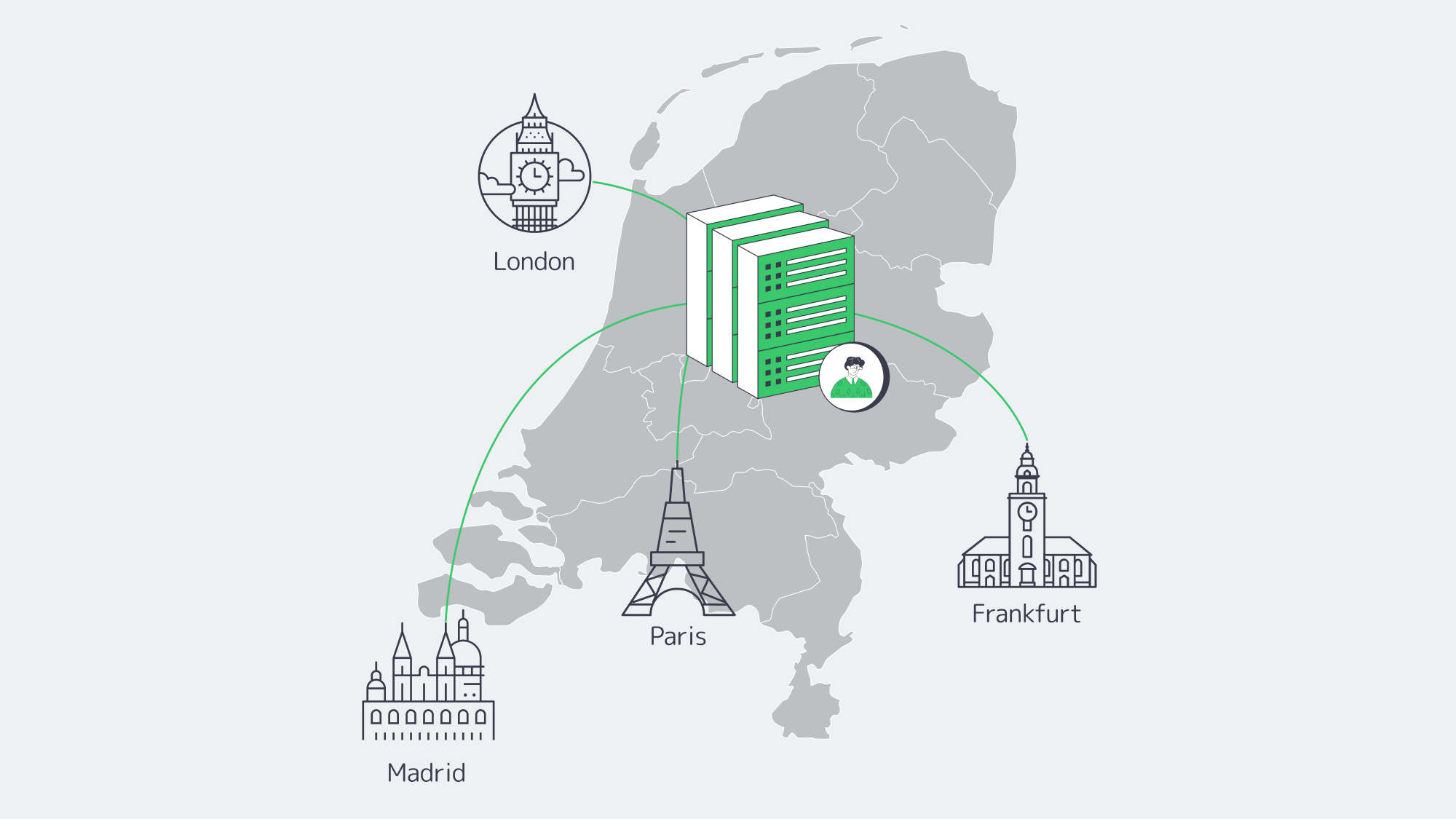
Latency is not a footnote—it is a P&L line. Parking workloads on dedicated server hosting in Amsterdam, with the right storage tier, ample RAM and modern multi-core CPUs, puts your stack close to EU consumers. Edge caching shaves repeat asset round trips; AMS-IX’s dense peering reduces the rest; well-matched storage and CPU capacity keep server-side work from becoming the next bottleneck. What reaches the shopper is an experience that feels instant—and a checkout flow that never gives doubt time to bloom.