
Blog

Why Singapore Powers Low-Latency FinTech Infrastructure
If modern finance runs on speed, trust, and uptime, infrastructure is its engine room. FinTech teams expanding across Asia need to measure network latency, define security controls, and document regulatory responsibilities before choosing a hosting location. A focused strategy built around hosting in Singapore can support that work through regional proximity, dense connectivity, and clear governance reference points.
Choose Melbicom— 100+ ready-to-go server configurations in SG — Tier III-certified SG data center — 39 CDN PoPs across 35 countries |
 |
Why Singapore Fits FinTech Infrastructure
Singapore is a major financial and connectivity hub. In 2023, it hosted 26 subsea cable landings across three landing sites and was expected to connect to more than 40 subsea cables by 2028 according to the Carnegie Endowment for International Peace. That concentration can shorten network paths to Asian markets, although actual latency still depends on routing, peering, and the destination.
Singapore’s FinTech sector attracted close to US$1.04 billion across 90 deals in H1 2025, up about 87% year over year. The figure shows continued investment activity, but infrastructure decisions should still rest on workload, route, control, and cost requirements.
Policy adds clearer reference points rather than automatic compliance. The Monetary Authority of Singapore’s Technology Risk Management Guidelines set out technology risk management principles and best practices for financial institutions, while the Personal Data Protection Act obligations govern the handling of personal data. Hosting location and single-tenant hardware can support a control design, but they do not by themselves make a workload compliant.
How Singapore Hosting Changes Latency
For workloads such as market-data ingestion, order routing, AML screening, and instant payments, network distance matters. Singapore places compute closer to many Asian endpoints, but the result must be verified against each counterparty and route. Current city-to-city measurements illustrate the geographic effect:
| Destination | RTT from Singapore | RTT from New York |
|---|---|---|
| Hong Kong | ~30 ms | ~203 ms |
Indicative RTTs checked on August 4, 2026 from independent, continuously measured Singapore–Hong Kong and New York–Hong Kong pings; values vary with routing and time.
Two Takeaways
First, regional adjacency: on August 4, 2026, Singapore-to-Hong Kong measured about 30 ms, while New York-to-Hong Kong measured about 203 ms—a gap of roughly 173 ms. That gap can matter for latency-sensitive systems, but teams should test the actual exchange, payment network, cloud on-ramp, or customer endpoint instead of relying on city averages.
Second, private routes can differ sharply from public internet paths. In September 2025, McKay Brothers announced a private London–Singapore service below 137 ms RTT, while WonderNetwork city-to-city measurements checked on August 4, 2026 were about 168 ms on the public path. London–New York is roughly 70 ms in measurements checked on August 4, 2026, while EXA advertises an under-60-ms specialized route.
Dedicated servers can remove provider-side noisy-neighbor contention; when used as bare metal, they also avoid provider-imposed hypervisor scheduling overhead. They do not eliminate all jitter. Application design, kernel and NIC tuning, storage, congestion, route changes, and counterparty systems still determine end-to-end latency and tail behavior.
Where Melbicom fits: Melbicom’s Singapore location is Tier III and offers network capacity up to 200 Gbps per server, with 100+ ready-to-go configurations. The suitable configuration depends on measured CPU, memory, storage, and network demand.
How Can Singapore Hosting Support Security and Compliance Work?

Financial-services infrastructure must be secure by design and operated with documented controls. Under the Uptime Institute Tier framework, Tier III data centers are concurrently maintainable: components can be maintained or replaced without shutting down IT operations. The Tier label describes facility topology; it is not a substitute for application resilience, a service commitment, or tested recovery procedures.
The PDPA’s accountability obligation requires organizations to manage and protect personal data through appropriate policies and practices. MAS TRM provides technology risk management principles and best practices for regulated financial institutions. Dedicated hardware can clarify asset ownership, access boundaries, and evidence collection, but customers still own the controls, configuration, tests, and evidence.
Locating a workload in Singapore can simplify a chosen data-location strategy, but the PDPA does not turn local hosting into automatic compliance. Its Transfer Limitation Obligation also governs overseas transfers by requiring comparable protection. Business continuity and disaster recovery still require tested architectures, backups, dependencies, and operating procedures.
For systems that communicate with counterparties located in Singapore, placing compute in the city-state can reduce physical path length. The benefit must be verified with endpoint-specific RTT and route testing because venue, carrier, peering, and failover paths can change the result.
Where we help: Melbicom’s Singapore location combines Tier III facility infrastructure, network capacity up to 200 Gbps per server, 100+ ready-to-go configurations, and 24/7 support. These features can support a documented data-location and recovery design, but compliance and recoverability depend on the customer’s architecture and controls.
Which FinTech Use Cases Gain the Most from Singapore Dedicated Servers?
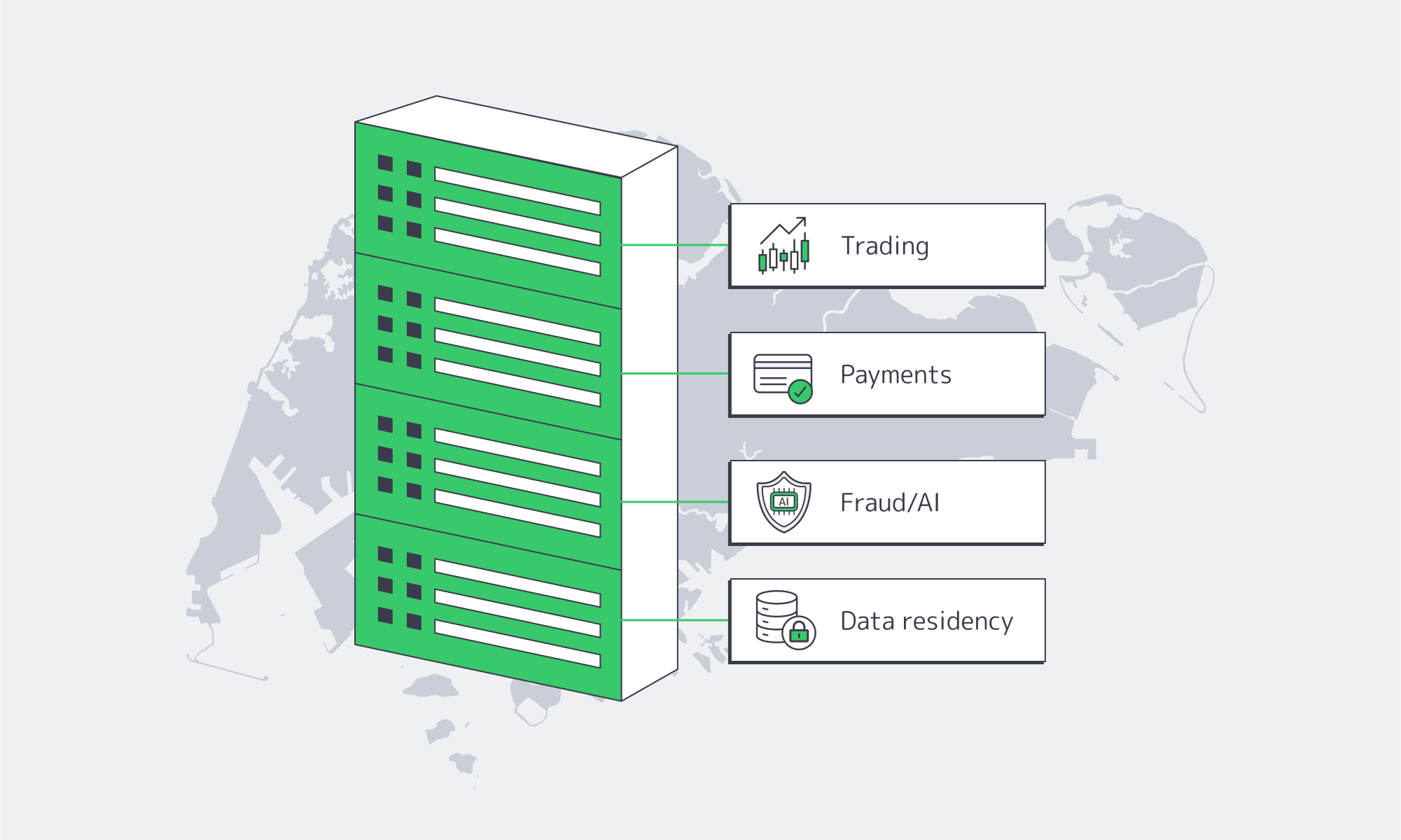
- Market infrastructure (e-FX, equities, crypto matching): Matching and market-data services benefit when the selected Singapore route is closer to the relevant Asian venues. The private sub-137-ms London–Singapore route announced in 2025 shows that specialized long-haul transport can also reduce interregional delay, but it is a private service rather than a public-internet baseline.
- Payments and digital banking: Authorization, 3-D Secure, AML/KYC, and ledger writes require stable capacity and measured latency. Single-tenant hardware removes cross-tenant host contention, but application queues, databases, and external payment dependencies still require load and failover testing.
- Fraud, risk, and AI inference: Feature stores, graph workloads, behavioral models, and real-time inference benefit from predictable resource allocation. Size CPU, memory, storage, and network capacity from profiling data, then test p95 and p99 latency under representative peaks.
- Data-location-sensitive services: A Singapore dedicated server deployment can support an organization’s chosen data-location controls and evidence collection. PDPA obligations, including overseas-transfer protection, still depend on policy, contracts, configuration, and operations rather than the server’s country alone.
How Should CTOs Choose the Best Dedicated Server Hosting in Singapore?
1) Proven network performance. Request RTT, packet-loss, route, and peering data to the actual exchanges, payment networks, cloud on-ramps, and recovery sites you use. WonderNetwork measurements checked on August 4, 2026 were about 30 ms between Singapore and Hong Kong, while McKay Brothers announced a private London–Singapore service below 137 ms in September 2025. Test both normal and failover paths.
2) Facility and resilience credentials. Verify the Tier III facility scope, maintenance procedures, power and cooling topology, incident history, and service terms. Use application-specific RTO and RPO targets, then test whether redundancy, backups, and failover design meet them; a Tier label alone does not set your workload’s availability.
3) Compliance posture. Map applicable MAS TRM and PDPA obligations to concrete controls such as access logging, key management, change approval, incident response, vendor oversight, and evidence retention. Confirm which obligations apply to your entity and workload instead of treating provider location or hardware tenancy as certification.
4) Scalability options. Compare ready-to-go and custom configurations, provisioning lead times, CPU and memory ranges, storage options, and port capacity. Melbicom has 100+ SG configurations; verify the exact inventory and delivery timing for the required build before committing.
5) Edge acceleration. For public endpoints, a CDN can shorten delivery distance for cacheable content and absorb regional traffic variation. Validate cache hit ratio, origin latency, dynamic-content behavior, purge controls, TLS handling, and cost; a larger PoP footprint does not guarantee a faster result for every request.
How Does Singapore Stack Up on Long-Haul Payment & Trading Routes?
| Route | Representative RTT Insight |
|---|---|
| London ↔ Singapore | <137 ms on a specialized private route announced by McKay Brothers in September 2025; about 168 ms in public city-to-city measurements checked on August 4, 2026. |
| London ↔ New York | About 70 ms in public city-to-city measurements checked on August 4, 2026; under 60 ms on EXA’s specialized route. |
These measurements, together with the roughly 30 ms Singapore-to-Hong Kong RTT measured on August 4, 2026, show why Singapore can reduce regional path length without eliminating long-haul delay. Use them as directional examples only; production decisions need endpoint-specific tests, packet-loss data, failover paths, and repeated measurements.
Singapore Dedicated Servers: Important Insights
- Latency is geography plus engineering. Singapore’s cable density and peering can reduce RTT to selected Asian endpoints, while specialized transport can shorten some long-haul routes. Actual performance depends on the destination and path.
- Compliance requires more than location. Singapore provides clear regulatory reference points, but neither PDPA nor MAS TRM is satisfied by server location alone. Dedicated hardware can clarify boundaries and evidence, while governance and operations remain essential.
- Determinism has limits. Dedicated bare metal removes cross-tenant host contention and provider-imposed virtualization overhead, but end-to-end jitter still depends on the application and network path.
- Resilience must be designed. Tier III describes concurrently maintainable facility infrastructure. Workload resilience still depends on architecture, failover, backups, testing, and service terms.
- Distribution should be measured. Pair Singapore compute with a CDN only where workload behavior and measurements show a benefit.
What Do You Gain by Switching to Dedicated Hosting in Singapore?

Performance and evidence are closely related in finance. Singapore can provide short regional paths to selected Asian endpoints and a governance environment familiar to many regulated firms. The benefit is workload-specific: measure actual counterparties, document controls, and test recovery rather than treating geography as a guarantee of latency, compliance, or business outcomes.
Public London–Singapore measurements checked on August 4, 2026 were about 168 ms RTT, while a specialized private route announced in 2025 was below 137 ms. That difference shows why route choice matters as much as server location. For teams that need Singapore dedicated server capacity, the practical decision is whether the available hardware, network, support, control evidence, and total cost meet the workload’s measured requirements.
Deploy low-latency servers in Singapore
Provision Tier III Singapore dedicated servers with network capacity up to 200 Gbps per server and 100+ ready-to-go configurations. Map routes and controls to the MAS TRM and PDPA duties that apply to the workload.