
Blog

Scaling Streaming Services with Dedicated Servers
Netflix reported a peak of 65 million concurrent streams for its November 2024 Paul–Tyson event. Metrics vary by platform, but the figure shows how quickly a single live event can concentrate demand. For streaming services, the operational question is whether the architecture can absorb rapid demand changes without buffering, outages, or uncontrolled delivery costs.
When audiences are large and traffic spikes are common, a scaling strategy should combine dedicated servers as the predictable capacity anchor, load-balanced horizontal scaling, high-availability clusters, multi-region failover, CDN delivery, and optional cloud bursting for exceptional peaks. This article explains that blueprint, along with hardware acceleration and modern codecs for 4K and adaptive bitrate streaming.
Choose Melbicom— 1100+ ready-to-go servers — 21 Tier III & IV data centers across 5 continents — 39 CDN PoPs across 6 continents |
 |
Why Dedicated Servers Anchor Streaming
High-traffic streaming workloads need sustained throughput, predictable CPU and I/O, and stable network performance. Multi-tenant platforms can meet those needs, but shared-resource contention and virtualization layers may make performance less predictable unless capacity is carefully isolated and reserved.
A fleet of dedicated servers provides single-tenant CPU, storage, and network resources. Horizontal fleets distribute segment and manifest requests across nodes, while traffic-included or flat-rate bandwidth plans can make steady delivery costs more predictable than usage-based cloud egress. The economic advantage depends on utilization, port commitments, traffic profile, and operating model.
Melbicom maintains 1100+ ready-to-go servers. Its infrastructure spans 21 data centers in 18 cities. The network provides up to 200 Gbps per server and 14+ Tbps of aggregate capacity, with 23 transit providers and 29 IXPs. We also provide 24/7 support.
With a hybrid model, steady traffic can remain on dedicated servers while cloud capacity is reserved for demand that is difficult to forecast. This can reduce exposure to variable egress and idle overprovisioning, but the result depends on actual traffic patterns, cloud pricing, replication, observability, and the cost of operating two environments.
Scaling Horizontally: A Server Fleet Design for High Traffic Streaming
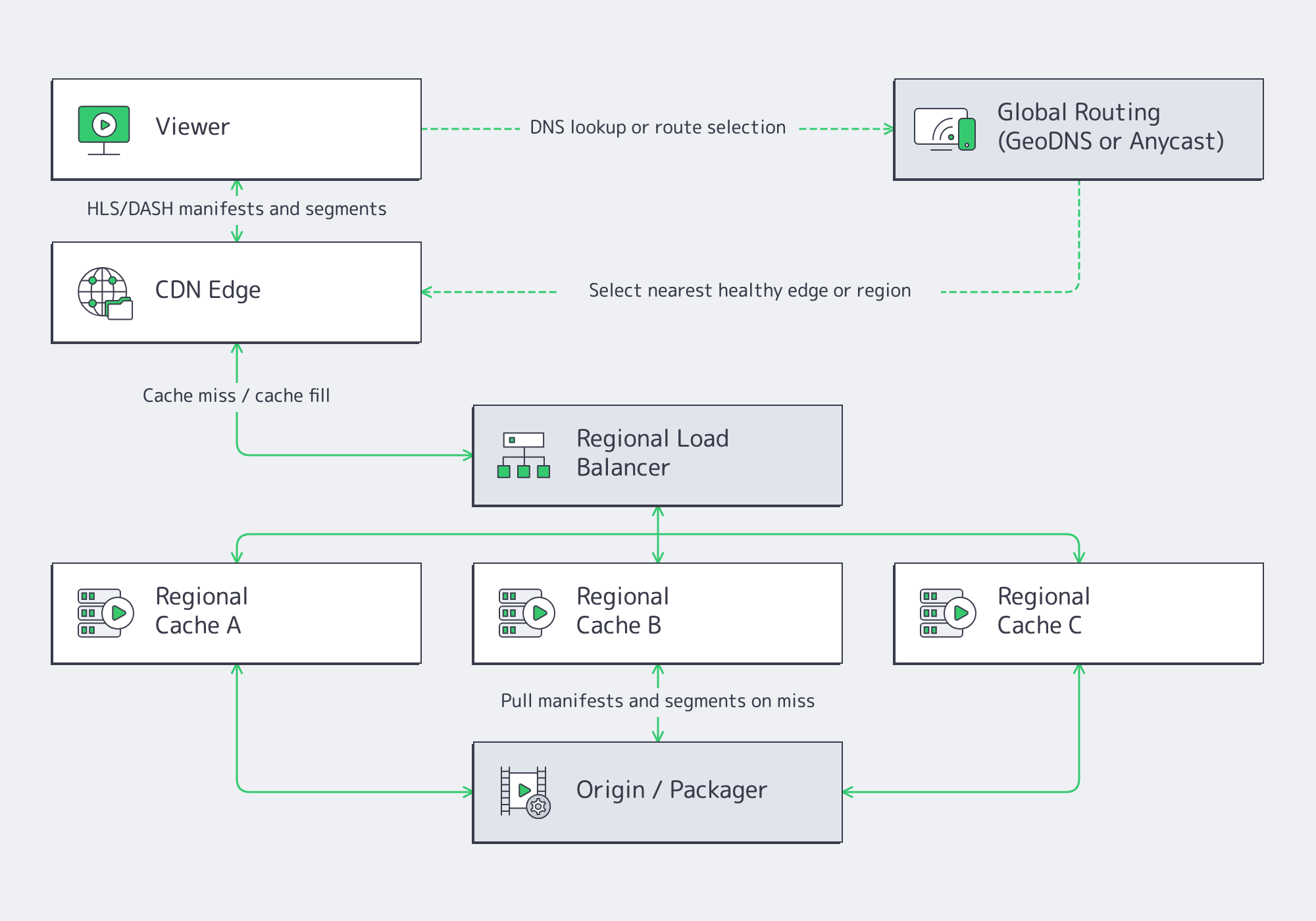
Horizontal scaling adds servers behind routing and load-balancing layers instead of relying on one increasingly large machine. HLS and DASH divide media into HTTP-delivered manifests and segments, so requests can be distributed across stateless or lightly stateful nodes. Capacity grows by adding nodes, provided session state, cache behavior, and origin limits are designed for distribution.
The balancing works best in two tiers:
- Global routing: Viewers are steered via GeoDNS or anycast to the nearest healthy region, be it Atlanta, Amsterdam, or Singapore.
- Local balancing: Traffic is spread across the server pool within the region using L4/L7 appliances or software on dedicated balancers with algorithms such as least connections and slow start.
Key design elements
- Statelessness/light state: Keep session state in the client or a distributed store so any node can serve a request. This reduces hard coupling and simplifies cache control.
- Back-pressure and shedding: Use health checks, circuit breakers, queue-depth signals, and admission controls to stop overloaded nodes from accepting excess work.
- Cache locality: Minimize origin requests by serving hot segments from RAM or NVMe caches, which can reduce startup delay and origin load.
- Rolling deploys: Drain, upgrade, and return node subsets before proceeding to the next group, reducing the need for global maintenance windows.
With this design, a node failure reduces headroom rather than stopping the service, provided remaining capacity and health checks are adequate.
Horizontal fleets can improve p95 start times when capacity planning and cache locality prevent per-node contention. Single tenancy also permits TCP, IRQ affinity, and NIC queue tuning that shared environments may not offer.
Clusters, Regions, and Network Factors Needed for High Availability
High availability depends on more than node hardware. ECC memory, redundant power supplies where available, and mirrored storage can reduce hardware-related failure risk, but continuity comes from clustered service operation, health checks, failover logic, and multi-region design.
- Use active-active clusters for origins and packagers so either side can serve traffic when its peer fails. Stateless tiers simplify this pattern; authentication, catalogs, and watch history still need replicated consensus stores or primary-secondary failover.
- Deploy in multiple regions to reduce the impact of an incident at the data center level. Health-aware DNS or anycast routing can stop directing new sessions to an unhealthy region and steer them to the closest healthy site.
- Use tiered redundancy as a physical-infrastructure baseline, not a substitute for application resilience. Melbicom’s current portfolio includes Tier III & IV DCs in Amsterdam and Tier III & IV DCs in Frankfurt; cluster and region design still determine service continuity.
The network also affects availability. Multi-homed upstreams, route diversity, redundant switching, NIC bonding, and health-aware routing reduce single points of failure. BGP policies can support cross-site routing, while health-aware DNS or anycast can stop directing new sessions to unhealthy regions.
Melbicom’s network has 14+ Tbps of aggregate capacity, 23 transit providers, and 29 IXPs; its CDN spans 39 PoPs across 35 countries. Those resources expand route and delivery options, but the platform still needs tested failover thresholds and capacity reserves.
A Hybrid Infrastructure Solution: Steady Loads Kept Dedicated, Spikes to the Cloud
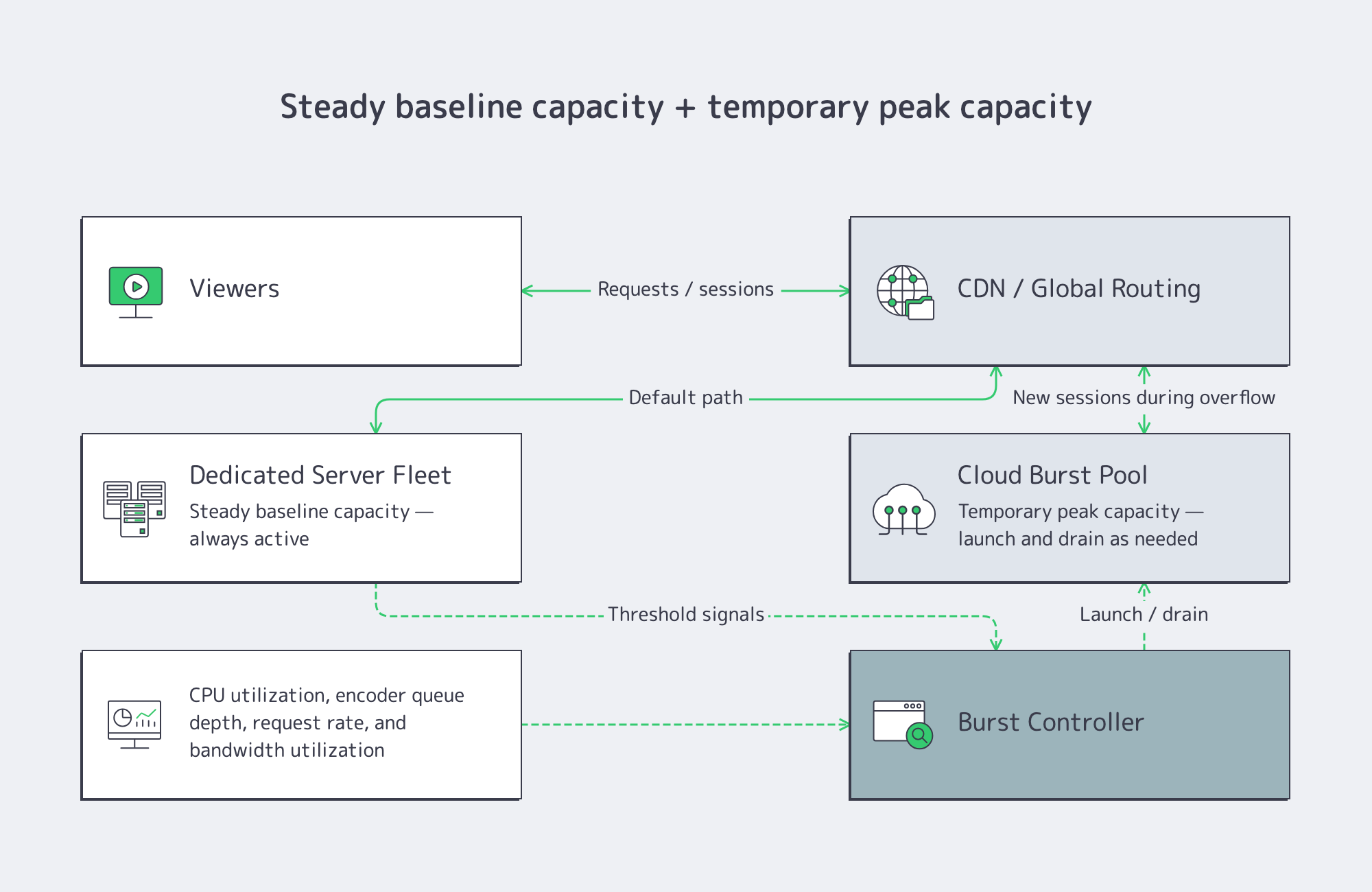
Large event spikes create a capacity-cost dilemma. A hybrid model keeps predictable baseline traffic on dedicated infrastructure and adds cloud capacity only when measured demand exceeds reserved headroom:
- Run the steady base on dedicated servers to keep latency predictable and use committed bandwidth efficiently.
- Burst spikes to the cloud with autoscaling compute groups or managed media services that absorb temporary overflow.
- Use CDN and global routing with multiple origins—one pool on dedicated servers and another in the cloud—so new sessions can shift according to health and utilization.
Execution details for hybrid operation
- One artifact, two substrates: Containerize the streaming stack so the same image runs on both dedicated servers and the cloud.
- Automate scale-out triggers: Set explicit CPU, encoder-queue, request-rate, or bandwidth thresholds so burst capacity launches during a surge and drains after demand subsides.
- Partition traffic: Keep existing sessions stable and route only new sessions to the cloud as dedicated-cluster limits approach.
Hybrid operation is not automatically cheaper. It is useful when temporary cloud overflow costs less than permanently provisioning peak capacity after cloud egress, replication, orchestration, and operational overhead are included. Model the decision with production traffic and provider invoices rather than a fixed percentage.
Melbicom operates 21 data centers in 18 cities and a CDN spanning 39 PoPs across 35 countries. That footprint lets teams use dedicated servers for origins closer to demand and use cloud overflow only when measured thresholds justify it.
Hardware Acceleration & Next-Gen Codecs
Scaling requires more than adding servers. Streaming stacks also transcode contribution feeds into adaptive bitrate ladders, and real-time 4K encoding can become compute-bound. Hardware encoders can accelerate supported codecs, but actual capacity depends on output quality, preset, resolution, frame rate, and encoder generation.
- GPUs with supported hardware encoders can process multiple renditions concurrently and reduce CPU load. Benchmark the exact codec, preset, resolution, frame rate, and quality target before sizing a node.
- AV1 and HEVC can reduce bitrate at comparable quality relative to older codecs, but encoding complexity, device support, licensing, and hardware acceleration differ. Maintain fallback renditions for unsupported clients.
- I/O and NICs. Multi-10-GbE and 25/40/100 GbE NICs can move tens of gigabits per node, while NVMe and RAM caches serve hot segments quickly. Melbicom supports up to 200 Gbps per server.
Edge placement complements hardware acceleration. Moving caches and transcoders closer to viewers reduces network distance and can lower RTT, startup time, and rebuffering. Validate the effect with regional probes and player telemetry because route quality, peering, congestion, and cache-hit ratio matter as much as geographic distance.
Global CDN Delivery with Distributed Origins

Viewers distributed across regions should not depend on a single distant origin. CDNs cache segments near users, reduce repeated origin fetches, and shield the origin during surges. For VOD, popular content can remain at the edge; for live streaming, edges relay newly published segments as they become available.
Design aspects that scale well:
- Multiple origins per region reduce single-point failure risk locally.
- Geo-routed entry directs sessions to a healthy region close to viewers.
- Efficient replication ensures published titles and live ladders appear at edges without repeatedly refetching the same objects from the origin.
Melbicom’s CDN spans 39 PoPs across 35 countries and integrates with dedicated servers across 21 data centers. This supports a single-vendor origin-and-edge footprint while keeping origin configuration under platform control during surges.
High Traffic Streaming Server Architecture
Dedicated servers provide predictable baseline capacity in a high traffic streaming server architecture, while horizontal fleets, regional load balancing, multi-region failover, hardware-assisted transcoding, and CDN delivery handle scale and resilience. Cloud capacity should absorb exceptional spikes only when measured utilization and cost thresholds show bursting is preferable to adding permanent capacity.

The architecture must also be operated using measurable signals. Track p95 start time, rebuffer ratio, encoder queue depth, cache-hit ratio, and per-region error budgets. Wire cloud burst and failover actions to validated thresholds, then test them under load. Place capacity near actual demand, but verify route quality and cache performance instead of relying on distance alone. Single-tenant infrastructure is the predictable base; resilience comes from the full system design.
Scale with Dedicated Servers
Provision high-performance dedicated servers worldwide and handle traffic surges with confidence.