
Blog
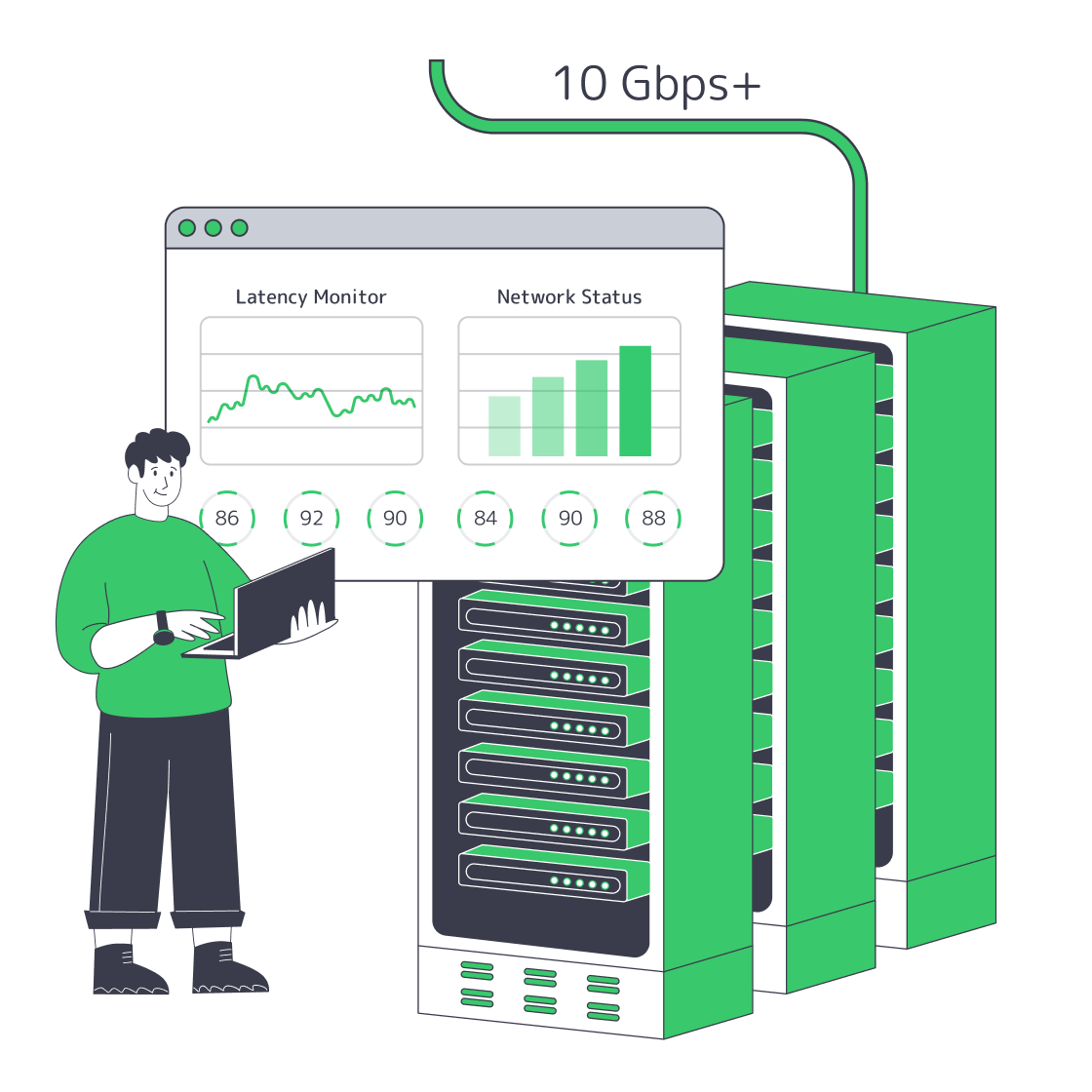
How Real Unmetered Ports Power Modern Workloads
“Unlimited bandwidth” is one of those phrases that sounds magical and usually isn’t. On shared hosting it often meant “until you use too much, then we slow you down.” On a dedicated server, though, it can be very real and extremely useful—if you understand what you’re actually buying.
By 2026, analysts expect around 82% of all internet traffic to be video, turning bandwidth from a line item into a core business dependency for streaming, gaming, collaboration, and more. When your workloads are UHD streaming, multi‑tenant SaaS, or global file distribution, the difference between a truly unmetered port and a marketing “unlimited” plan is the difference between scaling and stalling.
Choose Melbicom— Unmetered bandwidth plans — 1,300+ ready-to-go servers — 21 DC & 55+ CDN PoPs |
 |
This piece digs into what “dedicated server unlimited bandwidth” really means, how modern providers avoid the old “unlimited” traps, and which modern workloads absolutely need the real thing.
What Does Unlimited Bandwidth Really Mean for Servers
On a dedicated server, “unlimited bandwidth” means unmetered data transfer up to the capacity of your network port, not infinite speed. The provider stops counting terabytes and instead sells you a fixed pipe (i.e, 1–200 Gbps) that you can saturate around the clock. In this context, “unlimited” equals predictable capacity, not a loophole in physics.
In a dedicated server unmetered bandwidth plan, the hard limit isn’t a monthly data cap, it’s your port size. A 1 Gbps port can only push so many bits per second; a 10 Gbps or 100 Gbps port can push far more. The provider simply doesn’t meter how many terabytes you move through that pipe each month. Instead of worrying about “will this launch blow past 100 TB?”, you think in terms of “can this port sustain my traffic profile?”
For example, if you ran a 1 Gbps port flat out for an entire month, you’d move on the order of ~330 TB of data. With a 10 Gbps port, that scales to multi‑petabyte territory. Metered billing models often attach overage fees above a certain TB threshold; unmetered models remove that dimension entirely and simply charge you for the port.
Historically, a lot of “unlimited” offers were more illusion than reality. Bandwidth was expensive, so some providers oversold shared links and leaned on “fair use” clauses or 95th‑percentile billing to rein in heavy users. The result: plans that claimed “unlimited” but quietly throttled or penalized you once you behaved like a successful service.
Today, transit costs are lower and global backbones are much larger, so serious providers can afford to be literal: no transfer caps, no thresholds, just the physical port as the limit.
That’s the model we follow at Melbicom: we treat “unlimited” as unmetered, port‑bound capacity. Our unmetered options ride on dedicated ports with guaranteed throughput and no oversubscription ratios, backed by a backbone above 14 Tbps and engineered specifically for high‑throughput workloads. You can push line‑rate traffic without hunting through the fine print for the catch.
How to Identify Truly Unmetered Dedicated Server Plans

A truly unmetered plan spells out its constraints in plain language: fixed port speed, no 95th‑percentile games, no hidden sharing ratios, and clear acceptable‑use rules. You should be able to run near line‑rate traffic for days without seeing throttling, surprise overages, or vague emails about “abuse.”
Here’s how to vet an unlimited bandwidth dedicated server offer.
- Confirm that “unlimited” refers to transfer, not burst.If the small print mentions 95th‑percentile billing, “burstable” tiers, or soft caps after some TB figure, you’re looking at a metered plan with nicer marketing. Unmetered means you are not charged per TB and aren’t cut off after some hidden limit.
- Make sure the port is truly dedicated (1:1).On a real unmetered port, if you pay for 10 Gbps, you alone control that 10 Gbps. Wording like “guaranteed bandwidth, without ratios” is what you want; it signals no silent sharing or oversubscription of your uplink.
- Check that the backbone can actually carry it.Providers with multi‑terabit backbones and diverse transit/IX peers have the headroom to keep unmetered ports honest. Melbicom, for instance, runs a 14+ Tbps backbone across 21 Tier III/IV data centers with 55+ CDN PoPs, so fully loaded ports are normal operating conditions, not edge cases.
- Prefer Tier III / IV, carrier‑rich facilities.Carrier‑neutral Tier III / IV data centers give your server multiple upstreams and paths, so “unlimited” isn’t undermined by congestion on a single carrier. Melbicom’s footprint follows this pattern: Tier III/IV sites in Europe, the Americas, Asia, Africa, and the Middle East, with per‑server bandwidth ranging from 1 Gbps up to 200 Gbps depending on location.
- Expect clear AUPs and testable performance.A good provider’s acceptable‑use policy bans actual abuse (open proxies, public torrent mirrors, etc.) rather than imposing fuzzy “fair use.” Ideally, you should be able to test from each location using downloadable files or your own scripts, and see that a “1 Gbps unmetered” port behaves exactly like one under sustained load.
Once those basics are covered, the remaining question is “How big a port do we need?” The rough math below assumes 100% utilization 24/7; your actual usage will almost always be lower, but it shows what’s theoretically on the table:
| Port Speed | Approx. Monthly Data at 100% Utilization | Typical Fit (Examples) |
|---|---|---|
| 1 Gbps | ~330 TB | Regional SaaS node, busy API backend, moderate VOD origin |
| 10 Gbps | ~3.3 PB | Multi‑region streaming origin, large SaaS region, big download mirror |
| 100 Gbps | ~33 PB | Major media node, CDN origin cluster, hyperscale data distribution |
The point is not that you’ll always drive ports this hard, but that a genuine dedicated server unmetered bandwidth plan allows you to. If a provider’s small print would prevent you from ever approaching these numbers in practice, their “unlimited” isn’t really unmetered.
At Melbicom, the pattern is explicit: you choose the port size (from 1 Gbps up to 200 Gbps per server), and when you opt for unmetered, that port becomes a flat, predictable cost—no surprise bills just because your product finally found its audience.
Which Workloads Require True Unmetered Server Bandwidth

Unmetered ports aren’t just for vanity. They’re for workloads where bandwidth is central to the business model: UHD/8K streaming, global SaaS, massive downloads, AdTech, and real‑time AI or APIs. In those cases, a capped plan becomes either a cost time bomb or a hard performance ceiling.
Some concrete examples:
- UHD and 8K Streaming Platforms: Streaming 4K typically needs around 25 Mbps per stream, and early 8K implementations can demand roughly 50–100 Mbps of sustained bandwidth. A few thousand concurrent viewers can overwhelm a capped plan quickly. Recent analysis of Sandvine’s Global Internet Phenomena data shows video applications already generate 39% of global fixed download traffic, with YouTube alone responsible for 16% of overall internet traffic. For live sports, IPTV, or large VOD catalogs, a 10 Gbps+ dedicated server unlimited bandwidth port is no longer overkill; it’s what keeps viewership spikes from becoming incidents.
- SaaS and Cloud Applications: In 2026, it’s estimated that 85% of business applications are SaaS‑based, so more critical workflows depend on continuous data movement between users and cloud services. High‑churn traffic—APIs, sync jobs, video calls, collaborative editing—doesn’t spike once; it spikes all day in different time zones. On a metered plan, every growth phase forces another bandwidth renegotiation. On unmetered ports, you treat bandwidth as a fixed cost and focus on latency, redundancy, and scaling patterns instead.
- Large File Distribution and Updates: Game patches, OS images, firmware, media assets, data sets—these are not small files, and a single popular release can push petabytes in days. Here, a dedicated server unmetered bandwidth configuration plus a CDN is the default pattern: let the origin run flat‑out on a large port while the CDN caches content close to users. Melbicom’s CDN, for example, runs in 55+ PoPs across 36 countries, tightly integrated with origin servers in 21 data centers, so you can combine unmetered origin bandwidth with globally distributed edge delivery.
- High‑Traffic Sites, Ad‑Tech, and Real‑Time APIs: Sometimes it’s not the size of each response but the sheer number of them. AdTech platforms, analytics beacons, social feeds, and high‑traffic content sites can generate billions of small responses per day. A metered plan turns that into a cost‑optimization exercise. An unmetered port turns it into an engineering challenge—keep p95 latency low at peak—so your team can tune code and architecture instead of designing around bandwidth caps.
In all of these scenarios, an unlimited bandwidth dedicated server isn’t a vanity asset; it’s a way to align infrastructure with how your product actually uses the network. It lets you focus on shaping traffic and optimizing architectures instead of performing invoice forensics at the end of every month.
Why Dedicated Server with Unlimited Bandwidth Matters

In 2026, we’re not just gently trending toward “more data”—we’re already there. Video dominates consumer traffic, SaaS dominates business software, and more workloads than ever are interactive, real‑time, and global. In that environment, bandwidth stops being a peripheral detail and becomes a first‑order design constraint.
That’s where the definition of “unlimited” really matters. A plan that promises the world but hides caps behind 95th‑percentile graphs or vague “fair use” clauses will, sooner or later, collide with your success. A dedicated server unlimited bandwidth plan, correctly implemented, does the opposite: it makes the limits explicit (your port speed) and makes everything else—especially your bill—predictable.
From a tech decision‑maker’s point of view, the practical recommendations look like this:
- Treat “unlimited” as unmetered, not unbounded.Insist that “unlimited” means “all the traffic your port can carry” with no per‑TB billing or soft caps. If the provider can’t say that plainly, assume you will hit hidden limits at the worst possible time.
- Tie bandwidth back to network reality.Choose providers that can prove they have dedicated ports, multi‑terabit backbones, and Tier III/IV, carrier‑rich facilities. If you can’t trace how your traffic leaves the data center (transit, IXPs, paths), you can’t trust “no throttling” to hold under load.
- Map workloads to ports, not caps.Size ports based on your actual workloads—UHD streams, SaaS tenants, download volumes—then use unmetered billing to remove guesswork around monthly transfer. Revisit port size as you grow, not because you’re afraid of unexpectedly expensive invoices.
Get those pieces right, and “unlimited bandwidth” stops being a red flag and becomes one of the cleanest, most understandable parts of your stack.
Get Unmetered Bandwidth on Dedicated Servers
Choose port speeds from 1 Gbps to 200 Gbps with predictable unmetered transfer. Our global network and Tier III/IV facilities keep throughput steady for streaming, SaaS, and large file delivery.