
Blog

Adult Data Security and Compliance on Dedicated Hosting
The adult entertainment industry depends on privacy: users expect discretion, regulators require strict controls, and attackers value sensitive account data. The 2016 FriendFinder Networks breach exposed about 412 million accounts, including millions associated with users who had tried to delete them. In another case, a misconfigured CAM4 Elasticsearch database exposed more than 10 billion records, including names, email addresses, payment logs, and password hashes.
Data revealing sexual preferences, browsing history, and identity documents is high-stakes because misuse can enable extortion, discrimination, and lasting reputational harm. These risks raise the bar for security and compliance. Using dedicated hosting can provide clear tenancy and infrastructure control, but it must be paired with privacy governance, access controls, secure development, monitoring, and tested incident response.
Choose Melbicom— 1,200+ server configurations — 21 global Tier IV & III data centers — 39 CDN PoPs across 35 countries |
 |
Adult Hosting Security and Compliance Risks
Adult platforms now face overlapping privacy, security, and age-assurance duties. A practical response is to minimize identity data, isolate verification systems, encrypt data in transit and at rest, and document where data is processed. Dedicated hosting improves control over these measures, but infrastructure alone does not establish legal compliance.
Adult platforms must protect highly sensitive data while complying with privacy and age-assurance rules that vary by jurisdiction. Under the EU GDPR, data concerning a person’s sex life or sexual orientation is special-category personal data, and serious infringements can carry fines up to the greater of €20 million or 4% of total worldwide annual turnover from the preceding financial year.
By June 2026, 23 U.S. states had enacted comprehensive consumer privacy laws, although coverage, exemptions, rights, and effective dates differ. Separately, at least 21 states other than Texas had adopted materially similar age-verification requirements for online sexual material by the time the Supreme Court upheld Texas’s law in June 2025. Texas permits government-issued identification, digital identification, or qualifying transactional-data methods, and verification may be performed by a third party.
Age checks can create new privacy risks when platforms collect or retain more identity data than necessary. The UK ICO advises services to use proportionate age-assurance methods and notes that, in many cases, it may be excessive to view an official identity document when the service may need only a yes-or-no result showing whether the user meets the threshold. A privacy-by-design approach therefore separates age assurance from content systems, minimizes collection, limits retention, encrypts stored data, and gives users clear access and deletion processes where law requires. Opting for single-tenant hosting can make data segregation, private networking, controlled administrator access, and documented regional placement easier to implement, but the legal outcome still depends on the service, jurisdiction, contracts, and processing design.
Modern Safeguards: Encryption, Least Privilege, and Zero Trust
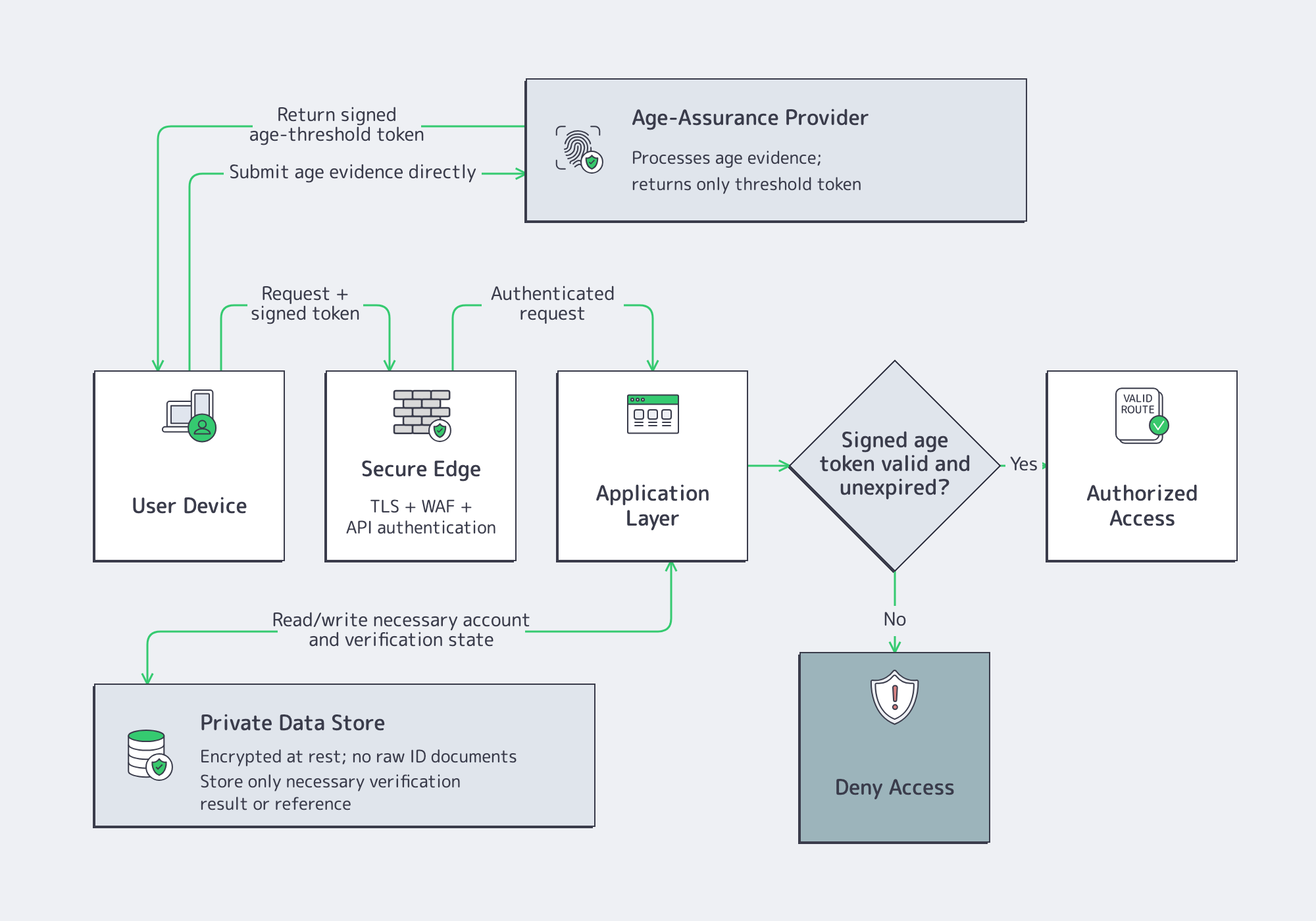
An encryption baseline: Encrypt sensitive data in transit and at rest according to its classification. Use TLS for websites, APIs, streaming, and service-to-service links, and encrypt databases, disks, snapshots, logs, and backups. Encryption reduces exposure from interception or stolen media, but key separation, rotation, access control, and recovery testing determine whether it remains effective.
Limited, pseudonymous collection: Collect only what is necessary, and prefer age-threshold results over copies of identity documents when the legal and assurance model permits. Pseudonymize usernames and identifiers, aggregate analytics, tokenize or truncate payment data, and apply documented retention limits to IP addresses, session data, and verification artifacts. Do not describe simple hashing as anonymization when values can still be linked back to individuals.
Hardening identities: Use Argon2id with a unique salt for new password storage; retain bcrypt only where migration constraints require it, and avoid plaintext or fast general-purpose hashes such as SHA-1. Require phishing-resistant multi-factor authentication for administrators and developers, offer strong multi-factor authentication to users, isolate credentials, rotate secrets, and prevent staging systems from reaching production data.
Least privilege principles and network segmentation: Apply least privilege to humans and workloads. Separate edge, application, verification, database, logging, and management tiers; keep databases on private networks; authenticate and encrypt east-west traffic; and use narrowly scoped service identities. Flat networks and broad entitlements increase the impact of a compromised account or workload.
Operate with zero trust and continuous verification: Authenticate and authorize requests based on identity, device or workload context, and policy rather than network location alone. Monitor for abnormal exports, privilege escalation, unusual token use, and access across regions. High-confidence containment actions, such as revoking tokens or isolating a host, can be automated, with human approval where business impact is significant. IBM’s 2026 research puts the global average cost of a data breach at $4.99 million. That cross-industry average is not a forecast for a specific operator, but it reinforces the value of detection and rehearsed response.
Patching, preparation, and testing: Integrate security into routine operations. Keep operating systems, dependencies, firmware, and management tools patched; validate configurations; use static and dynamic application-security testing where appropriate; and schedule penetration tests based on risk. Incident-response plans should cover credential rotation, host isolation, evidence preservation, backup recovery, communications, and regulator or user notification workflows before a live incident occurs.
Why Dedicated Hosting Improves Security and Compliance Control

Shared platforms can provide strong tenant isolation, but dedicated servers give operators a clearer hardware boundary and direct control over the operating system, kernel, network policy, and management plane. For adult platforms handling sensitive data and traffic spikes, that control can simplify hardening, capacity planning, and evidence collection. It does not eliminate application, identity, or governance risk. With dedicated hosting, teams can pin software baselines, harden kernels, use private management networks, and define firewall policies without coordinating around other tenants’ workloads.
Data locality and residency: Choosing the facility helps operators document where primary data and backups are deployed. It does not by itself resolve GDPR transfer rules, Standard Contractual Clause obligations, remote-access risks, or processor and subprocessor requirements. Melbicom offers dedicated servers across 21 global Tier III and Tier IV data centers, including Tier III and Tier IV facilities in Amsterdam. Customers can use that footprint to keep selected EU workloads in the EU and place latency-sensitive delivery closer to North American audiences.
Measured performance headroom: Encryption, logging, scanning, and streaming consume CPU, storage, and network capacity. The dedicated servers available from Melbicom include network options up to 200 Gbps per server and 1,200+ ready-to-go server configurations. Teams should select CPU, RAM, NIC, storage, and traffic plans from the actual workload profile and test peak behavior rather than assuming bandwidth alone removes bottlenecks.
Protected origins through edge distribution: A CDN can cache static assets and video segments closer to viewers, reduce origin load, and route requests across multiple origins. Melbicom’s CDN includes 39 CDN PoPs across 35 countries and supports geographic request routing and origin server pooling. Keeping an origin private still requires correct DNS, firewall, allowlist, TLS, and access-control configuration. If the threat model requires a WAF or bot management, confirm those controls separately rather than assuming they are included with CDN caching and routing. Use TLS on client-to-edge and edge-to-origin connections, because a CDN normally terminates the client TLS session rather than extending one session unchanged to the origin.
Operational support: Incident response depends on clear escalation paths and available operators. Melbicom provides 24/7 support for infrastructure assistance. Customers remain responsible for application incident response, evidence preservation, key revocation, legal assessment, and regulator or user notification.
Why use secure dedicated servers for adult sites?
Single-tenant hardware removes hypervisor co-tenancy for that server and gives the customer direct control over operating-system versions, crypto libraries, ciphers, SSH policy, and host firewalling. It can make tenancy and configuration evidence easier to document, but compliance still depends on application controls, data flows, contracts, retention, and operating procedures.
Solutions for adult content compliance
Compliance requirements should be built into data flows. With dedicated hosting, teams can isolate age-assurance services, keep verification artifacts on a restricted cluster, apply shorter retention where lawful, and separate regional datasets and backups. The architecture can make access, deletion, logging, and evidence collection more predictable, provided those workflows are implemented and tested.
Preserving privacy in adult entertainment
Collect less data, transform or tokenize it early, encrypt sensitive fields, and monitor privileged access. For age assurance, prefer a reusable or signed threshold result when permitted instead of retaining raw identity documents. These controls reduce exposure, but they do not promise anonymity when accounts, payments, legal records, or fraud controls can identify a user.
A Practical Blueprint for Implementation

1) Map and minimize. Map personal-data flows and record the purpose and lawful basis for each field. Keep only what is necessary, such as account details, payment tokens, viewing logs, or age-assurance results, and apply documented retention and deletion schedules. Describe data as anonymized only when re-identification is not reasonably possible; otherwise, treat it as pseudonymized.
2) Set identity boundaries: Separate administrator, developer, and service identities; require phishing-resistant multi-factor authentication for privileged access; grant production actions through named roles; and log deployments, schema changes, and secret access in tamper-evident systems.
3) Segment environments: Create separate network zones for front ends, APIs, databases, logging, and verification services. Keep databases on private subnets and restrict administrative access through hardened management paths or bastions.
4) Enforce encryption: Use TLS for client-facing and service-to-service traffic. Encrypt disks, snapshots, databases, and backups; store keys separately; define rotation and recovery procedures; and redact or encrypt personal data in logs.
5) Instrument and rehearse: Centralize telemetry, define normal access and export patterns, alert on material deviations, and run incident exercises that include host isolation, token revocation, evidence preservation, backup validation, communications, and notification decisions.
6) Place data deliberately: Deploy regionally to meet latency and documented residency requirements. Melbicom operates 21 global data centers, including Tier III and Tier IV facilities in Amsterdam. Confirm backup locations, remote access, and subprocessors as part of the design.
7) Architect for measured demand: Provision dedicated servers against tested CPU, memory, storage, and network requirements. Leave capacity for encryption, logging, verification, and peak streaming, and validate performance with load tests rather than relying on nominal port speed alone.
Providing Durable Privacy at Scale

Adult platforms need a privacy-by-design operating model that combines data minimization, single-tenant control where appropriate, encryption, least privilege, continuous verification, monitoring, and rehearsed response. Using dedicated hosting and a global CDN can improve control over data placement and performance headroom, but application architecture and governance still determine data protection.
Melbicom operates 21 global Tier III and Tier IV data centers, including Tier III and Tier IV facilities in Amsterdam. It offers up to 200 Gbps per server, 1,200+ ready-to-go server configurations, a CDN with 39 CDN PoPs across 35 countries, and 24/7 support. These capabilities can support adult-platform security and delivery designs; customers must still implement and validate the controls required for their jurisdictions and workloads.
Launch Secure Adult Platforms Today
Deploy high-bandwidth dedicated servers for your adult streaming network across 21 global data centers with 24/7 support.