
Blog

Palermo Edge: Routing For EU–MENA Low Latency
Latency engineering in Italy is no longer about “how close is my server to Rome or Milan?” It’s about whether your Palermo edge lands on the right submarine systems, hits the right exchange fabric, and avoids avoidable detours through Northern Europe. The fastest path to EU–MENA users is often the path with the fewest policy mistakes.
Palermo makes a clean case study—it sits next to cable landings and peering ecosystems built for Africa and the Eastern Mediterranean. For network engineers, that turns Italy server placement into a routing problem you can instrument, debug, and improve.
Choose Melbicom— Tier III-certified Palermo DC — Dozens of ready-to-go servers — 39 PoP CDN across 35 countries |
 |
Latency from Palermo to Key Markets
Speed-of-light sets the floor: roughly 1 ms RTT per ~100–120 km of real fiber route once you include slack, regen, and switching. After that, routing policy dominates. Cloudflare Radar’s Internet Quality data exposes estimated round-trip time and jitter for Italy under average utilization—useful as a coarse baseline before you dive into per-AS routing behavior.
Below is a practical benchmark model for a well‑peered Palermo footprint serving EU–MENA priority markets. Treat these as target envelopes for p50 RTT and typical jitter on clean paths (not guarantees) to sanity-check your real probes.
| Destination Market | Palermo p50 RTT (ms) | Typical Jitter (ms) |
|---|---|---|
| Milan / North Italy | 20–30 | 0.8–2.5 |
| Frankfurt / Central EU | 35–50 | 1.0–3.5 |
| London / UK | 45–65 | 1.5–5.0 |
| Paris / France | 40–60 | 1.5–4.5 |
| Athens / Greece | 35–55 | 1.0–4.0 |
| Istanbul / Türkiye | 45–70 | 2.0–6.0 |
| Tunis / North Africa | 25–45 | 1.5–5.0 |
| Cairo / Egypt | 45–75 | 2.0–7.0 |
| Dubai / UAE | 55–90 | 2.5–8.0 |
| Mumbai / India | 110–160 | 5.0–15.0 |
Why these ranges matter: if your Palermo→Tunis RTT comes back at 70–90 ms, you almost certainly got hauled north to a Frankfurt/Marseille hub before coming back south. That’s not “distance”—it’s policy and peering.
Which Sicily Cable Landings Optimize EU–MENA Routing
Sicily improves EU–MENA paths when traffic enters Mediterranean subsea corridors near the island and stays on peering-rich fabrics, instead of detouring through Northern Europe. Palermo is strongest when routes hit the Sicily Hub/DE‑CIX Palermo ecosystem early—where DE‑CIX cites 5–15 ms proximity to North Africa and designs claim 15–35 ms savings.
Palermo’s leverage is not “one magic cable.” It’s the portfolio: multiple landings and backbones that create route diversity, plus local interconnection that lets networks swap traffic without detouring north. Melbicom positions Palermo as connected into Sicily’s cable landings and Mediterranean subsea routes—good conditions for south/east-biased path selection.
What to Look for in Cable-Driven Route Quality
- Direct south/east exits (North Africa, Greece/Türkiye/Levant) that don’t transit a Northern European hub.
- Multiple independent paths (different landing stations/backbones) so a single cut doesn’t yank your p95 latency.
- Interconnect density at the edge: cable landings matter most when they terminate near IXPs and carrier hotels.
Palermo’s Sicily Hub Effect
As mentioned above, Palermo is a Mediterranean exchange close to North Africa and connected into the Sicily Hub interconnection environment, with many carriers participating in the regional ecosystem.
For engineers, the actionable part is what happens when traffic stays in the Sicily interconnect fabric instead of being exported north first. Melbicom’s Palermo positioning cites 15–35 ms latency savings and a 50–80% quality improvement for Africa/Mediterranean/Middle East routes compared to other European peering points—exactly the kind of delta you should validate with probes and traceroutes.
Why “Mediterranean Diversity” Became a Core Design Goal
Recent Red Sea cable cut events showed how fragile a single corridor can be: reporting indicated that a meaningful share of Europe–Asia/Africa traffic had to be rerouted, driving latency spikes and unstable routes. That’s why modern Italy server placement increasingly favors diverse Mediterranean exits and fast failover over “one best path.”
What BGP Policies Reduce Latency from Palermo Servers
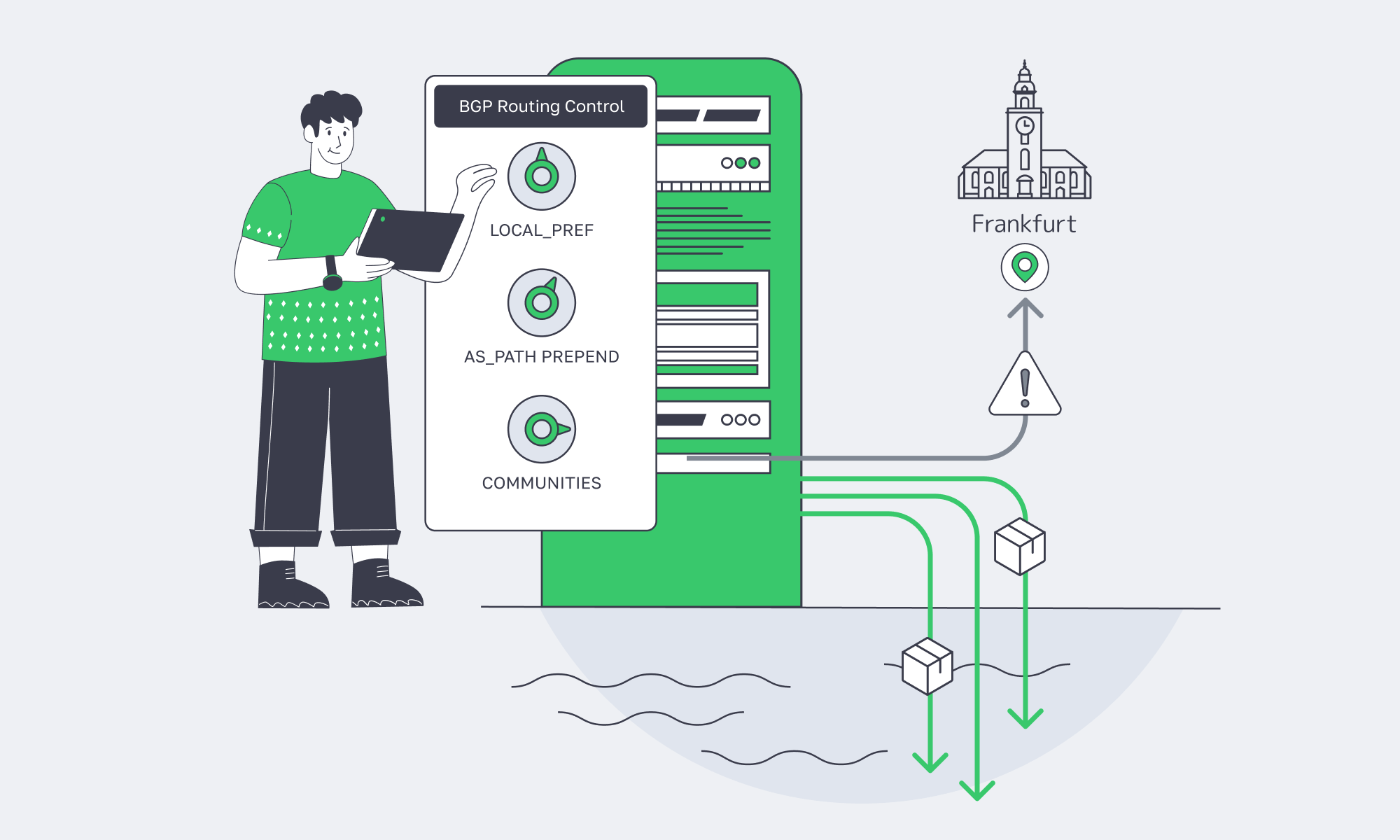
Latency from Palermo is usually a BGP outcome: which upstream learns your prefix, where it is preferred, and whether traffic stays on Mediterranean exchanges instead of pulling north. The goal is to control route learning and preference (communities, prepends, sessions), then verify with traceroute and regional probes so the “best” path is best for your target ISPs.
Traceroute Interpretation: Spotting “Northbound Hairpins” in 60 Seconds
A traceroute from a MENA eyeball ISP to a Palermo server usually tells you three things:
- Where the traffic first hits Europe (Sicily vs Marseille vs Frankfurt vs London).
- Whether it crosses an IXP fabric (often visible by IXP-facing hostnames or known exchange subnets).
- Where the policy decision happens (the hop where latency jumps and stays high).
Rule of thumb: if RTT jumps early (e.g., 15 ms → 55 ms by hop 4) and never comes back down, you didn’t take a local Med route—you took a northern hub detour.
BGP Basics That Actually Matter for Latency
You don’t need a BGP textbook. You need three concepts:
- Preference beats geography. BGP picks routes based on attributes (LOCAL_PREF, AS_PATH, MED), not distance.
- Symmetry is not guaranteed. Your inbound and outbound paths can differ; measure both directions.
- “Best” is per-AS. A path that’s optimal for one upstream may be worse for reaching your target ISP.
RIPE Atlas-based analysis is a reminder that what you see from the edge depends heavily on vantage point, transit policy, and peering—not just geography.
When BYOIP and BGP Sessions Help Performance or Resiliency
BGP sessions become a latency tool when you want to:
- Pin traffic to the right region. Announce the same prefix via different sessions and use communities or prepends to bias where it’s preferred.
- Engineer failover deliberately. Keep a “warm” alternative path alive so a cable or transit event doesn’t trigger a convergence storm.
- Keep IP continuity across moves. BYOIP plus BGP lets you relocate workloads (or add a second site) without renumbering.
Melbicom’s BGP Session service supports BYOIP, BGP communities, and full/default/partial route options, alongside RPKI validation and strict IRR filtering.
How to Monitor Mediterranean Edge Network Performance
You can’t “set and forget” a Mediterranean edge: most latency regressions are route drift, not hardware. Monitor two layers together—synthetic probes (RTT/jitter/loss/TTFB) from Southern Europe and MENA, plus routing intelligence (BGP updates, AS‑path changes, RPKI/IRR events). Alert on deltas, and keep daily traceroutes for diffs.
A minimal modern stack has two layers:
- Synthetic performance probes (RTT, jitter, packet loss, HTTP TTFB) from EU and MENA vantage points.
- Routing intelligence (BGP updates, AS‑path changes, RPKI/IRR events) tied to alerts and incident workflows.
Recommended Monitoring Pattern
- Probe from where users are. Use a mix of cloud probes and RIPE Atlas-style agents in Southern Europe, North Africa, and the Gulf.
- Alert on deltas, not absolutes. “+20 ms to Cairo for 10 minutes” matters more than a static threshold.
- Capture hop-by-hop changes. Store daily traceroutes so you can diff route shifts quickly during incidents.
- Watch BGP like an SRE watches deploys. Route leaks and upstream preference changes show up as churn in updates well before users complain.
A Concise Checklist for Italy-Centric Latency Engineering
- Measure p50/p95 RTT and jitter from EU + MENA probes to Palermo.
- Tag routes by “Med direct” vs “North hub” based on traceroute hop geography.
- Use BGP communities/prepends to keep priority markets off distant transits.
- Monitor BGP updates alongside RTT/jitter—and page on sustained deltas, not spikes.
- Pretest failover paths (including convergence behavior), then rehearse the playbook during maintenance windows.
- Re-run the benchmark suite after every routing change: new peer, new transit, policy tweak, or prefix move.
Turning Palermo into Your EU–MENA Latency Advantage
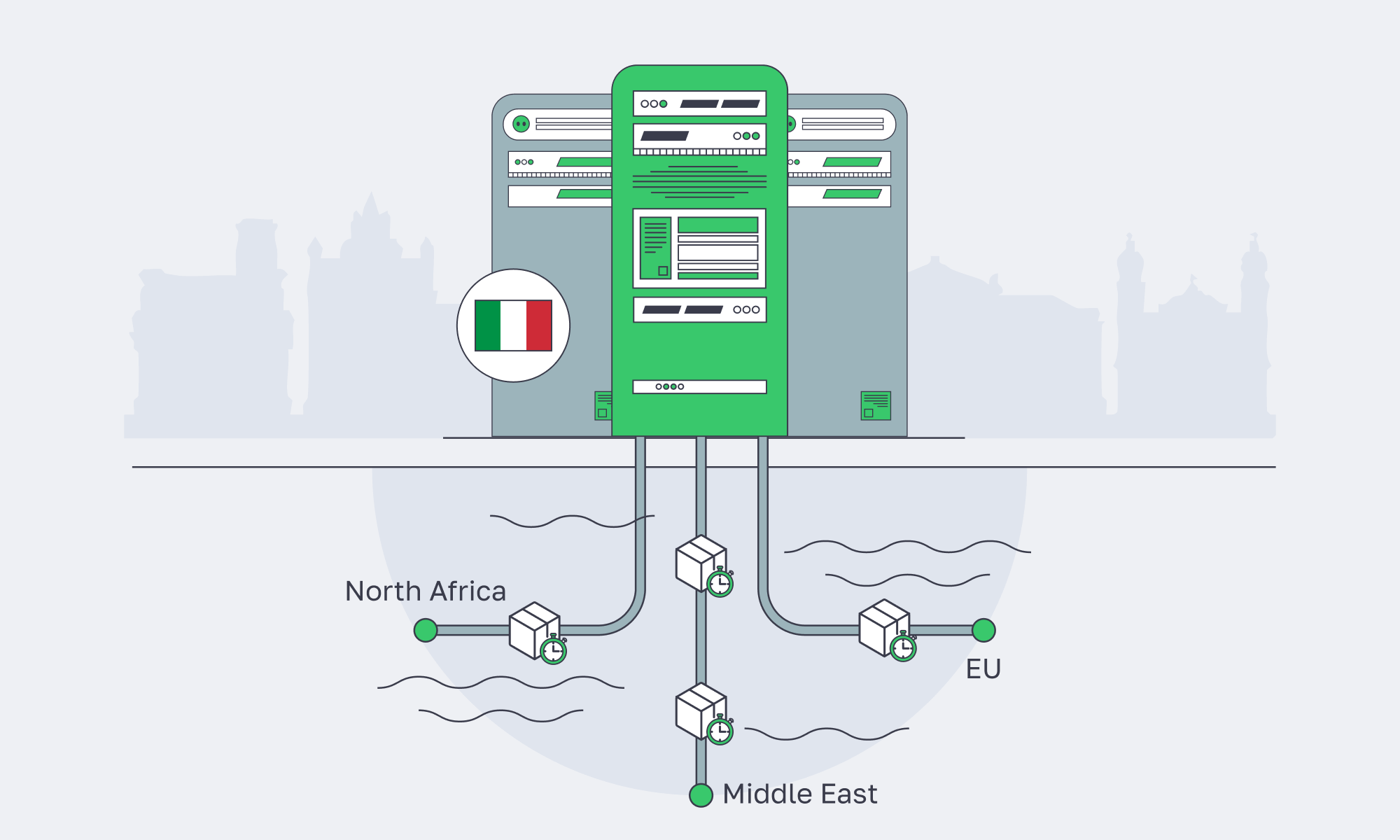
An Italy server strategy centered on Palermo is a bet that modern latency isn’t just distance—it’s interconnection. Sicily’s cable landings, exchange fabrics, and transit diversity can produce tighter RTT envelopes to North Africa and parts of the Middle East, while still staying competitive into core EU hubs.
The engineering playbook is straightforward: benchmark, interpret traceroutes, shape policy with BGP, and monitor routing drift like a first-class SRE signal. Do that, and Palermo stops being “a remote island” and becomes a controllable edge.
Low-latency servers in Palermo
Tap Sicily’s cable landings and regional peering for faster EU–MENA delivery. Configure hardware, enable BGP sessions with BYOIP, and go live in hours with 24/7 support.