
Blog

Netherlands Server: Bandwidth Checks and Deployment Guidance
Choosing a Netherlands server is no longer just a data-residency check. Eurostat says 52.7% of EU enterprises now use paid cloud services, up 7.4 percentage points from the prior survey, so the harder question is how to place predictable capacity when traffic, logs, backups, and partner integrations converge.
The practical decision is when a VPS is still enough, when dedicated capacity becomes safer, and how to validate the network, unmetered wording, data handling, and operating model before launch. For Netherlands-hosted workloads, Amsterdam connectivity can make central European deployments fast or expose weak routing choices.
Deploy in Amsterdam— 300+ Amsterdam server configs — 1–200 Gbps bandwidth plans — Private networking and BGP support |
 |
Why Amsterdam Changes the Shape of a Netherlands Server Deployment
Amsterdam matters because it is an interconnection system, not just a rack market. Netherlands workloads on a server in Amsterdam can sit closer to dense peering, transit, and exchange paths; a server on a thin network can still feel distant. The difference shows up in latency, route stability, and incident blast radius.
The public numbers explain why buyers test Amsterdam differently. AMS-IX public statistics show 935 route-server peers, 912 connected ASNs, 1,122 customer ports, and 913 IPv6 peers, with current traffic above 10 Tb/s and a recent peak above 15 Tb/s. That is not a provider guarantee, but it is a hard baseline for route-quality diligence.
A second signal is inter-region latency. A public cloud round-trip latency dataset places West Europe in the Netherlands and publishes median round-trip figures from that region of about 13 ms to Germany West Central, 15 ms to France Central, 23 ms to Poland Central, 24 ms to Italy North, and 36 ms to Sweden Central. Use them only as sanity checks.
Chart: Median Netherlands-to-Europe Round-Trip Latency
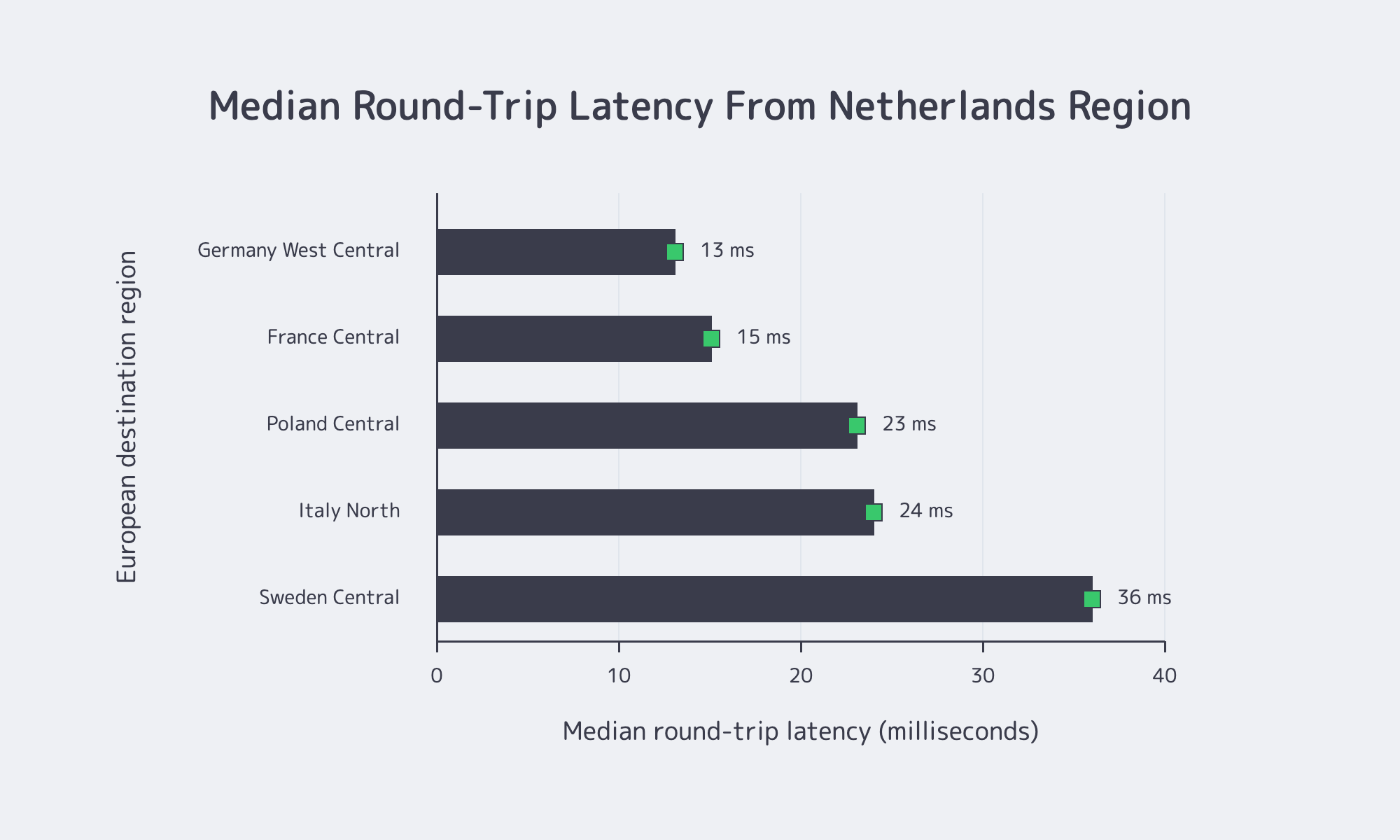
Source: source.
Netherlands Server: When VPS Makes Sense and When Dedicated Is Safer
A VPS makes sense when demand is uncertain, the workload tolerates noisy-neighbor effects, and operational simplicity matters more than strict isolation. A dedicated server is safer when sustained load, long-tail latency, fixed bandwidth economics, or audit scope make shared tenancy a business risk rather than a cost saver.
Use the matrix below as a practical decision frame rather than a rulebook.
| Decision Signal | VPS Usually Makes Sense | Dedicated Is Safer |
|---|---|---|
| Demand pattern | Early or irregular demand; bursty workloads with idle time | Sustained utilization; busy periods are routine |
| Performance tolerance | Small latency swings are acceptable | CPU contention, storage variance, or long-tail latency hurts operations |
| Compliance posture | Logical isolation is enough | Cleaner tenancy boundaries and narrower audit scope are required |
| Networking model | Mostly public internet traffic with simple addressing | Fixed-capacity ports, private networking, BYOIP, or routing policy matter |
| Cost shape | Elastic convenience matters most | Predictable compute and bandwidth economics matter most |
The common upgrade path is not dramatic. Teams start on VPS for prototypes, staging, low-duty background services, and modest internal tools. They move when graphs flatten into known load: backup windows collide with peak hours, cache rebuilds contend with user traffic, and scaling sideways becomes a workaround for variance.
That VPS-to-dedicated move should be triggered by evidence, not instinct. Track CPU contention symptoms, p95/p99 latency, disk wait, network saturation, packet loss, and deployment-window impact. Noisy-neighbor guidance frames shared-resource contention as an architectural risk, not just a hosting annoyance.
How to Validate Amsterdam Connectivity, Unmetered Wording, and Private Networking Options
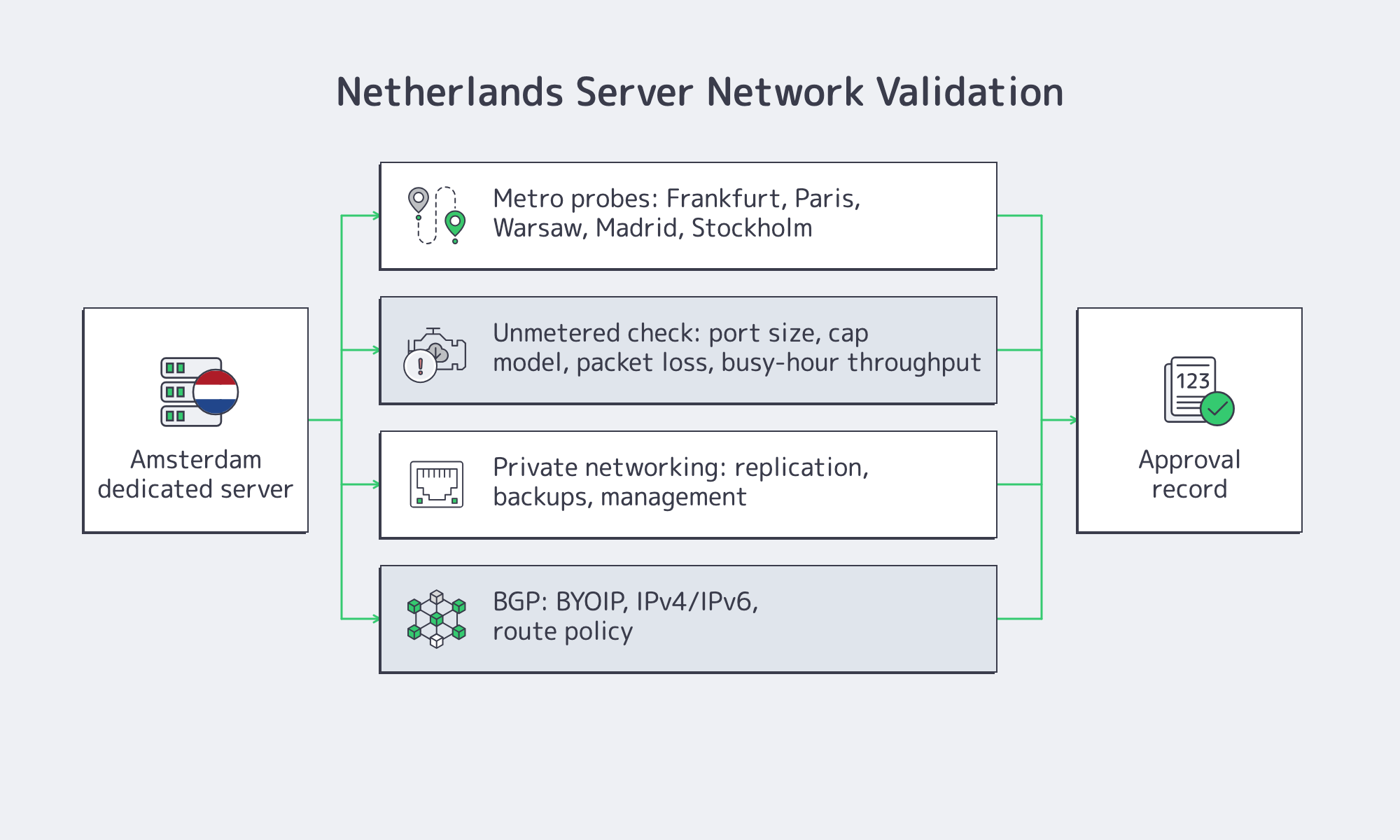
Do not buy a Netherlands server on labels alone. “Low latency,” “unmetered,” and “private network” only matter when they are measurable in your metros and clear in the commercial terms. Validate path quality, throughput behavior, billing language, private east-west design, and BGP requirements before order approval.
A Netherlands Server Should Be Benchmarked From Your Real Metros
Start with public evidence, then test the exact path. Melbicom’s Amsterdam dedicated server page publishes a test download endpoint and lists Tier III & IV DCs in Amsterdam and 1–200 Gbps per-server networking. That is the kind of buyer-visible signal to pair with your own probes.
Melbicom’s current Amsterdam configuration set includes 300+ ready-to-go dedicated server configurations. At the top level, the Netherlands list spans Intel and AMD processors, Xeon Scalable and Ryzen 7000/9000 options, 32–1536 GB RAM, and bandwidth plans from 1–200 Gbps with 50 TB or unmetered transfer choices. Custom server configurations can be deployed in 3–5 business days for planned rollouts.
Run latency, packet-loss, traceroute, and sustained-download tests from the cities where users, offices, APIs, and upstreams actually sit. For European acceptance testing, Frankfurt, Paris, Warsaw, Madrid, Stockholm, Riga, Vilnius, and Palermo are more useful than arbitrary map points because they mirror real network presence. A credible record includes median RTT, jitter, p95/p99 latency, packet loss, sustained throughput, route changes, and method.
A Netherlands Server Private Fabric Is About East-West Traffic, While BGP Is About Control
Private networking and BGP solve different problems. Private VLAN or private-network options are for east-west flows: database replication, cache fills, internal APIs, backup sync, and management traffic that should not compete with public ingress or egress. BGP gives control over your own IP space, address portability, and routing policy.
The decision is architectural. If internal systems talk constantly, private networking reduces unnecessary exposure and public-port contention. If address ownership, failover policy, or multi-location routing matters, BGP earns its complexity through BYOIP, IPv4/IPv6 support, route-policy control, and BGP communities. Without those requirements, BGP can be unnecessary operational weight.
How to Validate Compliance and Data Handling Without Hand-Waving
A Netherlands server is not compliant merely because it is in the EU. The useful test is whether you can document where data is stored, who can access it, which systems can move it elsewhere, and what evidence exists when access or processing changes.
For hosting, the processor relationship needs to be explicit. EDPB guidance treats a hosting provider that stores customer personal data on servers on the customer’s behalf as a processor. That makes processor terms, sub-processor visibility, deletion or return of data, audit support, and security evidence procurement questions, not legal boilerplate.
Keep the review operational. Draw production systems, backups, logs, metrics, privileged access, support access, and third parties on one diagram. If personal data leaves the EEA through support tooling, analytics, log processing, or backups, attach the transfer mechanism; the European Commission continues to position standard contractual clauses as a standard tool. Then map security evidence to controls operations can prove, including least privilege, limited-duration third-party access, incident logging, and security evidence reflected in current NIS2 and ENISA guidance.
Netherlands Server Deployment Checklist for Monitoring, Backups, and Access Controls
A reliable Netherlands server launch treats observability, recoverability, and access governance as release gates, not cleanup work. The useful checklist is short enough to run, specific enough to audit, and tied to measurable outcomes: external visibility, tested restores, least privilege, strong authentication, and controlled supplier access.
- Probe from outside the rack. Run synthetic checks from the European metros that matter, and centralize logs with protected transport, limited access, and timestamps that stay consistent across systems.
- Treat logs as sensitive data. Centralized logging guidance emphasizes useful, protected records; avoid secrets or personal data unless the reason is documented.
- Design backups for restores, not dashboards. Define recovery objectives, isolate backup credentials from production, and test restores; NIST ransomware-resilience guidance frames backups as something to conduct, maintain, and test.
- Lock down privileged accounts. Apply least privilege, separate admin identities from normal accounts, and protect system-admin accounts more strongly.
- Mandate strong authentication on admin and build paths. Build-environment guidance treats MFA as baseline; recovery flows must not bypass it.
- Time-box supplier and support access. Set scope and duration before approving third-party access, prefer temporary accounts, and keep an audit trail.
- Keep internal traffic internal when possible. Use private networking for replication, cache fill, backup sync, and management flows.
Where Dedicated Capacity Becomes a Melbicom Conversation
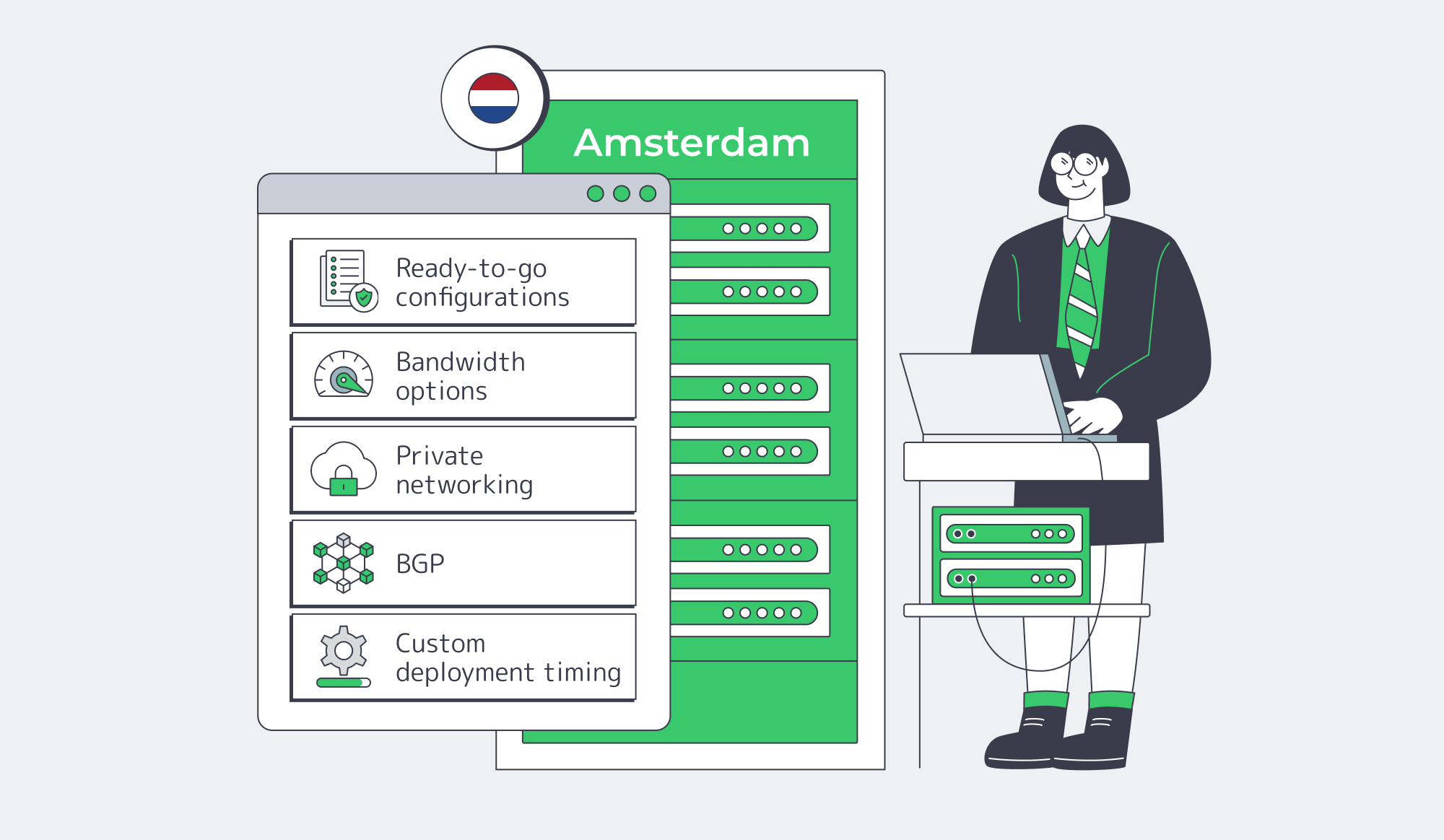
Dedicated capacity becomes the right conversation when the deployment has outgrown shared-tenancy assumptions and needs a testable operating model with predictable networking and clearer isolation. At that point, the decision is about proving the path, pipe, controls, and recovery plan before the move.
For that kind of deployment, Melbicom fits best as an Amsterdam dedicated server option rather than a generic European placeholder. We at Melbicom see the strongest cases when fixed-capacity networking, clean tenancy, private east-west traffic, and documented operating controls all matter at once. Melbicom’s wider footprint also gives Amsterdam deployments room to fit a broader architecture: 21 data centers globally, 23 transit providers, 29 IXP peering hubs, and 40 CDN PoPs across 35 countries.
Explore Netherlands Dedicated Servers
Review Amsterdam dedicated server options with published bandwidth plans, private networking discussions, BGP support, a large ready-to-go pool, and custom builds in 3–5 business days.