
Blog

Reduce Latency With Melbicom’s Multi-Region Servers
PMA study, U.S. affiliate marketing spending rose from $9.1 billion in 2021 to $13.62 billion in 2024, a 14.42% CAGR. That budget pressure makes latency more expensive as campaigns expand beyond traditional data hubs into regions such as the Indian subcontinent and West Africa, where Nigeria alone represents a 200-million-plus market. However, those new clicks arrive with a tough technical ceiling for performance marketers because distance induces latency. For distant origins, extra round trips can push mobile landing pages past the three-second threshold where Google says 53% of visits are likely to be abandoned. When every redirect and pixel fire counts, mere milliseconds can cost revenue: the link has been quantified as “+100 ms = –1% sales” by Amazon engineers, as reported by GigaSpaces.
Choose Melbicom— 1,100+ ready-to-go servers — 21 Tier III/IV data centers — 39-country CDN, 55+ locations |
 |
Adding extra CPU is no longer the strategic solution; instead, you have to focus on combating the distance and moving “closer to the click.” At Melbicom, we close that gap with dedicated servers distributed across continents, serving as origins, plus a 55-plus-location CDN to help affiliate networks deliver lower-latency user experiences from Los Angeles to Singapore or from Warsaw to Nigeria.
How Do Global Dedicated Server Locations Reduce Latency for Affiliate Platforms?
Global dedicated server locations reduce latency for affiliate platforms by moving dynamic landing pages, click redirects, trackers, and postback endpoints closer to the visitor. That shortens round-trip time before a CDN can help and limits how often mobile users wait through distant DNS, routing, and origin-response delays.
Latency also boils down to physics and routing. Light in fiber travels at a maximum of ~66 µs per 10 km, and that baseline is typically doubled or even tripled by circuitous paths. An AFRINIC-hosted latency study found that many West and Central African in-country paths exceeded 150 ms, with some above 350 ms, while Microsoft’s Azure telemetry reports roughly 200–233 ms P50 RTTs between an India region and common U.S. regions. Affiliate funnels add more round-trip operations from tracker to geo-router before the landing page, which is what can push the total wait time beyond the three-second mark.
Table 1 – The true price of distance
| Hosting setup | RTT pattern for Lagos visitors | Affiliate-funnel risk* |
| Single EU server (Frankfurt) | Longer cross-border path before the origin responds | More delay on redirects, tracking calls, and dynamic landing pages |
| Lagos local server (Melbicom LOS1) | Local Nigerian origin path | Baseline for West Africa testing |
*Actual conversion impact depends on page weight, device mix, carrier routing, and the number of tracking or redirect hops in the funnel.
Even a conservative 100–150 ms latency reduction can matter when it removes multiple handshake, redirect, and origin-response delays from a paid click path. In performance marketing, that difference can separate profitable from break-even campaigns when paid traffic is scaling.
Latency Headwinds in Emerging Markets
- Subscriber surges over weak paths: Over 160 million Africans gained broadband internet access between 2019-2022, according to the World Bank, but many African paths still detour through remote interconnection hubs; AFRINIC-hosted latency research found intercontinental routes averaging around 200 ms while intra-continental routes were typically 50-150 ms.
- Mobile user impatience: Nigeria alone has around 163 million internet users, many of whom connect primarily via mobile devices, according to Trade.gov. Mobile users are often more impatient, meaning every millisecond counts.
- Rich payloads. The heavy JavaScript bundles demanded by popularly accessed services such as crypto dashboards, iGaming lobbies, video segments, and adult HD streams choke narrowband links.
Why Single-Server Hosting No Longer Competes
Once upon a time, a lone data center based somewhere like Amsterdam or Los Angeles was “global enough,” but with modern expansion, it is a liability. The long routes are detrimental to SEO, there is often higher waste in terms of ad spending, and a single server means a single point of failure. An additional CPU at that same site improves nothing for distant visitors. Affiliates that neglect to geo-split their origins in today’s market are essentially risking conversion leaks.
Cross-Border Data-Center Network Architecture for Affiliate Campaigns
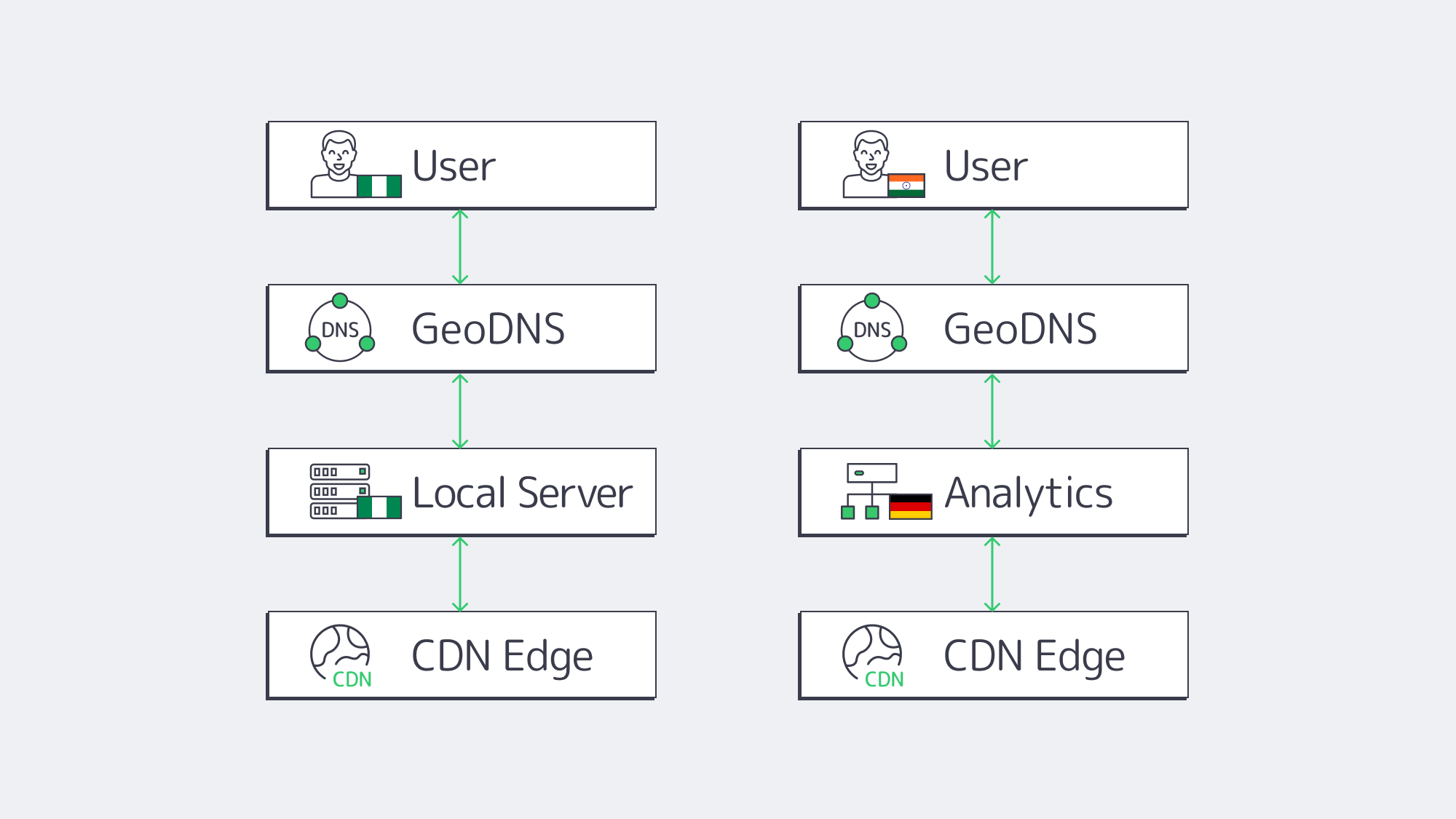
Melbicom supports this architecture with 21 Tier III/IV sites across North America, Europe, Asia, and Africa. Its portfolio includes 1,100+ ready-to-go configurations, bandwidth up to 200 Gbps per server, a 14+ Tbps backbone, and two-hour activation.
- West Africa, Lagos: Local presence reduces the need to serve Nigeria’s 200 million-plus market and neighboring West African traffic from Europe.
- South Asia, Mumbai: Regional origin placement keeps domestic users on shorter paths, while public telemetry shows India-to-U.S. round trips can exceed 200 ms. The India location sits near major IXPs for regional routing.
- Mediterranean transit, Palermo: The quality scores for North African and Middle Eastern routes improve by up to 80%, thanks to Palermo’s cable-landing position that trims latency by 15–35 ms.
At Melbicom, we can stitch these locations into a multi-region dedicated-server mesh for affiliate marketers using GeoDNS or anycast-style routing patterns that steer traffic to the nearest live node. Real-time portal metrics help flag regional spikes, making it easier to scale horizontally without moving the workload onto shared cloud.
Low-Latency Hosting Beyond the US and Europe
Traditionally, hosting in Los Angeles for the U.S. and Amsterdam for Europe was the general consensus. That still covers core revenue, but growth has headed south and east. For game studios, crypto exchanges, live-play tables, or order-book feeds, Atlanta, Palermo, Mumbai, and Lagos give campaign teams regional origin options for North America, the Mediterranean/Gulf corridor, South Asia, and West Africa instead of stretching every redirect chain from one hub.
Multi-Region Server Benefits
Each Melbicom location uses the same control panel and API, so campaign teams can spin up test servers quickly in any region. We also provide free 24/7 support, enabling campaign architects to do the following:
- Split funnels, keeping heavy personalization or analytics in a single hub by running tracking and click-redirects on light, regional CPU nodes.
- Isolate spikes locally, meaning spikes and overloads such as a weekend iGaming tourney in one region won’t affect another.
- Store data within its respective borders, e.g., EU user data inside EU racks, North American data in Los Angeles, without rewriting app logic.
How Do CDNs and Multi-Region Dedicated Origins Work Together?
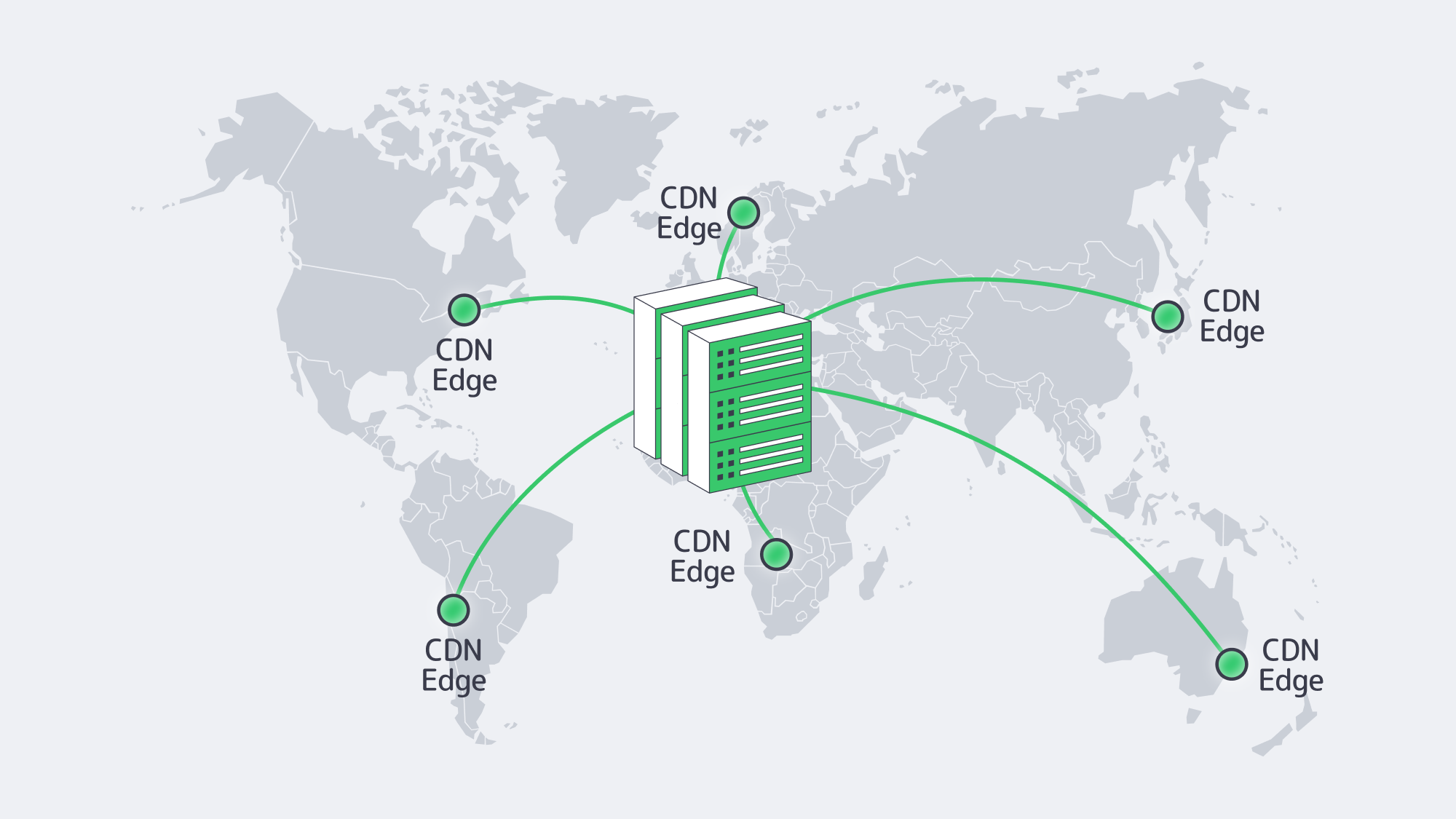
CDNs and multi-region dedicated origins work together by splitting the workload: CDN edges cache static assets near users, while regional dedicated origins answer dynamic requests, redirects, and tracking calls closer to the market. For affiliate campaigns, that pairing reduces origin trips, improves first render, and keeps heavy creative delivery off application servers.
Melbicom’s 55-plus-location CDN spans 39 countries across six continents and supports geographic request routing, prefetching, one-click cache purge, origin server pooling, and real-time analytics. It is well-suited for landing-page assets, JavaScript bundles, creative libraries, and 4K preview clips because the edge can absorb large static payloads while regional origins handle uncached and dynamic work.
Where a Melbicom CDN PoP and dedicated origin sit in the same city, such as Lagos, local origin placement helps cache-miss traffic avoid unnecessary transoceanic backhaul. That is the practical value of pairing edge caching with multi-region origins: static assets are served from the nearest edge, while cache misses and dynamic calls have a nearby origin instead of a distant default hub.
Together, the CDN and regional origins form a simpler delivery fabric: engineers cache static assets at the edge, keep dynamic responses near users, and reduce paid-traffic waste without redesigning the full application.
Outrunning the Click with Dedicated Servers

Global affiliate marketing was once gated by creative factors and compliance mandates, but today it is being gated by physics. As new users come online, they will expect instant experiences, which means the single-server blueprint has had its heyday. If you don’t want to watch conversions drain away with every extra round trip, then you need to look to infrastructure that helps accelerate growth, not throttle it. Melbicom provides servers and CDN edges close to emerging audiences, helping affiliate infrastructure support growth rather than throttle it.
Get low-latency hosting today
Deploy a performance-tuned dedicated server in any of Melbicom’s 21 global data centers and reach your audience in milliseconds.