
Blog

Low-Latency Live Streaming in Adult Entertainment with Dedicated Servers
Adult live streaming server solutions must handle high outbound traffic, interactive sessions, global audiences, and strict continuity requirements. A live stream can look acceptable at one bitrate and still fail under concurrency, route variability, or player-buffer pressure. The architecture must separate ingest, transcoding, packaging, interactive delivery, and edge distribution.
Choose Melbicom— 1100+ ready-to-go servers — 21 global Tier IV & III data centers — 39 CDN PoPs across 35 countries |
 |
Why Is Adult Live Streaming Demanding?
Live video capacity is driven by the complete encoding ladder, frame rate, codec, and concurrency—not resolution alone. As a practical live-planning range, 1080p streams commonly use about 3–12 Mbps, while 4K streams may use about 8–40 Mbps depending on codec and frame rate. 8K remains a specialized case and should be sized from tested encoder output rather than a generic bitrate assumption. Direct origin egress grows roughly with delivered bitrate multiplied by concurrent viewers, while CDN offload changes the calculation to cache efficiency and edge pull patterns.
Global audiences add route distance, jitter, and access-network variability. A single-region origin does not guarantee buffering, but it increases round-trip time and reduces recovery margin for distant viewers. Replicating or caching streams at edge locations closer to users can reduce origin load and network distance, while player buffering and adaptive bitrate logic still determine the final experience.
Interactive rooms may need glass-to-glass delay below one second, while large public rooms can often accept a few seconds in exchange for easier CDN scaling. Flash Player is obsolete, but RTMP/RTMPS remains common for contribution ingest. Modern stacks typically use RTMP/RTMPS or SRT for ingest, HLS or LL-HLS with a CDN for scalable playback, and WebRTC for interactive sessions.
Adult Live Streaming Server Solutions: Protocols, Codecs, and Edge Delivery
Meeting these demands requires a layered toolkit: cacheable adaptive HTTP streaming for large audiences, a real-time path for interactive sessions, regional edge delivery, and codecs selected for both compression efficiency and client compatibility.
Keeping Adult Streaming Low-Latency
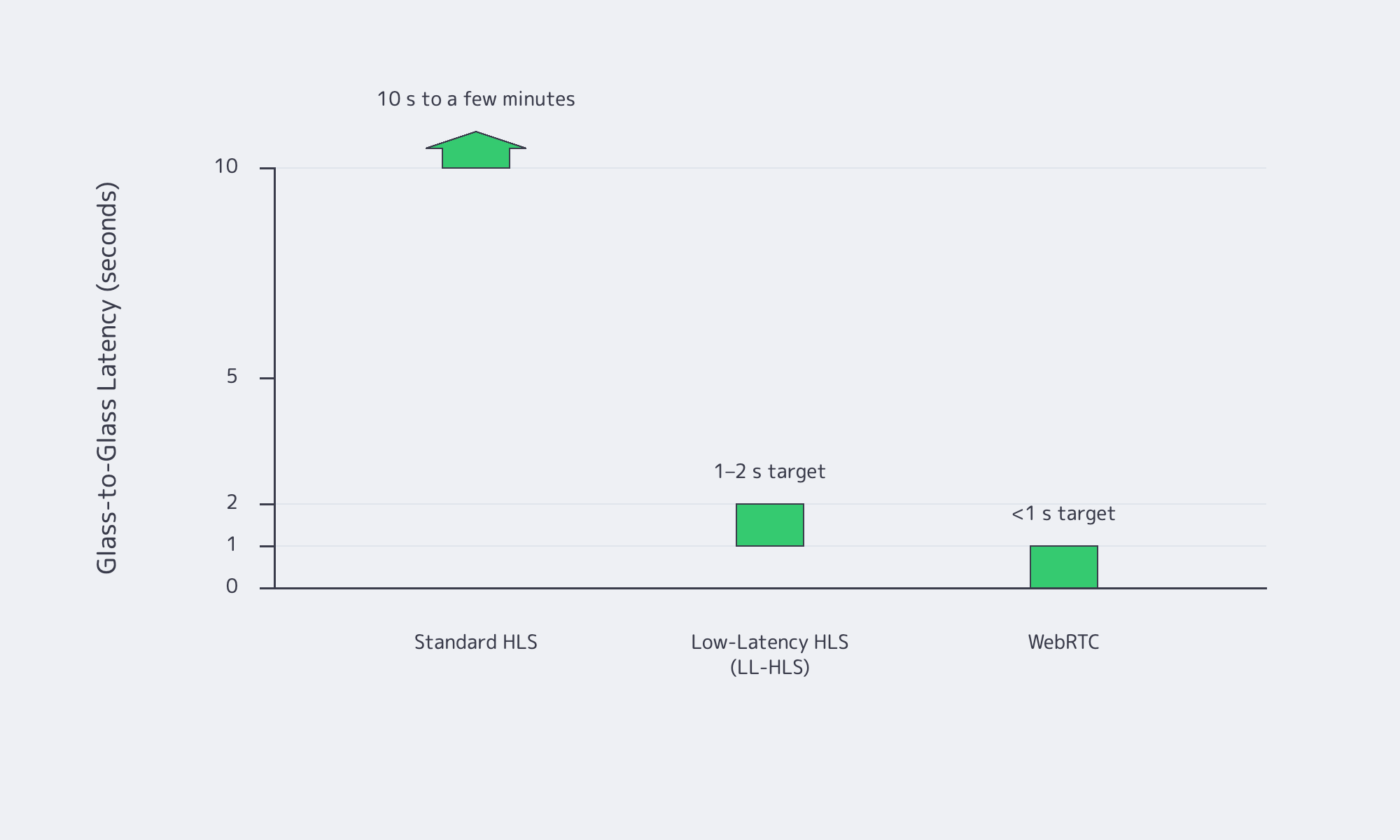
Standard segmented HLS and DASH commonly operate at 10 seconds or more of glass-to-glass latency. LL-HLS uses partial segments, blocking playlist reloads, and related low-latency features; Apple targets about one to two seconds and reports that less than two seconds is achievable at scale. Actual results still depend on the encoder, packager, CDN, player, and network path.
WebRTC is designed for real-time media and is the usual choice when the target is under one second. SFUs can support multi-party or one-to-many interactive rooms, but routing, TURN relays, congestion control, and per-viewer state make scaling more operationally demanding than cacheable HTTP delivery. A common pattern is LL-HLS for public rooms and WebRTC for private or highly interactive sessions.
On the contribution side, RTMP/RTMPS, SRT, or WebRTC can carry the performer feed to the origin, where it is transmuxed, transcoded, packaged, and distributed as required.
Making 4K and 8K Practical with Advanced Codecs
Codec efficiency varies by content, encoder, preset, frame rate, and quality target, so universal savings percentages are misleading. H.264 remains the broadest compatibility baseline. HEVC and AV1 can reduce bitrate at similar visual quality, but platforms must test playback support, licensing, and encoding cost against their device mix.
Live AV1 encoding is more computationally demanding than H.264, although modern hardware encoders and GPUs can reduce that cost. A practical ladder keeps H.264 for broad compatibility and adds HEVC or AV1 only where supported. 4K can be a production tier; 8K should remain specialized until encoder capacity, decoder support, and viewer bandwidth are proven end to end.
Why Use Dedicated Streaming Servers?
The high throughput and latency sensitivity of adult live streaming can expose the limits of shared hosting and undersized or burst-dependent VMs. Dedicated servers provide exclusive CPU, memory, and local storage resources, plus control over the server’s network interface, OS, kernel networking, hardware mix, and regional placement. Public cloud can also work when appropriately sized; the dedicated-server advantage is isolation and control, not an automatic latency guarantee.
High-Bandwidth Hosting for Adult Cams
Adult cam platforms can generate multi-gigabit peaks across popular rooms and parallel channels. Melbicom’s dedicated servers offer network capacity of up to 200 Gbps per server, but viewer capacity must be calculated from the delivered bitrate, protocol overhead, redundancy, and failure headroom. At 10 Mbps per viewer, 5,000 direct viewers represent about 50 Gbps before overhead. Pairing the origin with Melbicom’s CDN can move cacheable segment delivery closer to viewers and reduce repeated origin requests. The CDN footprint is 39 CDN PoPs across 35 countries; actual latency and cache performance still depend on routing, player behavior, and workload design.
Melbicom operates 21 data center locations, including Tier III & IV DCs in Amsterdam. Placing ingest and origin capacity near performer and viewer clusters can reduce network distance, while regional edge caching can absorb repeated segment requests. Glass-to-glass latency still depends on encoding, packaging, protocol, player buffering, and the access network.
Live Adult Content Pipelines via Dedicated Servers
The live pipeline includes ingest, transcoding, packaging, origin delivery, session signaling, and monitoring. Dedicated hardware lets teams separate GPU-accelerated transcoders, CPU-dense packagers or SFUs, and NVMe-backed origins so each role can scale independently. Melbicom offers 1100+ ready-to-go servers for matching compute, memory, storage, and network needs. Support is available 24/7.
Origin and Transcode Node Planning Baselines
| Component | Planning Baseline | Rationale |
|---|---|---|
| CPU | 16+ modern cores as a starting point | Benchmark each codec, preset, frame rate, and rendition count. |
| RAM | 64 GB ECC or more | Size for connection state, segment buffers, and process headroom. |
| Storage | NVMe SSD; capacity based on retention | Sustain segment churn, DVR/time-shift writes, and reads. |
| Network | Calculate from peak load; 10 Gbps+ for high-concurrency nodes | Use bitrate × concurrency, then add overhead, redundancy, and failure headroom. |
| GPU (optional) | Hardware encoder with verified codec/profile support | Offload live AVC/HEVC/AV1 encoding only after compatibility tests. |
Operational reliability still requires N+1 capacity per critical role, cross-site or cross-metro failover, health-aware load balancing, and tested recovery procedures. Sole tenancy and administrative access allow teams to tune TCP/UDP buffers, TLS termination, and congestion control supported by the chosen OS and kernel, without shared-host CPU, memory, or storage contention.
Future of Adult Streaming Infrastructure

The near-term direction is not simply higher resolution. Platforms are distributing ingest, transcoding, packaging, SFUs, and caches closer to users, while using per-title or per-scene encoding and hardware acceleration to reduce bandwidth and compute. 4K remains practical for selected tiers; 8K and immersive 180°/360° formats remain specialized because encoder cost, decoder support, and access bandwidth vary.
Deeper edge footprints and 5G/MEC can reduce network distance only when media services are actually deployed near users. AI-assisted encoding and forecasting can improve ladder selection and capacity planning, but they do not remove the need for measured traffic models, resilient origins, and enough server and network headroom for failure scenarios.
How to Scale Adult Streaming Infrastructure
Scalable adult live streaming infrastructure separates ingest, transcoding, packaging, origin delivery, interactive signaling, and edge distribution so each layer can scale independently. Use LL-HLS for cacheable one-to-many delivery, WebRTC for sessions that need sub-second interaction, and dedicated CPU, GPU, NVMe, and network capacity sized from measured peak concurrency.

Fidelity, immediacy, and reach require more than a large server. The platform needs a codec ladder matched to devices, a delivery protocol matched to interaction, regional placement, and a CDN for cacheable segment traffic. Dedicated hardware supplies CPU for packaging and SFUs, GPU capacity for UHD encoding, NVMe for segment churn, and high-capacity NICs sized for measured peak load.
Melbicom combines dedicated origins, network capacity of up to 200 Gbps per server, 21 data center locations, and 39 CDN PoPs across 35 countries. That footprint supports regional origin placement and edge offload; application teams still need load testing, failover design, codec compatibility, and player tuning. HEVC or AV1 can reduce delivery bitrate where client support is proven, but neither removes the need to size the platform for measured peaks and failure conditions.
Get Your Live Streaming Server
Deploy a high-bandwidth dedicated server with up to 200 Gbps per server and pair it with regional CDN edge capacity.