
Blog
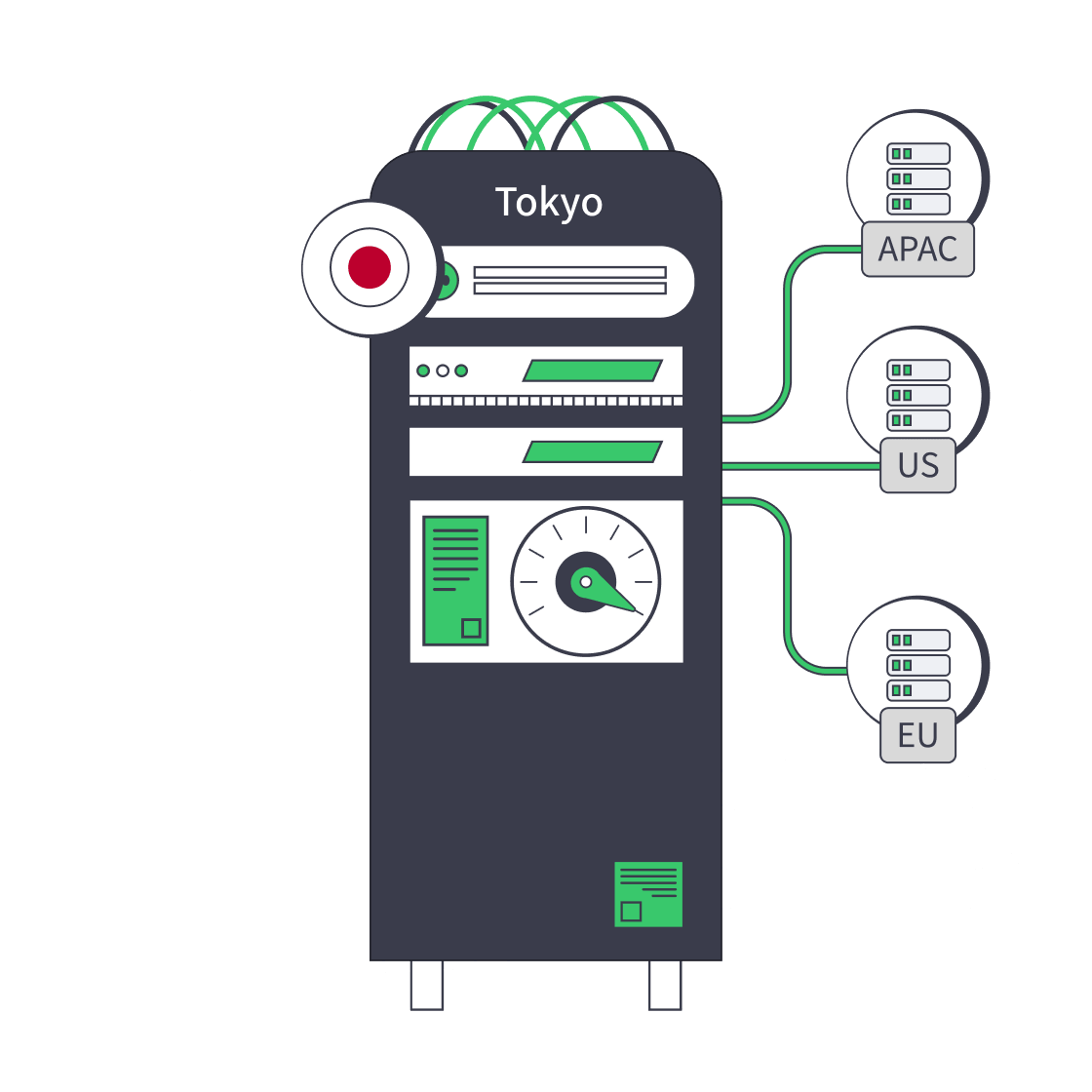
Japan Dedicated Server: Compliance, Latency Policy, & Multi-Region Failover
Buying a Japan dedicated server is really buying a latency envelope, a route-quality profile, and a governance boundary. On continuous backbone measurements, Tokyo-region workloads sit near Korea and Hong Kong, mid-range to Singapore and Sydney, and far enough from the US and Europe that synchronous failover becomes a design smell. Treat those figures as clean-network baselines, not user promises: last-mile routing, congestion, and application queues still decide what users feel.
The old “Asia bandwidth is scarce” story is outdated. The Internet Society’s IXP tracker reports Japan has 25 active IXPs, 676 members, 94% domestic network coverage through IXPs, and 92% local cache/server reachability for the 1,000 most-visited sites. The modern question is sharper: does your Tokyo route, tail-latency profile, data-transfer model, and failover plan match the workload?
Deploy in Tokyo— Tokyo-ready dedicated servers — Asia routes and failover — CDN reach across Japan |
 |
Why a Japan Dedicated Server in Tokyo Is Not an APAC Shortcut
Tokyo is a premium latency market because it is local to Japan and Northeast Asia, not because it sits in the middle of APAC. A Japan dedicated server should be chosen when Japanese users, nearby Korea/Hong Kong traffic, or Japan-regulated workflows justify a local hot path.
The table below uses continuous P50 round-trip backbone measurements as a planning baseline. It is useful for architecture, but insufficient for procurement; buyers still need provider-specific MTR, traceroute, TCP, and UDP tests from key access networks.
| Path from Tokyo Region | Indicative Median RTT | Architectural Read |
|---|---|---|
| Tokyo ↔ Seoul | 21–29 ms | Strong fit for fast session control and competitive play |
| Tokyo ↔ Hong Kong | ~53 ms | Good for regional control planes and latency-tolerant user paths |
| Tokyo ↔ Singapore | ~73 ms | Viable for failover and support services; not local for Japan |
| Tokyo ↔ Sydney | ~104 ms | Better for async replication than tight interactive commits |
| Tokyo ↔ US West | ~108–146 ms | Sensible warm recovery; risky for synchronous user-path writes |
| Tokyo ↔ Frankfurt / Western Europe | ~219–235 ms | DR, replay, analytics, or sovereignty partitioning, not chatty active-active |
That is why Tokyo-first architecture should be selective. Keep the match state, payment decision, signaling service, or inference hop close to Japanese users. Push static delivery into CDN, regionalize bulky analytics, and resist the instinct to make Tokyo the default home for every non-interactive component.
How to Choose a Japan Dedicated Server for Tokyo Latency-Sensitive Workloads
Choose a Japan dedicated server by starting with the user-visible latency budget, then checking route evidence, compute isolation, data-flow rules, and failover behavior. Tokyo fits hot session paths, trading/payment-adjacent systems, real-time collaboration, and user-path inference. Static delivery, batch jobs, and cached content usually do not need it.
Dedicated Server Japan Workload Fit: When Tokyo Is the Right Call
Gaming is the bluntest test. A study of FPS gameplay found that even network latency under 100 ms degrades performance and quality of experience; QoE dropped about 0.7 points on a five-point scale per additional 100 ms in the experiment. For authoritative game state, anti-cheat checks, matchmaking, or voice tied to the same session, latency is product design, not hosting cosmetics.
Real-time apps have a different ceiling but the same problem. APNIC’s working-latency analysis shows why an idle ping can be misleading once a connection is loaded; for conferencing, it leaves only about 130–340 ms of network RTT budget after application processing. The classic tail-latency research explains why p99 breaks systems before averages look alarming, while ITU planning guidance treats highly interactive voice, video, and data as delay-sensitive well below broad upper limits.
Fintech adds governance. METI reported Japan’s cashless payment ratio reached 42.8% of consumer spending, with the total reported as ¥141.0 trillion, or roughly US$900 billion. That makes payment, fraud, brokerage, and risk flows mainstream workloads. For these systems, a dedicated server in Japan is about predictable RTT, auditability, and pre-approved cross-border handling as much as speed.
For AI inference, ask whether the model blocks the user path. If it gates a voice turn, moderation decision, fraud score, ranking result, or retrieval step, Tokyo placement protects perceived responsiveness. If the job is offline enrichment or training, send it where capacity economics are better.
Japan Hosting Due Diligence: Route Quality and Cross-Border Data Transfer Checks
Advertised port speed is not due diligence. For Japan hosting, validate paths from the access networks your users actually use, measure peak-hour p95/p99 and working latency, and map every cross-border personal-data flow. APPI often allows transfer, but it requires governance, not casual replication.
Route quality should be tested, not inferred from a Tokyo postcode. Ask for test IPs and run MTR or traceroute from Japanese mobile, broadband, office, and partner networks. Test TCP and UDP separately if the product uses sockets, media, game traffic, or custom transport. Japan’s IX fabric is deep enough that poor Tokyo routing is often a provider-design issue, not an unavoidable geography problem.
Data residency and cross-border transfer are related but not identical. Japan’s APPI requires security controls, processor supervision, leak reporting, third-party transfer governance, and specific controls for foreign-country transfers under Articles 23, 25, 26, 28, and 31. In practice, define which data must remain Japan-authoritative, which data can be tokenized or pseudonymized, and which observability or model-training pipelines can leave Japan under documented consent, contractual, or equivalent-protection paths.
Financial workloads should also account for sector expectations. FISC says its security guidelines are voluntarily observed by most Japanese financial institutions, so vendor oversight, contingency planning, and incident handling need to be part of the hosting decision from day one.
How to Design Japan-to-US/EU Failover for Gaming, Fintech, and Real-Time Apps
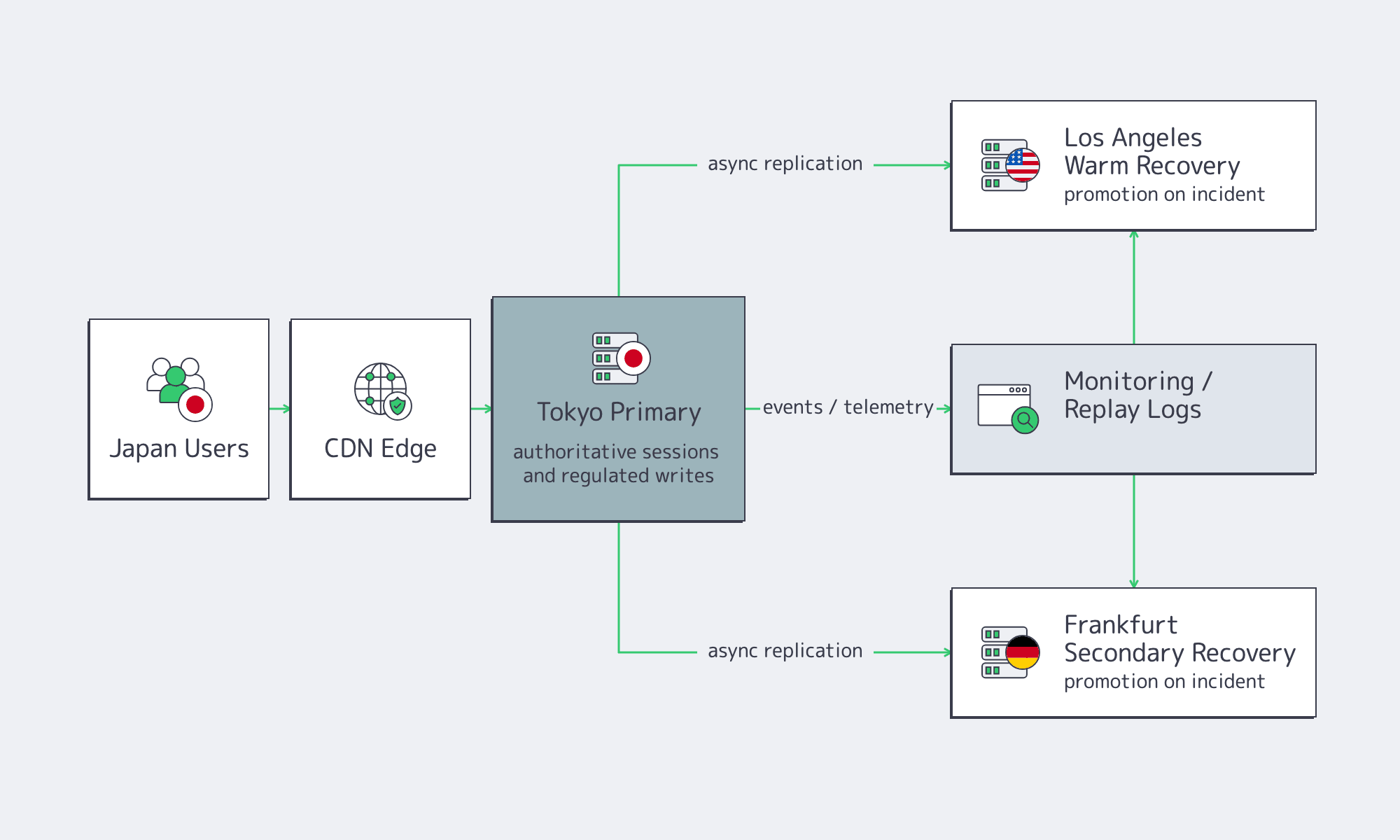
Japan-to-US/EU failover works when Tokyo stays authoritative for the latency-sensitive and compliance-sensitive path, while distant regions receive asynchronous state, replay logs, artifacts, and warm capacity. Treat the US West as Pacific recovery and Europe as a secondary operating sphere, not as synchronous extensions of Tokyo sessions unless the workload explicitly tolerates that latency.
Japan’s official business-continuity guidance stresses management-owned planning, flexible strategy, online decisions, information security, training, and supply-chain awareness. Infrastructure should mirror that: rehearse failover, document stale data, and decide which functions stop instead of crossing an ocean synchronously.
A practical Japan-US pattern keeps Tokyo authoritative for sessions and regulated writes, then replicates event logs, account state, model artifacts, and recovery images to Los Angeles for Pacific recovery. Atlanta can be a deeper US operating sphere for North American continuity.
A practical Japan-EU pattern treats Frankfurt, Madrid, Amsterdam, or another listed European location as warm recovery, analytics, support tooling, or partitioned customer operations. Melbicom’s Europe presence supports that planning model. The EU path is valuable, but not as a normal synchronous extension of a Tokyo session.
Provisioning Checklist for a Japan Dedicated Server Shortlist
A credible shortlist should translate the strategy into evidence: routes, measurements, data-flow controls, failover staleness rules, and deployable capacity. For Tokyo, that also means checking available configurations, per-server bandwidth, and the lead time for custom builds before the launch plan depends on them.
Capacity check matters before architecture hardens.
- Require real route evidence from Japanese access networks during peak hours, including p95/p99 and working-latency behavior.
- Classify the hot path: session state, fraud checks, payment decisions, voice signaling, match logic, or user-path inference.
- Inventory all cross-border transfers, including logs, analytics, support access, model features, and backup restores.
- Define failover staleness: what can replay, what must remain Japan-authoritative, and what should stop during an incident.
- Test US/EU recovery as async promotion; avoid active-active.
- Keep Tokyo focused on what users or regulators actually feel; move cacheable, batch, and support functions elsewhere.
Conclusion: Make Tokyo the Hot Path, Not the Whole Platform

A Japan dedicated server strategy works when Tokyo becomes the authoritative place for the work that must be close, predictable, and governed. It fails when teams treat Tokyo as a universal APAC shortcut or assume intercontinental regions can behave like a local extension under pressure.
The smarter pattern is narrower and stronger: Tokyo for the hot path, nearby Asia where regional reach matters, CDN for delivery, and US/EU regions for recovery or secondary operations. That design gives product teams room to serve Japan seriously without turning every component into a latency-sensitive component.
Explore Japan Dedicated Servers
Plan Tokyo-centered hosting with Melbicom’s Japan coverage, US/EU recovery, 21 locations/data centers, 20+ transit providers, 25+ IXPs, 39 CDN PoPs across 35 countries, 1,400+ configs, and custom builds in 3–5 days.