
Blog

Italy Dedicated Servers: A Due Diligence Playbook
Italy is no longer a “secondary” EU hosting decision. IMARC Group estimates the country’s data‑center market at USD 6.4 billion in 2025 and forecasts USD 16.0 billion by 2034.
If you’re here to rent a dedicated server in Italy, treat this guide like a production dependency: translate workload into CPU/RAM/NVMe and bandwidth tiers, pick a city that hits latency targets, and validate the boring‑but‑fatal details—routing, out‑of‑band access, remote hands, provisioning, and exit clauses. This is the checklist you can reuse.
Choose Melbicom— Tier III-certified Palermo DC — 6 ready-to-go servers — 40 CDN PoPs across 35 countries |
 |
Sizing Dedicated Servers in Italy
Sizing isn’t about buying “big.” It’s about making performance predictable under ugly realities: cache misses, replication spikes, batch jobs colliding with user traffic, and the day your database vacuum decides it’s the main character.
- Profile (peak QPS, background jobs, read/write mix, hot‑set size).
- Translate into CPU/RAM/NVMe and a baseline bandwidth tier.
- Add headroom you can justify (incident mode + growth).
- Decide scaling path (vertical now, horizontal later—or vice versa).
Italy Server CPUs: Cores and Clocks
For latency‑sensitive services, clock speed and sustained all‑core behavior often matter more than “how many cores can we afford.” Ask for the exact CPU model and generation, then sanity‑check it against your p95 CPU time per request and expected concurrency. If the provider can’t name the SKU, you can’t reproduce performance later.
RAM: budget for churn, not average
Memory pressure is an incident generator. Size for the worst five minutes: GC churn, cache turnover, and page cache behavior during heavy reads. Confirm ECC RAM and ask how upgrades are handled (in‑place vs reprovision). For data stores, treat RAM as a performance tier (indexes + hot sets), not a cost center.
Storage: NVMe as the default, not the upsell
NVMe isn’t just “faster disk.” It is designed for SSD workloads. NVM Express notes that NVMe provides a lower-latency, more scalable interface than legacy SATA. For latency-sensitive storage, confirm the exact SSD model and supported PCIe generation and lane width, then benchmark your read/write mix and tail latency. Interface bandwidth alone does not predict application performance.
Bandwidth: tier it like a resource, not a line item
Define two requirements: steady‑state commit (normal egress, replication) and burst (backfills, re‑shards, release windows). Also decide if you need metered transfer or an unmetered port. The “right” tier is the one that doesn’t punish growth—or turn incident response into a cost spike.
Which Italian DCs Meet EU Latency Needs?
An Italian data center meets a low-latency requirement only when measured RTT and packet loss from your target networks meet your service objectives. Compare Milan and Southern Italy from the same probes over comparable test windows, and inspect routing; geography alone does not establish which location is faster.
Start with targets, then choose geography. WonderNetwork’s public ping dataset averages 30 pings between individual test servers. A Milan ↔ Frankfurt average is not a regional p95 target or a measurement of Melbicom’s network; test the provider’s route.
But “Italy” is not just Milan.
Palermo as a latency and routing lever
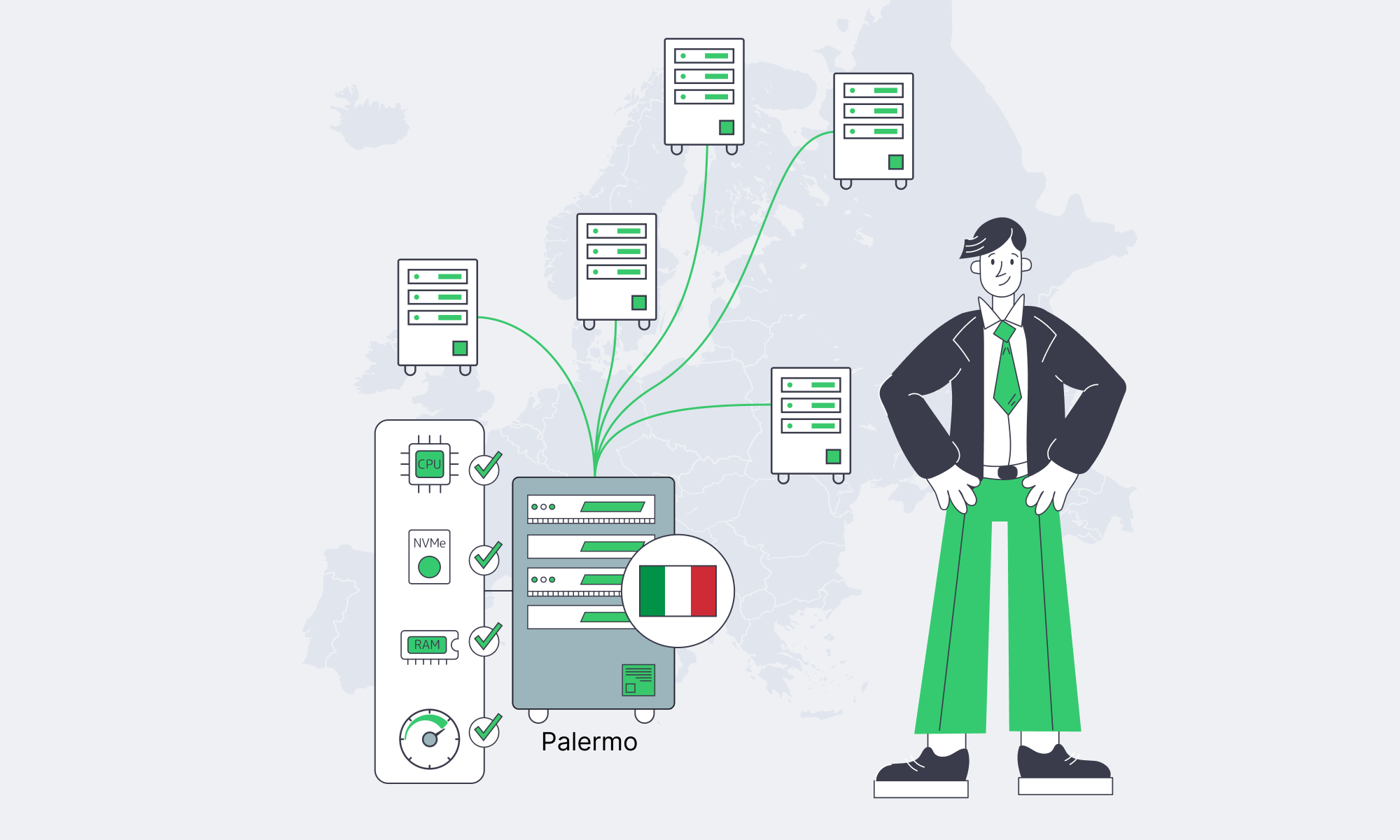
Melbicom’s Italy location is Palermo, a Tier III facility with per-server options up to 40 Gbps. Palermo’s connectivity to Sicily’s cable landing stations makes it a location to test for Mediterranean, North African, and Middle Eastern traffic. Any latency advantage depends on the specific source network, destination, and route.
Due‑diligence move: don’t accept “quality” as a vibe. Run multi‑probe RTT + packet‑loss checks from the networks you care about.
What to Validate in Italian Hosting MSAs
For a dedicated server in Italy, validate the MSA and service terms against operational requirements: network measurement scope, remote hands, IPMI/KVM access, provisioning milestones, and exit procedures. Distinguish advertised capabilities from written commitments, and confirm which work is included, chargeable, or subject to separate terms before signing.
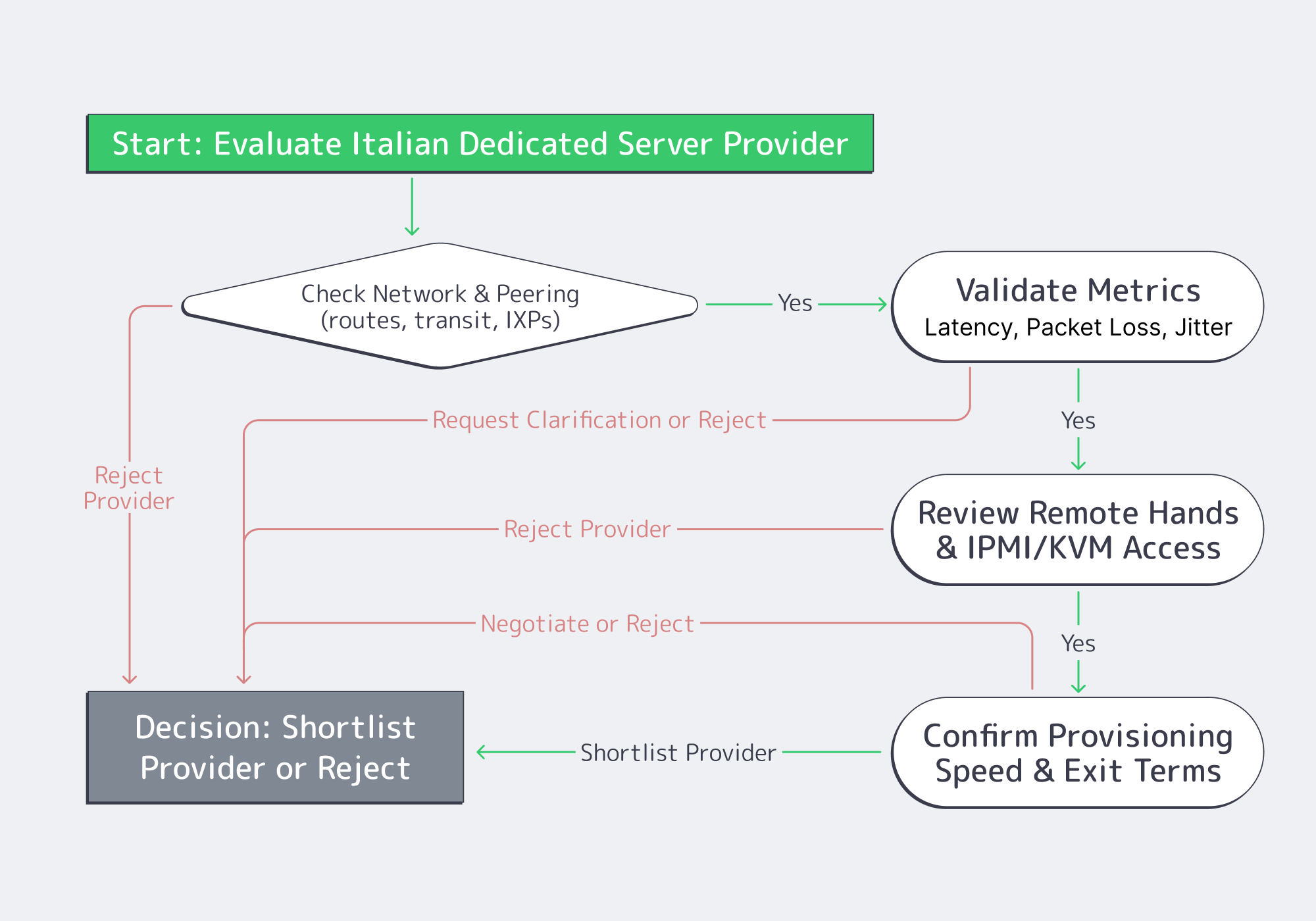
Here’s the due‑diligence checklist that actually changes outcomes.
- Peering and routing evidence. Ask for traceroutes to your top destinations (or a looking‑glass), and verify paths stay sane during peak hours. “Many peers” is not a guarantee; consistent paths are.
- Packet‑loss targets + measurement method. NTT’s backbone benchmark is ≤0.1% average monthly packet loss, subject to its service definitions and exclusions. This is not an industry-wide threshold or a Melbicom commitment. Lock down scope (inside provider backbone vs public internet), sampling, and metric reproducibility.
- Remote hands scope. Define which tasks are included or billable (reboots, reseats, KVM hookup, disk swaps, rack work), plus response times and escalation. Distinguish hardware-fault replacement from requested upgrades. This is how you turn “we’ll help” into an operational control.
- IPMI/KVM access (out‑of‑band recovery). Out‑of‑band access is your last line of defense when the OS is dead or the network is misconfigured. Validate isolation, credential rotation, and auditability.
- Provisioning lead time (stock vs custom). Put timelines in writing and separate “stocked config activation” from “custom build delivery.” When you need capacity under pressure, hand‑wavy provisioning is not a plan.
- Exit and migration clauses. Confirm notice periods, data wipe proof, and IP handling. If IP identity matters, routing options can make migrations cleaner; Melbicom supports BYOIP and BGP sessions on dedicated servers.
How to Build a Server Scoring Matrix
A scoring matrix turns subjective impressions into a repeatable decision. Weight the criteria that map to production risk, score each provider only with evidence, and force trade‑offs into the open. Include workload fit, measured latency, network quality, operational access (IPMI/KVM, remote hands), provisioning, and exit terms.
Weighted Score = Σ (weight_i × score_i) / Σ weight_i # score_i is 1–5, backed by a test result # or a contract clause |
| Category | Weight (%) | What “5/5” looks like |
|---|---|---|
| Workload fit (CPU/RAM/NVMe) | 25 | Exact CPU SKU, ECC RAM, NVMe; clear upgrade path |
| Latency to users/partners | 20 | Measured RTT meets p95 SLO from target regions |
| Network & peering quality | 20 | Clean traceroutes; defined loss target and method |
| Ops (IPMI/KVM + support) | 20 | OOB works; remote-hands scope and escalation defined |
| Provisioning + exit terms | 15 | Written timelines; migration window; IP portability |
To score honestly: run the same tests from the same probes, mark unknowns as unknowns, and penalize ambiguity in service terms. Evidence beats vibes.
Frequently Asked Questions (Ops Edition)
Is “Italy” automatically the lowest‑latency EU option? No. Latency is route‑dependent. Italy can be excellent for specific corridors, but you need measurements from your user regions and partner networks.
What’s the minimum due diligence before signing? A test IP for RTT/loss, exact hardware SKUs, written provisioning commitments, remote‑hands scope, and an exit clause you can execute without downtime gambling.
Do I need a CDN if I rent a dedicated server in Italy? If you serve global users or heavy static content, a CDN can reduce origin egress and improve TTFB for cached responses; cache misses still depend on the origin. Melbicom’s CDN spans 40 PoPs in 35 countries.
What’s the safest way to migrate in? Parallel run: replicate continuously, cut over in stages, and keep rollback. If stable IP identity matters and you control a portable address block, consider BYOIP via BGP sessions.
Italy Dedicated Servers: Key Takeaways
- Size from workload behavior: CPU/RAM/NVMe and bandwidth tiers should map to measurements, not guesses.
- Pick Italian locations by latency targets; test RTT, packet loss, and routes.
- Treat peering quality and out‑of‑band access as production requirements.
- Put remote hands, provisioning, and escalation rules in writing.
- Build an exit plan: migration windows and IP strategy are operational safety nets.
Dedicated Servers: Architecture Decisions
An Italy dedicated server is only “fast” if the whole stack is predictable: hardware that matches the workload, geography that matches users, routing that stays sane, and service terms that make recovery and exit possible. Do the diligence once—profile, measure, and score—and procurement becomes repeatable instead of emotional.
Deploy in Palermo today
Ready-to-go servers can be activated in 2 hours; custom configurations are delivered in 3–5 business days. Confirm Palermo stock and your delivery schedule, and compare Palermo vs Milan with real latency tests before ordering.