
Blog

Choosing the Right Infrastructure for iGaming Success
iGaming platforms operate in milliseconds; for anyone looking to run an online casino, poker room, or sportsbook, delay cannot be treated as a minor issue. With thousands of live wagers, latency or outages can damage revenue, user trust, and regulatory standing. The global online gambling market was valued at USD 88.0 billion in 2025 and is projected to grow from USD 97.7 billion in 2026 at an 11.0% CAGR through 2033, according to Grand View Research. With the stakes so high, infrastructure decisions are vital. Both customer trust and regulatory standing hang in the balance, and so it is important to make the right choices early on. Today, we will compare cloud and dedicated servers and discuss where each excels, calculate the total costs in conjunction with the performance, and weigh in on the emerging hybrid models.
Choose Melbicom— 1,100+ ready configs — 21 Tier IV & III data centers — 55+ CDN PoPs in 39 countries |
 |
The Key Differences Between Cloud and Dedicated Servers for iGaming
| Factors | Cloud Hosting | Dedicated Server Hosting |
|---|---|---|
| Scalability | Instant elasticity; you can spin up nodes in minutes and scale down after events. | Capacity fixed per box; new hardware requires a provisioning cycle (hours to days). |
| Performance Consistency | Good average latency, but virtualization and noisy neighbors cause jitter. | Low, stable latency and predictable throughput because resources aren’t shared. |
| Cost Model | Pay-as-you-go; attractive for bursts but pricey at steady high load (egress fees add up). | Fixed monthly/annual fees; lower TCO for stable, high-traffic workloads. |
| Control & Compliance | Shared-responsibility security, limited hardware visibility, and data may traverse regions. | Full root access, single-tenant isolation, and easier compliance with data-sovereignty rules. |
| Time-to-Market | Launch in a new jurisdiction overnight through regional cloud zones. | Requires a host with a local data center; lead time shrinks when ready-to-go inventory is available, as provided by Melbicom. |
Reliable Infrastructure Performance When Milliseconds Matter
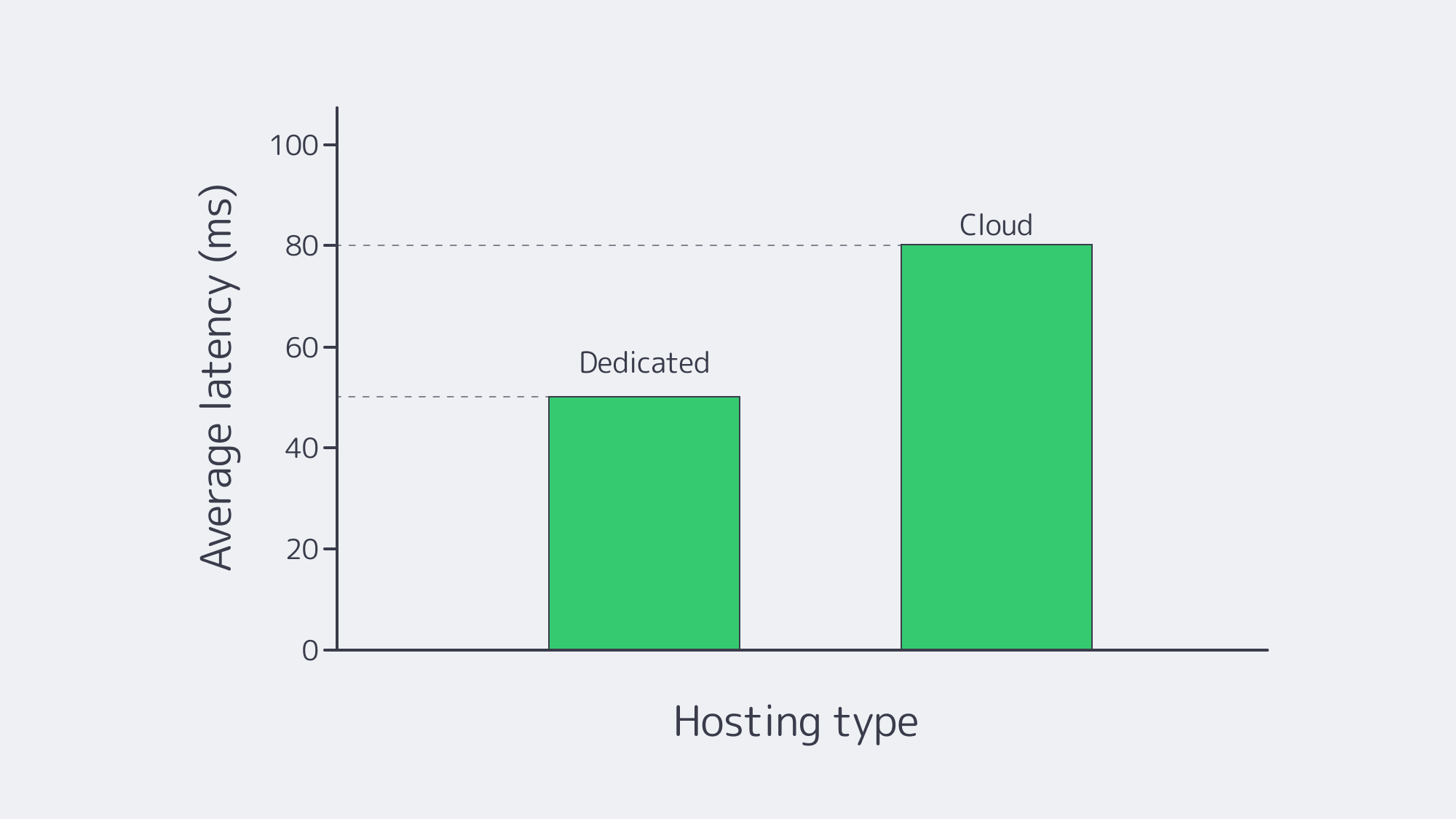
- Cloud server strengths: many top-tier cloud servers have NVMe storage and can provide <2 ms intra-zone latency, which is ample for back-office microservices.
- Cloud server weaknesses: there can be a lot of jitter with hypervisor overheads and lack of sole tenancy, potentially causing odds suspensions, which can lead to backlash on social media, etc.
- Dedicated server strengths: noise from neighbors is eliminated with single-tenant boxes, which helps stabilize latency for live betting, streaming, and payment flows. Melbicom offers per-server bandwidth up to 200 Gbps across 21 Tier IV/III data centers worldwide, giving operators dedicated headroom for sustained traffic when capacity is planned in advance.
- Dedicated server weaknesses: resilience and redundancy must be designed manually, because provider zones do not make them automatic.
With the strengths and weaknesses apparent, it is easy to see why the best modern practice is to pair a redundant cluster of dedicated machines (for odds, RNG, payment) with cloud-hosted stateless front ends. That way, you retain control of critical path processes while the web tier floats elastically.
Scalability: Elasticity Versus Predictability
Cloud Server Advantages
- Auto-scaling groups handle instant surge capacity changes.
- Cloning takes minutes, making QA or A/B sandbox creation a breeze, helping with development and testing.
- Nodes can be dropped in a freshly regulated state while licensing paperwork clears, which facilitates global pop-ups.
The Evolution of Dedicated Server Setups
The gap has been narrowed by modern server providers. At Melbicom, for example, we keep 1,100+ ready-to-go server configurations that can be deployed in under two hours, with custom builds delivered in 3-5 business days. That inventory is supported by a management API, can be planned against architects’ forecasts for Super Bowl or Euro finals loads, and lets hardware be booked days ahead rather than months.
Going Hybrid
A pattern is emerging among iGaming and streaming providers that combine the two options by keeping the baseline on dedicated hardware and leaving bursts to the cloud. At Melbicom, gaming and casino sector clients can configure dedicated clusters to keep normal load below saturation, then use Kubernetes HPA to scale stateless services or Cluster Autoscaler to add cloud nodes when demand exceeds planned headroom.
Economics: Pay-As-You-Go vs. Fixed Power
Cloud Server Cost Dynamics
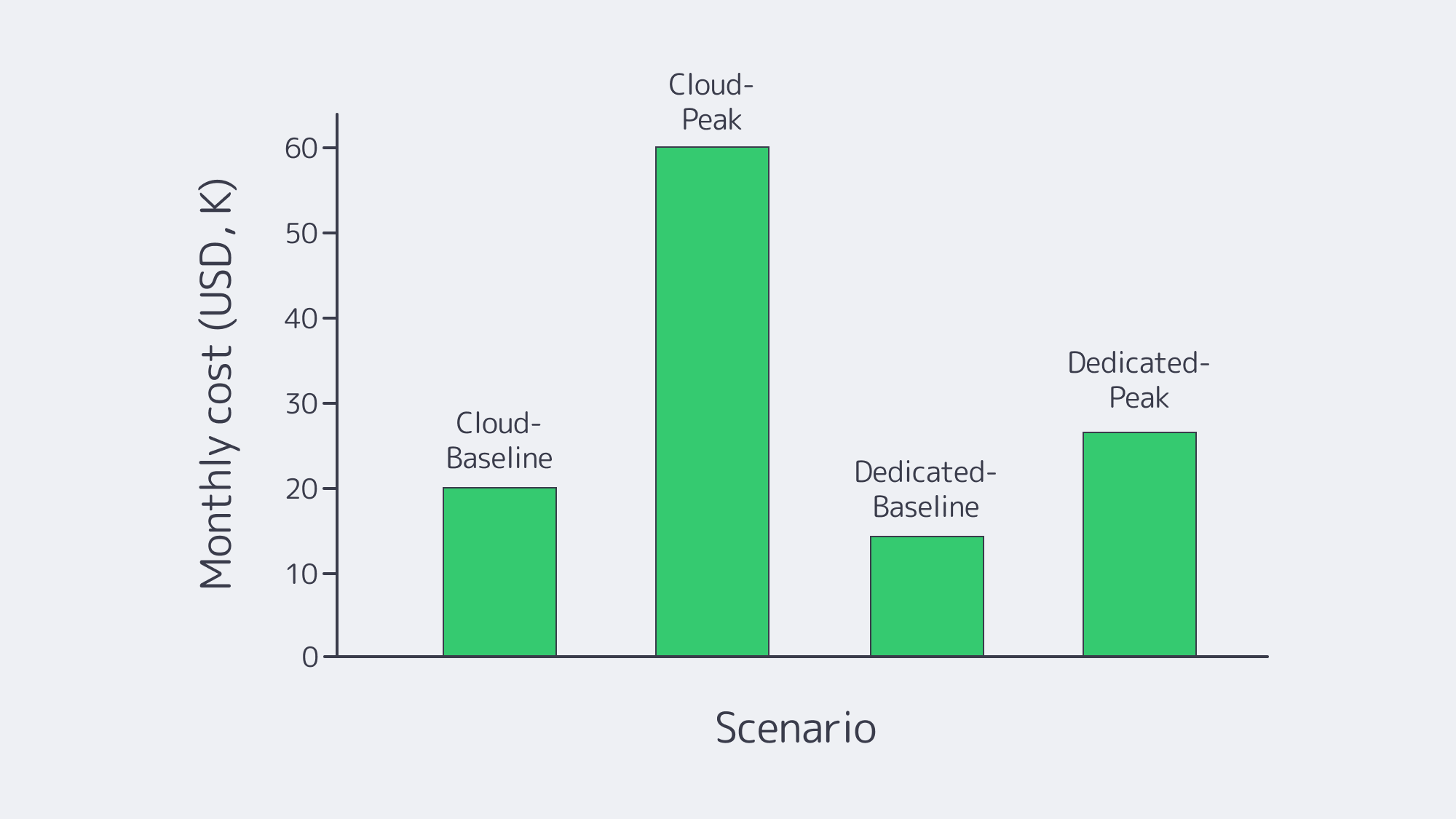
- OpEx freedom, appealing to startups and those piloting new markets.
- Hidden costs, data-egress fees, unexpected premiums for high-clock CPUs, and surcharges for managed databases.
- Higher waste, estimated wasted IaaS and PaaS cloud spend reached 29% in Flexera’s 2026 State of the Cloud Report. Often, in the bid to protect latency, over-provisioning is the default, which can be costly.
Dedicated Server Cost Dynamics
- The billing is flat and predictable, the price includes reserved capacity, making it easier for CFOs to forecast costs during viral promos or traffic spikes.
- Lower at-scale unit costs once bandwidth is factored in. For a steady 24/7 poker network, equivalent dedicated racks can undercut cloud compute when utilization is high and egress is heavy, but the exact break-even point depends on location, redundancy, and bandwidth profile.
Modern Trends
As baseline demand stabilizes, many operators reassess which workloads belong in public cloud and which belong on fixed infrastructure. This is selective, not a wholesale cloud retreat.
An EE Times summary of Barclays and IDC survey data framed repatriation as a cost-control move, while Flexera’s 2026 State of the Cloud Report reports that 73% of organizations still operate hybrid cloud environments.
Control, Compliance, and Single-Tenancy
- Cloud: While some providers offer ISO 27001 and PCI zones, physical-host opacity remains an issue; many gaming authorities insist on disk-level auditability, and some even request data hall entry.
- Dedicated: Audits are simple with single-tenant servers; hardware serials, sealed racks, and local key storage are easily verifiable. Regulations differ from region to region, but with Melbicom, cross-border data-sovereignty challenges can be addressed by deploying in Tier III facilities across Europe and North America, with Tier III and Tier IV options in Amsterdam.
- Security posture differences: Hypervisor patching is offloaded by the cloud’s shared-responsibility model, but perfect IAM hygiene is needed. With dedicated hardware, the OS and firmware must be patched, but this enables custom HSMs or proprietary anti-fraud sensors. It is now becoming common to encrypt databases with on-server HSMs and mirror anonymized analytics to the cloud.
Hybrid Architecture: Best of Both Worlds
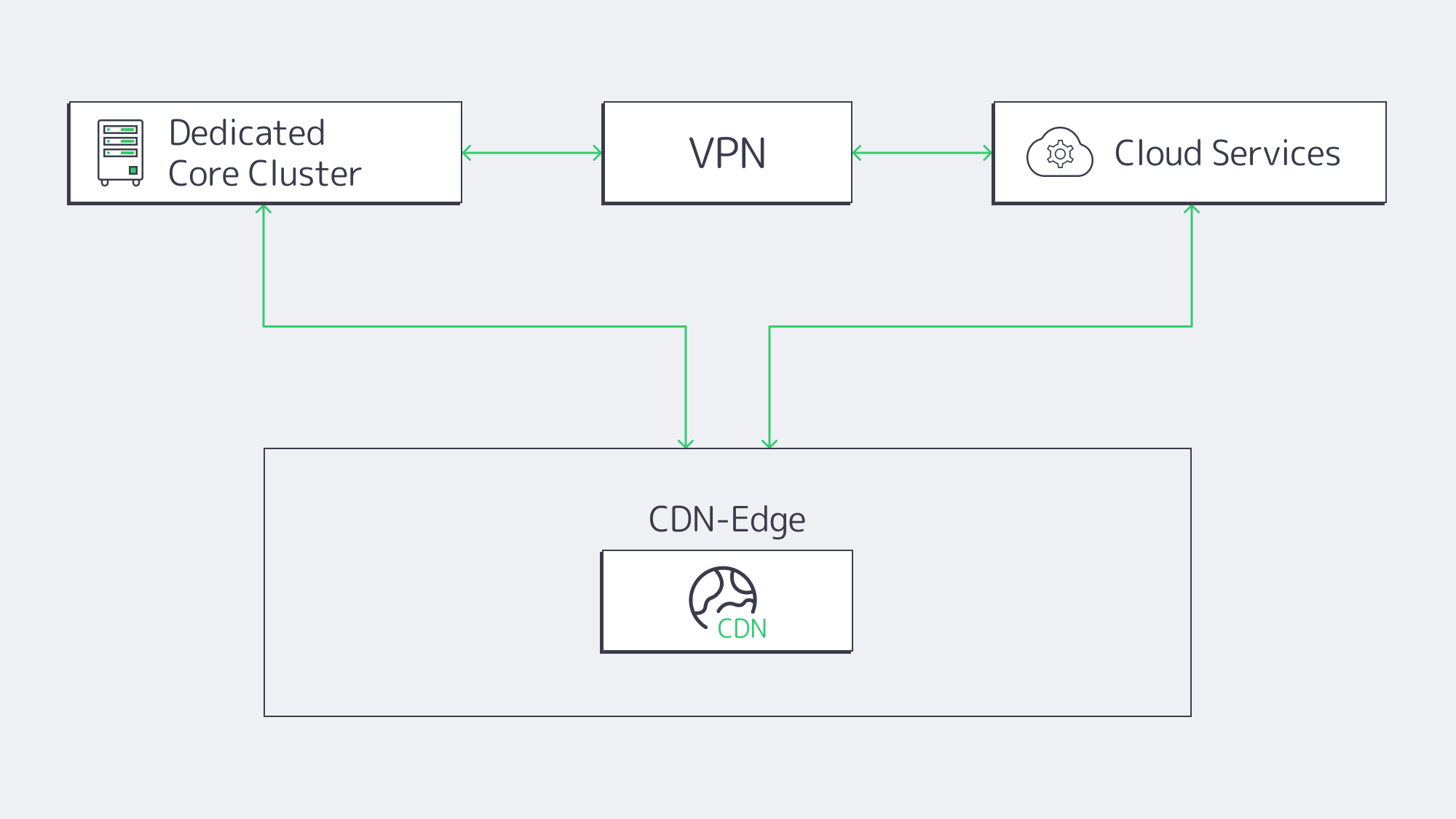
- Dedicated Core, Cloud Edge Leverage dedicated clusters near the main user base for real-money game logic, RNGs, and payment gateways while utilizing low-latency cloud regions for stateless APIs, UIs, and CRM microservices.
- Cloud Burst Operating via six high-spec servers for baseline needs, with behind-the-scenes auto-scaling cloud containers ready to spring into action when triggered by a surge that dissolves post-match.
- Dev in Cloud, Prod on Dedicated Spinning up test environments with CI/CD pipelines, running tests, and deploying approved builds to hardened dedicated servers to shrink time-to-market without the associated multi-tenant exposure risks.
- Splitting for Geo Compliance Use Melbicom dedicated nodes to process bets locally while sending anonymized aggregates to a central cloud data lake for BI and ML, an ideal pattern where data must stay in-country.
How the Debate Has Shifted Over Time
The ideological fight that was in full swing just a decade ago has reached a stalemate. Cloud emergence once promised to “kill servers,” and the loyalists waved latency graphs in defense and exasperation. Then Moore’s Law slowed, and providers added premium SKUs, and the cloud prices plateaued. Dedicated automation also changed the argument with IPMI APIs, and inventories that can be deployed in an instant, bringing better agility to dedicated servers.
Final Word: A Winning Infrastructure Hand

The choice between cloud and dedicated is ultimately workload-specific; each has its merits. If uncertainty is high or the need is urgent, the cloud earns its keep, especially in situations where experimentation drives revenue. For stable high-throughput workloads, dedicated infrastructure can deliver stronger long-term cost control, deterministic performance, and the isolation that regulators look for. For iGaming demands, adaptability is key to keep up with shifting traffic and adhere to rules without losing budget control.
A forward-thinking solution is to structure your architecture around the best of both worlds. Keep latency-critical engines on high-bandwidth single-tenant servers for compliance and stability, then use cloud elasticity for spikes, peripheral microservices, experiments, and new markets.
Deploy Dedicated Servers Now
Deploy ready-to-go single-tenant nodes in under two hours and give players low-latency performance.