
Blog
Dedicated Servers: Slashing iGaming Hosting Costs
iGaming platforms run hot, late, and global, so the infrastructure choices you make can materially affect gross margin. The question is simple: where does the iGaming dedicated server model beat utility cloud on total cost of ownership without compromising performance and efficiency?
Choose Melbicom— 1,000+ server configurations — 21 data centers (2 upcoming) — 39 CDN PoPs across 6 continents |
 |
How Can Dedicated Servers Lower TCO?
An iGaming dedicated server can lower total cost of ownership when steady utilization makes fixed capacity economical after bandwidth, licenses, support, and operations are included. Compare that total with cloud commitments and autoscaling under the same workload; dedicated hosting is not always cheaper for variable demand.
Usage-based cloud bills can include compute time, storage I/O, inter‑AZ and regional traffic, and egress. A fixed dedicated rental covers the contracted resources, not every associated expense: traffic allowances, overages, managed services, and software licenses still matter. Cloud commitment discounts can also change the comparison, while unused committed capacity can erode savings.
Grand View Research’s current market estimates value online gambling at $88.0 billion in 2025 and forecast 11.0% annual growth from 2026 to 2033, with sports betting the largest sub‑segment in 2025. That market context does not establish steady utilization for an individual platform; size infrastructure from measured workload demand rather than industry growth.
The second half of the equation is predictability. IDC’s October 2024 analysis, citing its Cloud Pulse 4Q 2023 survey, says about half of surveyed cloud buyers spent more than expected in 2023 and 59% anticipated overruns in 2024. Those are historical results and expectations, not a current overspending rate. Fixed rental charges simplify one part of forecasting, not the entire operating budget.
An illustrative iGaming hosting comparison
| Illustrative hosting charges (USD) | Dedicated server | Cloud instance |
|---|---|---|
| Assumed monthly hosting charge | $250 (assumed constant) | $400 (assumed constant) |
| Hosting charges – 1 year | $3,000 | $4,800 |
| Hosting charges – 3 years | $9,000 | $14,400 |
| Modeled monthly variation | None assumed | None assumed |
Both monthly charges are hypothetical assumptions held constant for 36 months, not Melbicom offers, comparable supplier quotes, or a full TCO calculation. The totals exclude traffic and overage charges, CDN delivery, licenses, administration, staff time, migration, and redundancy. Equivalent capacity and performance have not been established; the lower assumed input—not the billing model alone—produces the difference.
Predictable Costs vs. Surprise Bills: How Flat‑Rate Pricing Improves Budget Control
Storage, egress, and cross‑region traffic need separate budget checks. A Backblaze-commissioned Dimensional Research survey conducted in May–June 2025 found that 95% of its 403 respondents reported unexpected cloud storage costs. Participants managed cloud storage strategy and budgets at companies storing over 250 TB in public cloud. This vendor-sponsored, storage-specific sample does not establish the incidence of surprise bills across all cloud computing or iGaming workloads.
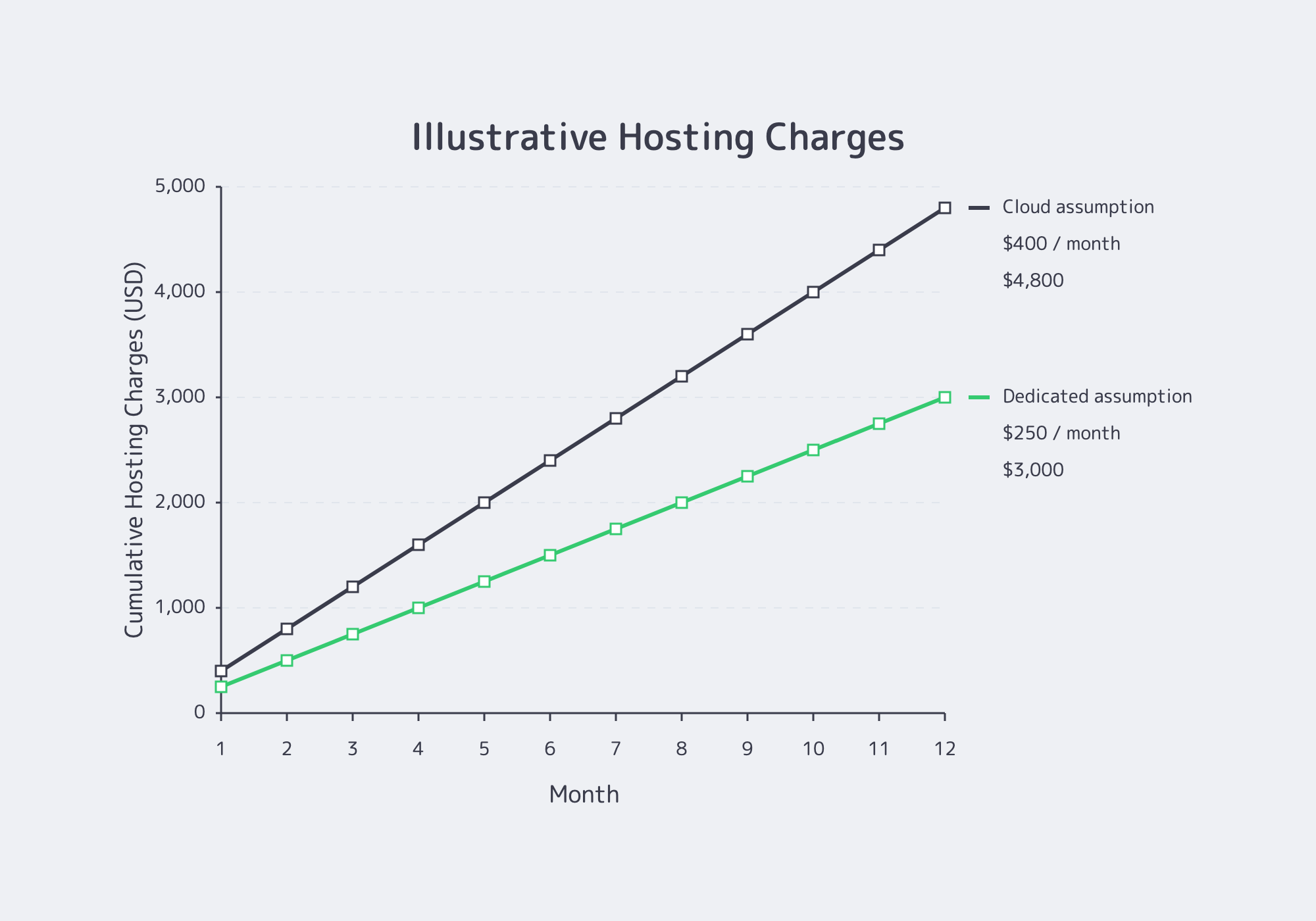
Under these assumptions, cumulative hosting charges differ by $1,800 after 12 months. It models neither demand variability nor an inherent platform cost advantage.
A fixed rental makes the contracted server charge predictable, but extra capacity and usage-based services still need budgets. To offload eligible content, put a CDN in front of your origins. Melbicom’s CDN operates in 39 PoPs across 35 countries. Cache hits can reduce origin traffic; cache misses and non-cacheable requests still reach the origin, and CDN delivery has its own charges. Compare combined origin and CDN costs rather than assuming offload is free.
Bandwidth headroom is also important: Melbicom offers up to 200 Gbps per server for workloads such as live‑dealer video and logs/telemetry replication. Port speed is not a traffic allowance: check the selected plan’s included transfer, unmetered terms, and any usage charges when budgeting.
Balancing Hosting Costs and Performance
Hybrid scaling for peak events (baseline on dedicated, burst tactically)
The working solution is frequently a combination: run a stable base load on dedicated machines and scale suitable stateless front ends or microservices in the cloud during peak events. That can provide elastic headroom for the Champions League final or the Super Bowl, but include inter-platform traffic and operational complexity in the calculation. Uptime Institute’s February 2025 analysis, based on its 2024 survey, describes public clouds alongside on-premises facilities, rather than a wholesale cloud exit.
Place origins in well‑peered metros, measure paths to critical markets, front eligible content with a global CDN, and keep backend services private where possible. Melbicom’s footprint comprises 21 Tier III/IV data centers, including São Paulo and Marseille coming soon. Its 1,000+ ready‑to‑go server configurations can be activated within 2 hours at available locations; plan extra lead time for custom capacity.
Automation can reduce management overhead
Configuration management and infrastructure as code (IaC) can automate software setup on dedicated servers after provisioning. Keep that separate from ordering or canceling physical capacity:
- After a server is provisioned, use configuration management and CI/CD workflows to install software and join it to a cluster.
- Scale physical capacity in planned steps, accounting for deployment time, billing periods, and cancellation terms; use provider APIs only for documented operations.
- Use CPU saturation, tail latency, and queue depth to trigger capacity reviews, and schedule additions ahead of sports seasons and promotions.
FinOps usage optimization connects rightsizing and automation with cost and performance goals; the tooling and operational responsibilities still differ between platforms. Melbicom provides 24/7 technical support and server administration services. Confirm administration scope and pricing; full application management is not necessarily included.
Capacity planning: enough headroom, not waste
iGaming capacity planning should be fact-based:
- Right‑size by region: measure peak concurrency by region and event schedule rather than over‑building a single mega‑cluster; compare paths from Melbicom’s server locations to players and payment services rather than assuming geographic proximity guarantees low latency.
- Incremental scale‑out: add servers as measured concurrency and resource demand grow, with headroom for failures. Melbicom offers monthly billing with a one-month minimum payment period; check billing and cancellation terms before planning seasonal reductions.
- Move bulk bytes to the CDN where content is cacheable, so origin capacity can focus on dynamic interactions while retaining enough headroom for cache misses.
Performance can affect ROI
Single‑tenant servers isolate host resources from other customers. Running directly on the hardware also avoids a provider-managed hypervisor, but applications, storage, operating systems, and network paths still affect latency. Dedicated hosting alone does not guarantee a particular end-to-end response time.
Measure tail latency, timeouts, and completed transactions under comparable load before and after a change. Check business outcomes separately; reduced jitter does not establish a proportional increase in session length, betting revenue, or hold rate.
Why Revisit Cloud Repatriation?
Selective repatriation can suit measured workload economics, operational control, or data‑residency requirements, while other services benefit from cloud elasticity. IDC’s 2024 analysis describes movement of selected workloads rather than wholesale cloud exits. Location alone does not establish compliance.
In an October 2024 update, 37signals reported reducing its annual cloud bill from a $3.2 million run rate to $1.3 million and forecast more than $10 million in five-year savings from its combined compute and planned storage exit. It reused existing data-center racks and power capacity without enlarging its operations team. This was a SaaS deployment on owned hardware in colocation, not an achieved five-year result or proof that rented dedicated capacity will reproduce those savings.
iGaming Hosting Solutions Checklist
- Lock in a predictable base. Size fixed-price dedicated nodes for measured baseline demand from durable workloads such as accounts, RNG/odds, and payments, with tested peak and failure headroom.
- Burst only the edge. Use cloud autoscaling for suitable stateless API and presentation tiers during major events, then scale them down afterward; account for backend limits and inter-platform traffic.
- Reduce avoidable egress. Serve eligible content from the CDN, measure cache-hit rates, and budget for origin transfer, cross-region traffic, and CDN delivery.
- Automate capacity turns. Automate server configuration and schedule physical capacity changes around sports seasons and promotions, allowing for provisioning and billing terms.
- Check bandwidth terms. Match port capacity to peak demand and verify included transfer, unmetered conditions, and overage charges for replication and video.
- Measure ROI in user terms. Measure bet latency, timeouts, and completed transactions alongside operating costs; test business effects rather than attributing session length or hold-rate changes to hosting alone.
- Keep options open. Allocate workloads by measured economics, while accounting for hybrid networking and management overhead.
Where Does Melbicom Fit When You Make “Dedicated Server vs Cloud” Trade‑Offs?
An iGaming dedicated server from Melbicom is worth evaluating when steady demand supports fixed-capacity economics. Melbicom offers 1,000+ ready‑to‑go server configurations with activation within 2 hours at available locations and bandwidth of up to 200 Gbps per server. Compare server, transfer, and support costs against an equivalent cloud deployment.
Melbicom’s Tier III/IV data centers comprise 21 facilities across 19 cities and 17 countries, including the coming-soon São Paulo and Marseille facilities. Use the CDN across 39 PoPs to offload eligible content, and include CDN delivery in the combined cost calculation.
What’s the Bottom Line?
When your platform runs continuously, a flat‑rate dedicated model can be a strong financial option if measured utilization justifies the capacity and the full operating cost is competitive. The cloud remains valuable for experimentation and short bursts, while commitments and autoscaling can improve its economics. Compare equivalent performance, resilience, traffic, and operational responsibilities rather than assuming either billing model always wins.
A forward‑looking plan doesn’t pick a single winner; it allocates workloads—dedicated for the stable spine, cloud for elasticity, CDN for eligible content, and S3‑compatible object storage for media, logs, and backups, ideally with clear pricing and data residency. Evaluate this combination against actual demand and operating costs, and assess providers on time‑to‑deploy, per‑server bandwidth, PoP coverage, and support depth rather than just GHz or core counts.
Build predictable iGaming infrastructure
Deploy dedicated servers with global CDN and 24/7 support to cut bill shock and keep latency low across peak events.