
Blog

Hybrid Storage With Dedicated Servers In São Paulo
São Paulo isn’t “regional” anymore—it’s a gravity well. In 2023, over 84% of Brazil’s population was online, and the city’s interconnection role keeps expanding. If your users, partners, or data producers are in Brazil, the fastest path is straightforward: keep compute and the hot working set in São Paulo, then scale out with cloud storage in São Paulo patterns for durability and retention.
The latency math supports the move. The Seabras‑1 route sits at roughly 105 ms RTT between New York and São Paulo, so hosting in Brazil can shave close to ~100 ms versus routing workloads north. Hybrid is also the default posture: 80% of organizations using multiple platforms prefer a mix of public cloud and private/on‑prem environments.
Choose Melbicom— Reserve dedicated servers in Brazil — CDN PoPs across 6 LATAM countries — 20 DCs beyond South America |
 |
How to Architect Hybrid Object Storage in São Paulo
Start with a São Paulo dedicated server as the performance anchor, then attach object storage as the elastic capacity layer. Keep hot reads/writes local; move cold data and long retention to objects via lifecycle rules. Standardize on S3‑compatible interfaces so apps can swap storage backends without rewrites as requirements evolve.
Dedicated Server São Paulo as the Storage Gateway
Treat the dedicated server São Paulo footprint as the edge of your data plane: it terminates user traffic, runs ingestion/ETL, and hosts the tier your pipelines touch constantly. Local disk bandwidth is the difference between “fast enough” and “architectural regret”—NVMe can sustain 7–8 GB/s, compared with ~550 MB/s for SATA SSDs.
Local Object Storage for Backups, Media Libraries, and Data Lakes
In São Paulo, hybrid storage usually converges on three workloads: backups (fast restores plus off-site copies), media libraries (hot caches plus long-tail archives), and data lakes (cheap objects plus local transforms). Keep the active working set on the server, and push the rest into object storage on a schedule.
One constraint to design around: Melbicom doesn’t yet provide managed cloud storage in Brazil today. Melbicom’s S3 service is currently hosted in a Tier IV datacenter in Amsterdam. Teams either build S3‑compatible storage on dedicated infrastructure (software-defined object storage on local disks) or integrate São Paulo compute with an external object store—without hard-wiring the system to any single vendor.
Brazil Deploy Guide— Avoid costly mistakes — Real RTT & backbone insights — Architecture playbook for LATAM |
 |
Policy-Driven Tiering That Doesn’t Trap You
Policies should decide placement, not ad‑hoc scripts. Use lifecycle rules to keep fresh objects on São Paulo NVMe for a short window, then transition or replicate to cheaper tiers and long retention. This matters because budgets slip fast: 62% of businesses have exceeded cloud storage budgets, and 59% saw cloud costs rise in the last year.
Hybrid Storage Reality Checks for São Paulo
| Metric (used once) | Why architects care |
|---|---|
| IX.br peak throughput > 22 Tb/s | A proxy for how much traffic and interconnect density lives in-region |
| 95% of IT leaders report surprise cloud storage charges | Evidence that cost variance is systemic, not an edge case |
| Brazil cloud market grows ~$24B (2025) → ~$78B (2032) | Data gravity will intensify; hybrid won’t stay optional |
Which Replication Policies Secure Data Across South America
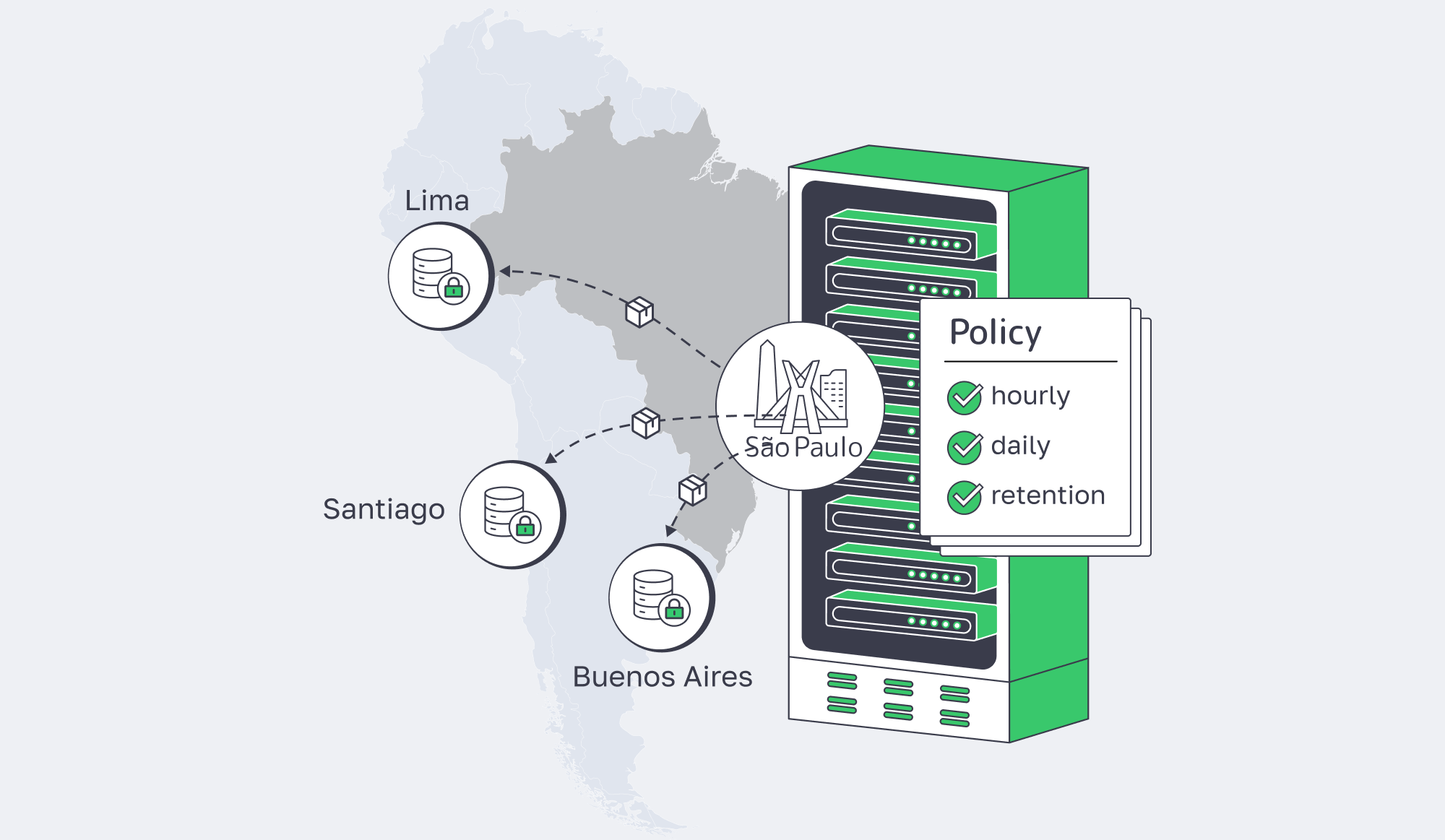
Replication policy is the bridge between local performance and regional resilience. Use São Paulo as the primary origin, then replicate critical objects to at least one other South American site for recovery and locality. Keep asynchronous replication for bulk data, and apply tighter consistency only where the write-path truly requires it.
Replication Rules: Scope, Timing, Placement
Replication shouldn’t be a DR checkbox—it’s a control plane with explicit knobs. Define scope (tier‑1 datasets and regulated objects first), timing (batch large objects; keep near-real-time replication for small, high-value writes), and placement (at least one geographically distinct South American location to reduce correlated failures). Many teams codify rules like “replicate incremental deltas hourly” to balance consistency against bandwidth and cost.
Cross-Border Replication Without Overbuilding
Brazil’s LGPD doesn’t universally mandate residency, but international transfers require a defensible framework, and guidance on cross‑border transfers continues to evolve. The practical implication: keep at least one replica in Brazil for recovery and audit, replicate outward only to approved jurisdictions, and encrypt replication traffic end-to-end.
Networking: Why Routes Matter
Replication succeeds or fails on network behavior—loss, jitter, and routing stability. Melbicom’s network services support routing control and private connectivity patterns. That matters when replication traffic shares pipes with latency-sensitive users: throttle replication during peaks, open it off‑peak, and keep failure modes legible.
What Egress-Aware Designs Minimize Enterprise Cloud Costs
Egress-aware design assumes your bill is shaped by data movement, not just storage size. Keep the busiest reads in São Paulo, cache aggressively on dedicated infrastructure, and offload repeat delivery to a CDN. Model cross-region traffic explicitly, because South America egress pricing can turn “cheap storage” into expensive operations.
Line-Rate Transfer Capacity (Theoretical maxima, 30-Day Month)
| Port Speed (Gbps) | Max Transfer / Month (TB) | Time to Move 10 TB (hours) |
|---|---|---|
| 1 | 324 | 22.2 |
| 10 | 3,240 | 2.2 |
| 40 | 12,960 | 0.6 |
| 100 | 32,400 | 0.2 |
The Egress Math in South America
Published examples put South America egress around $0.12–$0.18 per GB. That means pulling 10 TB can land in the $1,200–$1,800 range, and one example puts 8 TB egress from a South Brazil region at roughly $1,430. With a 10 Gbps port, that’s not a throughput problem—it’s a billing model problem.
Dedicated Server in São Paulo as an Egress Firewall
The simplest egress reducer is locality. Put hot content behind a dedicated server in São Paulo and treat object storage as the durability layer, not the serving layer: fetch once, cache locally, serve many times without repeated egress events. On metered bandwidth, repeats compound—Melbicom’s Brazil guidance warns that overages can become “a nasty surprise”. Portability is part of the prize, too: 55% of IT leaders said egress costs were the biggest barrier to switching cloud providers.
CDN in São Paulo, Brazil and Beyond as the Read-Traffic Absorber
A CDN turns your origin into a write-optimized system, not a read bottleneck. Melbicom’s CDN is delivered through 55+ strategic PoPs in 36 countries and supports pay-as-you-go or volume tiers with large-commit pricing as low as €0.002–€0.015 per GB depending on tier/zone. In practice, that means a São Paulo origin can stay focused on ingestion, auth, and writes, while the CDN absorbs repeat reads and smooths traffic spikes.
Cloud Storage São Paulo: The Hybrid Architecture That Holds Up Under Scale
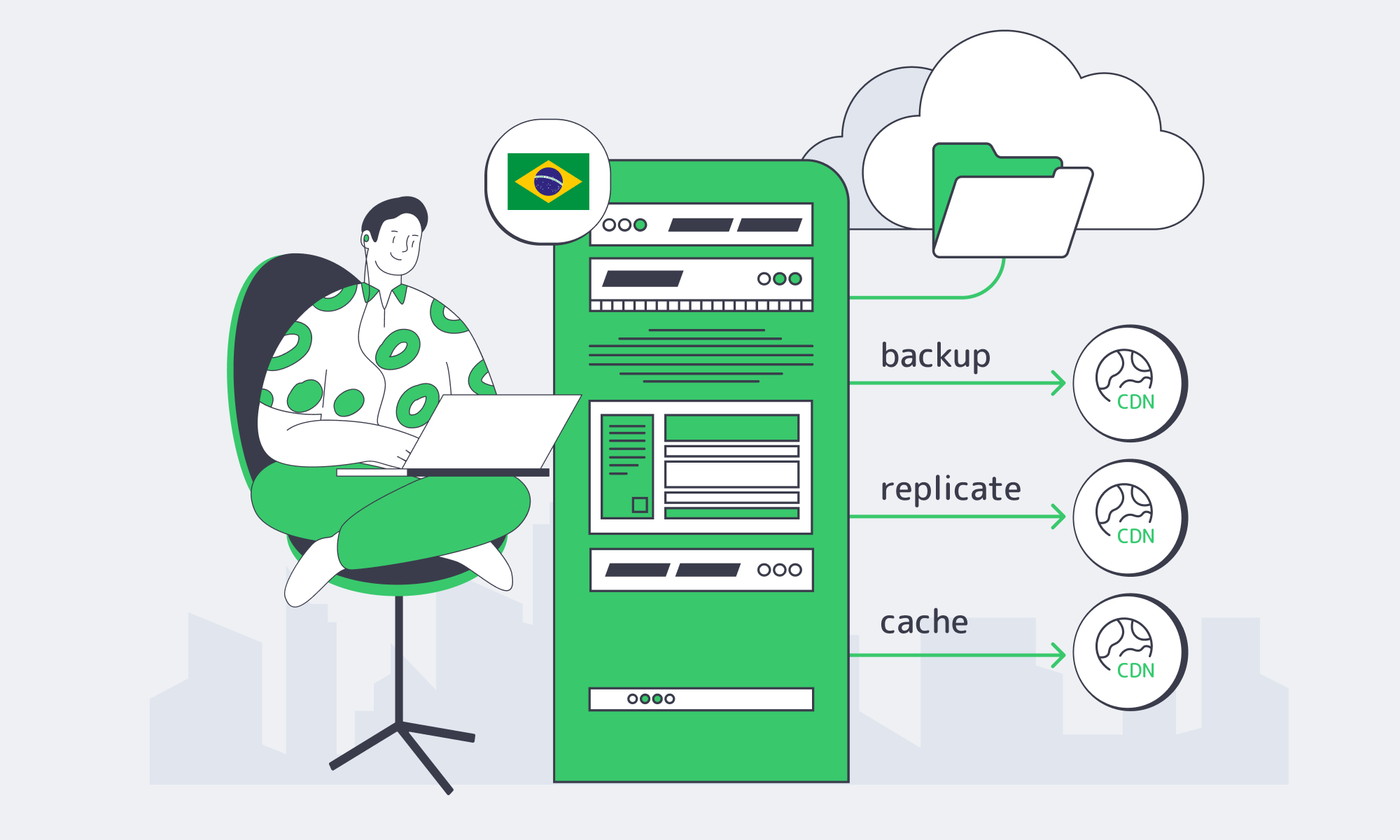
Hybrid in São Paulo works when the design treats dedicated compute as the control point and object storage as the elastic reservoir. Keep hot reads/writes local, replicate by policy to other South American sites, and use CDN distribution so cloud storage stops billing you for popularity. With cost management emerging as a top cloud challenge, egress-aware architecture is now part of platform engineering—not an afterthought.
Architecturally, the “boring” recommendations are the ones that prevent the expensive incidents later:
- Define an explicit egress budget (per workload) and make “unexpected egress” a regression—track it like latency.
- Cache with intent: pin hot objects to São Paulo NVMe, and use TTLs/lifecycle rules so cache doesn’t quietly become primary storage.
- Separate replication goals: one policy set for compliance/residency, another for RTO/RPO, and another for performance locality.
- Treat object storage as a durability layer first: move compute to data when possible; ship results, not raw datasets.
Plan Your São Paulo Hybrid Build
Share your target CPU/GPU, RAM, NVMe, and port speeds. We’ll help design a hybrid setup with dedicated servers in São Paulo, S3-compatible storage integration, and CDN coverage.