
Blog
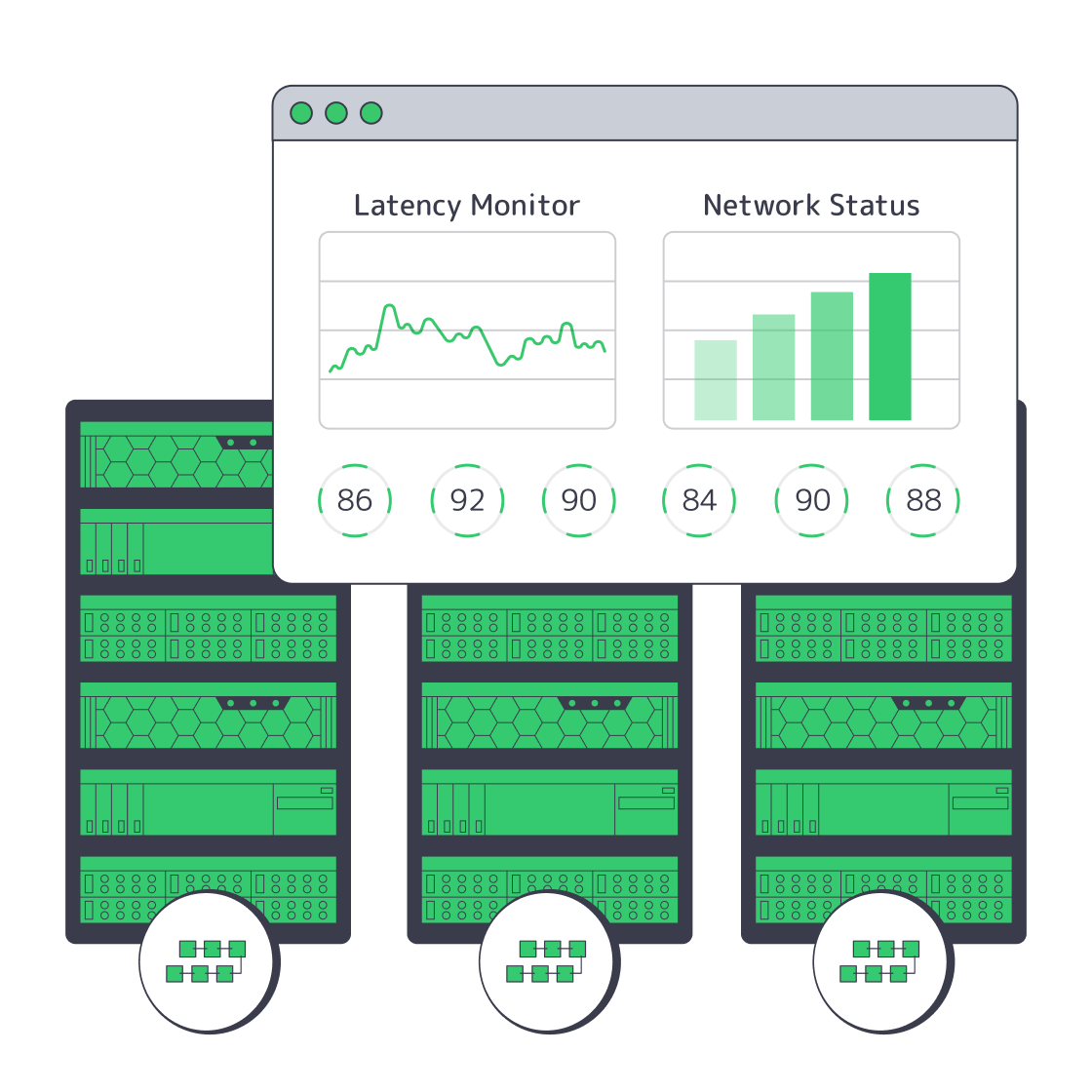
Dedicated Servers for dApp Backends and Off-Chain APIs
In Q2 2025, the dApp ecosystem averaged 24.3M daily active wallets, up 247% versus early 2024, according to industry tracking. That’s huge load growth for infrastructure that was never designed to serve interactive user traffic in the way a web or mobile app does.
User expectations, however, are still Web2-fast: Google’s research shows 53% of mobile visitors abandon a site if it takes longer than three seconds to load. If your dApp’s UI is waiting on an overloaded RPC endpoint, a slow indexer, or a congested on-chain call, users don’t care that “the blockchain is busy” – they just leave.
Base-layer constraints make this worse. Ethereum mainnet still processes only around 15 transactions per second, while traditional payment networks comfortably execute thousands of TPS. When popular early dApps like CryptoKitties pushed all logic and metadata on-chain in 2017, they famously congested Ethereum and slowed down unrelated applications. That experiment proved a point: the chain is a consensus engine and settlement layer, not a general-purpose application runtime.
Even “off-chain” isn’t automatically safe. In October 2025, a multi-hour outage in a major US cloud region froze thousands of apps – including Web3 platforms – because too much critical infrastructure depended on a single provider and region. And in November 2020, an outage at a leading Ethereum infrastructure provider rippled through wallets and dApps that had standardized on a single RPC backend.
Choose Melbicom— 1,300+ ready-to-go servers — 21 global Tier IV & III data centers — 55+ PoP CDN across 6 continents |
 |
We at Melbicom see – modern dApps that feel “instant” to users are almost always hybrid systems: minimal on-chain logic, plus powerful dedicated servers for backends, databases, APIs, indexing, storage, and observability. In this article, we unpack what that hybrid stack looks like in practice and why dedicated servers are such a strong fit for dApp backends.
Decentralization Meets Reality: Why dApps Need Off-Chain Backends
Blockchains are fantastic append-only ledgers; they are terrible primary data stores for interactive applications. Research on blockchain indexing is blunt: chains are optimized for integrity and consensus, not querying – most ledgers store data sequentially, which makes complex queries slow and expensive without specialized indexers.
Protocols like The Graph emerged specifically because directly querying chain state from UIs does not scale. The Graph’s own docs describe it as a decentralized indexing protocol that turns raw blockchain data into subgraphs – structured, queryable APIs dApps can hit using GraphQL instead of scanning blocks themselves. Those subgraphs are not magic; they run on servers, with CPUs, memory, and storage under someone’s ops budget.
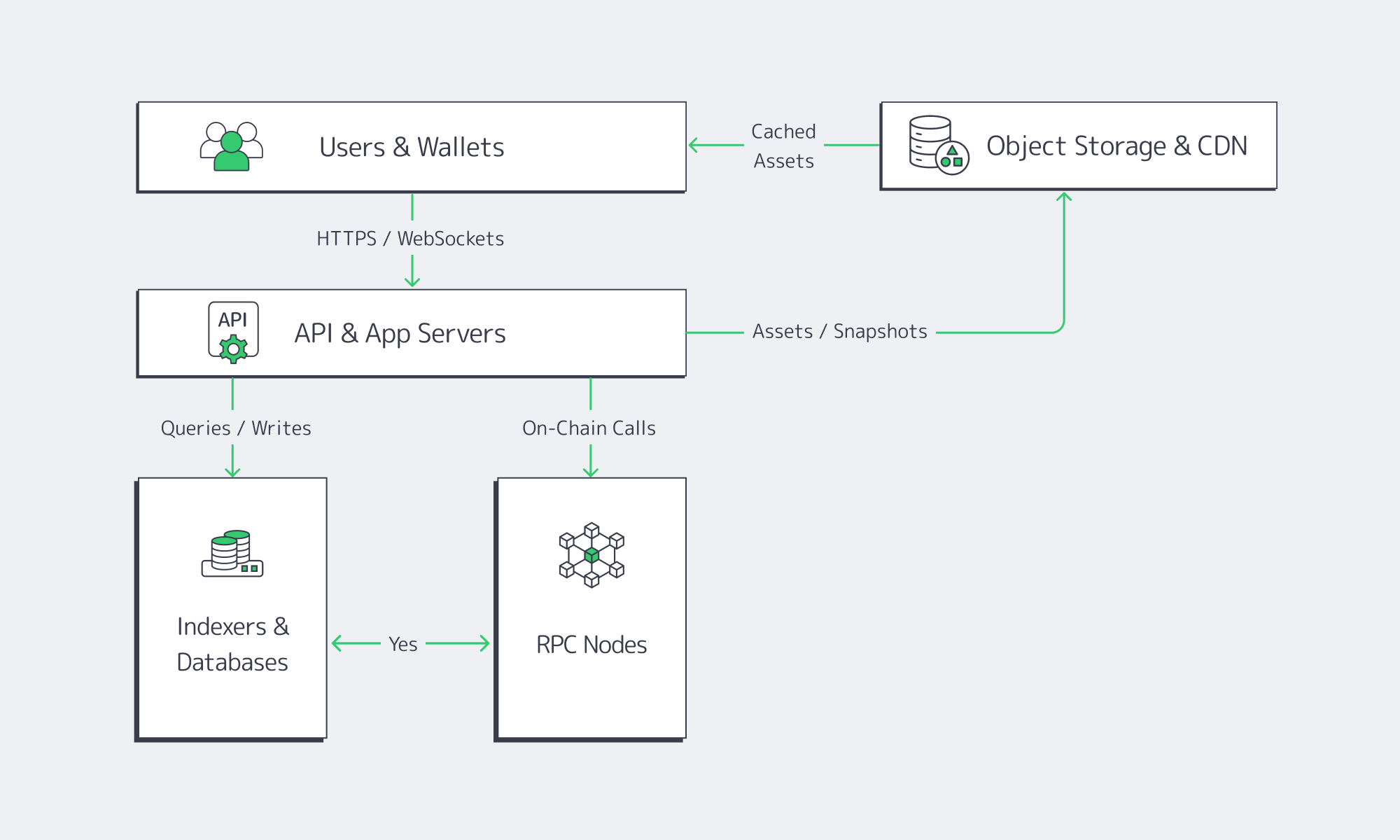
The same is true for RPC nodes. They are essentially specialized servers exposing a JSON-RPC surface between your application and the chain. Studies on Web3 infrastructure point out that every interaction – checking a balance, submitting a swap, fetching an NFT list – ultimately travels through RPC nodes that must stay online, current, and low-latency. When those fail, on-chain contracts keep existing, but your app becomes unusable.
Monitoring all this isn’t trivial either. Web3 observability guides highlight that teams must track both classic infrastructure metrics (CPU, RAM, disk IO, p95 latency) and blockchain-specific signals (block times, gas usage, reorgs, mempool depth). Those metrics live in logs, traces, and time-series databases – again, off-chain systems running on servers.
Many protocols now formalize “off-chain agents” as part of their architecture. The Ergo ecosystem, for example, relies on watchers and bots that continuously scan blocks, update databases, and trigger on-chain actions when conditions are met. Bridges, oracle networks, and cross-chain messaging systems follow similar patterns: long‑running services process events in real time and only occasionally commit back to the chain.
- On-chain is slow, expensive, secure, and authoritative.
- Off-chain is fast, flexible, observable, and where most UX and business logic live.
The question is not whether you need an off-chain backend – you already do. The question is what that backend runs on and whether it is architected for the scale and reliability Web3 usage now demands.
Best Backend Services for dApp Management
In practice, the best backend services for dApp management share three traits:
- They are close to the chain (low-latency RPC and indexers).
- They are close to the users (global delivery, caching, and storage).
- They run on infrastructure you can understand, observe, and control.
For most teams, that means building dApp backends on high‑performance dedicated servers and layering in specialized services – RPC providers, decentralized storage networks, DePIN, and so on – rather than replacing dedicated infrastructure with them.
What Runs Off-Chain in a Modern dApp Backend
A realistic dApp backend typically includes:
- RPC gateways and full / archival nodes serving JSON-RPC and websockets.
- Indexers and subgraphs that transform blockchain events into queryable views.
- Business-logic APIs (authentication, rate limits, portfolio views, risk rules).
- Job schedulers and bots publishing transactions, refreshing oracle feeds, or monitoring bridge events.
- Databases and caches for user profiles, sessions, non-critical metadata, and analytics.
- Observability stacks (logs, metrics, traces) correlating RPC performance, chain conditions, and app-level incidents.
All of that is “just software,” but it’s software with very particular needs: predictable IOPS and latency, high memory ceilings, fast recovery after a crash or resync, and a lot of network throughput.
Blockchain Infrastructure for Next-Gen dApps
Infrastructure for next‑gen dApps increasingly looks like a hybrid between Web3 protocols and Web2‑style distributed systems:
- Indexing layers – Teams often run their own indexers alongside or instead of public networks like The Graph, using the same ideas: consume chain data once, store it in a fast DB, expose a clean API. Even decentralized indexing still requires CLI tools, build pipelines, and servers to host the indexers themselves.
- Decentralized storage – IPFS, Arweave, and Filecoin store content-addressed blobs across distributed networks. But Web3 storage guides are explicit: you still need gateways, pinning services, and caching layers to make this usable in real-time applications. Typically, that means pairing decentralized storage with S3-compatible object storage and a CDN for hot assets – all hosted on robust server infrastructure.
- RPC and node fleets – setting up blockchain nodes requires certain hardware requirements: multi-core CPUs, large RAM, SSD or NVMe storage, and high-speed 1–10+ Gbps networking, especially for full or archival nodes. Those profiles line up extremely well with dedicated servers that we deliver at Melbicom.
dApp infrastructure maintenance is the ongoing work of keeping this stack patched, upgraded, observant, and ready for protocol changes. That work is drastically easier when the underlying platform is predictable single-tenant hardware instead of opaque shared virtual machines.
Comparing Dedicated Server Options Suitable for Scalable dApp Infrastructure
For most production dApps, the most scalable option is single-tenant dedicated servers with SSD or NVMe storage, high-bandwidth ports, and direct networking features such as BGP and private links. Virtual machines and serverless still help at the edges, but latency‑sensitive RPC, indexers, and APIs tend to belong on dedicated hardware.
As dApps mature, the architecture conversation usually isn’t “on-chain vs off-chain”; it’s “how much do we run on dedicated servers, and how do we combine them with managed services and decentralized networks?” The table below sketches typical patterns:
| Use Case | Pure On-Chain Approach | Hybrid With Dedicated Servers (Recommended) |
|---|---|---|
| Simple DeFi farm / staking UI | Contracts hold state; front-end reads directly via shared RPC. | Contracts stay minimal; API and indexer on dedicated servers handle positions, rewards history, and analytics. |
| NFT marketplace | All metadata on-chain; client queries chain directly. | Contracts store identifiers; metadata, search, and recommendations live in DBs and indexers on dedicated servers, fronted by CDN. |
| Cross-chain bridge or oracle | On-chain light clients only. | Off-chain watchers, relayers, and risk engines run on dedicated servers across regions, with occasional on-chain commitments. |
Dedicated infrastructure also plays a key role in DePIN and decentralized compute. Emerging reports show decentralized physical infrastructure networks can significantly undercut hyperscale cloud pricing – in some cases by up to 85% – and are projected by the World Economic Forum to reach trillions in value by 2028. But these networks still depend on physical servers; they are another layer in the stack, not a replacement for operating your own backbone for mission-critical workloads.
The pragmatic pattern we see: teams run core dApp backends, RPC, and indexers on dedicated servers, then selectively integrate decentralized compute or storage where it aligns with their risk and cost models.
Who Provides Reliable Servers for Running dApp Backends?

Melbicom focuses on dedicated infrastructure for Web3: single-tenant servers in 21 Tier III/IV data centers, a global backbone above 14 Tbps, and a CDN with 55+ PoPs across 36 countries. Combined with S3-compatible storage and 24/7 support, this gives dApp teams a predictable, latency-optimized platform for backends.
We designed our platform specifically around the workloads described above:
- Global footprint, local latency – Web3-ready configurations are available across 21 data centers in Europe, the Americas, Asia, Middle East, and Africa.
- Network tuned for blockchain – A backbone with more than 14 Tbps of capacity, over 20 transit providers, and 25+ internet exchanges is engineered to keep block propagation, gossip, and RPC traffic stable.
- Capacity when you need it – Web3 teams can choose from more than 1,300 ready-to-go server configurations, with custom builds delivered in 3–5 business days. This mix lets you spin up testnets quickly and then migrate to bespoke GPU, high-memory, or high‑storage configurations as projects grow.
- Integrated delivery and storage – An enterprise CDN with 55+ PoPs and unlimited requests, plus S3-compatible object storage in a Tier IV Amsterdam data center, makes it straightforward to ship dApp frontends, snapshots, proofs, and NFT assets close to users while keeping authoritative copies on resilient storage.
In practice, teams often run dApp backends on our servers, while also integrating multiple third-party RPC providers for redundancy. Unmetered, guaranteed bandwidth and stable IPs make it feasible to keep self‑hosted RPC, indexers, and subgraphs in the loop without unpredictable egress bills or IP changes.
Because Melbicom focuses on the infrastructure layer – servers, networking, CDN, S3 storage, and BGP – your team keeps full control over node clients, smart contracts, and app code. That aligns well with the operational reality many Web3 teams want: sovereign control over critical infrastructure, without having to also build data centers and global networks from scratch.
Conclusion: Hybrid Infrastructure Is How dApps Reach Scale

The last few years have been a stress test for Web3 infrastructure. Congested chains, RPC outages, and centralized cloud incidents all exposed the same weakness: if your “decentralized” application depends on a single region, a single provider, or a single endpoint, users will discover that weakness at the worst possible time.
At the same time, the core blockchain model is not going away. On-chain consensus is still the best tool we have for global, tamper-resistant state. The way forward is not to push everything into smart contracts, but to treat the chain as the final source of truth and surround it with robust, observable, regionally distributed off‑chain infrastructure.
Dedicated servers, global networks, CDNs, and S3-compatible storage are the pieces that let you build that hybrid model with the determinism and performance users expect.
Practical Takeaways for dApp Backends
- Design around end-to-end latency, not just gas. Map the full request path – UI → API → cache → indexer → RPC – and place latency-sensitive components (RPC, indexers, APIs) in the same region and on similarly performant dedicated servers.
- Run your own critical infrastructure, even if you use managed services. Use multiple RPC providers plus self‑hosted nodes, and design failover so no single provider can take your dApp offline.
- Invest early in observability. Capture metrics for block times, gas costs, RPC error rates, node sync lag, and p95/p99 API latency. Correlate them so you can distinguish chain-level issues from infrastructure or code regressions.
- Treat indexing and storage as first-class concerns. Whether you use decentralized indexing protocols or roll your own, budget dedicated servers and S3/object storage for subgraphs, search indexes, and historical analytics – and front them with a CDN for user-facing workloads.
- Adopt decentralized compute and storage incrementally. DePIN and decentralized storage networks can meaningfully cut costs and reduce centralization, but they still sit atop physical servers. Start by offloading appropriate workloads (e.g., archives, non-critical compute) while keeping core dApp backends on infrastructure you can control.
Taken together, these practices get you close to the original Web3 vision – applications that remain usable and trustworthy even when individual components fail – without sacrificing the performance and observability today’s users demand.
Scale Your dApp Backend on Dedicated Servers
Build low‑latency RPC, indexers, and APIs on single‑tenant hardware with global bandwidth and S3 storage. Explore configurations or request a custom build for your Web3 stack.