
Blog

Holland Dedicated Server: What Buyers Really Need in the Netherlands
Searchers typing “Holland dedicated server” usually do not need a geography lesson. They need a Netherlands buying framework: city, facility, network, data-handling terms, bandwidth model, support scope, and expansion path.
The value is not the label; it is Amsterdam interconnection, EU-located processing, throughput economics, support, and room to scale.
Choose Melbicom– 1,400+ ready-to-go servers – 21 global Tier IV and III data centers – 24/7 infrastructure support |
 |
What a Holland Dedicated Server Search Means for Netherlands Hosting
A “Holland dedicated server” search should be treated as a Netherlands hosting search, with Amsterdam as the default shortlist unless real latency tests prove another Dutch city fits better. The practical criterion is specificity: buy only when the offer resolves to a Dutch city, facility, test endpoint, and network model.
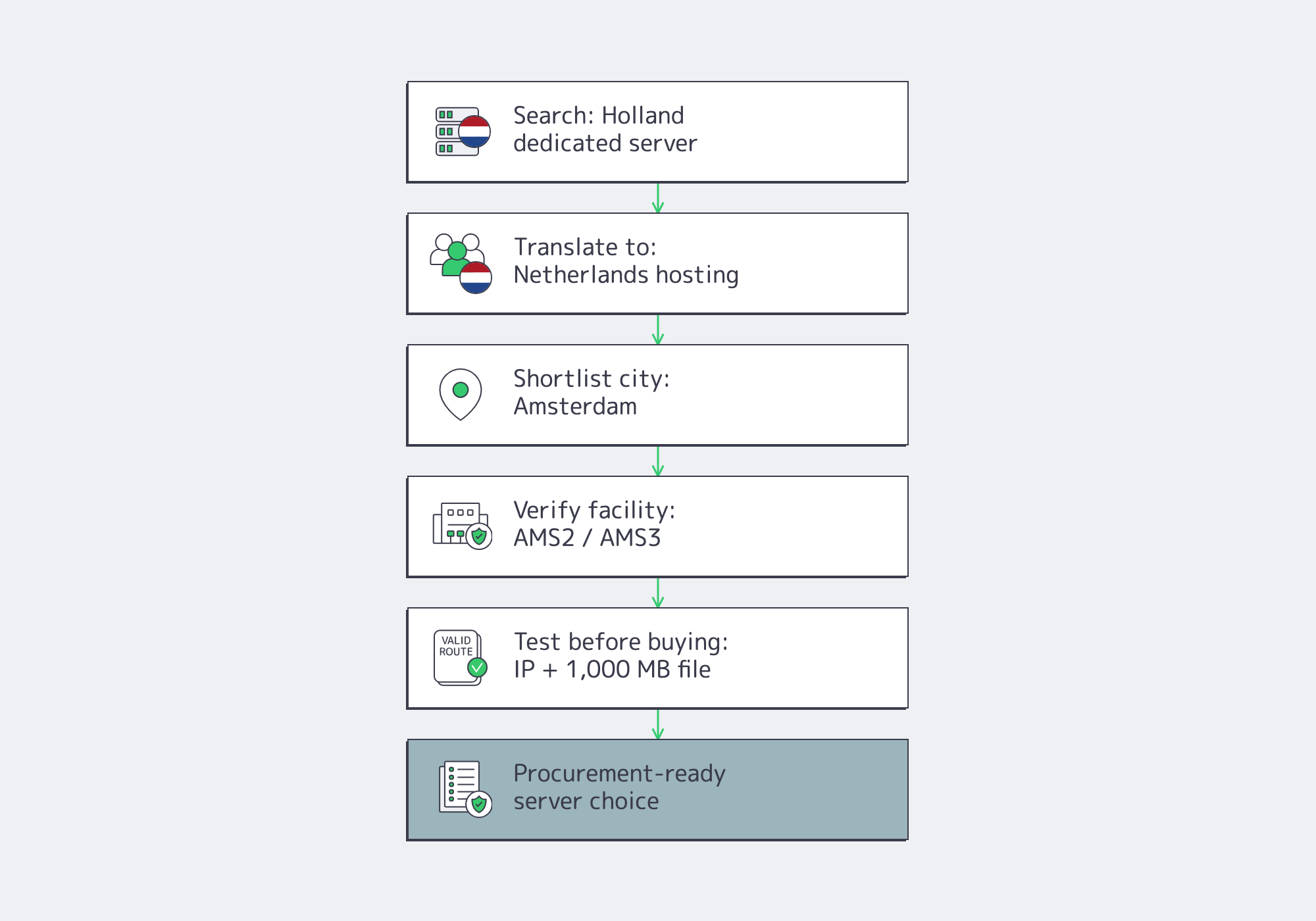
The brief clarification is enough: Holland refers to two provinces, while the country is the Netherlands. For hosting buyers, that makes “Holland dedicated server” an entry query, not a buying requirement. From there, procurement language should shift to Netherlands, Amsterdam, data center tier, port speed, transfer policy, support scope, and contract terms.
For buyers comparing Netherlands dedicated servers, the offer has to become operationally specific. For teams that already know Amsterdam is the latency target, Amsterdam dedicated servers should be evaluated directly. In our Netherlands configuration pool, deployment is centered on Amsterdam Tier III and Tier IV facilities, with a test IP and 1,000 MB test file so teams can validate routes before migration.
Amsterdam Connectivity, EU Data Handling, and Bandwidth Requirements
Netherlands dedicated hosting works when Amsterdam connectivity, EU data handling, and bandwidth policy line up in the same decision. The threshold is concrete: the provider should support measurable path testing, defensible processor and transfer terms, and a port model sized for sustained traffic rather than a one-off burst headline.
Amsterdam Interconnection Is Measurable
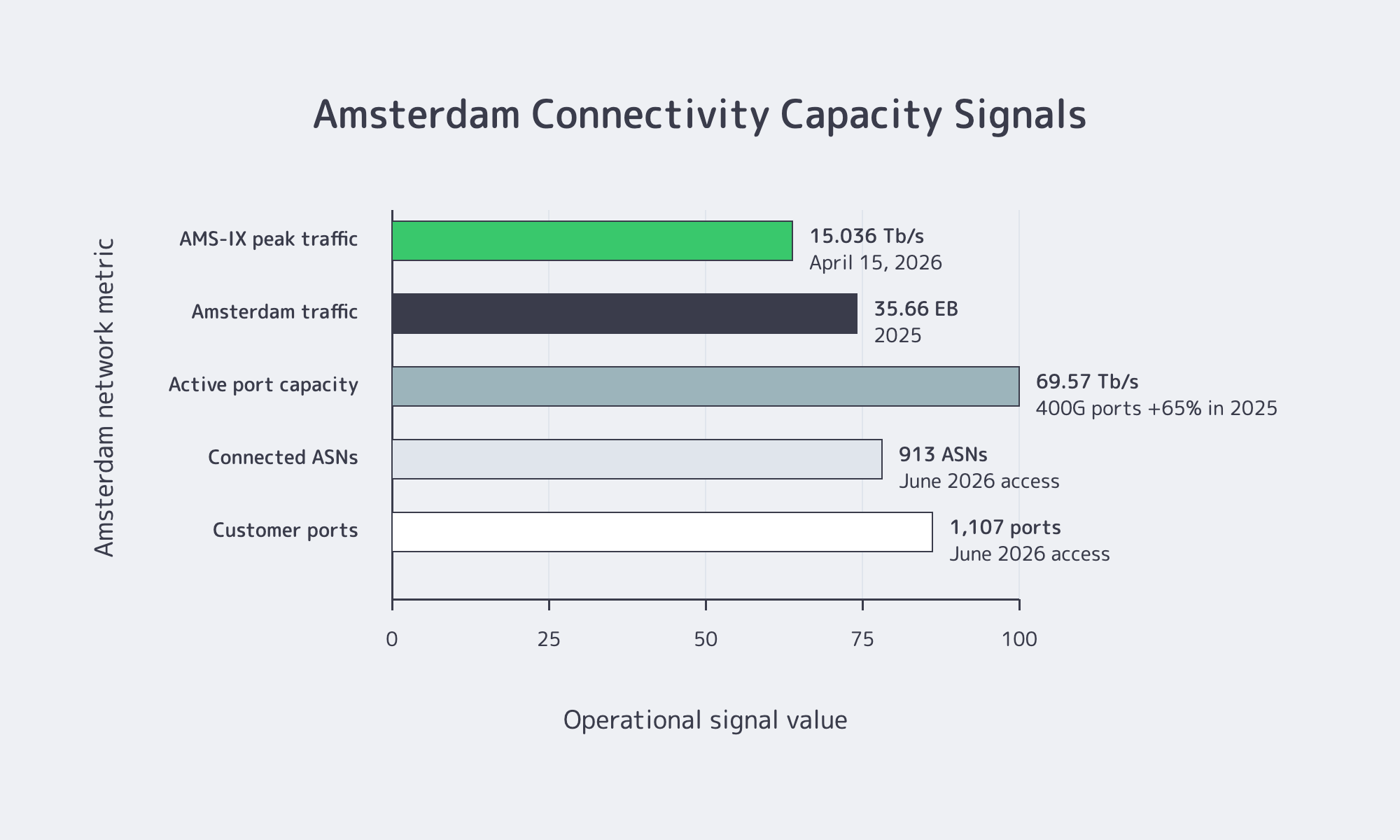
Amsterdam stays on serious European shortlists because its interconnection fabric is documented and operationally large. AMS-IX’s 2025 Facts & Figures update, published February 2, 2026, reported 35.66 exabytes of traffic in 2025, a 4% year-over-year increase, plus 69.57 Tb/s of active port capacity and a 65% annual increase in 400G ports. AMS-IX Amsterdam counters, accessed in June 2026, put the platform at more than 900 connected ASNs, more than 1,100 customer ports, and more than 900 IPv6 peers.
| Signal | Recent Data Point | Buyer Implication |
|---|---|---|
| AMS-IX peak traffic | 15.036 Tb/s on April 15, 2026 | Exchange-scale infrastructure |
| Amsterdam traffic volume | 35.66 EB handled in 2025 | Sustained demand, not speed-test theater |
| Active port capacity | 69.57 Tb/s; 400G ports up 65% in 2025 | Headroom for throughput-heavy workloads |
| Connected-network density | 900+ ASNs, 1,100+ customer ports, 900+ IPv6 peers | Lower risk of needlessly long paths |
| European capacity backdrop | CBRE projects 6.5% vacancy by end-2026 despite 750 MW of new capacity | Lead-time discipline matters |
Amsterdam does not automatically win every workload. It gives buyers a verifiable baseline. If users are spread across the EU, the United Kingdom, and nearby markets, Amsterdam deserves first-pass testing, followed by traceroutes, application probes, and test-file pulls from real user geographies.
EU Data Handling Is a Processing Chain
A Netherlands server helps with EU-located processing, but it does not complete the compliance work. The EDPB’s international-transfer guidance focuses on whether personal data becomes available outside the EEA, and the European Commission’s SCC page confirms that adequacy decisions or safeguards such as the modernized SCCs adopted on June 4, 2021, are the usual transfer routes.
That turns “EU hosting” into a processing-chain question: where production data is stored, where support staff can access it from, and where backups, monitoring records, and ticket attachments live. The EDPB’s Opinion 22/2024, adopted October 9, 2024, says controllers should have processor and subprocessor identities readily available and should verify sufficient guarantees. A Dutch data-center address is useful; a documented processor chain is defensible.
Buy Bandwidth for Sustained Traffic
Bandwidth is where Netherlands dedicated server decisions often get lazy. The right question is not “Which page says unmetered?” It is: what port speed, committed behavior, traffic profile, concurrency level, and upgrade path does the workload need at normal sustained load?
A serious Amsterdam offer should state the port range, whether bandwidth is guaranteed, how transfer is billed if metered, and whether heavier usage belongs on dedicated infrastructure rather than a fair-use cloud product. In our Amsterdam configuration pool, the network range goes up to 200 Gbps per server.
How to Evaluate Netherlands Dedicated Servers Beyond Search Terminology
Evaluating Netherlands dedicated servers beyond search terminology means converting each claim into an operational check. Before buying, verify a test IP and file, named data-center location, processor and subprocessor terms, 24/7 support scope, and an expansion path to higher bandwidth, private networking, BGP, or multi-region services.
The first operational test is support. “24/7 support” matters only when engineers handle recovery-blocking work. Our Support scope includes server reboots, OS reinstalls, BGP setup, network troubleshooting, and performance issues, with engineers on call 24/7. If the answer to “what happens during an outage?” is vague, the support story is still marketing.
The second test is data-handling visibility. Ask for the DPA, processor and subprocessor visibility, non-EEA transfer basis if relevant, and enough documentation to show how the processing chain works in practice. A Netherlands server location helps; the contract and operational evidence close the loop.
The third test is expansion. A Netherlands dedicated server should not become a dead end. Our Network can connect servers on a private network even between different data centers, while BGP Session is available in all locations for dedicated servers and supports BYOIP, IPv4, and IPv6. That matters when one Amsterdam deployment needs to become a multi-region or route-controlled platform.
When a Holland Dedicated Server Shortlist Should Include Melbicom
A Holland dedicated server shortlist should include Melbicom when Amsterdam deployment, high-bandwidth headroom, and expansion beyond one server matter. The operational fit is clear: Amsterdam facilities, up to 200 Gbps per-server networking, 24/7 technical support, test artifacts, and adjacent services that help a Netherlands server grow into a broader European platform.
For the Netherlands specifically, our Amsterdam location has 250+ ready-to-go Intel and AMD configurations, RAM options from 32 GB to 1,536 GB, Tier III and Tier IV facility options, and unmetered traffic models. Across the wider platform, Melbicom adds 1,100+ ready-to-go server configurations, 21 global Tier III and Tier IV data centers, 25+ IXP peering hubs, 20+ transit partners, and CDN coverage in 39 locations across 35 countries.
That combination lines up with the actual Netherlands buying criteria: start country-first, go city-first, inspect Network for private inter-data-center connectivity, use BGP Session for route control or BYOIP, and keep Support in view.
If the workload later needs edge distribution or storage, Melbicom also has CDN, S3 Cloud Storage, and data storage services.
The working checklist is simple:
- Translate the term first. If the quote never gets more precise than “Holland,” procurement has not started; the decision should say Netherlands and usually Amsterdam, with named facilities and test artifacts.
- Treat Amsterdam connectivity as measurable, not mystical. AMS-IX publishes current counters and traffic records, so buyers can judge density from data.
- Keep EU data handling separate from geography branding. A Netherlands server helps with EU-located processing, but processors, subprocessors, and non-EEA access still need the right documents.
- Buy bandwidth for sustained load. Port range, transfer policy, and upgrade paths matter more than generic “unmetered” wording.
- Prefer an expansion path. Private networking between data centers, BGP availability, and adjacent CDN or storage services reduce the odds of a second migration later.
The Purchase-Ready Takeaway
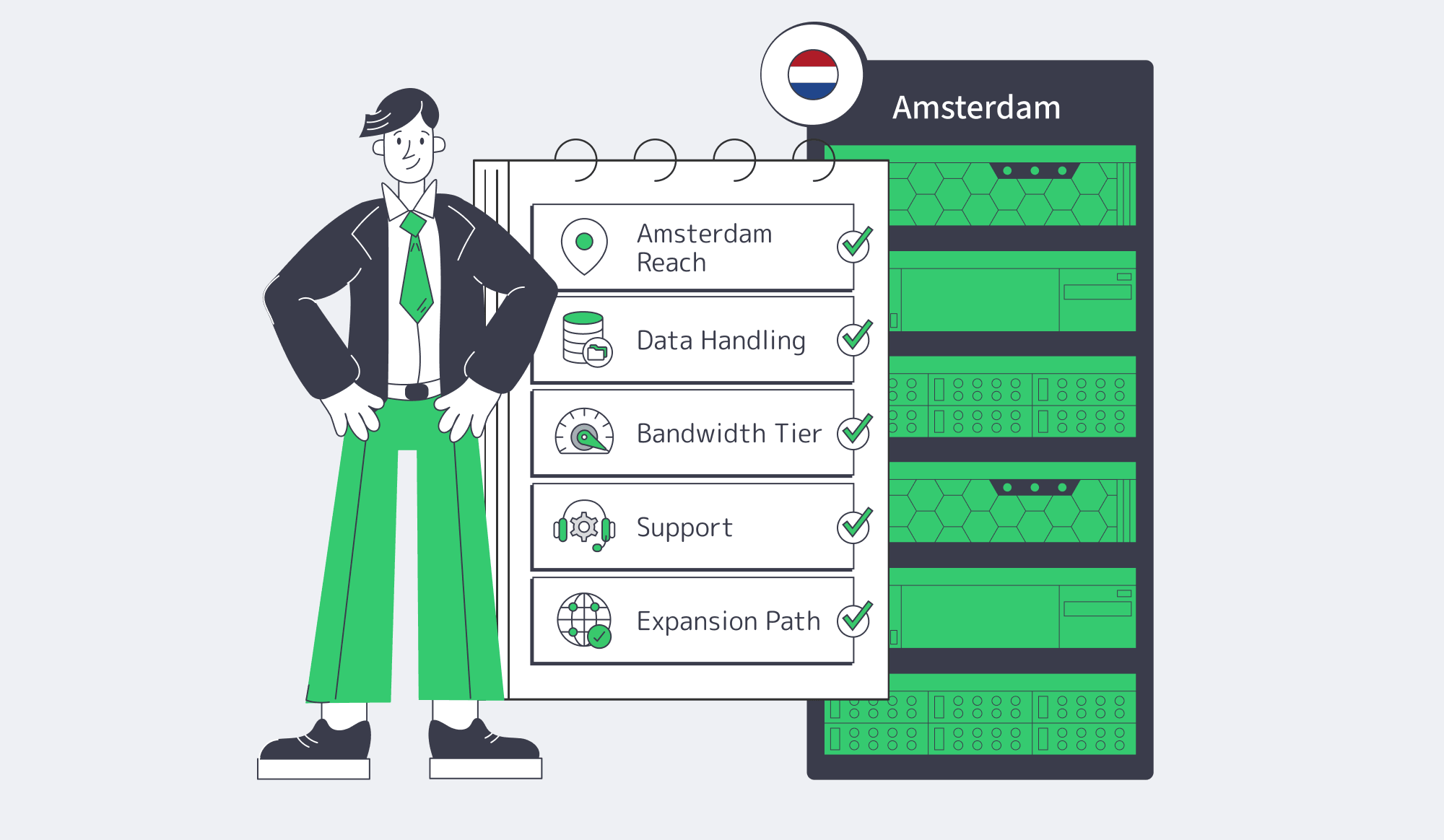
The best Netherlands server decision is the one that survives first contact with traffic, compliance, and growth. If a provider can prove Amsterdam reach, document data handling, offer the right bandwidth tier, answer operational questions at any hour, and extend into multi-region networking, the search term has done its job.
For buyers using “Holland dedicated server,” the move is simple: translate the phrase, then test the dedicated infrastructure. For teams that want Netherlands deployment with Amsterdam options, test endpoints, high-bandwidth tiers, 24/7 engineering coverage, and a route into broader network services, the next step should be infrastructure-specific, not terminology-specific.
Explore Netherlands Dedicated Servers
For a concrete Amsterdam starting point, Explore Netherlands dedicated servers: 250+ configurations in Amsterdam, Tier III and Tier IV facility options.