
Blog

High-Performance Servers for Crypto Exchanges and Trading Platforms
Milliseconds and credibility determine the life or death of cryptocurrency exchanges. Matching engines need to respond to events almost in real time, APIs must broadcast massive quantities of market data, and the system must withstand demand peaks while staying online. It is not just a best‑effort web workload; it is an ever‑running financial system. Here, the most reliable way to achieve low‑latency execution, sustained high throughput, and high uptime is to use high‑performance servers, which also provide the operational control required to meet emerging security and compliance demands.
The size of the market is the reason why the bar continues to go up. CoinGecko’s annual report shows that global crypto trading volume in 2023 was $36.6 trillion, a strong reminder that demand is not only huge but constant. And the expectations of performance resemble traditional finance. Industry guidance for digital‑asset venues focuses on microseconds‑to‑low‑milliseconds tick‑to‑trade tolerances (from price tick to order fill), and fairness demands tight dispersion around those figures.
Best Servers for Crypto Exchanges— 1,300+ ready-to-go servers — 21 global Tier IV & III data centers — 55+ PoP CDN across 6 continents |
 |
What Does Low‑Latency Really Mean for Crypto Trading?
Low latency isn’t a single number; it’s end‑to‑end from the user edge to the matching engine and back, with the distribution (p50/p95/p99) mattering as much as the mean. Two imperatives stand out:
Geographical distance and clean routing. The geography and the quality of paths dominate the round trip times. Placing exchange entry points and caching of non critical assets in the edge can reduce tens of milliseconds to distant users. As illustrated in the plot below: the spread of entry points and content has the benefit of decreasing slope and variance of RTT with distance.

Illustrative latency vs. distance for exchange users (non‑measured model).
Compute and network stacks with low jitter. Each microburst of garbage collection, each context switch from a noisy neighbor, and each network‑path buffer burst adds dispersion that traders perceive as slippage. Industry guidance for digital‑asset platforms addresses this fair‑access constraint: HFT paths run in microseconds, broader flows in single‑digit milliseconds, and variance matters as much as the mean.
Low‑latency trading servers. Fast CPU cores, local NVMe and predictable NIC interrupts on dedicated servers provide a consistent time-of-program execution, unlike a hypervisor. Melbicom’s regional placement, together with anycast or fast‑failover BGP, allows participants to keep users as close to ingress as possible while maintaining routing policy.
Real‑time market data feeds. Low latency entails line-rate fans-out as well. Web‑based market‑data services must send order‑book deltas to millions of sockets on demand. Headroom is sufficient even with volatility spikes with 10/25/40/100/200Gbps server ports and multi-provider transit with Tier III/IV sites. The CDN PoPs should primarily carry static UI assets, snapshots, and historical files to bring bytes closer to users and offload origins.
How Do Dedicated Servers Handle Surging Trading Volumes?
Cryptocurrency activity does not increase gradually, but it comes with a bang. Traffic bursts of 5× can occur when token listings, liquidations, or macro headlines hit. Coinbase recorded an event where traffic increased fivefold in four minutes—faster than autoscaling—so error rates spiked briefly, offered here not as a history lesson but as a warning data point. The response of the design is multi-layered:
Provision of the peak, rather than the average. Publicly stated capacities for matching engines at major venues are on the order of ~1.4 million orders per second—an ambitious but useful engineering goal. This is achievable with dedicated servers that let teams tune cores, frequency, RAM, and NVMe layout for the hot path, without multi‑tenant interference.
Scale horizontally under load. They include stateless gateways, partitioned order books as well as stateless replicated market-data publishers, which distribute loads among nodes. Servers provide the predictable per‑node ceiling; orchestration provides the elasticity.
Keep bandwidth slack. Computing is less challenging than egress. Melbicom helps ensure message storms don’t back up queues with per‑server ports up to 200 Gbps.
Exchange matching engine hosting. The engine benefits from high clocks and cache‑resident data structures, low‑latency NICs, and predictable storage‑flush paths; specialized tuning (interrupt coalescing, user‑space networking stacks, CPU pinning) is possible because dedicated servers avoid the variability of shared hypervisors—an advantage when managing microseconds end to end.
Ensuring 24/7 Uptime in an Always-On Market Environment

Crypto doesn’t close. Financial outages are costly in the millions of dollars per hour; an industry investigation of trading floor downtimes puts the number at about $9.33 million/hour, which highlights the importance of the platforms which earn per trade. There are 3 pillars of uptime discipline, namely:
- Facility resilience. Tier III/IV hosting where power/cooling is redundant and carrier type is not limited to a single carrier minimizes the risk of hardware or utility servicing interrupting the service. According to the listing provided in the Melbicom estate, Tier III/IV locations such as Amsterdam, Los Angeles, Singapore, Tokyo and so on are combined with on-site engineer to swap components.
- Duplications on functions and lack of points of failure. Active‑active load balancers, clustered gateways, hot‑standby matching engines, and geo‑redundant databases mean a single server failure is not noticeable to the user.
- Operational control. Such features as dedicated servers and 24/7 support allow continuing and running rolling upgrades, implementing kernel patches, and carrying out hardware upgrades without downtime.
Security & Compliance: What Defines a Secure Crypto Exchange Infrastructure?
Compliance is inseparable from performance and security posture. Single tenant servers are provided, which provide isolation, ownership of the OS/kernel, and controlled change, and this results in easier process of auditing and hardening:
Secure crypto exchange infrastructure. Dedicated servers avoid multi‑tenant hypervisors and enable strict host‑level controls: hardened baselines, minimized attack surface, hardware‑backed keystore/HSM policies, and full‑fidelity logging. BGP sessions (with BYOIP) enable stable addressing and anycast/fast‑failover ingress control, supporting deterministic routing and policy enforcement.
Finally, the certified processes and facilities facilitate compliance. Melbicom is audited against the ISO/IEC 27001:2013 standard, which governs an information security management system (ISMS). The foundation and the selection of the regions and data residency help the teams to document the controls to the regulators.
Architecture Patterns That Matter the Most

Modern architectures center on a plan that maximizes determinism and control.
Regional ingress + local bursts. Place gateways and partial services near users, while the authoritative matching engine runs in one or more core regions. UI and read‑heavy endpoints should be close to traders using Melbicom’s 21‑site footprint and 55+ CDN PoPs, while hot paths stay on tuned servers.
Data‑path separation. Individual market‑data publishers and internal risk engines are isolated so a burst in one plane does not choke another service.
Network‑level control. Use BGP‑based anycast and regional failover so source IPs remain stable during maintenance, and prefer short, reliable paths to common client geographies.
Challenges and how high‑performance dedicated servers answer them
| Exchange challenge | Impact if under‑engineered | Dedicated‑server answer |
|---|---|---|
| Uptime & maintenance | Lost fees and reputation; high-risk upgrade | Tier III/IV site, hot standby and rolling upgrades ensure trading remains online. |
| Low‑latency execution | Unfair dispersion, slippage, dissatisfied market makers | Regional placement, high clock CPU, deterministic single tenancy; small latency dispersion. |
| Security & compliance | High breach/audit risk | Single tenant isolation, OS-control and ISO/IEC 27001:2013 certification/basis. |
| Volume spikes & fan‑out | Queue surge, timeouts, crumbly data feeds | Horizontal clusters on predictable nodes; up to 200 Gbps per server of market‑data bursts; and fast capacity additions. |
What Capacity and Throughput Targets Should an Exchange Set?
The objectives are based on the product’s different combinations and the final users, but anything that can be consumed by a mass market is useful. Binance cites a matching‑engine ceiling of approximately 1.4 million orders per second, a useful target for optimizing the most critical paths. A pragmatic planning model:
- Size order intake for the peak number of concurrent sessions plus 20–40% headroom.
- Size matching so peak bursts clear with no tail buildup.
- Size market‑data egress for worst‑case deltas, not averages.
- Provision storage for write spikes and fast‑recovery snapshots.
Melbicom can add capacity quickly with 1,300+ ready configurations and ~2‑hour activation windows, allowing teams to provision for the spike rather than the average.
A Practical Deployment Checklist
- Pin your latency budget. The p50/p95/p99 change targets that would be used in order entry, matching and publication of market‑data. Bring users close to exchange entry points via regional ingress.
- Right‑size the engine. Faster clock CPU, cache books and local NVMe, preferable in case of logs/ snapshots in single tenant nodes.
- Design for the surge. Pre‑warm extra gateways and publishers for storm conditions, and size egress for those peaks. Target capacity above the mean.
- Separate planes. Separate order entry, matching, market‑data, and admin networks; no planes are shared.
- Engineer for failure. Use active‑active load balancers, hot‑standby engines, rack‑ and region‑level replication, and tested cutovers.
- Control your routes. The BGP session (BYOIP may need to be used) should utilize stable endpoint routes and anycast and use fast routing.
- Prove compliance. Obtain a mapping of controls to ISO/IEC immense stretches of 27001:2013 ISMS and have proof at a fresh place.
Conclusion: Dedicated Servers are the Backbone of Trustworthy Crypto Trading
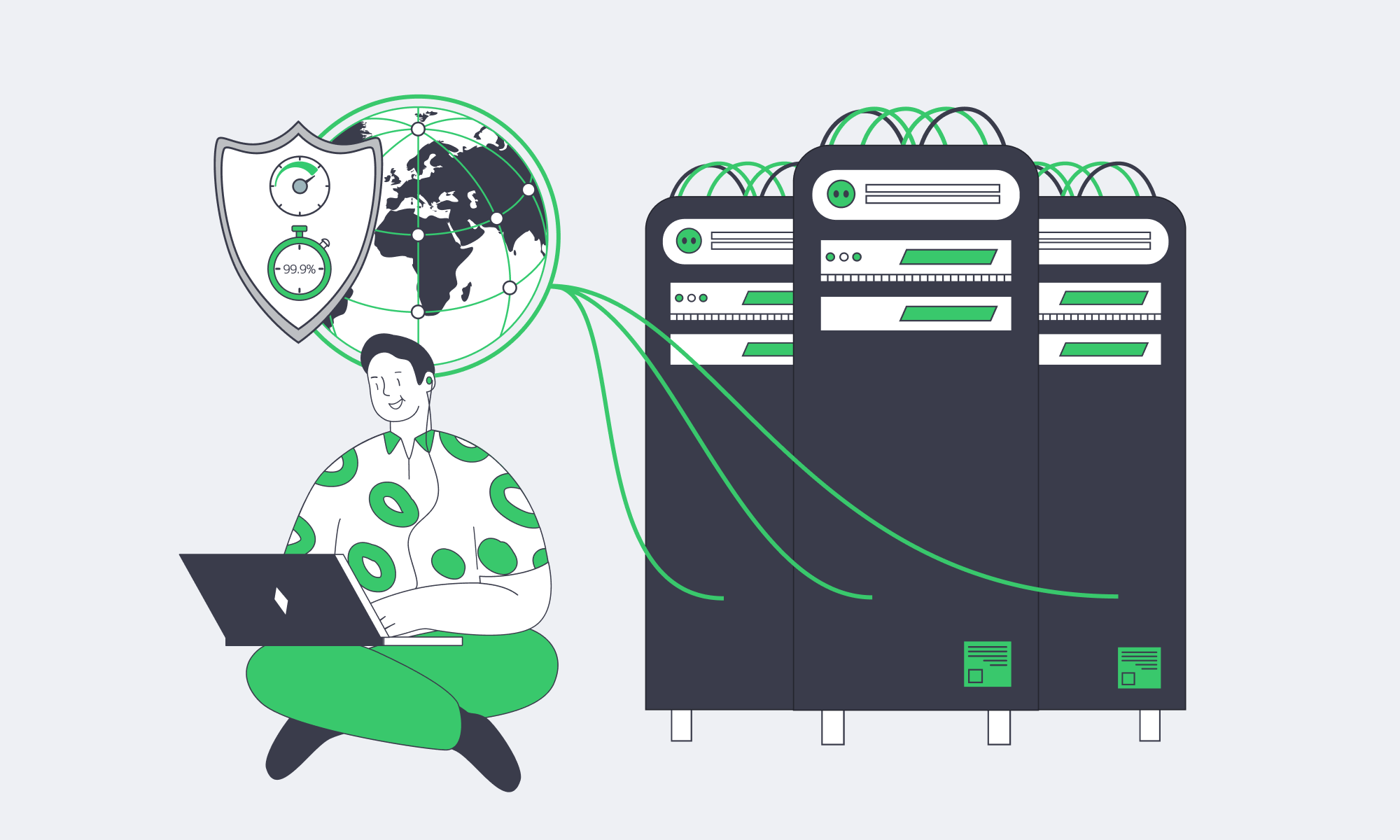
Exchanges compete on speed, reliability, and stability. It demands infrastructure with low‑jitter latency, high sustained throughput, and measured resilience—not just in normal periods but in the exact minutes when markets are most volatile. The data justifies the investment: the size of the crypto volumes, the assumption that the execution routes will take only microseconds, the real price of the downtime, etc., all indicate the single-tenant level of performance and the control of the network on the network level.
Dedicated servers, acting upon a globally dispersed, professionally operated platform, fulfill those needs and create architectural freedom: decide regions, actualize hardware to workloads, push content to the edge, and have your routes. Thus, day in, day out, trading venues keep books fair, UIs responsive, and reputations intact.
Build a low‑latency crypto exchange
Provision tuned, single‑tenant hardware in key regions to cut jitter, handle volume spikes, and meet uptime targets for your trading platform.