
Blog

GPU-Optimized Servers for ZK Proofs & Web3 Research
Zero-knowledge proofs (ZKPs) have moved from “clever crypto demo” to production infrastructure: ZK-rollups, privacy-preserving DeFi, ZK-based identity, and data-availability schemes all rely on generating proofs at scale. That’s a specific hardware problem: parallel compute, huge memory bandwidth, and a predictable environment.
Recent work on GPU-accelerated ZKP libraries shows proof generation speed-ups ranging from roughly 1.2× to over 8× (124%–713% faster) versus CPU-only runs for practical circuits. GPU-centric studies find that well-tuned GPU implementations can drive up to ~200× latency reductions in core proving kernels compared to CPU baselines. And production deployments of CUDA-based ZK libraries report roughly 4× overall speed-ups for real-world Circom proof generation.
Those gains only turn into real-world value when the GPUs sit inside dedicated, well-balanced servers: high-core-count CPUs to orchestrate the pipeline, ample RAM to keep massive cryptographic objects in memory, NVMe storage for chain data and proving keys, and strong networking to move proofs and state quickly.
Choose Melbicom— 1,300+ ready-to-go servers — 21 global Tier IV & III data centers — 55+ PoP CDN across 6 continents |
 |
This is where Melbicom’s GPU-powered dedicated servers come in. We at Melbicom run single-tenant machines in 21 Tier III+ data centers across Europe, the Americas, Asia, and Africa. For ZK proofs, that combination of GPU density, memory, and predictable network paths is what turns “interesting benchmarks” into production-ready proving infrastructure.
What GPU Configuration Optimizes Zero-Knowledge Proof Performance
The optimal GPU setup for zero-knowledge proof generation combines massive parallelism, high memory bandwidth, and large VRAM capacity. For zk proofs, that means modern NVIDIA GPUs (24–80 GB) in dedicated servers, paired with fast host memory and I/O so the GPU can continuously process MSMs, FFT/NTT steps, and proving keys without stalling.
Most of the heavy lifting in ZK proofs comes from multi-scalar multiplication (MSM) and Number-Theoretic Transform (NTT) kernels. Studies of modern SNARK/STARK stacks show these two primitives can account for >90% of prover runtime, which is why GPU implementations dominate end-to-end performance.
A good GPU layout for ZK proofs focuses on:
- Core count and integer throughput. For large circuits, you want tens of thousands of CUDA cores working in parallel. An RTX 4090, for example, exposes 16,384 CUDA cores and pushes up to 1,008 GB/s of GDDR6X bandwidth.
- VRAM capacity. Real-world ZK benchmarks show curves and circuits that can consume 20–27 GB of VRAM during proof generation. That immediately rules out older 6–8 GB cards for bigger circuits or recursive proofs; 24 GB is a practical minimum, and 48–80 GB becomes essential for very large proving keys or deep recursion.
- Memory bandwidth. Data-center GPUs like NVIDIA A100 80 GB ship with HBM2e and deliver on the order of 2 TB/s memory bandwidth, making them ideal for MSM/NTT-heavy workloads that are fundamentally bandwidth bound.
Topology matters as well. ZK stacks today are usually optimized for one GPU per proof, not multi-GPU sharding of a single circuit. That means:
- One GPU per box works well for single, heavy proofs (zkEVM traces, recursive rollups).
- Multiple GPUs per server are ideal when you want to run many independent proofs concurrently – batched rollup proofs, per-wallet proofs, or proof markets.
We at Melbicom see most advanced teams standardizing on 1–2 high-end GPUs per server, then scaling out horizontally across many dedicated machines instead of fighting the complexity of multi-GPU kernels before the prover stack is ready.
Which Server Specifications Support Large-Scale ZK Computations
A ZK prover node is effectively a specialized HPC box: it streams huge matrices and vectors through heavy algebra kernels under strict latency or throughput requirements. To keep the GPUs saturated, the server around them needs balanced, predictable, stable performance.
The ideal ZK-focused server is built around three pillars: high-core-count CPUs, large RAM pools, and fast storage/networking. The goal is simple: never let the GPU wait on the CPU, memory, or disk—especially when proving windows or test campaigns are time-bound.
ZK Prover Server Baseline
Here’s a concise baseline for ZK proof and ZK-proof blockchain workloads:
| Component | Role in ZK / Blockchain Workloads | Recommended Specs for Heavy ZK Proofs |
|---|---|---|
| GPU | Runs MSM/NTT and other parallel cryptographic kernels; holds proving keys & witnesses | Latest-gen NVIDIA GPU with 24–80 GB VRAM and high bandwidth (e.g., RTX 4090 / A‑class), 1–2+ GPUs per server depending on parallelism needs |
| CPU | Orchestrates proving pipeline, node logic, preprocessing, I/O | Modern 32–64‑core AMD EPYC / Intel Xeon, strong single-thread performance, large cache |
| RAM | Stores constraint systems, witnesses, proving keys, node data | 128 GB+ DDR4/DDR5, with 256 GB recommended for large circuits or multiple concurrent provers |
| Storage | Holds chain data, proving keys, artifacts, logs | NVMe SSDs for high IOPS and low latency; multi‑TB if you keep full history or large datasets |
| Network | Syncs blockchain state, exchanges proofs, connects distributed components | Dedicated 10–200 Gbps port, unmetered where possible, with low-latency routing and BGP options |
CPU and RAM: Feeding the GPU
Even with aggressive GPU offload, the CPU still:
- Builds witnesses and constraint systems
- Schedules batches and manages queues
- Runs node clients, indexers, or research frameworks
- Handles serialization, networking, and orchestration
A low-core CPU turns into a bottleneck as soon as you run multiple concurrent provers or combine node operation with research workloads. Moving to 32–64 cores allows CPU-heavy stages to overlap with GPU kernels and keeps accelerators busy instead of stalled.
RAM is the other hard constraint. Proving keys, witnesses, and intermediate vectors for complex circuits can easily consume tens of gigabytes per pipeline. Once the OS starts swapping, your effective speed-up vanishes. That’s why ZK-focused machines should treat 128 GB as the floor and 256 GB as a comfortable baseline for intensive zk proofs and ZK-proof blockchain experiments.
We at Melbicom provision GPU servers with ample RAM headroom and current-generation EPYC/Xeon CPUs so research teams can keep entire circuits, proving keys, and node datasets resident in memory while running multiple provers side by side.
Storage and Networking: Moving Proofs and State
For ZK-heavy Web3 stacks, disk and network throughput are first-class design parameters:
- Storage: NVMe SSDs cut latency for accessing chain state, large proving keys, and data-availability blobs. This matters when you repeatedly regenerate proofs, replay chain segments, or run ZK proofs crypto experiments across big datasets.
- Networking: Proof artifacts (especially STARKs) can be tens of megabytes. Rollup sequencers, DA layers, and validators all stream data continuously. Without sufficient bandwidth, proof publication and state sync become the new bottleneck.
Melbicom runs its servers on a 14+ Tbps backbone with 20+ transit providers and 25+ IXPs, exposing unmetered, guaranteed bandwidth on ports up to 200 Gbps per server. Because these are single-tenant bare-metal servers in Tier III/IV facilities, Melbicom’s environment avoids hypervisor noise and noisy neighbors. That determinism is particularly important when you’re trying to reproduce ZKP research results or hit on-chain proving SLAs reliably.
How to Select GPUs for Blockchain Research Workloads

The right GPU for blockchain and ZK research balances compute density, memory capacity, and total cost of ownership. For many ZK workloads, modern NVIDIA GPUs with 24–80 GB VRAM strike the best trade-off, with enterprise GPUs favored for the highest-capacity proofs and prosumer GPUs used where cost efficiency and flexibility matter more than capacity.
In broad strokes:
- For very large circuits, deep recursion, or rollup-scale proofs in production, A‑class data‑center GPUs (such as A100 80 GB) are ideal. They combine 80 GB of high-bandwidth memory and >2 TB/s bandwidth, making them suitable for massive proving keys and wide NTTs.
- For lab clusters and mid-scale prover fleets where proofs fit in ~24 GB, RTX 4090-class GPUs are compelling. A single 4090 offers 24 GB of GDDR6X with ~1,008 GB/s bandwidth and 16,384 CUDA cores, providing excellent throughput at a far lower unit cost than data-center cards.
Economically, this often leads to a two-tier model:
- Development and research fleets built on 24 GB GPUs (e.g., for protocol experiments, circuit iteration, or testnets).
- Production prover clusters that add A‑class GPUs where circuits or recursion depth demand larger memory footprints or higher concurrency.
GPU-accelerated libraries like ICICLE, which underpin production provers, have already shown multi‑× speed-ups at the application level: one case study reports 8–10× speed-up for MSM, 3–5× for NTT, and about 4× overall speed improvement in Circom proof generation after integrating ICICLE. That kind of uplift is what makes it practical to move more proving work off-chain or into recursive layers.
Parallelism strategy also shapes the hardware plan. Because most proving systems today are optimized for one GPU per proof, it’s usually easier to:
- Run multiple independent proofs per server (one per GPU), or
- Scale out across many GPU servers, rather than complex multi-GPU sharding inside a single proof.
We at Melbicom keep dozens of GPU-powered server configurations ready to go—ranging from single‑GPU boxes to multi‑GPU workhorses—and can assemble custom CPU/GPU/RAM/storage combinations in 3–5 business days for more specialized ZK and blockchain research workloads.
Key Infrastructure Takeaways for ZK Proofs

For teams designing serious ZK-proof and ZK proof blockchain infrastructure, a few practical takeaways consistently show up in the field:
- Standardize GPUs as the default proving backend. MSM and NTT dominate proving time and map naturally to thousands of GPU threads; recent work shows GPU-accelerated ZKPs reaching up to ~200× speed-ups over CPU baselines on core kernels.
- Over-provision RAM relative to your largest circuits. Assume per-pipeline working sets in the tens of gigabytes; plan for 128 GB minimum and 256 GB+ on nodes running concurrent provers, to avoid swapping + subtle failures in long-running proof workloads.
- Design networking as part of the proving system. High-throughput links (10–200 Gbps) with good peering are essential when proofs, blobs, and chain state move between sequencers, DA layers, and storage. Melbicom’s 14+ Tbps backbone with strong peering and BGP support is built to keep those paths short and predictable.
- Prefer dedicated, globally distributed infrastructure. Single-tenant GPU servers in Tier III+ sites give deterministic performance and stronger isolation than shared cloud. Combining those with a well distributed CDN lets you pin ZK frontends, proof downloads, and snapshots close to users while keeping origin traffic on-net.
These aren’t abstract “nice-to-haves” – they’re the baseline for hitting proving windows, reproducing research results, and operating complex ZK systems under production load.
Building ZK-Proof Infrastructure on Dedicated GPU Servers
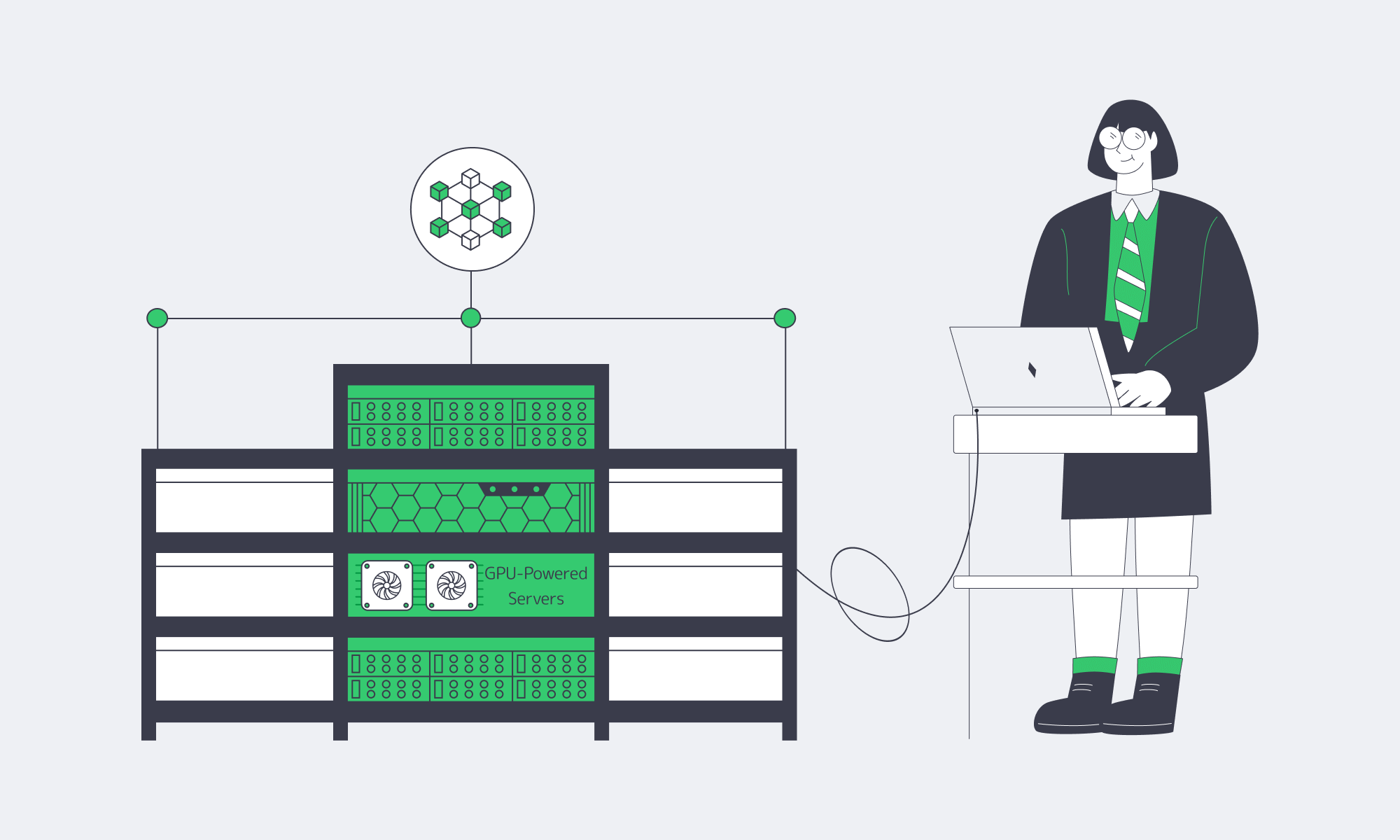
Zero-knowledge proofs may be “just math,” but turning that math into scalable Web3 infrastructure is an engineering exercise in compute, memory, and networking. Dedicated GPU servers are the practical way to get there: they expose raw accelerator performance, enough RAM to keep large cryptographic structures in memory, and the predictable network capacity required to move data and proofs on time.
AsZK systems evolve—ZK-rollups moving more logic off L1, ZK VMs becoming more sophisticated, and more protocols adopting ZK techniques for privacy and scalability—the hardware bar will only rise. Teams that treat GPU-optimized servers as first-class infra today will be better positioned to run fast provers, adapt to new proving systems, and maintain a tight feedback loop between research and production deployments.
Deploy GPU ZK Servers Today
Spin up dedicated GPU servers in 21 Tier III+ locations with unmetered 10–200 Gbps ports. Fast activation for in‑stock hardware and custom builds in 3–5 days to power your ZK proving and blockchain research.