
Blog
Germany’s Servers Blend Savings With Low Latency
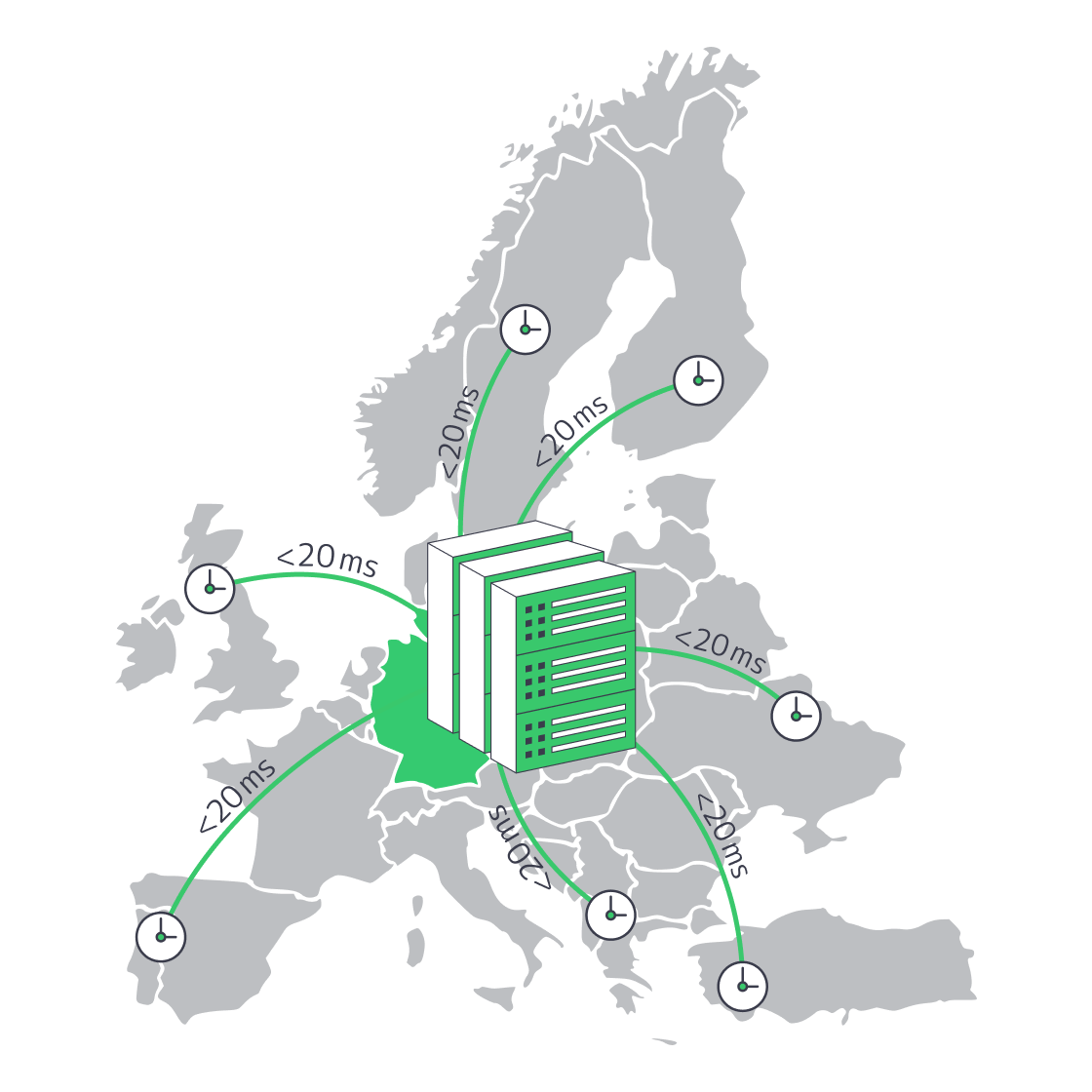
The German hosting sector has grown into a strong default for startups that need enterprise-level performance without premium-hub spending. Frankfurt is the ecosystem’s center of gravity: it hosts DE-CIX, one of the world’s largest internet exchanges, and sits among Tier III data centers that keep typical round-trip times to many major Western and Central European cities below about 20 ms. Intense competition, current multi-core hardware, and burstable bandwidth options make the buying decision less about sacrificing performance and more about reducing total cost of ownership while preserving speed, resilience, and scale.
Choose Melbicom— 250+ ready-to-go server configs — Tier III-certified DC in Frankfurt — 55+ CDN sites in 39 countries |
 |
How Do German Dedicated Servers Compare in Price and Performance?
German dedicated servers can pair low monthly pricing with strong EU performance when the server sits in Frankfurt: current Melbicom Frankfurt configurations start at €112/month, scale from 1 to 200 Gbps per server, and use nearby DE-CIX peering to keep major Western and Central European round trips in the low double digits.
Server pricing in Germany is still shaped by supply and demand. Frankfurt alone has around 745 MW of data-center capacity, second in Europe only to London, with a 7 percent vacancy rate among FLAP-D markets that keeps the market highly competitive.[1] For buyers, the useful comparison is not only headline price, but the mix of monthly cost, dedicated hardware, port speed, and proximity to dense peering.
Competition shows up on invoice line items; Melbicom’s current Frankfurt inventory supports the following range:
| Current Frankfurt Option | Supported Range | Why It Matters |
|---|---|---|
| Ready-to-go configurations | 250+ | Broad inventory without custom-build delay |
| CPU and memory range | Intel and AMD CPUs; 16–768 GB RAM | Covers entry services through dense application workloads |
| Network capacity | 1–200 Gbps per server | Allows low-latency deployments to scale bandwidth as traffic grows |
| Advertised price range | €112–€6,202/month | Keeps budget and high-capacity configurations in the same Frankfurt region |
Where 95th-percentile billing is available, it can be a second cost lever. The method drops the highest 5 percent of five-minute traffic samples, so short bursts can be absorbed without sizing the whole month around a launch spike or news-driven traffic surge.[2] It does not make bandwidth free, but it can reduce overbuying when traffic is bursty rather than continuously saturated.
The hardware range is also broad enough for current capacity planning: Frankfurt options span Intel and AMD CPUs, 16–768 GB RAM, and 1–200 Gbps network capacity per server. Single-core legacy boxes are not a serious 2026 baseline.
Energy-Efficient Tier III Facilities Cut Opex
TCO includes hardware outlay, bandwidth, and power. Under the current German Energy Efficiency Act framework, data centers that begin operations on or after July 1, 2026, must achieve PUE ≤ 1.2, while sites that began earlier must reach PUE ≤ 1.5 from July 2027 and ≤ 1.3 from July 2030.[3] A 2026 draft amendment proposes relaxing those PUE thresholds for new and existing facilities, so procurement teams should confirm the final EnEfG language during contract review.[4] Either way, cooling, power-train overhead, and waste-heat planning are becoming procurement issues, not just facilities-team concerns.
How Does Frankfurt DE-CIX Peering Reduce Latency Across Europe?
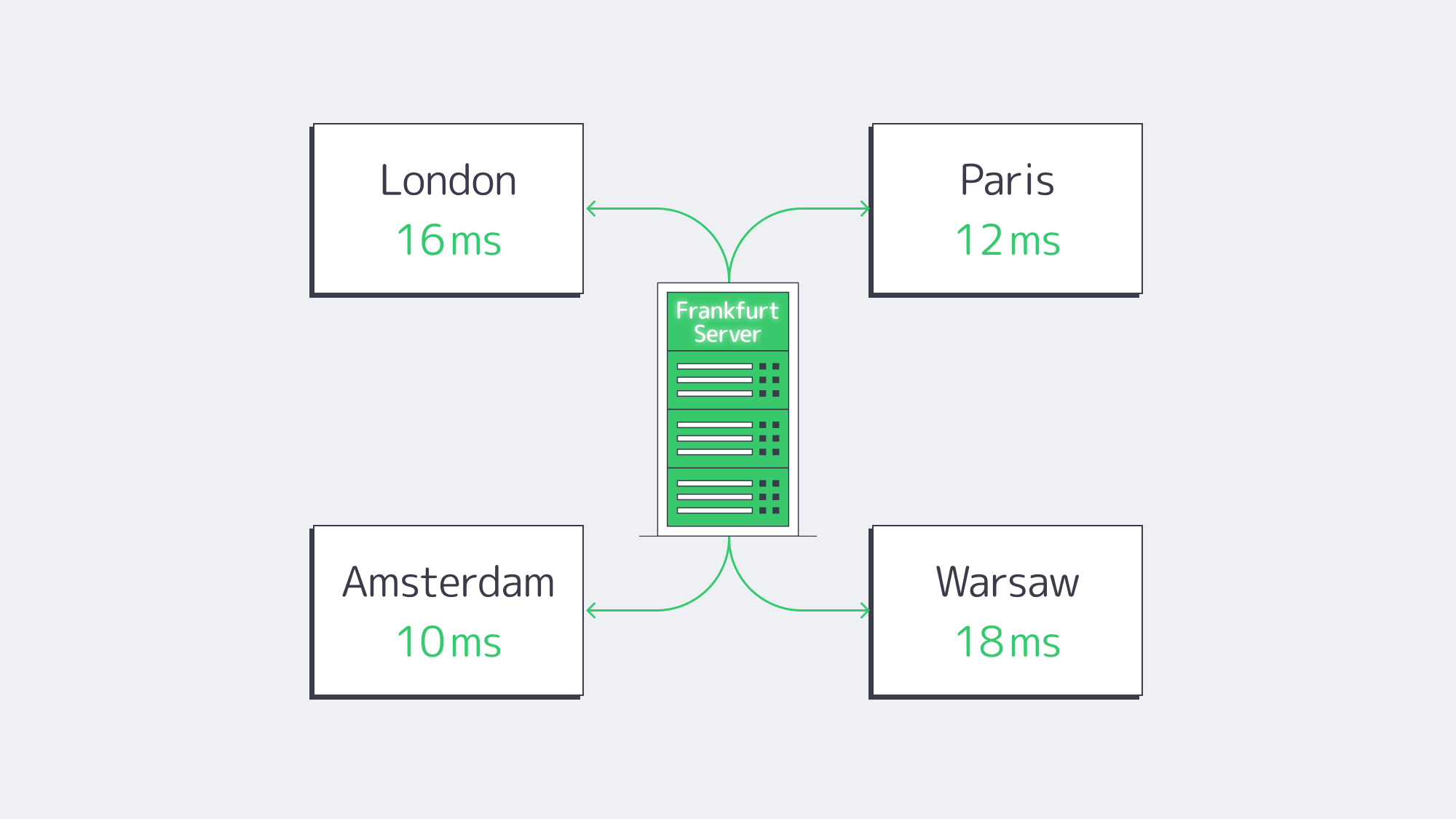
Frankfurt moves packets like no other European city. In 2025, DE-CIX Frankfurt handled 48 EB of traffic, up 6 percent from 2024, and set a new all-time peak of 18.73 Tbit/s on 9 December 2025.[5] The exchange gives customers reach to more than 1,000 local, regional, and global networks, reducing backtracking and keeping many European routes on short, direct paths.[6] Geography helps too: Frankfurt is close to London, Paris, Amsterdam, and Warsaw, keeping fiber miles modest.
Typical round-trip times (RTT):
| City | RTT (ms) | Source |
|---|---|---|
| London | 16.5 | wondernetwork.com |
| Paris | 12.0 | wondernetwork.com |
| Amsterdam | 9–11 | DE-CIX Looking-Glass |
Why Sub-20 ms Latency Matters for Users and APIs
Sub-20 ms RTT matters because each page view or API call often chains several network round trips. Keeping the server close to London, Paris, Amsterdam, and Warsaw gives application teams more of the response-time budget for TLS, database work, and business logic instead of spending it on fiber distance.
Which Industries See Revenue Gains from Lower Latency in Germany?
SaaS: Milliseconds Guard MRR
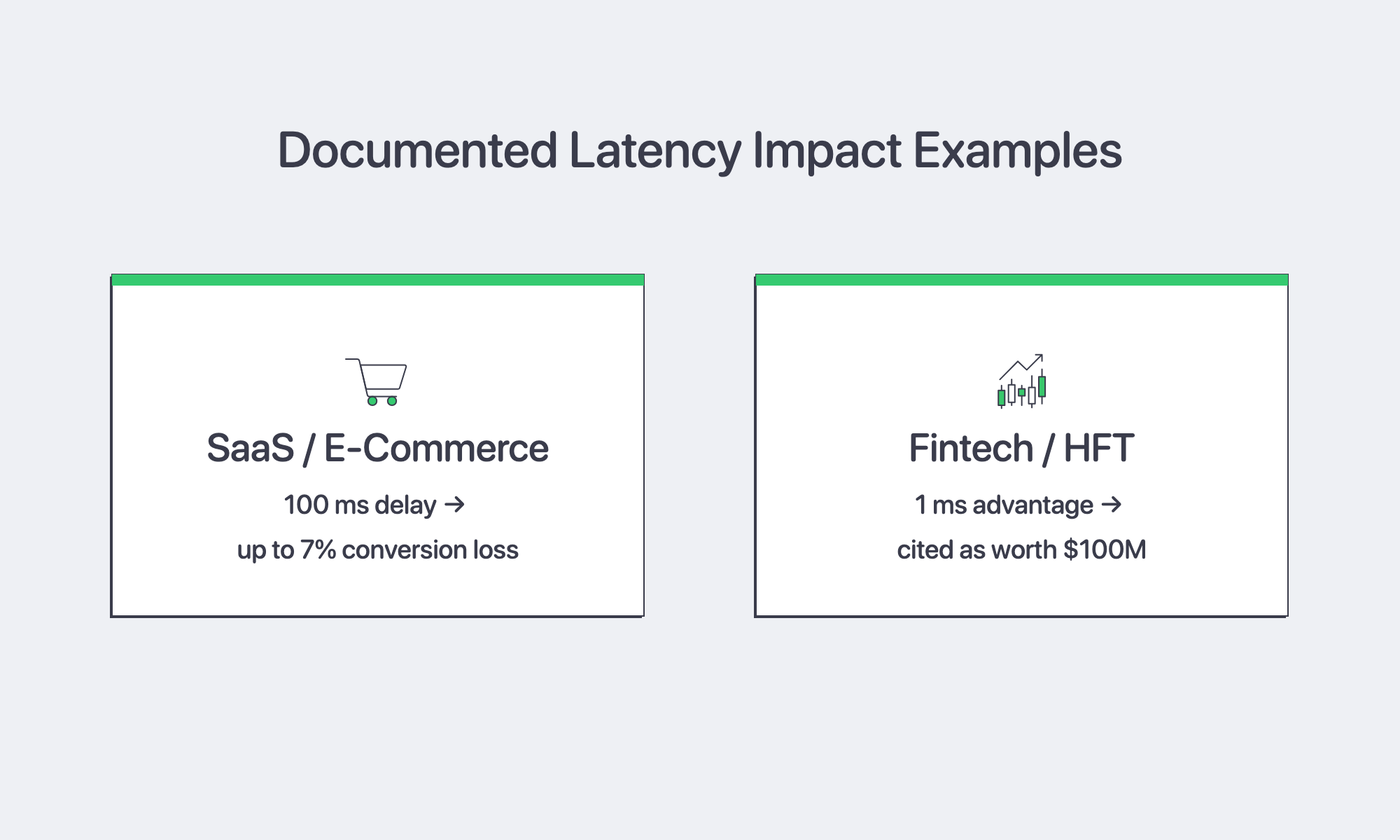
An AWS Partner Network summary of Amazon and Akamai performance research reports that an additional 100 ms of latency cost Amazon 1 percent of sales and could hurt conversion rates by as much as 7 percent in Akamai’s study.[7] For a SaaS company with €10 million in ARR, even small latency increases can turn into meaningful conversion or retention risk. Anchoring the application in Frankfurt keeps UI round trips across much of Western and Central Europe in the teens, leaving only small latency differences for interactive workflows.
Fintech & HFT: Milliseconds Mean Millions
Trading desks measure latency in monetary terms, and research on high-frequency trading notes that a one-millisecond advantage has been cited as worth $100 million to a major brokerage firm.[8] Physical proximity still matters: Deutsche Börse’s 2026 network access guide describes 10 Gbit/s dedicated cross-connects in Frankfurt co-location for latency-sensitive T7 applications.[9] Shorter round-trips between acquirer, issuer, and fraud-scoring engines can also reduce card-authorization times, lowering cart abandonment risk.
What Sets Our Frankfurt Servers Apart?
At Melbicom, the Frankfurt offer turns that regional advantage into deployable bare metal without procurement drag. The current Frankfurt inventory includes 250+ ready-to-go configurations, with Intel and AMD CPU options, 16–768 GB RAM, and network capacity from 1 to 200 Gbps per server. Ready-to-go servers can be activated within 2 hours; custom configurations are delivered in 3–5 business days. Teams can scale west to Amsterdam or east to Warsaw on the same network footprint, backed by 24/7 support.
Why Germany Is a Low-Latency, Cost-Efficient Choice for Dedicated Servers
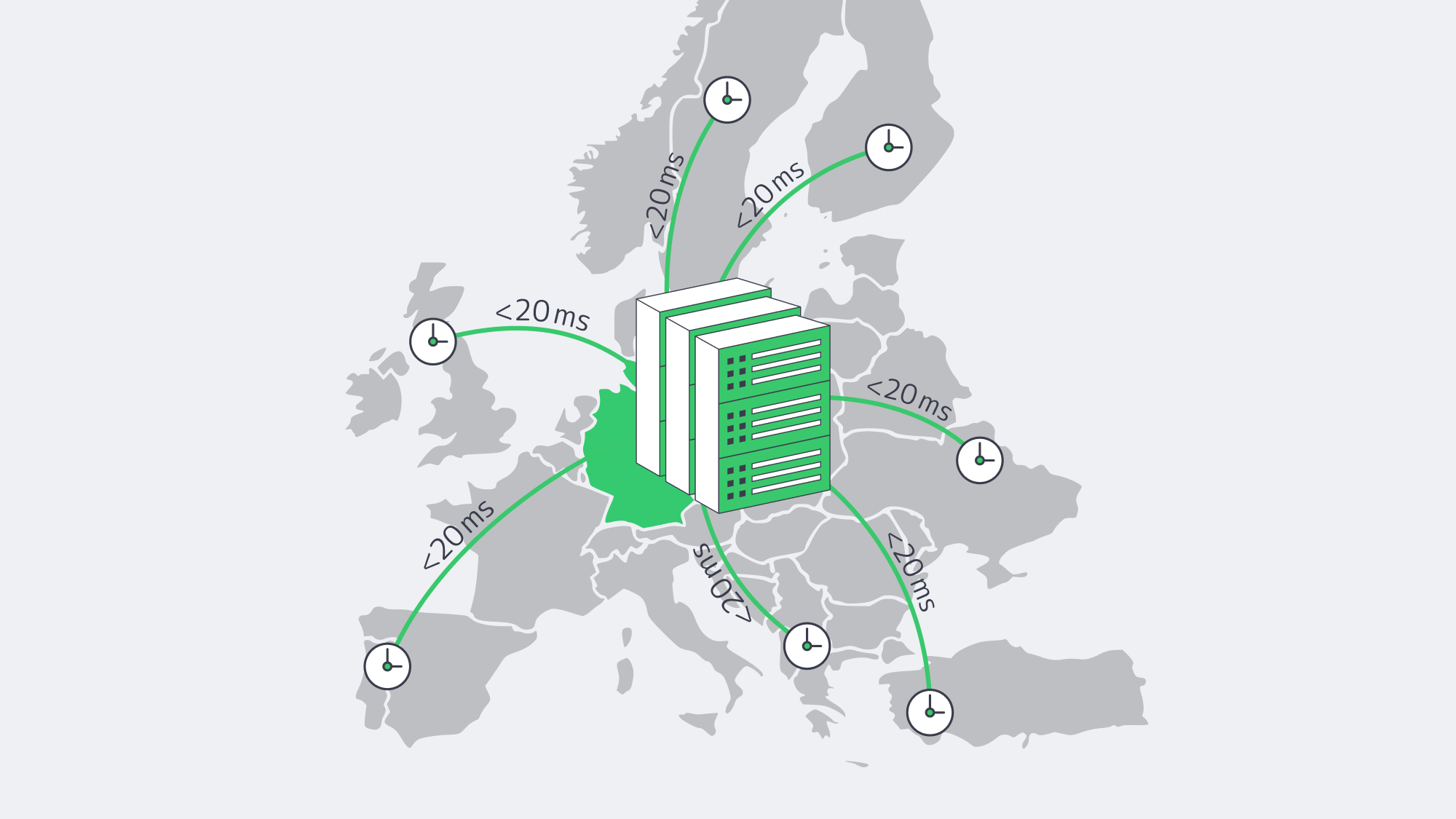
Architects used to frame infrastructure as a trade-off: lower-cost servers in second-tier markets or high performance in premium hubs such as London. Frankfurt changed that equation. Deep data-center capacity and the gravitational effect of DE-CIX put price and performance closer together than is typical in infrastructure economics. When an application can reach major Western and Central European population centers in about 20 ms or less while keeping server costs predictable, Germany becomes a practical default rather than a compromise.
Germany dedicated servers should be treated as a starting point for budget- and user-experience-driven startups. Tier III energy-efficient data centers, tighter efficiency rules, nearby peering, and burstable bandwidth options help keep latency low and cost planning manageable. Whether the workload is a latency-sensitive trading cache or a multi-tenant SaaS application, Germany dedicated hosting can deliver without blowing the budget.
Deploy in Germany Today
Launch high-performance dedicated servers in our Tier III Frankfurt facility within 2 hours—high bandwidth options, low latency, and 24/7 support.