
Blog

German Dedicated Server: How to Choose Sovereign EU Bare Metal Without Lock-In
A German rack is not sovereignty by itself—Frankfurt may simplify data residency and Central European routing, but it does not reveal who administers the server, where support data travels, how prices change, or whether the workload can move.
The European Commission’s October 2025 Cloud Sovereignty Framework evaluates legal, operational, supply-chain, technology, security, and compliance controls. For bare metal, the real question is whether the buyer can verify control, predict the bill, measure performance, and leave.
German Servers– 200+ Frankfurt configurations – Tier III & IV DCs in Frankfurt – Up to 200 Gbps per server |
 |
Sovereignty for a German Dedicated Server
A sovereign German dedicated server should give the buyer documented control over jurisdictional exposure, administrative access, technical architecture, and exit. German location is one relevant fact, not the whole answer. The workload should remain reproducible on standards-based infrastructure without proprietary tooling or undocumented support practices.
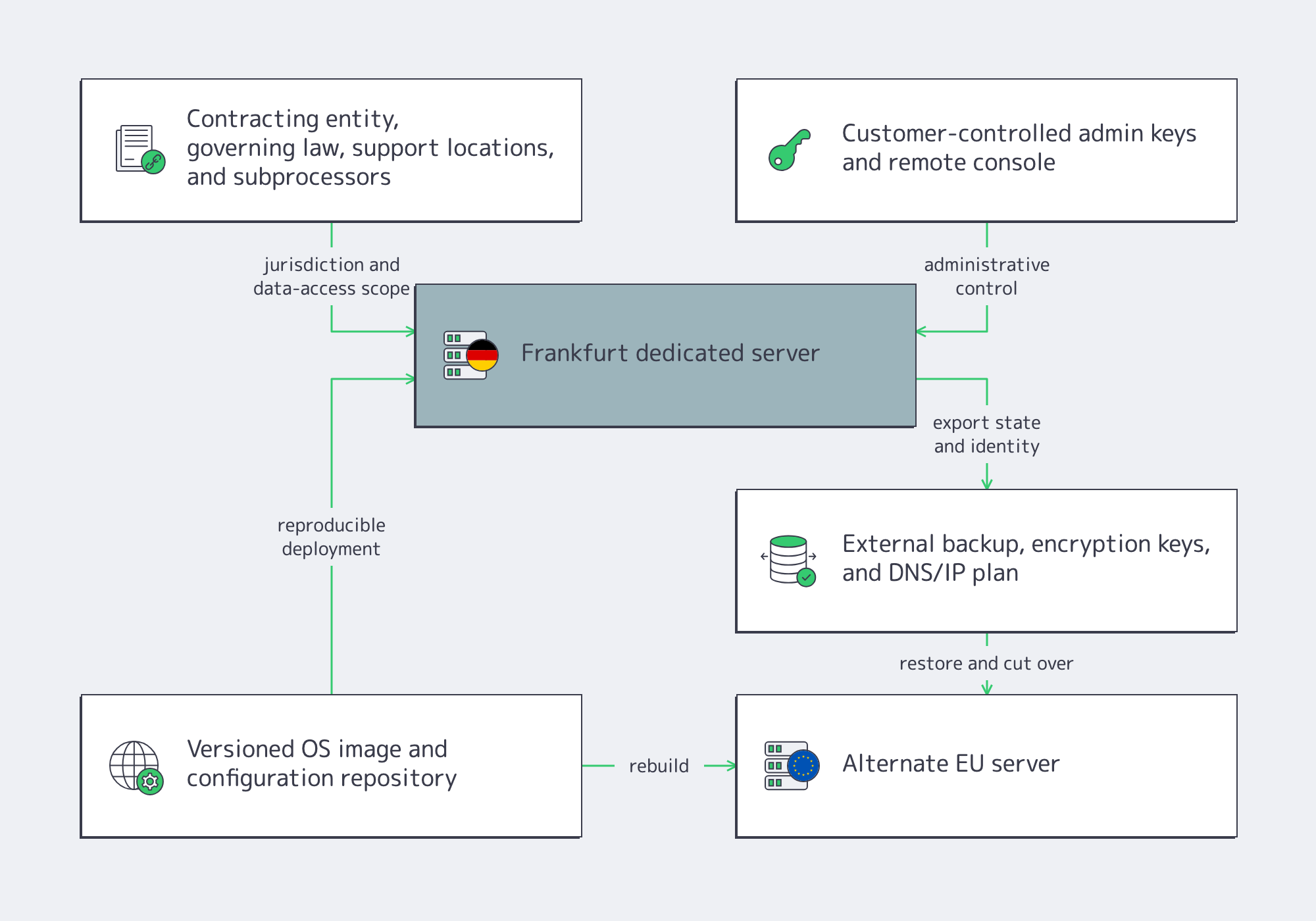
Start with entities, not coordinates: identify the contracting company, data-center operator, support locations, subprocessors, governing law, and every jurisdiction touching customer or diagnostic data. Map production data, backups, monitoring, authentication logs, support attachments, and console metadata.
Operational control means customer engineers can reinstall the OS, restore data, rotate credentials, update routing, and recover monitoring from customer-owned artifacts. Technology control favors standard operating systems, documented automation, independent DNS, and portable VM or container formats. Supply-chain control requires named components, substitution rules, and a replacement path.
Where German Dedicated Server Buyers Face Lock-In and Cost Risk
Lock-in is highest when deployment automation, backups, addressing, or commercial terms cannot travel with the workload. A useful acceptance test is restoring a production-sized dataset and starting a canary service elsewhere within 24 hours, using customer-controlled artifacts and documented fees rather than a proprietary control plane or an engineer’s memory.
Technical lock-in starts with undocumented builds and configuration drift. Data lock-in appears when backups cannot be restored independently or keys remain provider-controlled. Operational lock-in hides in monitoring, secrets, access lists, and recovery procedures trapped in a provider portal.
Network lock-in is expensive because provider-assigned addresses spread into firewall rules, partner allowlists, certificates, webhook destinations, and documentation. RFC 5887 explains why IPv4 and IPv6 renumbering remains difficult. DNS helps only when applications use names consistently and TTLs are lowered before cutover.
Customer-controlled address space and BGP can reduce renumbering exposure but add registry, filtering, monitoring, and routing work. Melbicom offers BGP Session as a separate service. For Frankfurt deployments, confirm address arrangements, routing policy, and operational responsibilities before ordering.
Commercial flexibility is separate. Verify contract duration, cancellation, renewal, traffic commitments, address charges, setup fees, price-change rights, and overlap costs. Short commitments reduce contractual exposure, not migration work.
The EU Data Act, applicable since September 12, 2025, offers a benchmark for covered data-processing services. It generally limits transition periods to 30 days, caps initiation notice at two months, preserves at least 30 days for retrieval, and prohibits switching charges from January 12, 2027. Scope depends on the service.
Price shocks need an exit model. A 12% increase on a €1,000 monthly deployment adds €1,440 annually. Model 10%, 20%, and 30% increases, then add migration labor and one or two months of parallel infrastructure.
Germany vs. Netherlands Bare-Metal Hosting
Germany is usually stronger when German users, domestic processing requirements, or Frankfurt-centered partners dominate; the Netherlands can provide better westbound paths and geographic diversity. Decide with at least seven days of identical testing, comparing p95 latency, route changes, sustained throughput, and peak-window packet loss, with a provisional loss gate below 0.1%.
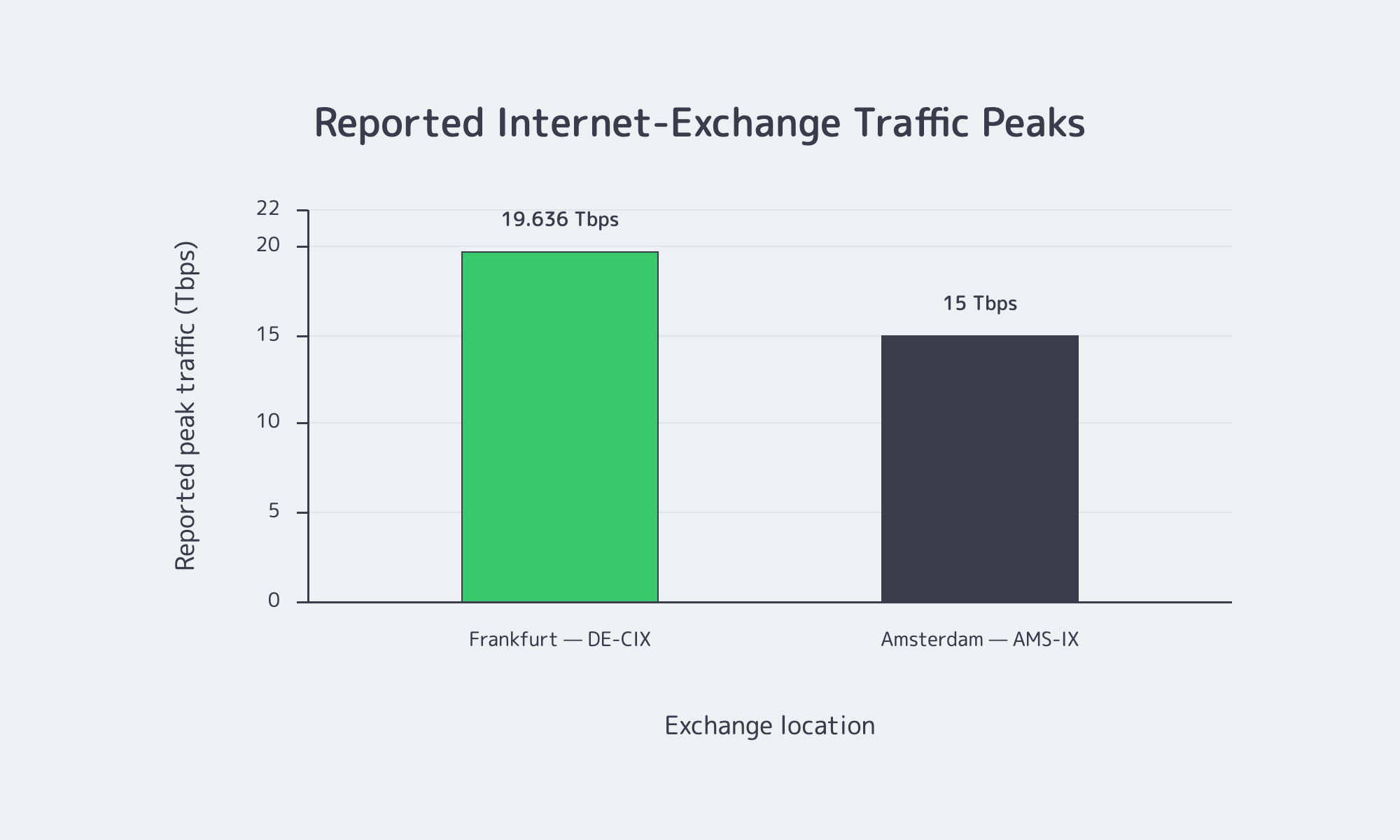
Exchange scale is context, not application evidence. DE-CIX reported a Frankfurt peak of 19.636 Tbps and access to more than 1,000 networks in July 2026. AMS-IX reported a 15 Tbps peak in April 2026, plus 35.66 exabytes and 902 connected networks in 2025. Neither guarantees the best route.
| Decision factor | Germany and Frankfurt signal | Netherlands and Amsterdam signal |
|---|---|---|
| Primary users | Strong for Germany and Central Europe | Strong for the Netherlands and westbound Europe |
| Compliance scope | Can satisfy German-location policies after transfer checks | EU and GDPR jurisdiction, but not Germany-specific residency |
| Interconnection | Large exchange and carrier ecosystem | Major international exchange ecosystem |
| Resilience role | Natural Germany-centered primary | Useful recovery or second-production location |
| Acceptance test | Seven days from representative networks | Same build, payloads, window, and telemetry |
Measure p95 and p99 RTT, packet loss, jitter, route changes, TCP and TLS setup, time to first byte, and sustained bidirectional transfers. Use real API calls and large transfers, not only pings. Treat 0.1% as a procurement gate, not a universal rule.
Melbicom provides 200+ Frankfurt configurations and 300+ Amsterdam configurations. Melbicom offers Tier III & IV DCs in Frankfurt and Tier III & IV DCs in Amsterdam. Deploy the same customer-controlled OS build and observability stack in both, subject to hardware availability, and compare real paths.
A dual-site design helps only when replication delay is acceptable and failover is rehearsed. An untested destination is not a recovery environment.
GDPR, Frankfurt Connectivity, and Portability Checks before Migration
Before migration, verify the processor chain, map every international transfer, test Frankfurt routes from real user and partner networks, and prove that images, data, keys, logs, DNS, and addressing can move. Do not cut over until a timed rehearsal meets the recovery objective and the contract defines return, retention, deletion, and audit evidence.
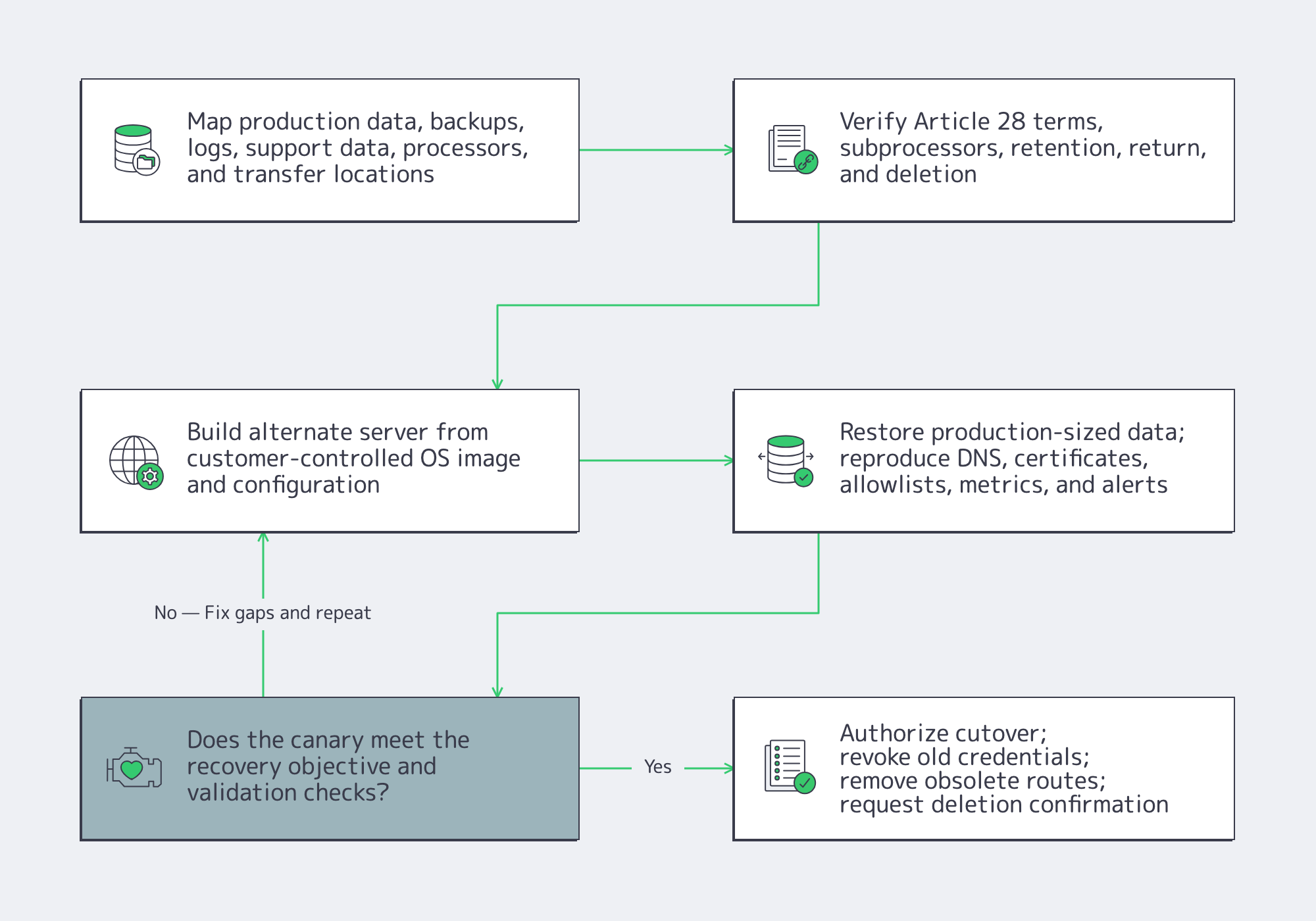
German storage does not complete GDPR compliance. Article 28 requires processor guarantees, a binding agreement, and subprocessor controls. Article 44 covers third-country transfers; Article 32 requires risk-based security, resilience, restoration, and testing. Support tickets or diagnostics processed abroad still matter.
For each data category, record processors, locations, retention, transfer mechanism, and deletion path. Cancellation alone does not prove deletion.
Portability testing should cover:
- Installation: Start from a customer-controlled operating-system image or automated build and confirm that the target hardware supports it.
- Configuration: Version packages, users, jobs, firewall rules, mounts, certificates, secrets, monitoring agents, and manual steps.
- State: Time snapshot creation, transfer, verification, restore, database recovery, and application validation—not copy speed alone.
- Identity and operations: Find hard-coded addresses, lower DNS TTLs early, reproduce certificates and allowlists, and verify equivalent metrics and alerts.
- Exit: Validate returned data, revoke old credentials, remove obsolete routes, limit overlap, and obtain applicable deletion confirmation.
Melbicom’s network footprint includes 29 IXPs and 23 transit providers. Frankfurt options span Intel and AMD processors, 16–768 GB of RAM, and per-server networking up to 200 Gbps. Buyers should still test the ordered port, destinations, and sustained throughput in both directions.
How to Control Hardware Availability, Price Increases, and Support Risk
Treat catalog availability, current inventory, reserved allocation, and replacement stock as four different states. Before scheduling migration, confirm exact quantity, component layout, acceptable substitutions, delivery window, and failure-replacement path. Then stress-test the full price and support model against scarcity, material increases, and a realistic outage rather than trusting a product card or chat badge.
Gartner forecast worldwide server spending to grow 36.9% in 2026, with data-center-system spending above $650 billion. A quote should identify CPU model and generation, memory layout, drive model and usable capacity, redundancy, NIC capability, port speed, and substitution rules. For fleets, confirm simultaneous allocation and spare capacity.
Across our infrastructure, Melbicom provides 1000+ ready-to-go configurations, including 200+ Frankfurt options. Custom server configurations are delivered in 3–5 business days. Cutover planning should still wait for confirmation of the exact Frankfurt quantity, storage layout, substitutions, and delivery window.
Eurostat reported €0.2264 per kWh for medium non-household consumers in Germany in the second half of 2025, versus an EU average of €0.1837. This does not predict hosting prices, but buyers should document fees, currency, renewal mechanics, and increase triggers. A 60- to 90-day notice target gives many teams time to benchmark, reserve hardware, transfer data, and run overlap.
Test support with a failed drive, unreachable server, routing anomaly, or suspected instability. Uptime Institute’s 2026 outage analysis found that 57% of respondents’ most recent major outages cost more than $100,000, and one in five exceeded $1 million. Melbicom provides 24/7 support, but buyers should establish evidence requirements, authorization, escalation, status cadence, hardware procedures, and failover triggers before production.
A Low-Lock-In German Server Standard
A German server should pass seven proofs before it becomes difficult to replace: documented sovereignty and subprocessors; measured Frankfurt routes; allocated hardware and substitution rules; a total-cost model with 10%, 20%, and 30% stress cases; tested support escalation; a production-sized restore within the recovery objective; and a documented return-and-deletion path.
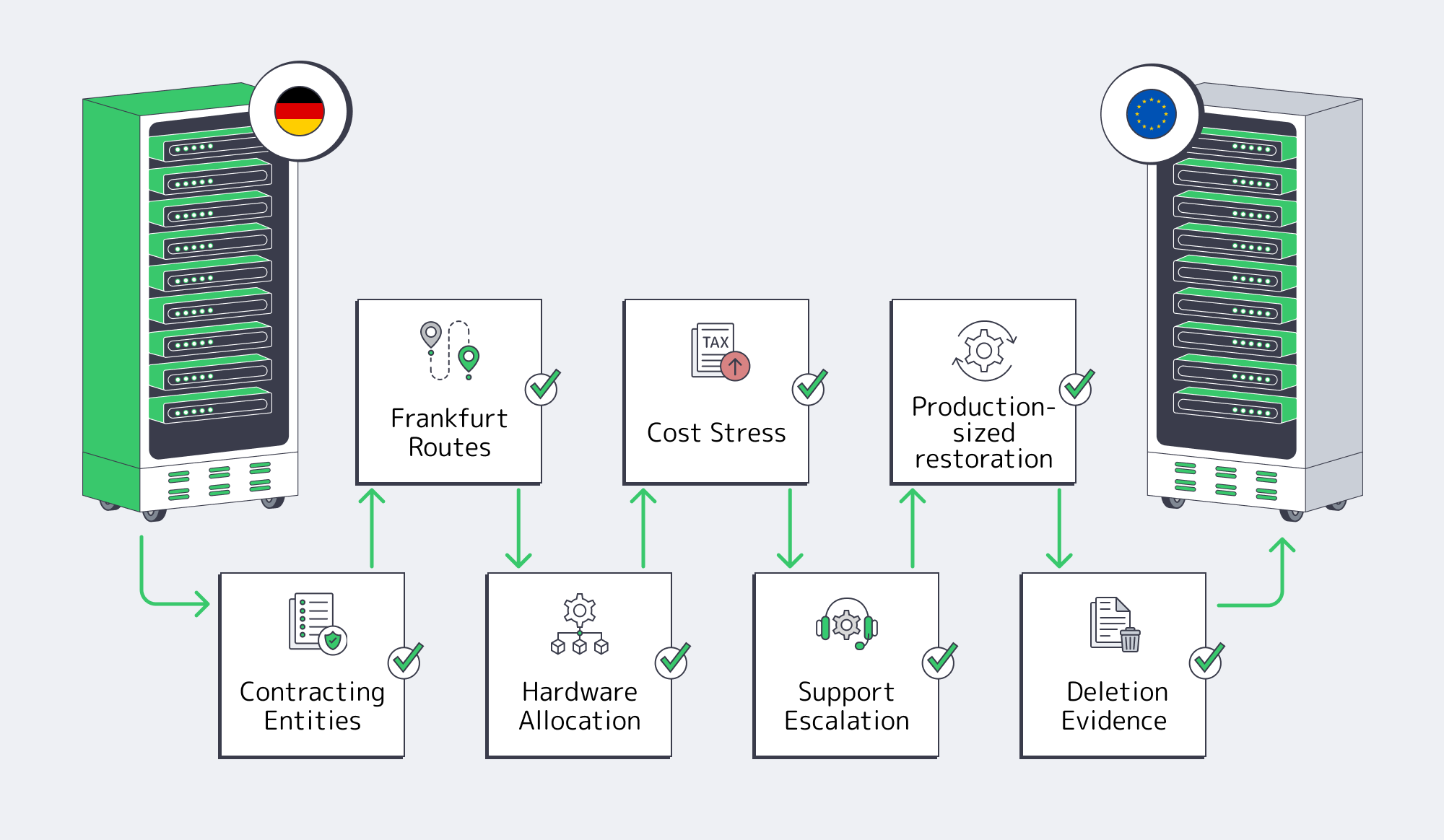
These controls do not require an elaborate abstraction platform. Standard operating systems, independent DNS, customer-controlled automation, external backups, portable addressing where justified, explicit contracts, and recovery drills do most of the work. The sequence is straightforward: benchmark the location, verify the data chain, reserve hardware, model the bill, test support, and rehearse the exit.
A German dedicated server should earn its place through measured routes, verifiable data handling, allocated hardware, predictable terms, usable support, and a demonstrated path out. Physical location reduces exposure; portability prevents it from becoming a trap. That is when comparing Melbicom’s Frankfurt options becomes a technical procurement step.
Choose a Portable German Server
Compare 200+ Frankfurt configurations, facility tiers, bandwidth, and recovery-friendly infrastructure against your sovereignty and exit checks.