
Blog

Future-Proof iGaming with Global Dedicated Server Clusters
iGaming has seen a steep growth curve that is predicted to continue, with the online gambling market estimated at USD 97.7 billion in 2026 and projected to reach USD 202.8 billion by 2033.
However, despite the demands, scaling has a few caveats. The usage patterns are tricky to calculate with huge spikes in traffic that far exceed daily baselines during major events to contend with, as well as the near-zero tolerance that gamers have for delays. Mere millisecond shifts in latency dramatically affect user behavior, meaning that scalability relies less on procurement factors and more on architectural design.
To keep scalability future-proof, you need a forward-looking roadmap. For iGaming infrastructure on dedicated servers, that means horizontal clustering, low latency, planned server capacity, and automation for chaotic workloads. The goal is a scalable blueprint with modular resilience for AI, real-time analytics, and blockchain under realistic workloads.
Choose Melbicom— 1,100+ ready-to-go configs — 21 Tier IV & III data centers — 39 CDN PoPs in 35 countries |
 |
Horizontal Clustering: The Bedrock of Scalable Dedicated Servers for iGaming
Scaling vertically requires ever-larger machines; realistically, it means finite headroom for most. The overprovisioning is often wasteful and creates single points of failure within the infrastructure that lead to longer maintenance windows and result in more downtime. By adding servers in parallel with horizontal clustering, you have a better alternative that intelligently balances traffic without wasting provisions, and failure is treated as a routine event rather than a deadly threat.
Horizontal clustering also lets you separate concerns into independently scalable pools. For iGaming operations, use this tier blueprint:
- For Web/API and game servers: Nodes remain as stateless as possible and are routed with L4/L7 load balancers. Game rooms and tables are partitioned through consistent hashing, and game nodes are added to the pool when a tournament starts. This prevents tuning and pushing a single box past its breaking point.
- For the data: Heavy reads are dealt with by blending read replicas, and writes are handled via clustering or sharding. The transaction integrity is protected by distributed SQL or sharded RDBMS patterns, and bet placement, settlement, and odds queries are easily handled regardless of the volume.
- Maintaining a low-latency state and messaging: In-memory caches and message queues help decouple spikes from the database’s critical path.
Operating in clusters boosts throughput and availability because health checks and load balancers can drain a single server should a failure be encountered, while the rest continue working. This means safer rollouts, as new builds can be hosted on a subset of nodes with blue-green deployment or canary setups. With a model that adds nodes to increase headroom, your capacity grows in alignment with growing demand, and there is no need for any redesigning, regardless of whether you need to scale from five thousand to fifty thousand concurrent users at a moment’s notice.
This blueprint is easy to start; Melbicom’s dedicated servers align cleanly. Melbicom offers more than 1,100 ready-to-go configurations, with per-server bandwidth available up to 200 Gbps, helping you right-size the outlined tiers and keep headroom on hand to expand clusters as concurrency climbs.
Lower Latency and Regulatory Alignment
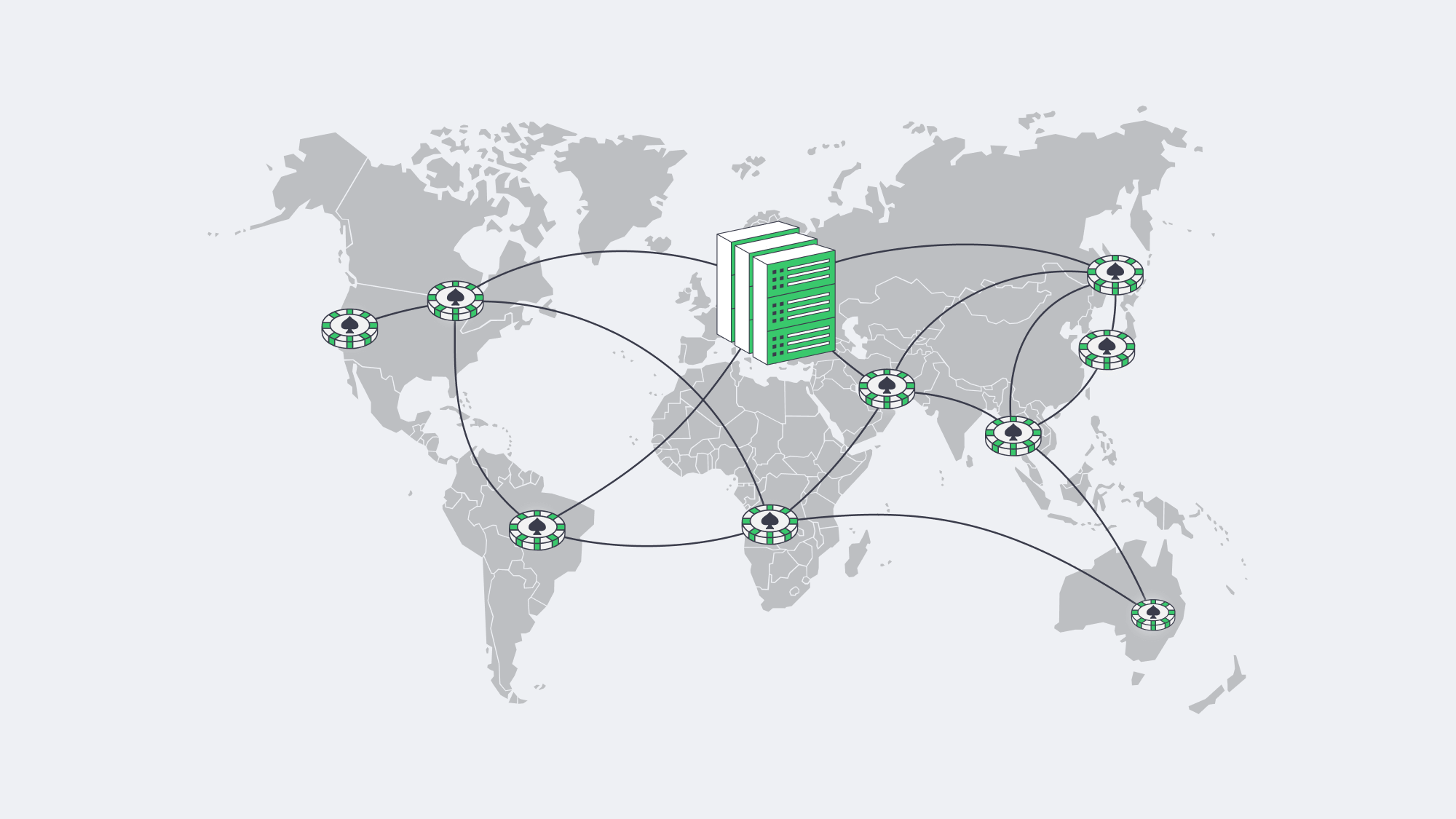
We often think of scaling in terms of “how much,” but “where” is just as important, especially in iGaming, with latency being a key concern. Physical distance equals delay; the longer the distance between a player and your servers, the more latency erodes conversion and churn. Gameplay and in-play betting should be instantaneous for all users, even if those at the table are located as far apart as Madrid, LA, and Singapore at the same time. To provide that globally, multi-regional deployment is vital to your infrastructure.
Design with regional hubs as your focus: Place your active clusters in key geographical regions (e.g., EU, US, APAC). DNS-based global load balancing or anycast can help ensure that a bet placed in Frankfurt resolves to Europe by default, whilst an Atlanta-based one lands in North America. Keep the data local to make compliance easier. Use active-active operation where possible to keep failover seamless and capacity steady.
Free the core cluster via CDN offload: Reduce origin loads and roundtrips by pushing static assets, media, and selected API responses to the edge. The Melbicom CDN spans over 39 locations, ensuring that assets and streams terminate within proximity of the user, freeing up the core cluster and enabling the focus to be on latency-sensitive interactions.
Physical foundational considerations: High-capacity, well-peered networks in fault-tolerant facilities are needed to keep user experiences consistently sub-100 ms. Melbicom operates with a geo-redundant design with data centers in 21 global locations to support rapid transactions and recovery. Our data centers have redundant power and diverse network paths, reducing the risk that regional incidents cause prolonged downtime.
The big payoff of operating with regional hubs is that regional traffic peaks locally; spillover is caught by neighbors; for example, surges from the Champions League are handled by European clusters, the Americas absorb spikes caused by the NFL, while APAC handles weekend traffic.
Handling Surges Seamlessly with Automation and Server Capacity Planning
The iGaming market moves rapidly, and the supply and demand for server capacity are unpredictable, making it tough to keep up with through manual scaling. To keep ahead, automation and server capacity planning are vital; if not, you run the risk of last-minute scrambles that spoil UX.
Infrastructure as Code (IaC). You can smoothly expand clusters in planned windows to cover predictable surges with a ready-to-deploy inventory by provisioning and reimaging servers using code (Terraform/Ansible). At the same time, standardized images across nodes prevent configuration drift.
Elastic orchestration. Although physical servers don’t “pop” instantly, near-instant service-level elasticity can be achieved on dedicated hardware, comparable to cloud operation, by packaging services into containers, scheduling with a cluster manager, and autoscaling horizontal pods on CPU/memory/queue depth.
Autoscale through blending predictive and reactive triggers:
- Schedule rollouts for derbies, tourneys, and promotions.
- Set reactive triggers such as thresholds on error budgets, P95 latency, specific queue lengths, or cache hit rates.
- Avoid idle waste by automating graceful cooldowns when surges recede.
Close the loop with health checks and continuous load testing based on previous peak behavior, so traffic drains away from unhealthy instances and services before automation restarts capacity.
Through this method, you remain cost-aware at baseline, ruthless with headroom, and far more efficient than manually possible.
Build to Fail Safely with Modular, Resilient Architecture as a Backbone

As well as the hardware considerations, you have software architecture to think about if you truly want your scalability to remain future-proof. The benefits of a modular system as a backbone are: localized failure, rapid feature integration, and the ability to scale components independently.
Microservices and event-driven flows: Break down the individual platform services such as identity, wallet, risk, odds, settlement, game sessions, chat, bonus, and analytics. Use APIs and streams for communication. Publish event-driven actions such as “bet placed,” “odds updated,” or “game finished” to a durable bus; adding a fraud model or a loyalty engine is a plug-in, not a rewrite.
Isolation and fallbacks: Isolate each microservice so one failure cannot collapse the stack, then define fallbacks for each service. If chat slows, degrade it while bets proceed. If personalization times out, revert to defaults. These patterns reduce cascading degradation during partial service outages.
Redundancy should be throughout: Use primary/replica or clustered databases with automatic failover to make sure that no single data node, cache, or gateway is a lynchpin. Keep multiple instances of all stateless services and run hot spares for critical paths. Site-level incidents can be handled via active-active regions where possible, and if not, at the very least, hot standbys.
Harden your architecture design through regular testing: Run chaos drills in staging and practice region evacuation and database failover. This confirms load balancers honor health checks and rollback paths stay predictable.
Working this way protects revenue by reducing the risk of outages during the Super Bowl and accelerates delivery, giving your teams the confidence to deploy changes.
AI, Analytics, and Blockchain Readiness
As you scale and integrate new features, emerging workloads can disrupt operations. The safer practice is to architect ahead with a system ready for new demand.
For AI and real-time analytics, keep transactional paths clean (write bet → ack) while mirroring events to analytics clusters for separate processing.
Model scoring helps decide where to add a GPU dedicated server beside adjacent data streams. Keep analytics stacks as separate tenants so they scale independently and support model experiments without starving bet paths.
You should track P95 latency for real-time operational analytics, such as a dashboard for bet placement, queue times for settlement, cache hit ratios, and regional error budgets, to make sure automation responds rapidly to link breaks or traffic shifts.
Crypto wallets and provably fair gaming that rely on blockchain networks can face slow confirmations or transient unavailability. The solution is to have their gateways isolated behind queues to prevent stalling when awaiting confirmations. Integrate modularly to keep the core platform running smoothly regardless of any external network hiccups. Remember that fast NVMe stateful nodes require high-bandwidth links to sync heavy chains and state snapshots. At Melbicom, we offer uplinks with up to 200 Gbps per server.
Modularity also helps cover new interaction patterns. VR/AR tables, large-scale PvP pools, and social gameplay can all cause unpredictable surges. To cope, you need architecture that lets you place specialty services in regional hubs and add edge offload via CDN. WebSocket, HTTP/2, and other protocols should be tuned for connection at scale.
This architecture is more pragmatic in cost terms: with a disciplined baseline (e.g., 60–70% utilization) and planned surge capacity, you avoid overbuild and panic-buy cycles. Use the right-sized node types per tier, and reserve GPUs only for workloads that need them.
Further tips: To ensure rightsizing and detect anomalies early, you can leverage unified tracing, metrics analysis, and logs across tiers. Tie SLOs such as bet latency and odds freshness to automated actions and keep personal and wagering data in-region by default. That way, you replicate summaries rather than raw PII across borders, satisfying auditors.
iGaming Infrastructure Growth Patterns
Use this summary as a reference blueprint for iGaming architecture decisions:
- Operate horizontally from the get-go by deploying multiple web/API and game nodes with load balancers to help keep nodes as stateless as possible.
- Introduce caches and queues and utilize clustered databases with read replicas to help decouple the data path.
- Launch globally early by placing small but real clusters in your two most important regions, route by proximity through global load balancing, and keep the user data local to simplify compliance.
- Build IaC, golden images, and orchestrate your deployments with automation to scale. Predict known events and employ reactive triggers to allow for any unexpected surges.
- Ensure each tier has redundancy, test failovers, and add graceful degradation paths to protect against failure.
- Keep bet paths clean by supporting the core with analytics and AI to stream events and score models out-of-band, returning only the necessary signals.
- Observe to iterate, trim any waste, move bottlenecks, and use the data to inform the next scale-up.
Be sure to choose facilities and networks that won’t result in any bottlenecks. Melbicom’s dedicated servers are housed in Tier IV & III sites across 21 global locations. The infrastructure is engineered for redundancy, and servers can provide connectivity up to 200 Gbps, which helps prevent sudden spikes from saturating the network when capacity is planned correctly.
Build for Sustained Global Performance
If you want to keep your iGaming scaling capabilities future-proof, then you need a disciplined architecture that is built to work in parallel and focused on proximity and automation. You can give your capacity more elasticity and resilience through horizontal clustering, which, paired with automation and server capacity planning, helps you cope with the chaotic traffic expectations. Global deployment supports low latency and fairness, helping to satisfy regulators, and failure containment is easier to deal with thanks to the modular nature of the blueprint. These architectural design choices work hand in hand to ensure your scaling is steady and smooth rather than episodic and make engineering for iGaming predictable despite the challenges that event days and release cycles can otherwise cause.
The result is a platform that is architecturally strong and resilient as opposed to simply bigger, which means surges can be absorbed more predictably, features launch faster, and the future integration of AI, analytics, and blockchain is less likely to disrupt core operations. Reaping the rewards of this architectural blueprint requires dedicated servers in global locations that are clustered, observable, and automated from the bootloader up to provide resilient iGaming infrastructure.
Launch Your iGaming Servers Today
Choose from 1,100+ ready-to-go configurations across 21 global data centers and scale with room to grow.