
Blog

Dubai vs. Fujairah for Gulf Hosting
The network topology of the Gulf is evolving, but replacing every Dubai dedicated server with Fujairah infrastructure is not a universal upgrade. Dubai remains a major UAE peering and carrier marketplace, while Fujairah sits beside a major east-coast cable-landing ecosystem and SmartHub IX. The better location depends on target networks, application paths, carrier choices, and measured latency, packet loss, jitter, and cost.
This report explains when Fujairah’s cable adjacency and interconnection options can make it a strong alternative to Dubai, and how Melbicom’s Fujairah dedicated servers can support GCC-facing architectures. It does not treat geography as proof of lower latency or lower cost; those outcomes require production-shaped route tests and an explicit redundancy design.
Choose Melbicom— 14 ready-to-go servers — Tier III data center in Fujairah — 39-PoP CDN across 35 countries |
 |
Rethinking the Default Dubai Dedicated Server
Dubai’s environment enabled the region’s digital expansion, and it may remain the stronger choice when a workload benefits from its dense carrier and peering marketplace. Today’s hosting requirements should be tested against actual user networks: Fujairah becomes attractive when east-coast cable adjacency, route diversity, or specific paths to South Asia, East Africa, or GCC markets perform better. A GCC latency target is a design goal, not a location guarantee.
How Does Fujairah Affect Dubai Hosting?
Fujairah does not replace Dubai as the UAE’s interconnection center. It adds a second placement option: Dubai emphasizes peering and carrier density, while Fujairah emphasizes cable-landing adjacency and east-coast route diversity. The right choice is the location that wins production-shaped tests from relevant user networks and upstreams.
How Does Fujairah Use Peering and Cables?
Fujairah combines a major cable-landing ecosystem with SmartHub IX, a DE-CIX-powered exchange operating across Fujairah and Dubai. That creates useful options for regional peering, carrier transit, and east-west capacity, but it does not guarantee a specific path. The provider’s contracts, BGP policy, and target networks determine the route.
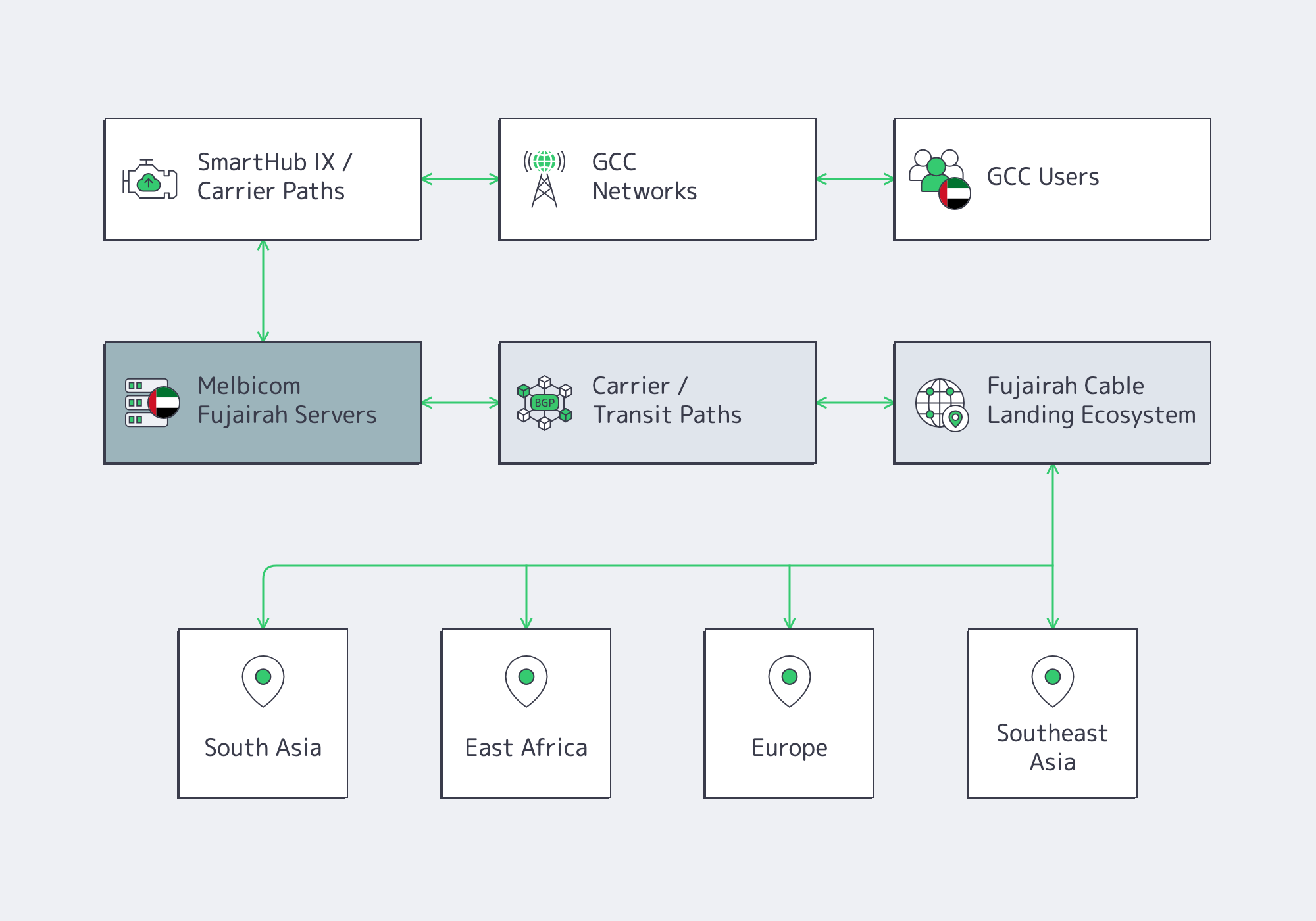
Fujairah’s advantage is physical and architectural. The city sits beside a substantial cable-landing ecosystem connecting routes toward Europe, South Asia, and East Africa. That adjacency can shorten some paths or reduce dependence on inland backhaul, but destination, carrier, congestion, and BGP policy still decide the path. A cable landing near the server is not the same as a guaranteed direct route.
The local exchange is SmartHub IX, not UAE-IX. DE-CIX describes UAE-IX as a Dubai exchange and SmartHub IX as a geo-redundant platform in Fujairah and Dubai. Local peering can keep traffic local and reduce transit dependence when the target networks participate, but the benefit must be measured from the actual ASNs and access networks that serve users. A result achieved by one network at one exchange is not a transferable benchmark for another provider or location.
Fujairah also offers route-diversity potential, but failover is not intrinsic. It exists only when the deployment has independent carriers or circuits, suitable BGP policy, capacity on the alternate path, and tested operational procedures. A second cable on a campus does not protect an application unless the network and service architecture can use it.
How Do Dubai and Fujairah Costs Compare?
Compare Dubai and Fujairah using provider quotes and measured traffic. Rack, power, cross-connects, transit commits, peering reach, support, and recovery capacity all affect total cost. Fujairah may reduce backhaul for some cable-adjacent routes, while Dubai may offer better economics through carrier and peering density.
The main variables of hosting economics in the UAE are: 1) where traffic enters paid transit; 2) how much traffic can use peering; and 3) the facility, power, cross-connect, and recovery costs required to control those paths. Neither city automatically reduces every pressure.
Facility-specific operating costs
East-coast campus economics can be attractive, but geography does not prove a lower rack or power price. Compare contracted power, rack, remote-hands, cross-connect, installation, and minimum-commit charges for the actual facility.
Bandwidth economics at scale
Peering may reduce paid transit, while multiple carriers can improve price competition. The result depends on which networks exchange traffic, the committed data rate, burst model, transfer allowance, and whether a route still traverses paid transport.
Redundancy requires design
Fujairah’s cable adjacency creates options, not automatic failover. Compare independent carrier entrances, physical path diversity, BGP policy, capacity reservations, and failure tests. Dubai can also support resilient design through carrier and peering diversity.
Onshore deployment and compliance
Onshore hosting can support data-location and governance requirements, but the applicable rules depend on sector, data type, controller and processor roles, and recovery design. A Fujairah site should not be described as automatically satisfying sovereignty or disaster-recovery requirements.
The practical conclusion is to model the whole service, not assume a city-level discount. Measure Time to First Byte, RTT, loss, and jitter from target networks; price the primary and recovery paths; and compare the same capacity, support, and transfer model in both cities. Fujairah is compelling when the data, not the map, shows an advantage.
A Quick Comparison
| Key Factor | Dubai Hosting | Fujairah Hosting |
|---|---|---|
| International Connectivity | Dense carrier and peering marketplace centered on UAE-IX | Cable-landing adjacency plus SmartHub IX and east-coast carrier routes |
| Latency to Regional Users | Often strong for UAE and networks reached through Dubai peering; test target ASNs | May shorten selected GCC, South Asia, or East Africa paths; test target ASNs |
| Bandwidth Costs | Depends on carrier mix, peering, commits, and cross-connects | Depends on carrier mix, cable or backhaul requirements, commits, and cross-connects |
| Infrastructure Overhead | Facility-specific power, rack, metro-connect, and support costs | Facility-specific power, rack, cable, cross-connect, and support costs |
| Redundancy & Failover | Requires explicit multi-carrier, path, and application failover design | Cable diversity creates options, but failover still requires explicit design |
Turning Connectivity Into Business Value
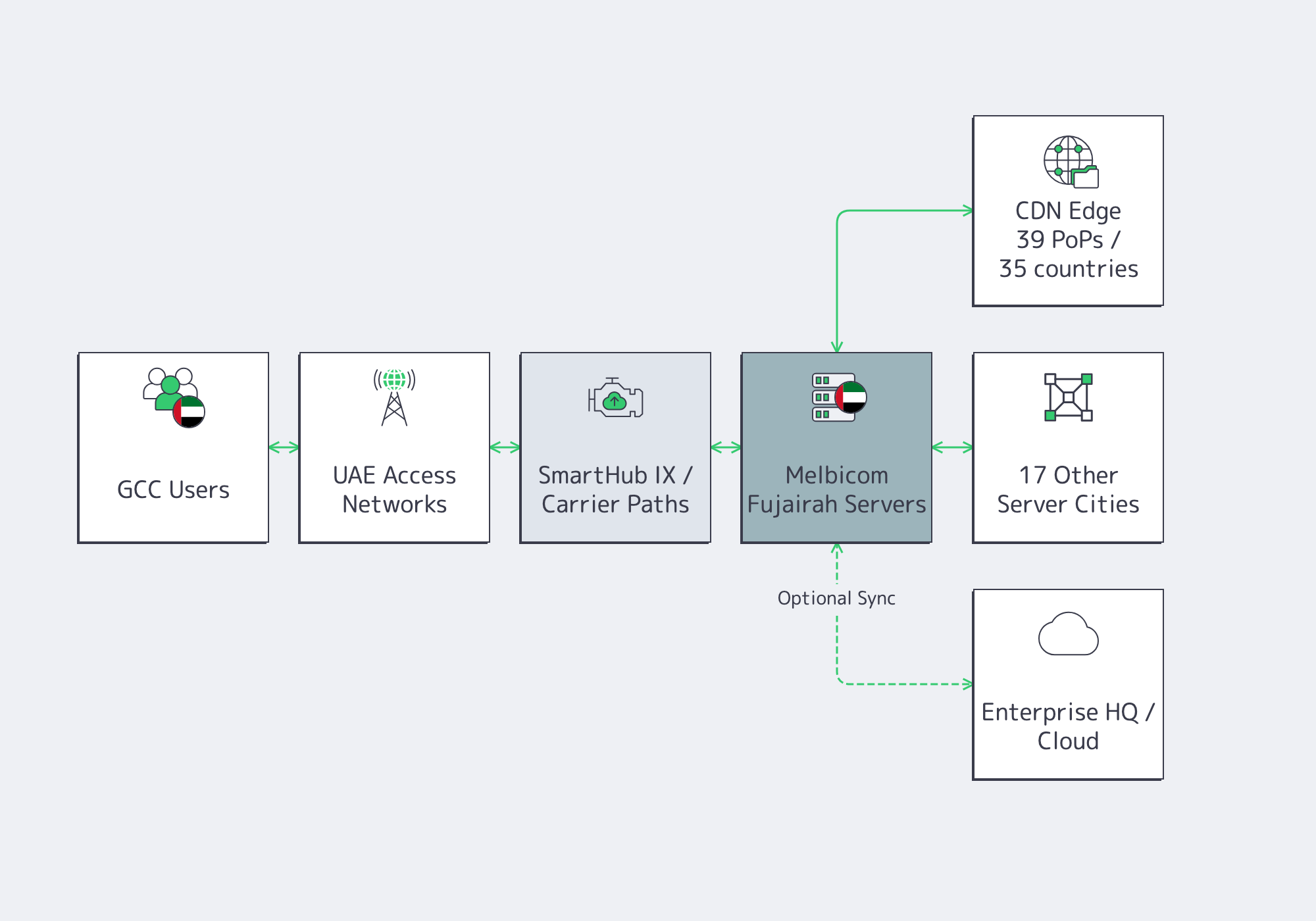
Right-sized compute, on demand. We offer dozens of ready-to-go dedicated server configurations in Fujairah to match compute, memory, and storage to the workload without overbuying. As demand increases, add capacity according to measured utilization and failure-domain requirements.
Throughput headroom when it counts. Fujairah supports network capacity up to 20 Gbps per server. Size the port for P95 and bursts, then verify transfer terms and throughput for streaming, distribution, replication, and high-volume APIs.
Global footprint, local results. Melbicom operates 21 data centers in 18 server cities across 17 countries. Place compute and recovery capacity where they fit the workload, then use a CDN across 39 PoPs in 35 countries to cache eligible static assets near users without treating the edge as a substitute for application placement.
Tiered reliability where it matters. Melbicom operates Tier III and Tier IV facilities, including Tier III & IV DCs in Amsterdam and Tier III & IV DCs in Frankfurt; Fujairah is Tier III. Facility tier describes site design and maintainability, not application uptime by itself. Melbicom also provides 24/7 support.
Regulatory alignment by design. Hosting in the UAE can support local data-handling requirements, but it does not eliminate legal analysis, access controls, encryption, retention rules, or documented cross-border replication decisions.
Final thought. Measure before migrating. Use a test endpoint and production-shaped requests from target networks, then compare P50 and P95 RTT, packet loss, jitter, route stability, Time to First Byte, and sustained throughput with a Dubai alternative. Also model the data center, transit, cross-connect, and recovery costs. Fujairah is the better choice only when results support the workload’s performance, resilience, and budget.
Why Fujairah, Why Now
The network is not the map. Fujairah combines east-coast cable adjacency with a local interconnection ecosystem, while Dubai concentrates a larger carrier and peering marketplace. Hosting where the relevant paths converge can improve performance and resilience, provided the routing, capacity, and failover design fit the workload.
For organizations targeting the Gulf or expanding an existing presence, the decision matrix has distilled to a few clear questions: Can the deployment meet GCC latency targets without over-engineering? Are independent paths and failover procedures documented? Will unit costs improve at the required traffic level? In Fujairah, the answer can be yes, but it is not yes by default. If target networks perform better from Fujairah, the location can serve as a primary site, regional node, or recovery location; if not, Dubai or a mixed topology may be the better design.
Conclusion: When Fujairah Fits Gulf Hosting

Fujairah is a serious UAE hosting option because of its proximity to multiple subsea systems and the SmartHub interconnection ecosystem. Those features can improve selected routes and create useful diversity, but they do not automatically beat Dubai on latency, cost, or resilience. Results depend on the networks, contracts, and failure design.
Melbicom’s role is to provide right-sized dedicated servers in Fujairah, 24/7 support, and a broader global footprint for multi-region design. Treat a Dubai dedicated server and Fujairah hosting as alternatives to test, not labels that predict performance. Choose Fujairah only when production measurements and commercial terms support the decision.
Launch in Fujairah Now
Deploy a Fujairah dedicated server, test it from your target networks, and scale only after the route and throughput results meet your requirements.