
Blog

Dynamic BGP: Faster, Safer Networks for Growth
Organizations are spreading workloads across public clouds, edge equipment, and a wider array of data-center locations. In this environment, the routing model in place today can decide whether tomorrow’s network becomes a business engine or a bottleneck. Static routing still appears in many diagrams because it is visually clean: an engineer manually enters a next-hop address, commits the change, and the route takes effect. But adding a new subnet, signing a new carrier contract, or responding to an outage still requires another manual edit. According to Uptime Institute, nearly 40% of organizations have had a major outage caused by human error over the past three years, and 85% of those incidents stemmed from staff failing to follow procedures or from flawed processes. A 2016 Ponemon Institute/Vertiv benchmark put average data center downtime costs near $9,000 per minute. Manual static routing magnifies both risks by inviting errors and delaying recovery.
Choose Melbicom— 1,400+ ready-to-go servers — 21 global Tier IV & III data centers — BGP sessions with BYOIP |
 |
Dynamic routing with the Border Gateway Protocol (BGP) replaces that fragility with automation. Routers advertise what they can reach, learn what other routers can reach, and converge on the best policy-compliant path. In controlled designs, a link failure causes the advertisement to disappear and traffic to be redirected without a manual route edit. When a new site appears, its prefixes are distributed without opening tens of SSH sessions. The same protocol that exchanged roughly 1.2 million advertised IPv4 prefixes across the public Internet by early 2026, as shown in an APNIC analysis, can underpin a private fabric, delivering automated path discovery, policy control, and resilience. The next sections compare static routing’s manual overhead with BGP’s intelligence, quantify the resulting savings, and show how we at Melbicom make dynamic routing straightforward.
Where Static Routing Breaks at Scale
Static routes are manually configured statements that never change unless a human changes them (for example, “send 10.12.0.0/16 to 192.0.2.1”). That simplicity works on an access-switch floor that rarely changes. It becomes a maintenance marathon across a mesh of fifteen branch offices spanning two clouds and several partners:
- Manual blast radius. Adding a data-center VLAN may require updates across tens of routers. Each change can introduce a typo, missed hop, or ACL error, creating black holes that take hours to find and fix.
- No automatic failover. Losing a primary WAN circuit keeps traffic flowing into a dead end until an operator reprograms the path, adding minutes that reduce availability and user satisfaction.
- Zero policy intelligence. Static routing has no mechanism to favor lower-cost carriers at peak, pin voice traffic to low-jitter links, or direct European users to a PoP in the EU. Any adjustment needs another human input.
How the Border Gateway Routing Protocol Automatically Controls Resilience
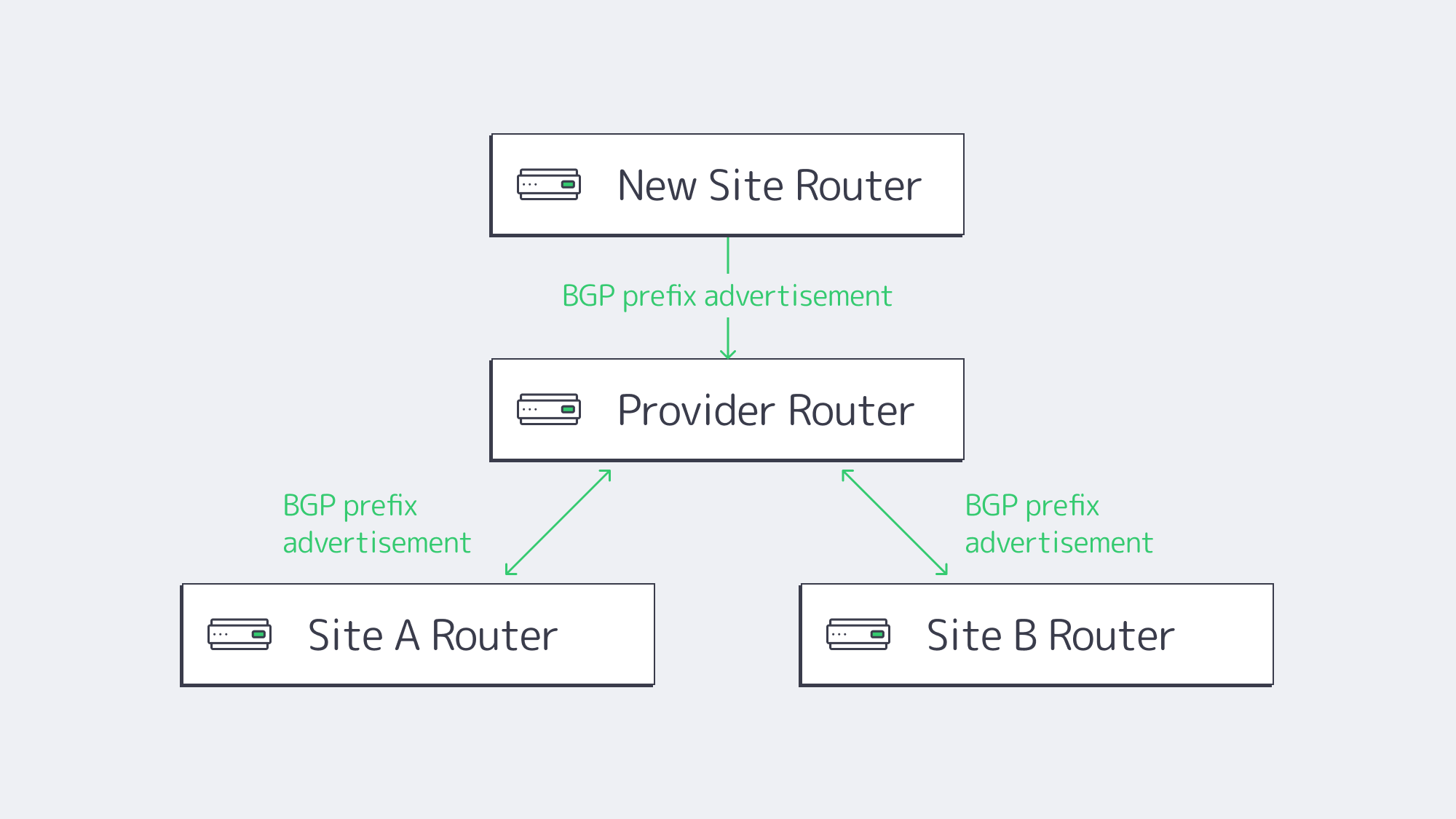
The Border Gateway Protocol assumes networks change and adapts by propagating updates and selecting new best paths. BGP speakers exchange reachability information and tag route announcements with policy attributes. Four capabilities explain why BGP scales where static routing breaks:
- Automated path discovery. As soon as a new prefix is announced, participating routers learn about it without spreadsheet scavenger hunts or midnight console sessions. Withdrawals propagate quickly, so failover in controlled designs can complete before users notice.
- Policy control. Local preference, MED, and communities let architects incorporate business intent, cap traffic on premium circuits, favor low-latency fiber, and guide partner flows through inspection stacks. These policies persist and continue to steer traffic even as the underlying physical paths change.
- Internet-scale resilience. BGP already operates at Internet scale, with more than one million publicly routed IPv4 prefixes. When BGP is paired with Bidirectional Forwarding Detection and sensible timers, many link failures can be detected in sub-second timeframes and rerouted according to policy.
- Observability. Session telemetry exposes flaps, path changes, and upstream anomalies that would otherwise be hidden behind static IP route lines, turning reactive firefights into proactive analytics.
BGP Latency and Cost Gains Across Sites
The advantages of BGP increase in multi-datacenter topologies. Imagine hubs in Los Angeles, Amsterdam and Singapore:
- Anycast service IPs. Each site advertises the same /24. Global routing sends users toward the topologically closest reachable instance, often improving round-trip time for European visitors compared with serving them from North America or Asia, without DNS changes. If the Amsterdam site goes offline, its BGP advertisement is withdrawn and traffic shifts to another advertised site in Los Angeles or Singapore.
- Active-active bandwidth. Two ISPs per site no longer need to operate as primary/backup waste. Local preference steers bulk traffic to lower-cost carriers while reserving premium links for latency-sensitive flows, increasing utilization and reducing billing spikes.
- Link-specific tuning. Loss and jitter monitoring systems can let route-optimization engines shift affected flows with more specific prefixes, keeping contracted gigabits productive and limiting burst charges.
Quick TCO Calculator: Static vs BGP
| Cost Component | Static Routing (Annual) | BGP Dynamic Routing (Annual) |
|---|---|---|
| Engineer labor for route changes | 50 changes × 1 h × $110 = $5 500 | 50 reviews × 0.1 h × $110 = $550 |
| Downtime from slow failover | 2 incidents × 20 min × $9 000 = $360 000 | 2 incidents × 1 min × $9 000 = $18 000 |
| Training & ASN fees | $0 | $4 000 |
| Five-year projection | >$1.8 M | < $120 k |
How to adapt: Enter your own number of incidents, outage minutes and labor rates. Replace the $9,000/min benchmark with your own revenue, productivity, and contractual costs. Many organizations pay back the BGP setup costs in the first avoided outage.
Implementation Notes for Safer Border Gateway Protocol Routing
Implementing border gateway protocol routing is not as difficult as it may sound:
- Start at the edge. Connect your primary data centers to upstream providers while leaving the LAN on OSPF or static routing, a low-risk path to quick operational gains.
- Set guardrails. Use import/export filters to block route leaks and full-Internet tables; prefix limits and max-AS-path filters add inexpensive safeguards.
- Automate verification. Unexpected advertisements, flapping neighbors, and policy violations can be identified almost in real time by streaming telemetry, route monitors, and what-if tools.
Security fits in as well. Contemporary implementations combine RPKI origin validation, IRR-based filtering, prefix limits, and segmentation so route advertisements are validated, accepted prefixes stay within policy, and lateral movement is limited after compromise in one workload.
Melbicom Makes BGP a Checkbox
We at Melbicom take away the final obstacles. Dedicated servers and VPS plans support BGP sessions with default, full, or partial route availability. Our BGP Session service supports IPv4 and IPv6, BYOIP, BGP communities, and up to 16 prefixes—ideal for anycast footprints or multi-homed edge nodes. For VPS, pricing starts at $5/month with a 10€ setup fee; for dedicated servers, BGP sessions are free with setup waived. Sessions are available across our 21-site backbone, which includes Tier IV and Tier III capacity in Amsterdam and Tier III sites across Europe, North America, Africa, and Asia, offering up to 200 Gbps per-server connectivity. Our 55+ location CDN footprint across 39 countries can complement that routing design when applications also need edge caching, lower origin load, and regional redundancy. Our engineers are available 24×7 and fluent in BGP; we can advise prefix planning, policy tuning, and RPKI rollouts when required.
Dynamic Routing as a Strategic Advantage

Static routing was the right solution for some older problems; now it often compounds them. Each manual entry is both a cost and a liability, and the list expands with every new site, circuit, and microservice. The Border Gateway Protocol replaces that brittle spreadsheet with a living, policy-driven map that can heal around failures, reduce latency, and enforce cost controls in real time. In multi-datacenter designs, the gains are measurable: fewer manual edits, faster failover, fewer outage minutes, and infrastructure that scales by policy rather than late-night toil.
For leaders planning the next expansion, dynamic routing is not a luxury feature; it is the operating system of the network. The sooner your routers speak BGP, the faster your business can move at cloud speed.
Order Your BGP Session Now
Enable automatic resilience and traffic engineering with BGP sessions from Melbicom—available across our global backbone.