
Blog
Application Hosting Market: Four Forces Driving Growth
A 2025 market forecast estimates the application hosting market at USD 79.16 billion in 2024 and projects a 12.6 percent CAGR from 2025 to 2034, reaching USD 259.35 billion. (Research and Markets) The four drivers examined here—SaaS growth, AI infrastructure demand, edge deployment, and tighter data-governance requirements—continue to shape where businesses host critical applications.
Choose Melbicom— 1,100+ server configurations — 21 global Tier IV & III data centers — 55+ locations in 39 countries |
 |
Application Hosting Market Growth Drivers
SaaS Demand Keeps Surging to New Heights
The global SaaS market was estimated at USD 408.21 billion in 2025 and is projected to reach USD 465.03 billion in 2026, with a 12.85 percent CAGR through 2035. (Precedence Research) That scale translates directly into backend capacity requirements: providers must support large tenant populations with high availability and low latency.
AI Workloads Reshape Infrastructure Economics
McKinsey projects demand for AI-ready data-center capacity to rise at an average 33 percent a year from 2023 to 2030, with around 70 percent of total capacity demand tied to facilities equipped for advanced-AI workloads by 2030. (McKinsey & Company) High-density GPUs and CPUs raise power, cooling, and network requirements, increasing interest in single-tenant servers where hardware can be tuned without hypervisor overhead.
Edge Computing Stretches the Network Perimeter
Grand View Research estimates the edge AI market at USD 30.0 billion in 2026 and projects USD 118.7 billion by 2033, a 21.7 percent CAGR. (Grand View Research) Physics matters: light in fiber adds roughly 10 milliseconds of round-trip propagation time for every 1,000 kilometers before routing and processing delays. Enterprises are therefore placing latency-sensitive components closer to users and pairing regional infrastructure with globally distributed CDN capacity.
Compliance Becomes an Architecture Constraint
Compliance increasingly influences workload placement, but the requirement depends on sector, data type, and jurisdiction. Eurostat reports that 52.74 percent of EU enterprises with at least 10 employees used paid cloud computing services in 2025. (Eurostat) The practical result is not “cloud versus no cloud” but deliberate choices about data location, service providers, transfer mechanisms, and auditability.
U.S. and European Hosting Patterns
U.S. and European application-hosting patterns cannot be compared with a single cloud-adoption percentage because surveys measure different populations and services. A U.S.-weighted 2026 cloud survey found hybrid architectures dominant, while Eurostat measured paid-cloud purchases by EU enterprises. Workload placement should therefore be compared by cost, latency, data location, transfer rules, and portability.
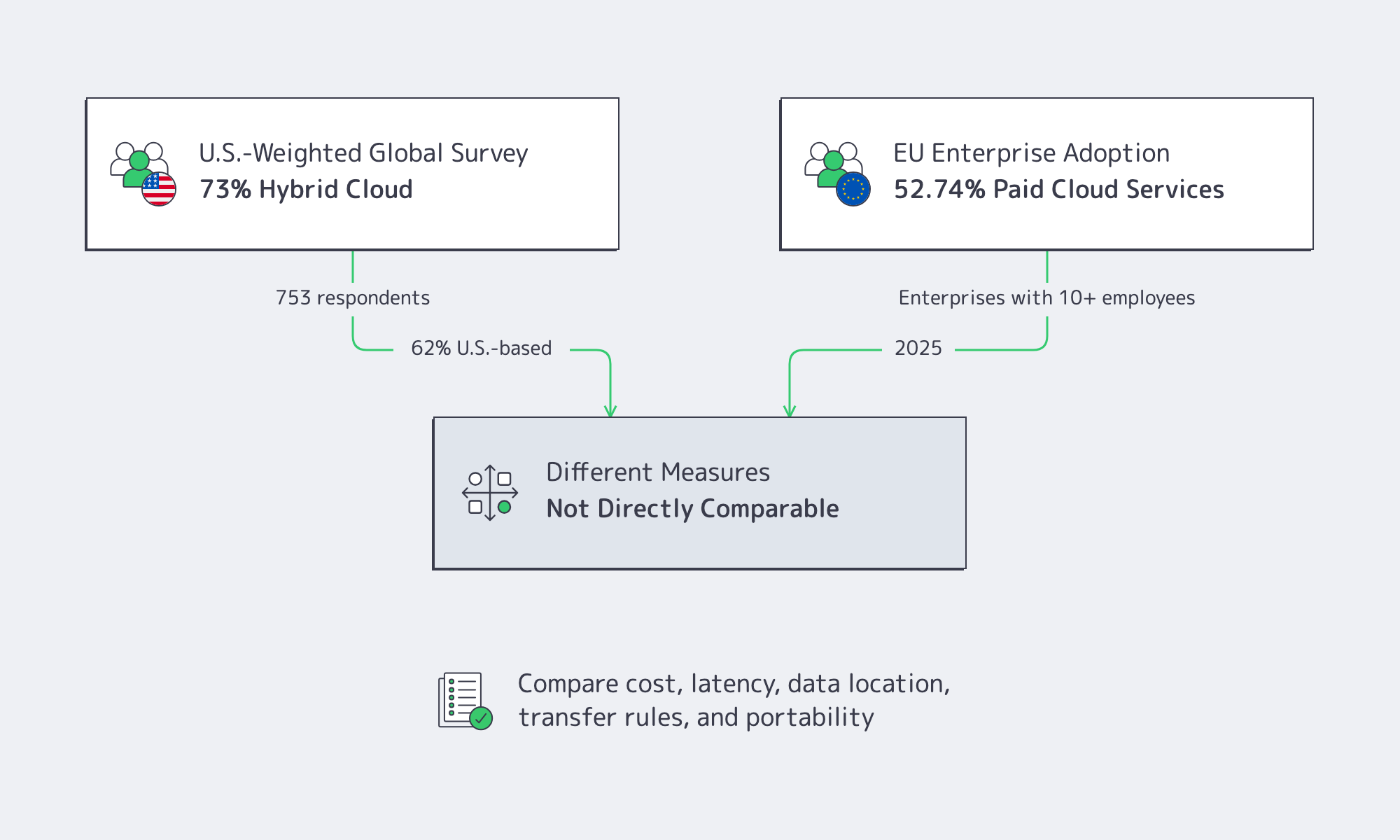
Flexera’s 2026 survey of 753 cloud decision-makers and users, 62 percent of them U.S.-based, found that 73 percent of organizations operate hybrid cloud estates and that enterprises run 54 percent of workloads in public cloud. (Flexera) These results show deep public-cloud use without supporting a cloud-only U.S. default.
Europe is not cloud-light. Eurostat reports that 52.74 percent of EU enterprises with at least 10 employees used paid cloud services in 2025, rising to 84.67 percent among large enterprises. (Eurostat) Those figures measure purchased services, not workload share, so they should not be compared directly with architecture surveys.
European designs also face explicit transfer and portability rules. GDPR conditions apply to personal-data transfers outside the EEA, while the EU Data Act has applied since September 12, 2025 and includes cloud-switching and interoperability requirements. (European Data Protection Board, European Commission)
Result: architects in both regions increasingly operate hybrid and multi-provider estates, but European projects often require more explicit decisions about data location, transfer mechanisms, provider jurisdiction, and exit paths.
Provider Segments in Flux
| Segment | Core Value | Growth Signal |
|---|---|---|
| Hyperscalers | Massive on-demand scalability and bundled managed services | Public-cloud workload shares continue to rise while 73 percent of organizations operate hybrid estates (Flexera) |
| Colocation & Dedicated | Fixed-fee economics, single-tenant control and custom hardware | The colocation market is projected to grow from USD 104.2 billion in 2025 to USD 204.4 billion by 2030, a 14.4 percent CAGR (Research and Markets) |
| Edge & CDN Nodes | Proximity and cached delivery | The edge AI market is projected to grow at a 21.7 percent CAGR from 2026 to 2033 (Grand View Research) |
Today, providers differentiate on connectivity, jurisdictional fit, power density, hardware choice, and operational support. That shift leaves room for specialists, especially in dedicated servers.
Why Are Dedicated Servers Back in the Application Hosting Mix?
Dedicated servers are returning to application-hosting designs because steady, high-utilization workloads often need predictable monthly cost, single-tenant performance, hardware-level control, or jurisdiction-specific placement. They do not replace cloud elasticity; they complement it inside hybrid architectures where each workload is placed according to cost, latency, compliance, and operational requirements.

Hybrid cloud is now the dominant architecture: 73 percent of organizations in Flexera’s 2026 survey operate hybrid estates. (Flexera) Within those environments, dedicated hardware remains relevant for workloads with stable utilization, specialized hardware, strict tenancy boundaries, or predictable throughput:
- Performance & Cost – Fixed-capacity applications such as high-traffic web services and large databases can cost less on monthly dedicated capacity than on consumption-priced cloud when utilization stays high, while single-tenant physical servers remove noisy-neighbor contention.
- AI Training & Inference – Reserving an entire GPU server lets teams tune drivers and frameworks and avoid shared-resource contention; the cost advantage depends on utilization, hardware availability, and contract terms.
- Compliance & Sovereignty – Single-tenant hardware can simplify access control and evidence collection, but compliance still depends on configuration, processes, contracts, and lawful data-transfer mechanisms.
- Predictable Throughput – Dedicated ports and fixed bandwidth commitments can reduce contention; Melbicom supports per-server bandwidth up to 200 Gbps.
Melbicom supports this placement model with dedicated servers in 21 Tier III/IV data centers, including Amsterdam and Frankfurt, and a CDN in 55+ locations across 39 countries. Teams can combine single-tenant compute, regional deployment, and edge delivery through one provider while keeping cloud services for workloads where elasticity is the priority.
Market Snapshot
| Segment | Reported Base-Year Size (USD) | Forecast CAGR |
|---|---|---|
| Application hosting (overall) | 79.16 B (2024) | 12.6 % (2025–2034) (Research and Markets) |
| SaaS software | 408.21 B (2025) | 12.85 % (2026–2035) (Precedence Research) |
| Data-center colocation | 104.2 B (2025) | 14.4 % (2025–2030) (Research and Markets) |
| Edge AI | 24.9 B (2025) | 21.7 % (2026–2033) (Grand View Research) |
Dedicated Opportunity in a Hybrid World
Cloud elasticity remains valuable for variable loads, while steady workloads may favor predictable monthly capacity. Finance teams compare committed cloud spend, egress, and dedicated-server fees; engineers may need hardware-level control; risk teams may prefer clearer tenancy boundaries. As AI power density and edge deployment grow, dedicated servers can serve as one layer in a hybrid application-hosting design, especially in regional Tier III/IV facilities with 24/7 support.
Melbicom offers 1,100+ ready-to-go server configurations across 21 data centers, with per-server bandwidth up to 200 Gbps and custom configurations delivered in 3–5 business days. Customers can select hardware, location, and bandwidth for the workload, then combine regional dedicated infrastructure with CDN delivery where appropriate. The result is a hybrid option that pairs fixed-capacity infrastructure with regional reach while cloud services remain available for bursts and managed-service needs.
Strategic Takeaways

The application hosting market continues to expand as SaaS, AI, edge processing, and governance requirements increase infrastructure demand. The regional picture is no longer a simple U.S. cloud-first versus European hybrid-first split: hybrid architectures are widespread, and European projects add more explicit data-transfer, switching, and sovereignty considerations.
IT leaders are increasingly combining hyperscaler elasticity with dedicated-server control and edge delivery to meet cost, latency, and governance goals. The right mix depends on workload utilization, user geography, data classification, portability requirements, and the team’s operational capabilities.
Teams should evaluate application hosting platforms by workload fit rather than category labels: measurable latency, predictable cost at target utilization, hardware and tenancy requirements, regional availability, transfer and audit obligations, and a practical exit path.
Deploy Dedicated Servers Today
Launch customizable dedicated servers in any of our 21 global data centers and tap up to 200 Gbps bandwidth with 24×7 support.