
Blog

Dedicated Servers for iGaming Security and Compliance
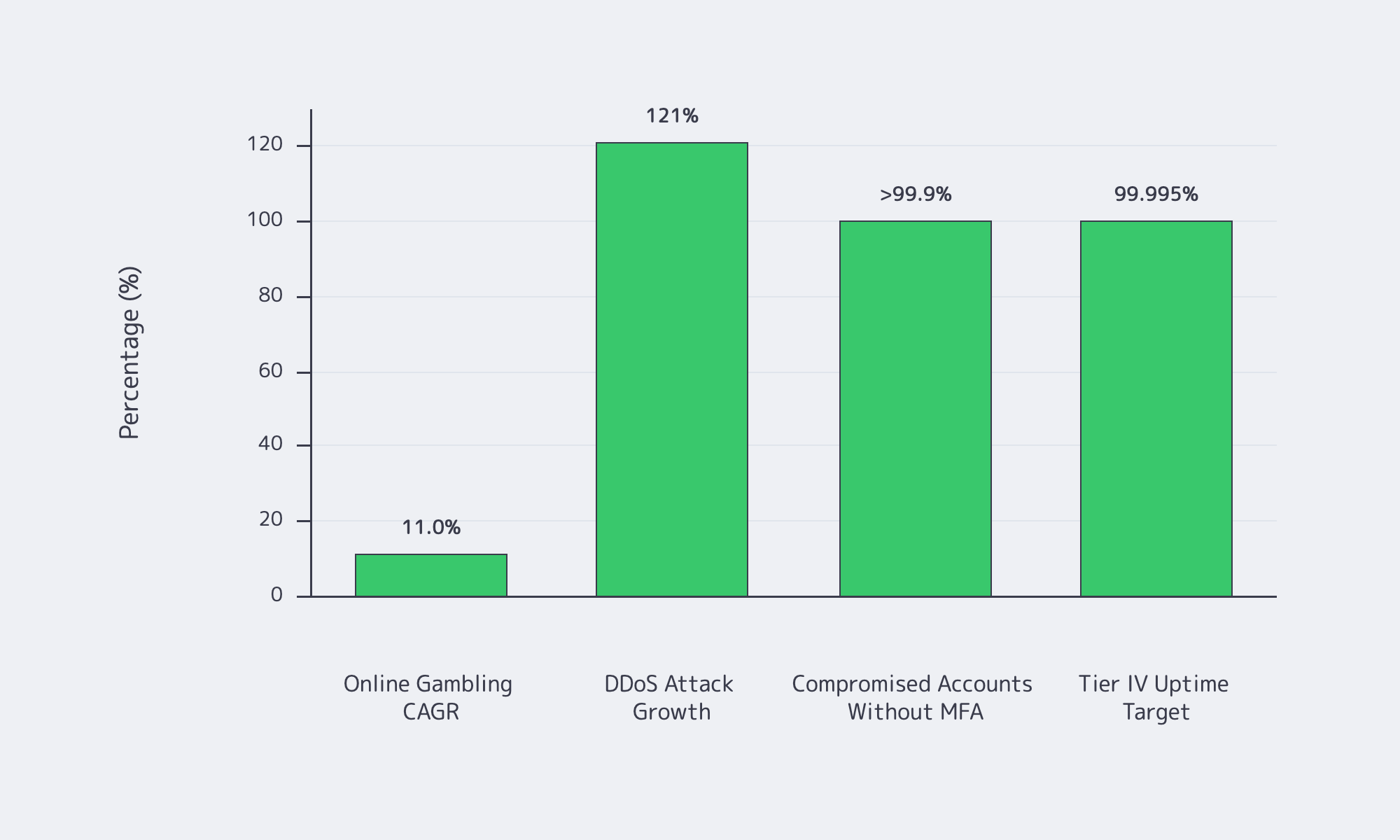
Online gambling has grown into a roughly $97.7 billion market in 2026 with projected double-digit growth. The upside is undeniable; so are the risks. DDoS pressure is escalating, too: attacks surged 121% in 2025, and Cloudflare ranked gambling and casinos and gaming as the third- and fourth-most attacked industries in Q4. The stakes aren’t just technical: the global average breach cost reached $4.4 million in IBM’s 2025 report. In this environment, compliance is inseparable from security, and both are inseparable from infrastructure choices. This guide explains how dedicated hosting anchors modern iGaming compliance and security—focusing on data sovereignty, robust controls (encryption, DDoS resilience, MFA), and audit-ready operations—while addressing emerging threats and evolving rules without dwelling on legacy practices.
Choose Melbicom— 1,100+ ready-to-go configs — 21 Tier III/IV data centers — 55+ PoPs in 39 countries |
 |
Why Dedicated iGaming Hosting Is Different
iGaming compliance dedicated hosting is different because the server location, tenant isolation, access controls, and evidence trail all affect licensing risk. A compliant setup must keep regulated data in approved jurisdictions, separate critical gaming systems from shared infrastructure, and produce logs auditors can verify quickly.
- Data localization and sovereignty. Player and wagering data often must remain in-country. Dedicated servers make it straightforward to pin workloads to a specific jurisdiction when licenses bind compute and storage locally.
- Secure facilities and hardware. UK Gambling Commission guidance requires any server used in the gaming process to be housed securely, with audit trails and backup requirements. Facility standards matter: Tier IV and Tier III data centers signal fault tolerance and layered security aligned to audit checklists.
- Audit trails and accountability. Every financial transaction, gameplay event, change, and access attempt must be logged and retained. Auditors increasingly expect quick retrieval, forensic fidelity, and clear chains of custody.
- Availability and integrity. Uptime and data integrity are compliance issues. Tier IV’s 99.995% target—less than 30 minutes of annual downtime—illustrates the operational bar regulators and players implicitly expect.
- Privacy and data protection. iGaming platforms sit at the intersection of gambling rules and general data protection laws. Encryption, access control, and least-privilege practices are baseline, not “nice to have.”
How Dedicated Servers Meet iGaming Compliance at the Infrastructure Layer

Dedicated hosting is single-tenant by design: one operator, one physical machine. Full OS and network-stack control maps cleanly to compliance.
Data sovereignty you can prove. Operators select exact data centers for each workload—essential for satisfying in-country hosting mandates. Melbicom’s footprint (21 global locations) lets teams place systems where licenses require, confining regulated data at the jurisdictional edge. When player latency also matters, coupling compute with CDN keeps content close without moving regulated data.
Auditability down to the serial number. Single-tenancy simplifies audits. You can provide hardware identifiers, rack placement, and access logs, and you can show who touched what, when. Disk-level evidence is far easier to produce when no other tenants share the device. On multi-tenant platforms, regulators often balk at black-box layers; on dedicated servers, you can show the physical chain of custody.
Control that fits the rulebook. Some jurisdictions require certified RNGs, specific crypto modules, or validated OS/database versions. Dedicated servers let engineering teams harden kernels, pin versions, and schedule patch windows around peak betting periods—without waiting for an abstracted cloud to expose the right knobs. That control extends to configuration baselines aligned to internal policy and external rules, and to evidence generation for audits.
Facility standards that check boxes. Ensuring dedicated servers are hosted within modern Tier IV or III data centers aligns infrastructure resilience with regulator expectations on integrity and availability.
Capacity without co-tenancy risk. iGaming traffic is spiky by nature—major events can multiply load in minutes. With up to 200 Gbps per-server bandwidth, Melbicom’s network helps absorb legitimate surges while giving room for upstream DDoS mitigation to work. The crucial point for compliance: performance during peaks protects fair-play guarantees and reduces operational incidents that can trigger reporting duties.
For teams that must defend design choices to both executives and auditors, this is the elevator pitch: dedicated servers make where data lives, who can access it, and how it’s safeguarded demonstrably clear.
Dedicated Server Security: Encryption, DDoS Resilience, MFA, and Continuous Monitoring

Build a minimal-trust path: edge → WAF → app tier → transaction services → databases, each on distinct servers or server groups. Enforce mutual TLS between tiers, bind secrets to hardware, and log every hop with integrity checks.
Encryption at rest and in transit. Full-disk encryption protects logs and databases if media are removed; app-level encryption protects the most sensitive tables. Keys should live in HSMs or secure modules under operator control. On the wire, TLS 1.3 with modern ciphers is the baseline. Some teams are already planning for post-quantum crypto in high-value paths. Dedicated servers let you choose libraries and rotate keys on your cadence.
DDoS resilience and network controls. Because gaming absorbs a disproportionate share of global DDoS, network design must assume sustained volumetric attacks and low-and-slow Layer-7 campaigns. Dedicated servers integrate with upstream scrubbing, anycast routing, and rate-limiting at the edge; coupling with a global CDN soaks static load at distance while keeping regulated data anchored. The objective is compliance-grade availability: stay up, stay fair, and log precisely what happened.
Access control with MFA everywhere. Least-privilege access, hardware-backed admin credentials, and per-service identities shrink the blast radius. MFA is one of the highest-leverage account controls: Microsoft reports that more than 99.9% of compromised accounts lack MFA. On dedicated servers you can enforce MFA for SSH/RDP, PAM, and back-office apps, tie privileges to change windows, and record every privileged session.
Continuous monitoring as a control, not an afterthought. SIEM pipelines pull logs from OS, runtime, database, and network layers; detections blend rules with ML to distinguish finals-night surges from credential-stuffing. Continuous vulnerability scanning and configuration compliance checks replace slow, point-in-time reviews. When something drifts—a weak cipher sneaks back in, a port opens unexpectedly—the system alerts and, where policy allows, auto-remediates. Paired with disciplined patch ops, this not only reduces risk but also yields audit-ready artifacts: evidence of controls working, in real time.
Fraud and game-integrity analytics at the host. Because you control the box, kernel-level agents can watch for tampering, RNG anomalies, or bot signatures without violating provider terms. That protects fairness and gives auditors telemetry for game-integrity checks.
Threats, Rules, and Modern Answers
The threat model is changing fast. Attackers now combine AI-enhanced social engineering (e.g., deepfake voice phish), double-extortion ransomware, and API abuse aimed at payments and game providers. They probe for software supply-chain weaknesses and attempt to manipulate outdated game logic. Meanwhile, regulators add jurisdictions and tighten expectations on reporting, retention, and transparency. The cost of getting it wrong—fines, lawsuits, license jeopardy—keeps rising.
Modern countermeasures fit naturally on dedicated infrastructure:
Zero Trust and segmentation by default. “Never trust, always verify” between services. Place player databases, transaction processors, and game engines on separate server groups; require identity-aware proxies and mutual authentication for every call. If one tier is compromised, it can’t pivot. Dedicated hosting makes these guarantees concrete because topology is fixed and inspectable.
Compliance as code. Express the rulebook—approved ciphers, closed ports, password and key policies, file integrity monitoring, retention windows—as machine-readable baselines. Agents verify and enforce continuously, not quarterly. Drift becomes a ticket or an automated fix. During audits, you hand over change histories and control effectiveness reports rather than screenshots.
Automated audit support and regulator visibility. On dedicated servers, evidence collection is programmable: access logs, change manifests, performance and availability metrics, and signed configuration snapshots can be generated on demand. Where a regulator requires near-real-time supervision, expose a tightly scoped read-only feed without handing over operational control.
Operational agility to keep pace with rules. When a market introduces new data handling or reporting requirements, dedicated environments let teams implement them immediately—no waiting for a multi-tenant platform to expose features. That agility matches a broader infrastructure shift: IDC notes that only 8–9% of companies plan full workload repatriation, while most repatriate specific workload elements such as production data, backup processes, and compute resources. In iGaming, that selective control translates directly into faster market entry and cleaner audits.
Auditor-Friendly Architecture Under Load
- Regional clusters for sovereignty. For each licensed market, deploy a jurisdiction-bound cluster: app/API, transaction services, and databases on dedicated servers inside the required borders. Keep PII and bet records local; replicate only what’s lawfully allowed, ideally in encrypted, minimized form.
- Global delivery without data sprawl. Use a CDN to cache static content worldwide and terminate traffic close to players, while keeping stateful workloads in the regulated region. This balances latency with sovereignty.
- Defense in depth with measurable controls. WAF and rate-limits at the edge; mutual TLS internally; FDE + HSM-bound keys at rest; SIEM-driven monitoring; and automated checks that produce CI/CD and runtime evidence.
- Capacity engineered for spikes. Size for “finals night,” not Tuesday morning. Melbicom’s per-server bandwidth headroom supports burst handling while upstream mitigation scrubs attack traffic. Overprovisioned, isolated tiers prevent a noisy app from starving the transaction path.
One Compliance-Security Problem

iGaming platforms don’t get to choose between speed, compliance, and safety—they must deliver all three. Dedicated hosting makes that tractable. By fixing data sovereignty at the infrastructure level, isolating critical services, and enforcing encryption, DDoS resilience, MFA, and continuous monitoring, teams reduce both the probability and the blast radius of failure. Just as important, single-tenant transparency makes audits faster and cleaner: where data lives, who accessed it, and what changed are questions the environment can answer with evidence.
Melbicom’s role in this picture is pragmatic. 1,100+ ready-to-go server configurations placed in the right data centers satisfy localization; Tier III and Tier IV data centers align with resilience goals; up to 200 Gbps per-server bandwidth and 55+ CDN PoPs across 39 countries support both peak traffic and robust edge defenses; and global reach enables jurisdiction-by-jurisdiction deployments. The result is an infrastructure posture that lets engineering prioritize fairness, availability, and trust—while compliance teams get the auditability they need.
Launch Your Dedicated Server
Deploy gaming-ready dedicated servers in your required jurisdiction today. Choose from 1,100+ configurations with Tier III & IV facilities, ready-to-go deployment, and up to 200 Gbps bandwidth.