
Blog
Why Dedicated Servers Elevate ERP Performance And Compliance
Long gone are the days when resource planning was destined for a back-office ledger. These days, the ledger is a real‑time operating system bursting with data, wrapped in AI, and bound by strict regulatory rules that demand predictable performance, isolation, and verification. Given those requirements, it is unsurprising that many are returning to ERP hosting on dedicated servers once again to keep compliance black and white and have hands-on control. Modern multi‑tenant clouds often struggle to satisfy these demands, and the pivot is underscored by industry surveys that show 42% of IT pros migrated workloads from public clouds back to dedicated servers in the last year for more predictable costs, stable performance, and governance needs.
Choose Melbicom— 1100+ ready-to-go servers — 21 global Tier IV & III data centers — 39 PoP CDN across 6 continents |
 |
Why Is ERP Getting Harder to Host?
Current ERP stacks are defined by the following three major factors:
- Heavier data: The datasphere for ERP has far broader telemetry, assets, and transactions that come from omnichannel commerce and third‑party datasets. Yet the demand for low‑latency I/O and high‑throughput networks remains continuous, and that datasphere will only continue to expand, as IDC predicts explosive growth.
- Stricter regulations: Auditability and the ever‑evolving rules in finance, healthcare, and public sectors are driving the need for single‑tenancy isolation. Proving geography is also required as data‑residency rules become stricter, which dedicated infrastructure can facilitate.
- AI: ERP models are increasingly employing AI-driven features for forecasting, scheduling, and anomaly detection. These copilots are compute‑intensive and bursty, leading many to encounter unexpected cloud bills in the $5,000–$25,000 range.
These pressures stress the importance of fast, private infrastructure that you can orchestrate, which dedicated servers deliver.
Why Are Teams Moving Workloads Back from Cloud to Dedicated?
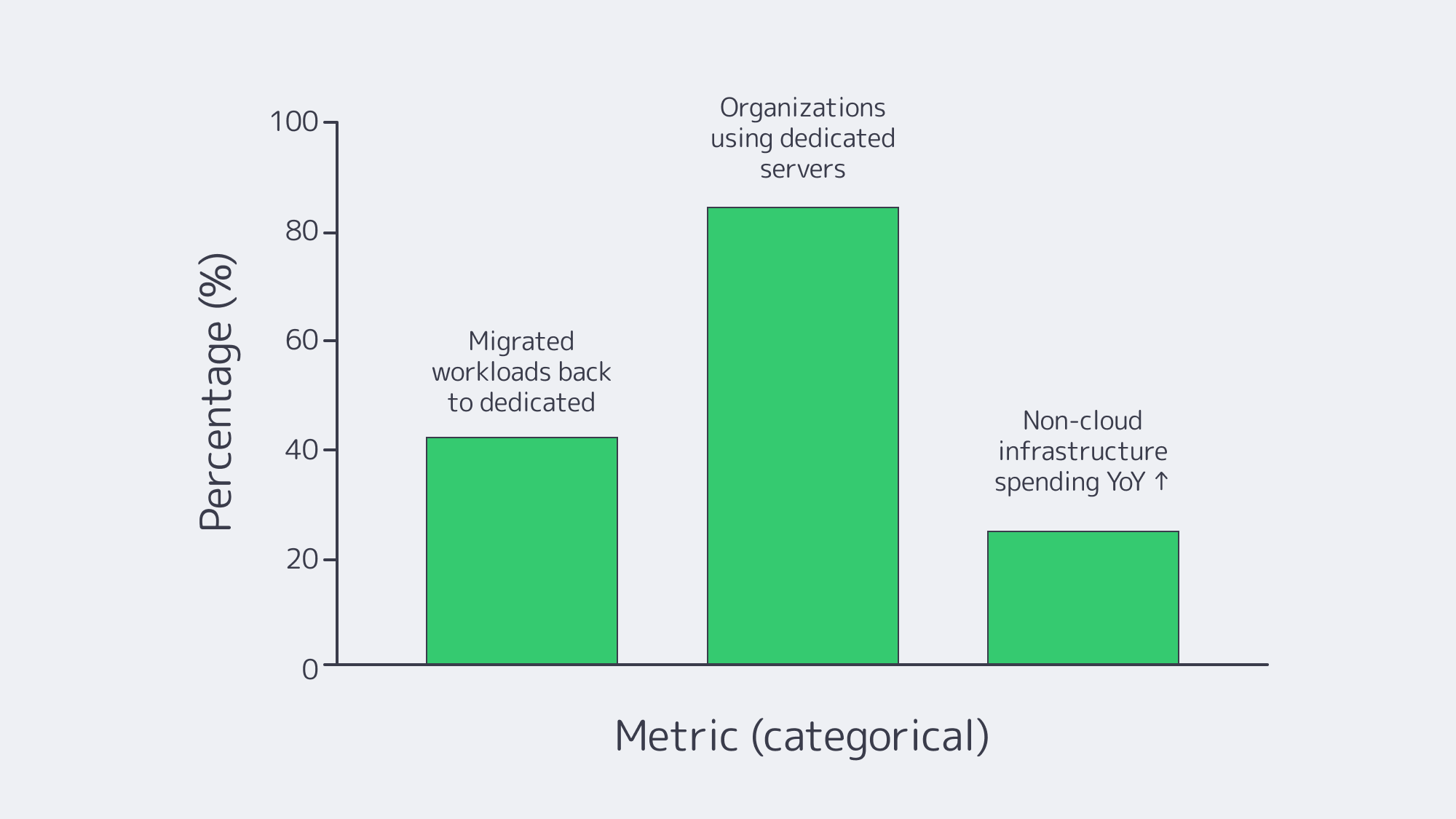
One thing is for sure: repatriation is happening at scale. Recent research reports that 42% of organizations moved workloads from public cloud to dedicated servers in the previous 12 months. The driving factors behind this decision were, firstly, full control and customization, followed by performance, compliance, and predictable pricing, with 86% stating they already run dedicated servers in their mix.
Quite often, budget dynamics are at the heart of most business decisions. As ERP stacks are always‑on and transaction‑heavy, metered pricing plans often mean unexpected costs soaring. With dedicated capacity, you can simplify forecasting; a successful month doesn’t come with the caveat of added costs or anxiety.
When you examine spending patterns, the trend in return to dedicated infrastructure also tracks. The IDC identified a 25.8% year‑over‑year jump in non‑cloud infrastructure spending in a recent quarter. So, organizations are clearly re‑investing in single‑tenant capacity.
How Performance Improves with ERP Hosting on Dedicated Servers
While many think of performance in terms of speed, in reality it is more about consistency under load. By having your ERP hosted on dedicated infrastructure, you have no noisy neighbors or a hypervisor taxing your database, and your app servers own 100% of the cores, RAM, and I/O. This brings the following benefits:
- Deterministic latency. With a dedicated ERP host, you have full control throughout the pipeline, allowing you to orchestrate CPU scheduling, NUMA policy, NVMe layouts, and network paths. This means you can run complex MRP, end‑of‑period closes, and large exports at line rate.
- Right‑sized bandwidth. Sustained throughput is needed for ERP that is integrated with e‑commerce, partner EDI, or BI platforms with decisive east‑west bandwidth. Melbicom can provide per‑server ports up to 200 Gbps to ensure database replication and object storage sync concurrency.
- Locality benefits. Round-trip times are significantly reduced with dedicated hosting because you can keep ERP placed close to users and data sources by choosing exact facilities and interconnects.
You are also ready to scale with ease on platforms with well‑known scale‑up behaviors, such as Odoo server deployments or Epicor servers tuned for heavy financials. A dedicated server ensures cores, memory, and NVMe can be packed to yield measurable improvements. This is also true in the case of Infor server reporting or keeping a Sage X3 print server isolated to prevent batch document generation from throttling OLTP.
Control and Customization Payoffs
With a dedicated server, you get much more control than cloud providers typically allow. Although their instance menus are broad, freedom is limited. The dedicated hosting route allows you to:
- Run OS and database versions certified by your ERP, even if modules demand specific kernels or drivers.
- Shape topology: You can separate apps, DB, and integration nodes across servers, pin cores for JVMs or .NET runtimes, and choose RAID levels to complement traffic.
- Install numerous deep integrations, such as factory OPC-UA gateways, Epicor Spreadsheet Server, without any restrictions.
Control and customization rank highly as driving factors behind dedicated server choice in surveys, with 55% of organizations giving it as their primary reason. ERP roadmaps buried under hyperscalers’ abstraction layers make compliance much trickier.
ERP Nuances & Requirements: Odoo, Workday, etc.
- Odoo requirements: With a dedicated server, you can scale Odoo cleanly. Postgres, workers, and caches can be separated, CPU affinity can be tuned for long‑running jobs, and write-intensive modules can be facilitated by using NVMe.
- Workday server integrations & locations: When integrating with Workday’s SaaS endpoints, place your dedicated ERP or data hub close to the workday server locations your tenant uses to minimize egress and meet residency requirements.
- IFS server / Infor server: Single-tenancy provides better performance for latency‑sensitive shop‑floor connectors and on‑prem MES links.
- Epicor server & Epicor Spreadsheet Server: Reporting and Excel‑access paths can be kept on the same low‑latency network paths as the ERP database, preventing throttling.
- Sage X3 print server: You can prevent your transactional cores from being affected by document bursts by decoupling print/report generation.
Simplifying Compliance Audits Through ERP Platform Isolation
Dedicated ERP hosting is single‑tenant by design, reducing the risks associated with multitenancy and making compliance far simpler by default. The isolation clarifies and satisfies audit boundaries:
- Demonstrable data residency: Instead of auditors having to infer geography from cloud “regions,” you can prove the location because you can choose it. Melbicom has Tier III/IV facilities sited across multiple continents, which enables you to deploy and match jurisdictional policy.
- Verifiable access control: You have sole ownership, so all admin accounts, logging, network ACLs, and change windows align with your ERP release cadence.
- Auditability: You can easily test and present asset tags, topology diagrams, and jump‑host policies.
Dedicated environments meet privacy and oversight demands, and the preference is also prevalent in survey responses, where organizations shared that they avoid putting their most regulated data in public clouds.
The Practical Differences Between Cloud and Dedicated for ERP?
| Aspect | ERP on Dedicated Server | ERP on Public Cloud |
|---|---|---|
| Performance | Exclusive cores, RAM, and NVMe; no “noisy neighbors.” Deterministic latency for OLTP and batch. | Shared, virtualized resources; performance can fluctuate with contention and throttling. |
| Customization | Full control over OS/DB versions, middleware, and topology (e.g., separate Odoo server DB/app tiers). | Constrained to provider‑approved images, services, and shapes; limited kernel/driver control. |
| Compliance & Data Location | Single‑tenant isolation; choose exact jurisdiction; easier audit trails. | Multi‑tenant by default; residency and isolation depend on provider controls and shared‑responsibility models. |
| Cost Predictability | Fixed monthly/annual pricing; high utilization doesn’t spike the cost. | Metered charges for compute/storage/egress; surges and analytics/AI runs can trigger bill shocks. |
The above table highlights differences for ERP hosting that make an impact.
Decision‑Making Takeaways for ERP
- Performance prioritized: Consistent throughput and low latency are provided with a dedicated server hosting, which is important for mixed OLTP + analytics/integrations.
- Compliance is built in: Single tenancy means isolation from the get-go, and explicit geography helps simplify audits while satisfying data‑sovereignty obligations.
- Strategic control: Dedicated setups have structures that align well with ERP roadmaps, such as custom kernels, database versions, and topology choices.
- Predictable costs: There are no nasty surprises for always‑on ERP with fixed pricing that trumps metered options with AI features at scale.
- Trends speak volumes: Surveys show many teams have moved or are moving workloads back to dedicated servers. There is also a spike in re‑investment in non‑cloud hosting infrastructure.
Operational Moves

With data residency rules overhead, if you are looking to modernize your ERP and leverage the latest AI, you need a safe infrastructure. The verifiable isolation, full control, and transparent reporting of dedicated servers provide the safest option and satisfy auditors. The performance they offer also brings operational advantages, ensuring smooth core transactions and a large tuning surface for laying down AI pipelines without the costs spiralling. With the security offered, we are seeing many organizations reverse the shifts they once made over to the cloud after losing control.
Melbicom’s globally distributed, certified facilities have a design that is ideal for high‑throughput ERP for those bound by strict compliance, with workloads that incorporate the latest AI assistance. We can rapidly provision and have a network built for sustained loads, with hybrid footprint setups available. We can keep ERP isolated at the origin while our CDN layer (in 39 locations) pushes static assets to the edge.
Deploy ERP on Dedicated Servers
Provision dedicated, compliant infrastructure for ERP with predictable performance and costs. Choose global data centers and high‑bandwidth ports, backed by 24/7 support.