
Blog
Dedicated Server United States: East vs. West, SLAs, and Cost Control
Buying a dedicated server in the United States is no longer a coastal shortcut. The old rule – East for Europe, West for Asia, one region for savings – breaks once dynamic APIs, replication traffic, media control planes, and recovery events carry real cost. Microsoft’s Azure latency tables put scale on the problem: representative median RTTs are about 73 ms from East US to West US, 79 ms from East US to UK South, 107 ms from West US to Japan East, and 147 ms from West US to UK South.
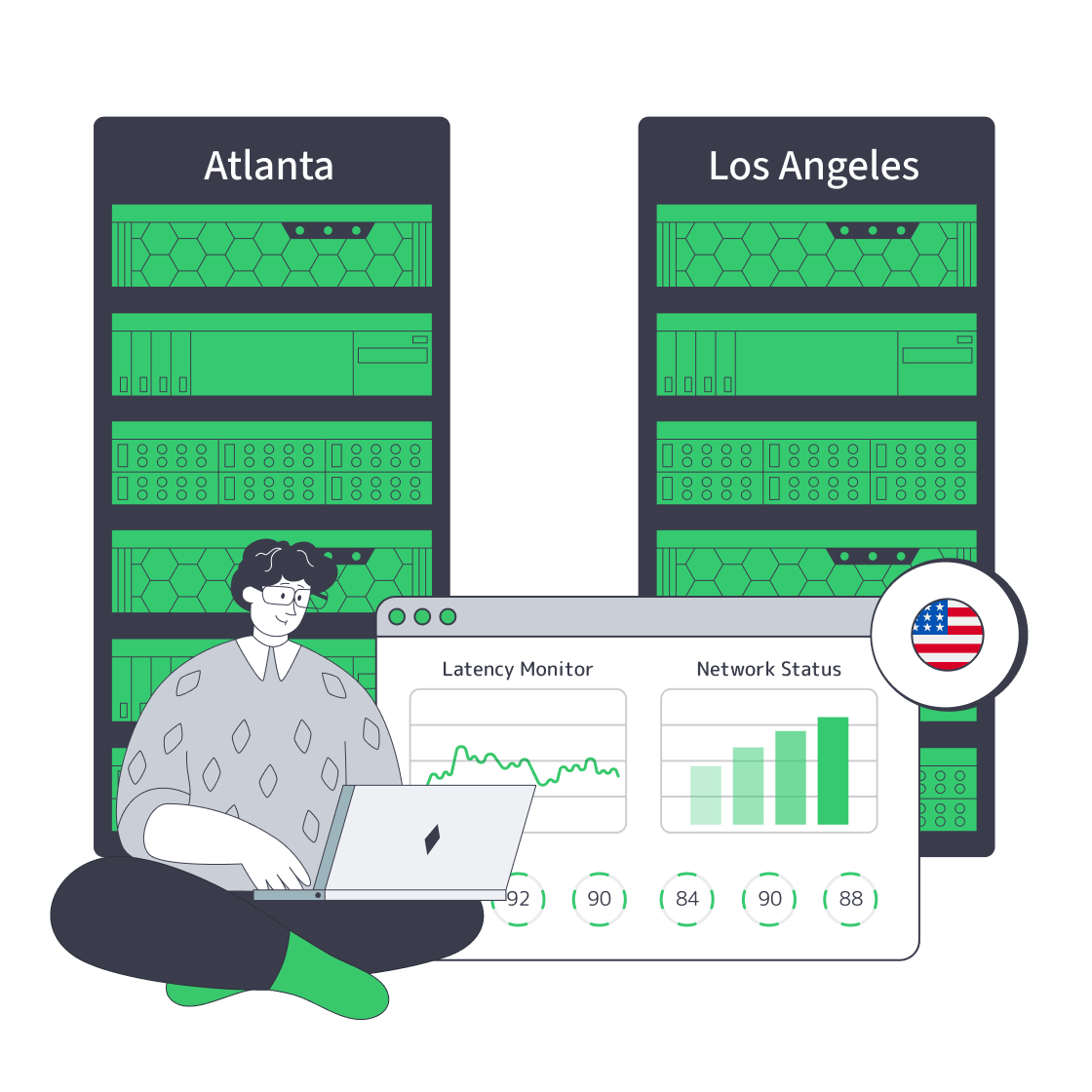
Melbicom makes the decision concrete: Atlanta and Los Angeles, both are Tier III facilities, with per-server bandwidth up to 200 Gbps in Atlanta and 200 Gbps in Los Angeles, control panel, API, KVM, IPMI, and bandwidth and data-transfer filters. The framework is simple: place latency-sensitive work first, decide whether the second coast is for performance or disaster recovery, then optimize the bill.
Choose a U.S. Coast— Atlanta or Los Angeles — Up to 200 Gbps in Atlanta; 200 Gbps in LA — Ready or custom builds |
 |
How to Choose East vs. West for a Dedicated Server in the United States
Choose east or west by locating the traffic that cannot hide behind a cache: writes, authentication, API calls, operator actions, and hard dependencies. East usually fits Europe-adjacent and Eastern/Central U.S. demand; West fits Pacific and Asia-facing paths. When both matter, assign each coast a role instead of chasing a single compromise metro.
The table uses Microsoft medians, not Melbicom measurements, as a proxy for the routing penalty distance still imposes.
| Representative Pair From Published Tables | Median RTT | Buying Implication |
|---|---|---|
| East US to West US | 73 ms | Coast-to-coast synchronous write paths will feel it immediately. |
| East US to UK South | 79 ms | An eastern U.S. location keeps Europe-linked traffic materially closer. |
| West US to Japan East | 107 ms | A western U.S. location is the better Pacific-facing launch point. |
| West US to UK South | 147 ms | Serving Europe from the West adds a substantial trans-U.S. penalty first. |
For a dedicated server in the United States, east vs. west is shorthand for the long-haul penalty on every uncached request. Single-region placement should remove the most expensive user-visible path. Once both paths matter, split roles across coasts instead of forcing one metro to impersonate the country.
Mapping Latency and Service-Level Targets to a Dedicated Server in the United States
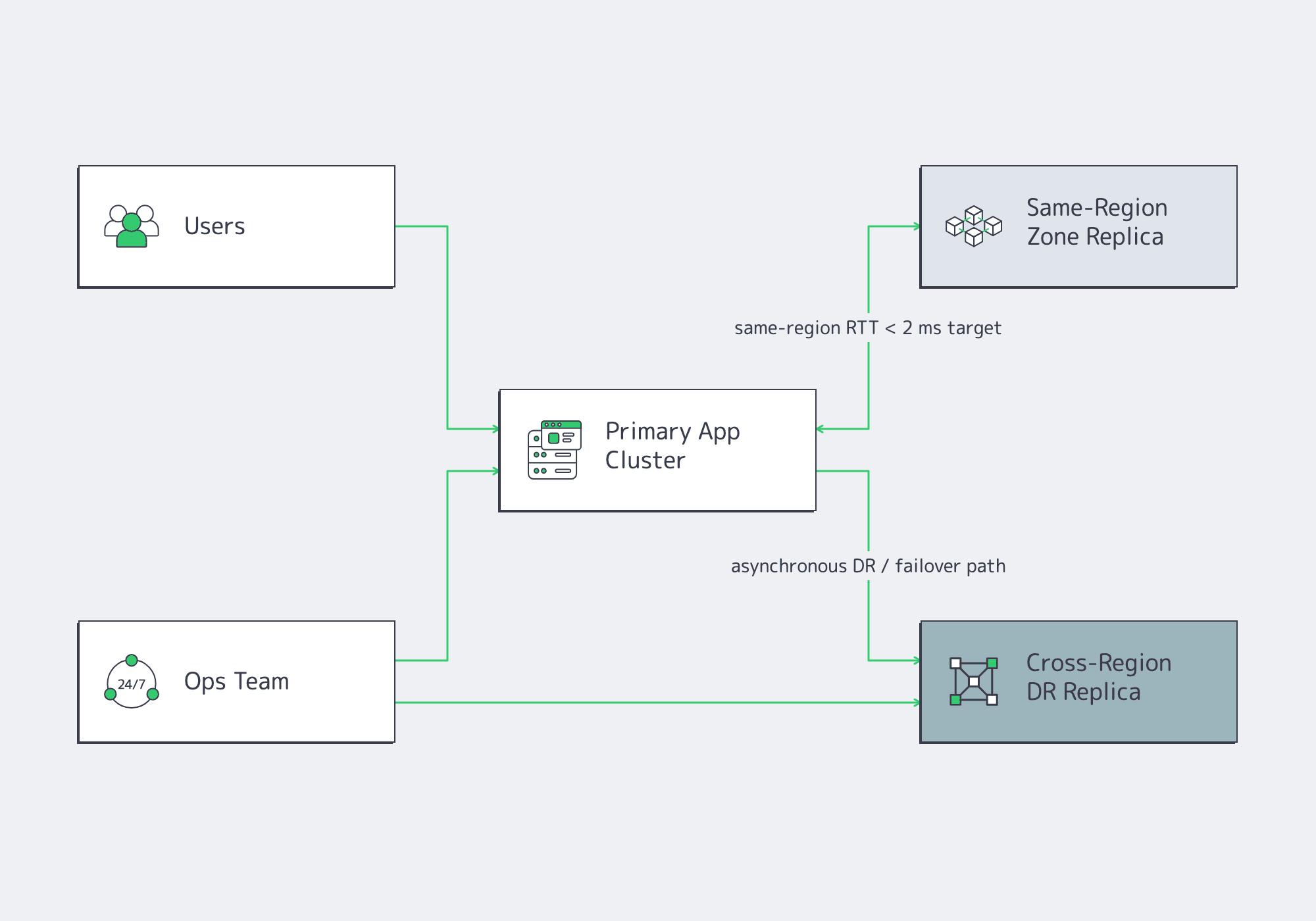
Map the server plan to internal service targets: p95 latency, recovery time, and acceptable data loss. Keep synchronous replicas and quorum-heavy services near each other, where regional latency can stay low. Use coast-to-coast links for disaster recovery, read locality, stateless absorption, and staged failover, not default chatty writes.
Microsoft says availability zones target inter-zone round-trip latency below roughly 2 ms, recommends multiple availability zones for production workloads, and points mission-critical workloads toward multi-zone plus multi-region architecture. That is the line: same-region zones can protect tightly coupled systems; coast-to-coast replication is a different operating mode.
The economic case is just as sharp. Uptime Institute reports that 54% of respondents said their most recent significant outage cost more than $100,000, while one in five put the figure above $1 million. At that price point, a second region stops looking like decorative redundancy and starts looking like usable insurance.
When Multi-Region Replication Is Worth It for SaaS, Media, and API Backends
Multi-region replication is worth it when it reduces real user latency, contains outage cost, or lets a national platform absorb uneven demand without sending every transaction across the continent. SaaS decisions hinge on write authority, media decisions on origin pressure, and API decisions on dynamic ingress and state boundaries.
SaaS
For SaaS, the decisive variable is where the write path lives. If users, support teams, and core transactions lean eastward, keep primary writes there and use the opposite coast for asynchronous disaster recovery, read locality, search copies, object replication, and fast failover capacity. Cross-region replication becomes wasteful when it turns a transactional database into active/active behavior before the application can resolve conflicts.
Media
For media, the old one-origin-plus-CDN pattern is weaker than it looks because manifests, entitlement checks, live spikes, and packaging pipelines do not cache away cleanly. AppLogic Networks says video remains the largest application category by volume, users download an average 5.6 GB per day, and live-streamed sports can spike traffic 3-4x above normal usage. Place origins and control planes near the heaviest egress region, keep the opposite coast warm, and use CDN plus object storage so origins carry less.
API Backends
For API backends, a second coast becomes useful early because traffic is dynamic and often impossible to hide behind cache. Postman’s API report says 82% of organizations use some level of API-first development, 65% generate revenue from APIs, 46% plan to increase API investment, and 93% still struggle with collaboration. A practical east-to-west split is active/active stateless ingress, local queues and caches, and one deliberate source of truth for mutable state unless the platform can reconcile active/active writes.
US Dedicated Hosting Checklist: Carriers, Bandwidth Caps, and Remote Console
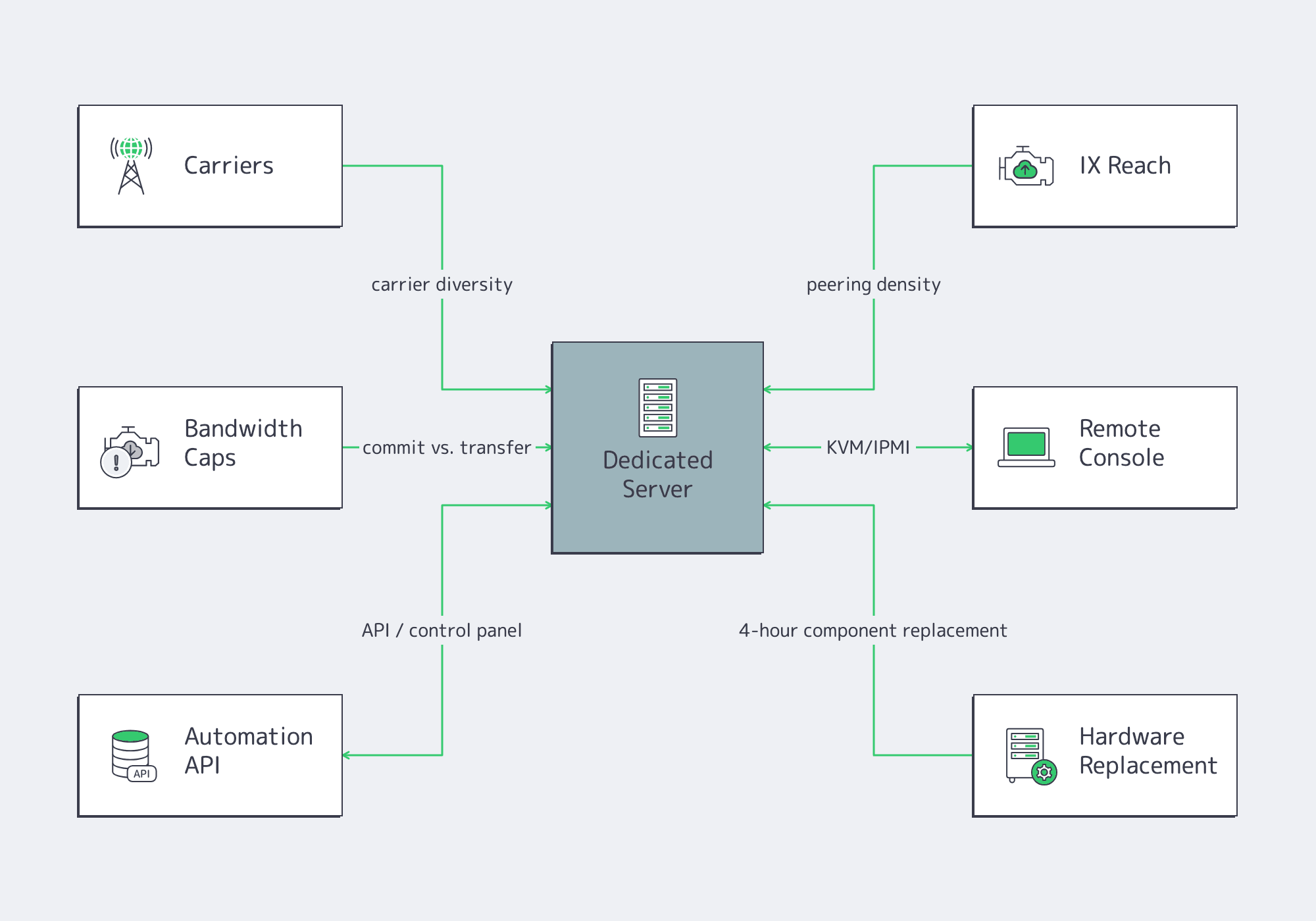
Do not buy a U.S. dedicated server by port speed alone. Route quality comes from carrier diversity, peering density, transfer model, and operational tooling. Verify network reach, translate bandwidth into monthly volume, confirm remote console and automation access, and know the hardware-replacement path before the incident starts.
The Internet Society explains why peering and IX participation matter: they shorten routes, reduce latency, and lower cost. PeeringDB shows a dense exchange presence in Los Angeles, including Any2West with 266 peers and BBIX US-West with 82 peers; Atlanta also has exchange options, including CIX-ATL and Equinix Atlanta. The right question is which metro matches your upstreams, eyeball networks, partners, and CDN paths.
Bandwidth caps are where cost control becomes math. One gigabit per second sustained for 30 days is about 324 TB; 10 Gbps is about 3.24 PB; 40 Gbps is about 12.96 PB. Port speed, commit, bundled transfer, and metered traffic are different decisions. Operational readiness is just as concrete: remote console plus automation is how teams recover from a bad kernel, bootloader, or network change without waiting in a ticket queue. Melbicom’s U.S. pages advertise control panel, API, KVM, IPMI access, and replacement of failed server components within 4 hours.
| U.S. Location | Melbicom’s Current Ready-to-Go Range | Planning Signal |
|---|---|---|
| Atlanta | 28 configurations; Intel Xeon E5 v4 and Scalable G1-class CPUs; 32-256 GB RAM; 1-40 Gbps bandwidth with 50 TB or unmetered plans; public location network options up to 200 Gbps per server. | East/Southeast anchor for primary writes, Europe-adjacent traffic, analytics, and DR counterpart to Los Angeles. |
| Los Angeles | 35 configurations; Intel Xeon E5 v4 and Scalable G1-class CPUs; 128-256 GB RAM; 1-40 Gbps bandwidth with 50 TB or unmetered plans; public location network options up to 200 Gbps per server. | West/Pacific anchor for media origins, API ingress, APAC-facing routes, and DR counterpart to Atlanta. |
Custom server configurations can be deployed in 3–5 business days when the ready-to-go list does not match the workload. Where BGP matters, evaluate support for announcing your IP networks and route-change operations; routing features should complement, not replace, a tested disaster-recovery runbook.
Cost Control for a Dedicated Server in the United States
Cost control is topology discipline, not a hardware shopping exercise. The efficient U.S. design often starts with one authoritative region, then adds a narrow second region for stateless ingress, caches, replicated assets, and recovery capacity. That captures latency and resilience gains without paying a permanent active/active tax.
For media, move cacheable bytes to CDN before buying more origin port speed. For SaaS, split transactional writes from analytics, exports, search indexing, and file distribution before mirroring the whole stack. For APIs, split ingress east/west before splitting every database east/west. These choices keep the bill rational while improving user experience.
Use this sequence before committing spend:
- Put the primary write path on the coast where interactive users, operator actions, and latency-sensitive dependencies already live.
- Keep synchronous replication inside one region; treat coast-to-coast links as disaster recovery, read locality, or stateless traffic distribution unless active conflict handling is already built.
- Add the second coast when outage cost, national user spread, or Pacific- versus Europe-facing traffic patterns justify it.
- Price network capacity by monthly transfer volume and event peak shape, not by the port label.
- Validate carrier and IXP quality with tests from each metro, because peering depth turns advertised capacity into usable performance.
- Require remote console and automation from day one; API plus KVM/IPMI is resilience, not an upsell.
- Replicate only the layers that buy latency or recovery: cacheable media to CDN, assets to object storage, stateless ingress to both coasts, and stateful tiers only as far as service targets require.
Applying the Framework to Melbicom’s USA Dedicated Server Options
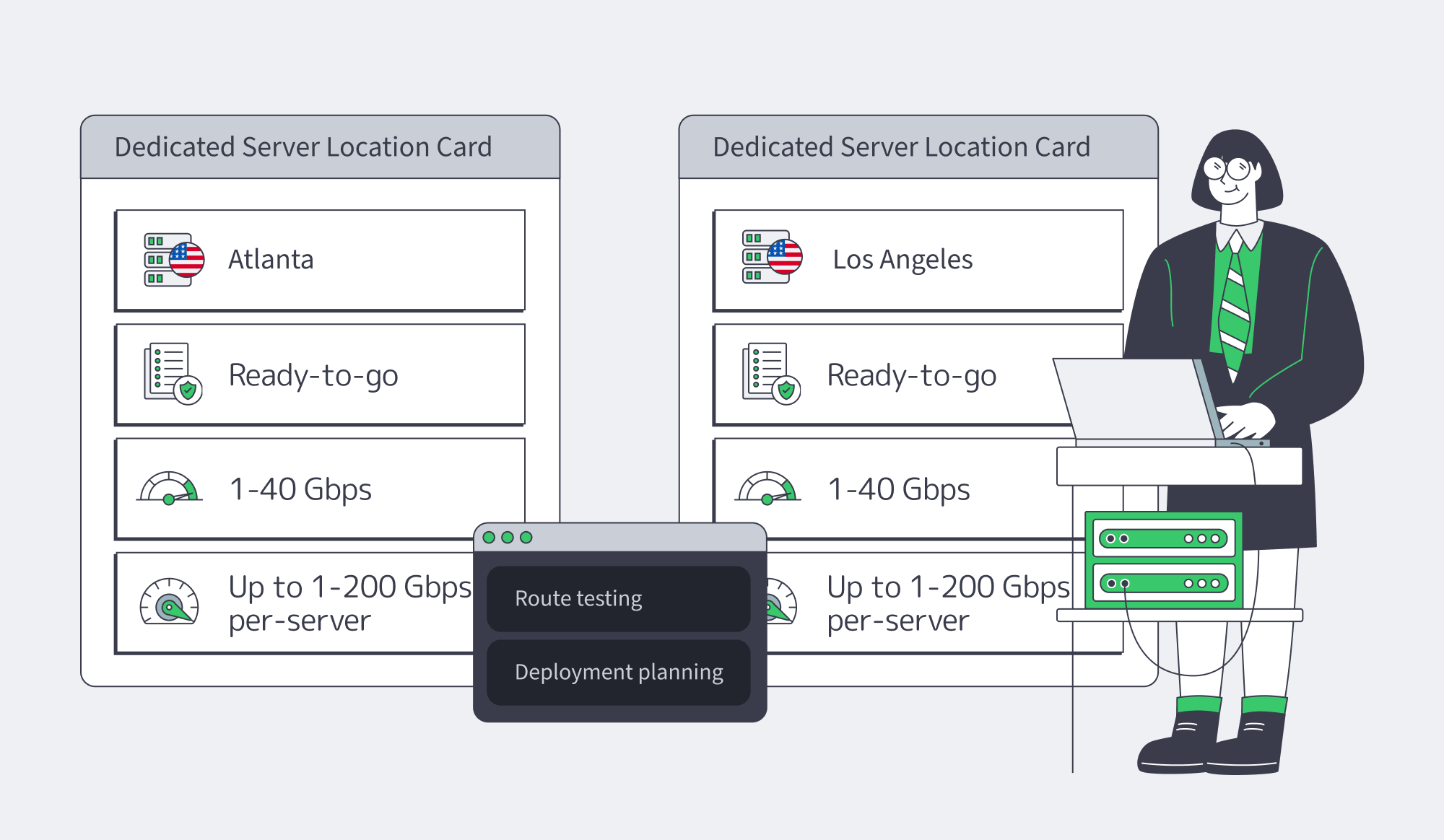
Melbicom makes the framework practical by giving U.S. buyers two real placement choices: Atlanta and Los Angeles. Use those metros to test routes, model transfer economics, decide whether disaster recovery needs a second coast, and validate operational readiness before the architecture hardens.
At Melbicom, our global footprint includes 21 data centers, including those U.S. metros, alongside 1100+ ready-to-go configurations, 23 transit providers, 29 IXPs, 14+ Tbps of network capacity, and a CDN footprint in 39 CDN PoPs across 35 countries. Start with the coast that protects user latency, then add the opposite coast when recovery design or traffic mix proves the need.
Compare USA Servers
Compare Atlanta and Los Angeles options for routes, bandwidth, and recovery.