
Blog

Dedicated Servers in Spain: A Buyer’s Guide to Location, Network and Workload Fit
Searching for a dedicated server in Spain gives you a country filter. Production infrastructure requires more: a verified physical location, measurable routes to Spanish users, hardware matched to actual workloads, and acceptance criteria that can disqualify an unsuitable offer.
According to CNMC’s June 2026 report, 91% of Spain’s fixed-broadband lines used fiber-to-the-home at the end of 2025. Even with fast access, congestion, routing changes, and application bottlenecks can slow responses. Server selection therefore needs to account for the paths to Spanish users and the application’s behavior under load.
The buying question is straightforward: Will this specific Spanish deployment meet the performance requirements of the users and applications it must serve?
Servers in Spain– 80+ ready-to-go configs – Tier III DC in Madrid – Metered and unmetered traffic |
 |
Which Requirements Should Guide Dedicated Server Selection in Spain?
Dedicated server selection in Spain should follow four acceptance gates: verified physical location, measured routes to priority user networks, hardware performance under realistic peak workloads, and operational readiness. Each candidate should satisfy predefined latency, capacity, and deployment requirements. Reject configurations that cannot demonstrate acceptable performance before production cutover.
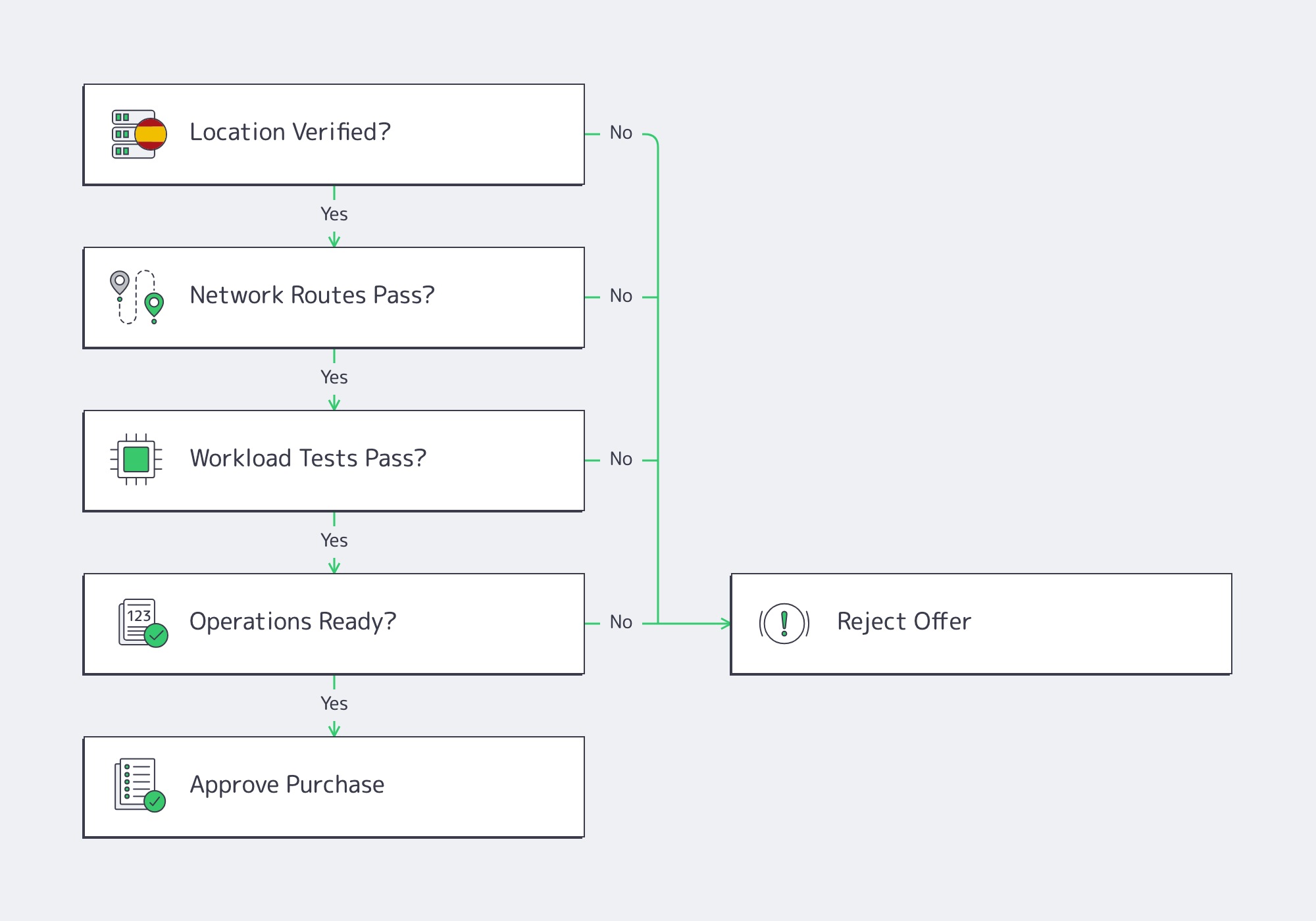
Four Acceptance Gates
Location. Verify the actual hosting city rather than accepting a generic country label. Confirm that the ordered server, pre-sales test endpoint, and provisioned machine correspond to the intended metro.
Network. Measure routes from the access networks carrying your users. Two servers in Madrid can produce different latency distributions because of transit, peering, congestion, and return-path differences.
Workload. Define success through application outcomes: requests per second within a p99 latency budget, database transactions without I/O stalls, or batch jobs completed within their processing window. Google’s SRE guidance emphasizes high-percentile latency because averages conceal performance degradation.
Operations. Confirm inventory, provisioning windows, support access, and recovery procedures. Establish who handles hardware failures, software administration, backups, and restoration, and ensure the deployment schedule accommodates the required operational checks.
Start with a measurable requirement: “The production API must handle forecast peak traffic plus a defined growth and burst margin while maintaining its existing p99 response-time objective.” That statement determines what to test and prevents procurement from becoming a comparison of impressive specifications.
Location, Network and Workload Fit
Compare a confirmed physical city with timestamped measurements from priority user networks, then test candidate hardware against the application’s peak workload and latency objectives. A location label, exchange membership, or specification sheet cannot prove production fit. Approve only when the ordered deployment and its measured behavior meet your documented acceptance criteria.
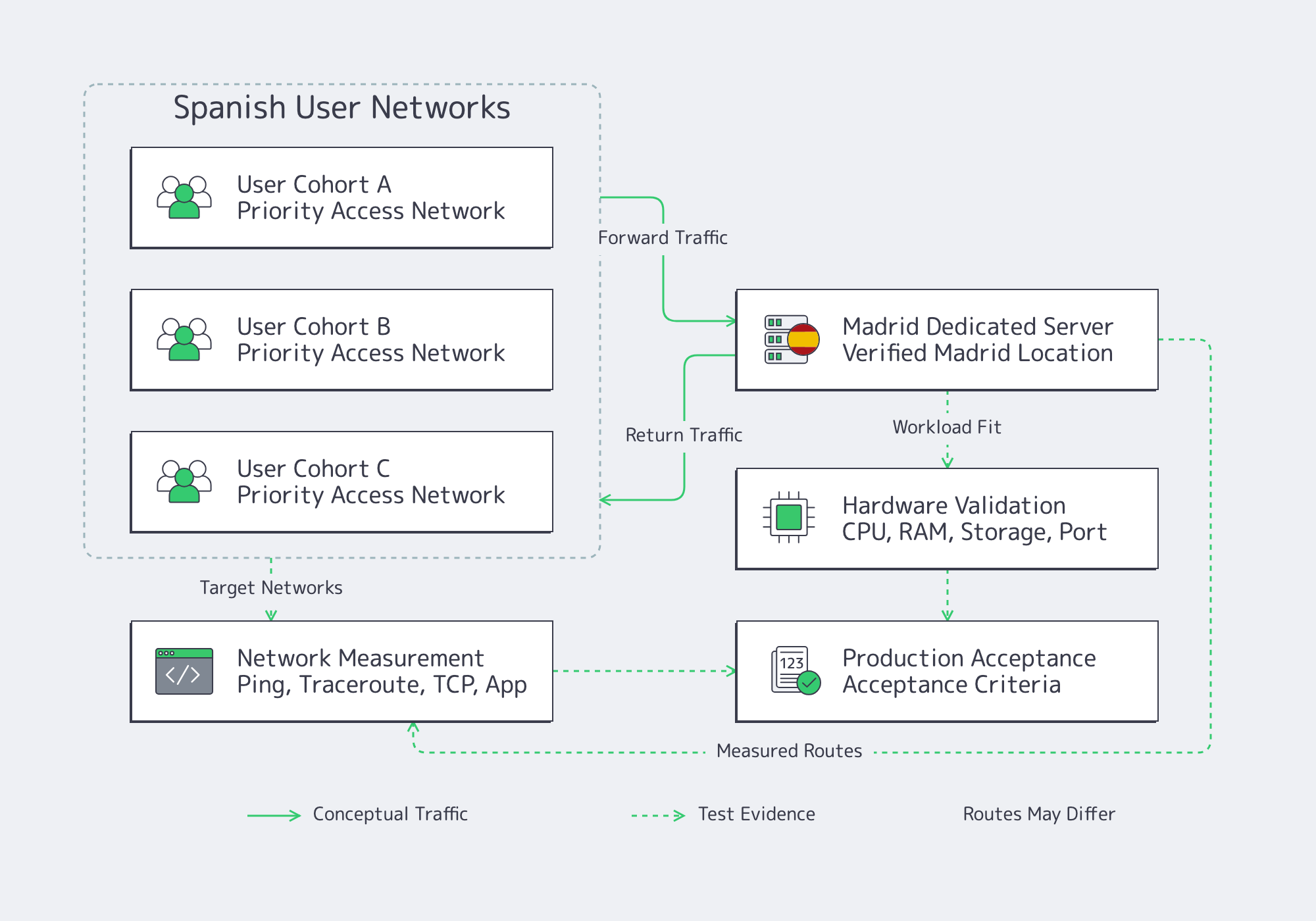
Madrid is a substantial interconnection market, making it a practical location to evaluate for applications serving Spanish users. The relevant question is how a specific deployment reaches the networks carrying those users, particularly during busy periods.
Spanish Server Network Evaluation: Test the Networks That Matter
Actual traffic paths depend on routing arrangements, so network evaluation should measure the routes used by the intended application. Shared exchange presence creates opportunities for local interconnection, but route measurements establish how traffic actually travels.
Build a test population from application logs. Map client IP addresses to autonomous systems and prioritize networks carrying most of your Spanish traffic, then include networks serving business-critical customers.
When internal telemetry is unavailable, national market data offers a starting point. CNMC reported that four major operator groups represented 93.7% of Spanish fixed-broadband lines in December 2025.
Use RIPE Atlas for recurring ping and traceroute tests from target networks. Collect p50, p95, and p99 RTT, packet loss, and IPv4/IPv6 behavior across busy and quiet periods.
Document probe locations, sampling intervals, sample counts, aggregation methods, and measurement windows. High-percentile results are meaningful only when the sample population and methodology are sufficiently representative.
Measure TCP connection time, TLS negotiation, time to first byte, and application response latency separately. ICMP measurements cannot expose application queueing, and traceroute cannot establish route symmetry.
For throughput, iperf3 supports controlled tests. Use adequately provisioned endpoints, multiple flows where appropriate, and CPU monitoring to distinguish network limitations from endpoint bottlenecks.
Spain Server Workload Fit
Hardware selection should follow measured workload behavior.
For interactive APIs, compare per-core performance, concurrency, and p99 latency at peak load. For databases, prioritize active working-set memory and storage latency under representative read/write patterns.
The fio testing framework measures IOPS, throughput, and completion-latency percentiles. Reproduce production block sizes, queue depths, concurrency, and read/write ratios rather than relying on sequential throughput figures.
Caching workloads may primarily need RAM. Batch processing emphasizes completion time. Download origins need sustained storage throughput and network goodput. Consolidated services require tests that reproduce simultaneous peaks.
For an API expecting significant growth, a useful capacity test is to replay forecast peak traffic plus a defined burst margin while monitoring p99 latency, CPU utilization, memory pressure, and error rates. Select the margin from traffic variability, expected growth, and the service’s ability to absorb sudden demand.
Set Workload and Service Acceptance Thresholds Before Approving a Hosting Offer
Approve a dedicated server in Spain against documented production requirements, not specifications alone. Establish workload-specific latency, throughput, utilization, and recovery thresholds before testing. Record the evidence, responsible owner, and rejection condition for every gate. Production SLOs, measured baselines, and forecast demand should determine final approval.
Dedicated Server Acceptance Worksheet
Each owner should document test evidence and approve or reject the relevant gate. Establish thresholds from the production baseline and the application’s requirements.
| Decision Gate and Owner | Acceptance Criteria and Required Evidence | Reason to Reject |
|---|---|---|
| Physical location — Infrastructure lead | Madrid confirmed; order details, test endpoint, and provisioned server consistent with intended metro | Only country-level location disclosed or deployment differs |
| User-path network — Network engineer | Priority Spanish user cohorts meet the application’s p95 RTT budget and packet-loss tolerance. Evidence: timestamped measurements by ASN, compared with the incumbent | Material user cohorts exceed their latency budget or experience persistent application-impacting loss |
| Routing — Network engineer | IPv4/IPv6 paths remain within latency budgets across busy and quiet periods. Evidence: recurring traces and application timings | Recurring detours cause p95/p99 regressions |
| Port throughput — Network engineer | Controlled tests demonstrate sufficient sustained throughput for forecast peak egress and concurrent transfers. Evidence: iperf3 results, endpoint capacity, CPU utilization, and test parameters | Achievable throughput cannot support required traffic after endpoint limitations are excluded |
| Application CPU — Application owner | Forecast peak and required burst margin pass with p99 inside SLO and sufficient CPU headroom. Evidence: load-test traces | Latency target fails before required peak or CPU contention causes unacceptable queueing |
| Memory — Application owner | Peak working set, caches, and background processes fit within RAM without sustained swapping or latency-damaging reclaim. Evidence: memory telemetry | Memory pressure or swapping causes application latency or reliability failures |
| Storage — Database or storage owner | Representative fio workload meets application p99 latency, IOPS, and throughput requirements under expected concurrency | Storage latency deteriorates at expected concurrency |
| Operations — Infrastructure lead | Inventory, provisioning, support, deployment, restore, and recovery procedures verified. Evidence: order confirmation and recovery-test results | Required configuration or recovery procedure cannot be confirmed |
Network acceptance should reflect the locations and access networks serving actual users. Measurements from controlled mainland-Spain probes toward Madrid can establish a useful baseline, but they do not substitute for application measurements from the intended client population.
Similarly, ICMP packet loss requires corroboration through TCP retransmissions and application errors. High-speed throughput tests may require multiple concurrent flows.
Most importantly, retain the rejection column after shortlisting. An attractive price cannot compensate for a route that repeatedly misses the latency budget or hardware that saturates before forecast peak.
Matching Spain Servers to Workloads
Once route testing supports a Madrid deployment, use Melbicom’s Spain configuration catalog to shortlist servers by CPU, RAM, storage, bandwidth, data transfer, and price.
Memory illustrates why workload measurements matter. An application comfortably using 64 GB gains little from purchasing 256 GB without a corresponding requirement. A database with a 110 GB active working set, however, may find 128 GB insufficient for comfortable operating headroom, making a higher-memory configuration worth evaluating.
Network sizing follows the same logic. A service averaging 400 Mbps but bursting to 4 Gbps during releases requires a different configuration from one with steady traffic. Account for overlapping backups, replication, and application egress.
Our Madrid location supports per-server networking up to 40 Gbps. Match the port to your peak traffic, then choose traffic terms for the expected transfer volume.
For transfer-heavy workloads, our Spain unmetered dedicated-server options provide another configuration path to evaluate alongside expected traffic economics. Select the port speed and traffic terms appropriate to the workload.
The Final Buying Decision for Spain

A dedicated server in Spain is production-ready only when its physical location, routes to important user networks, hardware capacity, and operational requirements have passed explicit acceptance tests.
The essential buying rules are:
- Prioritize the cohorts that matter. Build network tests around actual Spanish user traffic and business-critical applications rather than national averages alone.
- Test simultaneous workload peaks. Validate application latency, database I/O, background jobs, and network egress together when they share hardware.
- Separate advertised capacity from measured delivery. Facility network capacity, port rates, and application throughput are different measurements.
- Make recovery part of procurement. Define backup ownership, restoration objectives, and operational responsibilities before scheduling migration.
- Preserve the right to reject. A configuration that misses a critical production threshold should not pass merely because its location, price, or specifications appear attractive.
The right configuration need not be the largest or fastest advertised. It must meet measurable requirements with enough headroom for changing demand.
Explore Dedicated Servers in Spain
Melbicom offers dedicated servers in Spain from Madrid, with ready-to-go configurations and metered or unmetered bandwidth options.