
Blog
Dedicated Server Netherland: A Buyer Guide to Netherlands Hosting
“Dedicated server Netherland” may be grammatically imperfect, but the buying intent is clear: dedicated infrastructure in the Netherlands, often Amsterdam, with strong European connectivity and predictable performance.
The buying framework is routing, bandwidth, DDoS response, EU obligations, provisioning, and support—not spelling.
What Dedicated Server Netherland Searches Mean for Netherlands Hosting?
A “dedicated server netherland” search usually means the buyer wants a physical server in the Netherlands, commonly Amsterdam. The useful comparison is not linguistic: it is measured latency from target users, sustained bandwidth headroom, DDoS handling, GDPR processing terms, provisioning time, and 24/7 operational support.
Variants such as “Netherland dedicated server,” “Netherlands dedicated hosting,” and “Amsterdam dedicated server” may lead to the same shortlist, but SaaS, streaming, and database workloads need different latency, throughput, memory, and storage profiles.
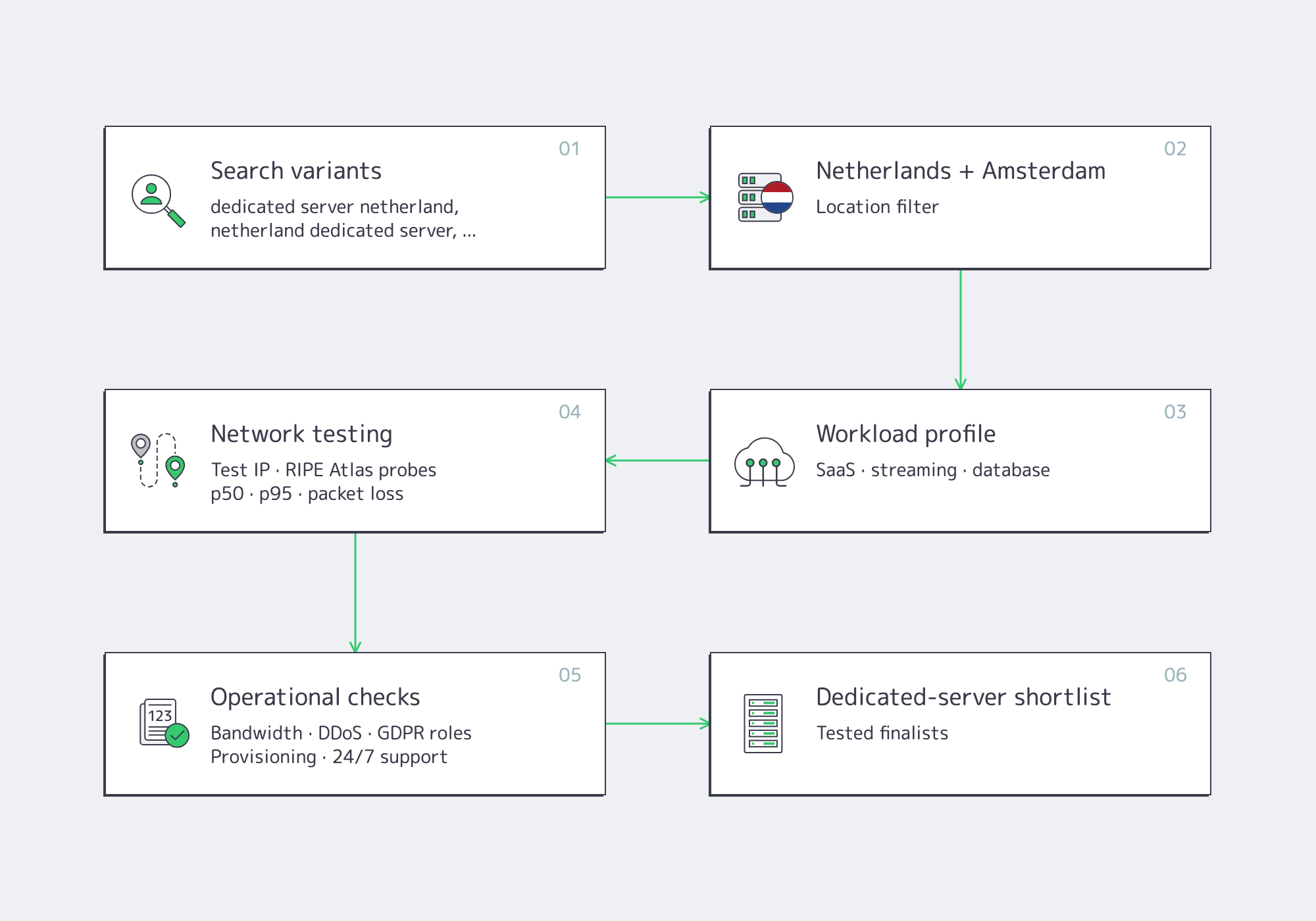
Document user regions, protocols, monthly transfer, peak throughput, storage writes, recovery requirements, and regulatory context before comparing hardware. Otherwise, headline core counts and port speeds can obscure routing, packet loss, traffic clauses, and support ownership.
Start with Melbicom’s Netherlands dedicated server options. Verify the facility, test IP, network path, inventory, and delivery window.
Dedicated hosting fits workloads needing exclusive resources, sustained network use, custom storage, or operating-system control. Because capacity scales in server-sized steps, include headroom for peaks, maintenance, and failover.
Amsterdam Connectivity, Bandwidth, and DDoS Requirements to Compare
For Amsterdam dedicated hosting, compare p50 and p95 round-trip time from real user networks, keep ordinary sustained traffic below roughly 70% of the selected port, and require automated DDoS mitigation before the uplink saturates. A faster port matters only when routing quality, traffic terms, and attack handling are equally clear.

AMS-IX reported that its Amsterdam platform carried 35.66 exabytes in 2025, connected 902 networks, reached a 14.2 Tbps peak, and had 69.57 Tbps of active port capacity. These figures show ecosystem density, not guaranteed performance for every server in the city.
Amsterdam Connectivity for a “Netherland Dedicated Server” Shortlist
Connectivity must be measured from the outside in. Each path depends on the user’s ISP, autonomous system, peering, transit, congestion, and routing policy; one office ping cannot represent multiple markets.
Test across weekday and weekend windows. RIPE Atlas can run ping, traceroute, DNS, TLS, and HTTP measurements from selected probes. Record median and p95 latency, loss, and path changes; LatencyMON shows latency over time.
Tail latency often matters more than the minimum: a 20 ms median with a 70 ms p95 can be less consistent than a stable 30 ms path. Investigate repeated p95 results above 1.5 to two times the median.
An Amsterdam test IP and downloadable test object are available on Melbicom’s data-center page. Melbicom’s network uses 29 Internet-exchange peering hubs and 23 transit partners, but buyers should still validate routes from their own source networks.
Amsterdam Servers– 300+ Amsterdam configurations – Up to 200 Gbps per server – Tier III & IV DCs in Amsterdam |
 |
Bandwidth Math Beyond the Advertised Port
Port speed, transfer allowance, committed rate, burst capacity, and billing model are separate variables. A 10 Gbps interface does not automatically permit continuous line-rate use; a smaller port may suit high volume with modest peaks.
The ceilings below assume uninterrupted line-rate transmission for 30 days, decimal units, and no Ethernet, IP, TCP, TLS, retransmission, or application overhead.
| Dedicated port | Thirty-day line-rate ceiling | Planning interpretation |
|---|---|---|
| 1 Gbps | 324 TB | Suitable when ordinary sustained traffic stays comfortably below 700 Mbps |
| 5 Gbps | 1.62 PB | Useful for multi-gigabit peaks or several high-volume services |
| 10 Gbps | 3.24 PB | Appropriate when measured delivery, replication, or recovery demand can use it |
The 70% threshold is planning headroom, not a universal standard. It leaves capacity for bursts, backups, replication, overhead, and growth. Ask four questions before ordering:
- Is the port dedicated to the server?
- Is transfer metered or unmetered?
- Is the advertised speed committed or merely burstable?
- What happens when a quota, percentile, or usage condition is exceeded?
The Amsterdam location supports per-server network capacity from 1 to 200 Gbps, while current configuration bandwidth plans span 1–100 Gbps with 50 TB or unmetered transfer options. Buyers can compare 1 Gbps unmetered, 5 Gbps unmetered, and 10 Gbps unmetered Netherlands configurations.
At multi-gigabit rates, benchmark realistic packet sizes, connection counts, TLS processing, storage throughput, and application workers. Small packets can be harder to process than the same bit rate of large sequential transfers, and iPerf alone misses the next bottleneck.
DDoS Protection for Real Attack Volumes
DDoS protection is an incident system, not a checkbox. Cloudflare reported 47.1 million attacks during 2025, up 121% year over year, with its largest disclosed attack reaching 31.4 Tbps for 35 seconds. The figures show why mitigation must begin upstream, before a server’s 1, 10, or 100 Gbps connection fills.
Confirm where detection occurs, whether mitigation is automatic, which protocols are covered, how clean traffic returns, and whether upstream capacity can saturate first.
Network filtering does not replace application defenses. Public APIs, login systems, and dynamic services still need rate controls and application-aware protection. Establish who adjusts filtering, how false positives are escalated, which telemetry is available, and which incidents remain the customer’s responsibility.
EU Data Location and Operational Controls
An Amsterdam server can support a European data-location strategy, but physical location does not make a workload GDPR-compliant. The buyer still determines lawful basis, processing roles, data flows, retention, access controls, security measures, and international-transfer mechanisms.
When the host processes personal data on the customer’s instructions, Article 28 terms must reflect the actual service. The European Data Protection Board expects controllers to track processors and subprocessors and verify sufficient guarantees. EU contractual clauses and EDPB guidance provide the framework.
Review who can access the server, where management systems and backups run, which subprocessors participate, and how data is deleted. A Netherlands server does not prevent transfers through remote access, logs, or backups elsewhere.
GDPR Article 33 can require controller notification to the supervisory authority within 72 hours of becoming aware of a qualifying breach. Contracts should define notification contacts, escalation, log access, evidence preservation, and investigation support.
The Dutch NCSC states that the Cybersecurity Act implementing NIS2 entered into force on August 15, 2026. In-scope organizations may face registration, security, risk-management, and incident-reporting duties, including an initial report within 24 hours. Applicability depends on entity, size, sector, and service—not server location.
Choosing Netherlands Dedicated Hosting
Choose Netherlands dedicated hosting by scoring the workload rather than the spelling variant: user geography, CPU and storage profile, p95 throughput, attack exposure, regulatory duties, delivery requirements, and support boundaries. Reject any option that lacks a test target, exact traffic terms, documented processing roles, or a clear route for urgent escalation.
Use a weighted scorecard, while treating serious security, compliance, or access failures as rejection conditions:
- Network fit — 30%: p50 and p95 latency, packet loss, route stability, and reachability from real user networks.
- Bandwidth economics — 20%: normal throughput, peaks, transfer volume, commitment, metering, and the next capacity tier.
- Security and DDoS — 20%: automatic mitigation, saturation behavior, protected protocols, telemetry, and escalation.
- Compliance fit — 15%: processing roles, subprocessors, transfer paths, incident notice, deletion, and evidence.
- Operational support — 10%: contact channels, engineering access, ownership, and out-of-hours coverage.
- Provisioning and hardware — 5%: CPU, RAM, storage, disk layout, port, OS, and delivery window.
Network receives the largest weighting because poor routes cannot be repaired inside the server. Hardware should follow the limiting resource: per-core speed, memory, compute throughput, or storage IOPS.
Test support before an incident. Ask a presales question about a route, traffic clause, disk-replacement process, or operating-system requirement, then assess whether the answer is specific and ownership is clear. Melbicom provides 24/7 support, with phone, email, and Telegram contact paths on our contact page; buyers should still confirm the boundary between infrastructure assistance, server administration, and application troubleshooting.
Provisioning affects the economics. Melbicom’s Amsterdam portfolio includes 300+ configurations across Tier III & IV DCs in Amsterdam, with Intel and AMD processors and 32–1,536 GB of RAM. Custom configurations are delivered in 3–5 business days.
A slightly oversized available server may be rational when launch delay is expensive; a custom build may be better when excess capacity would create years of recurring waste.
A Netherlands Dedicated Server Decision That Holds Up in Production
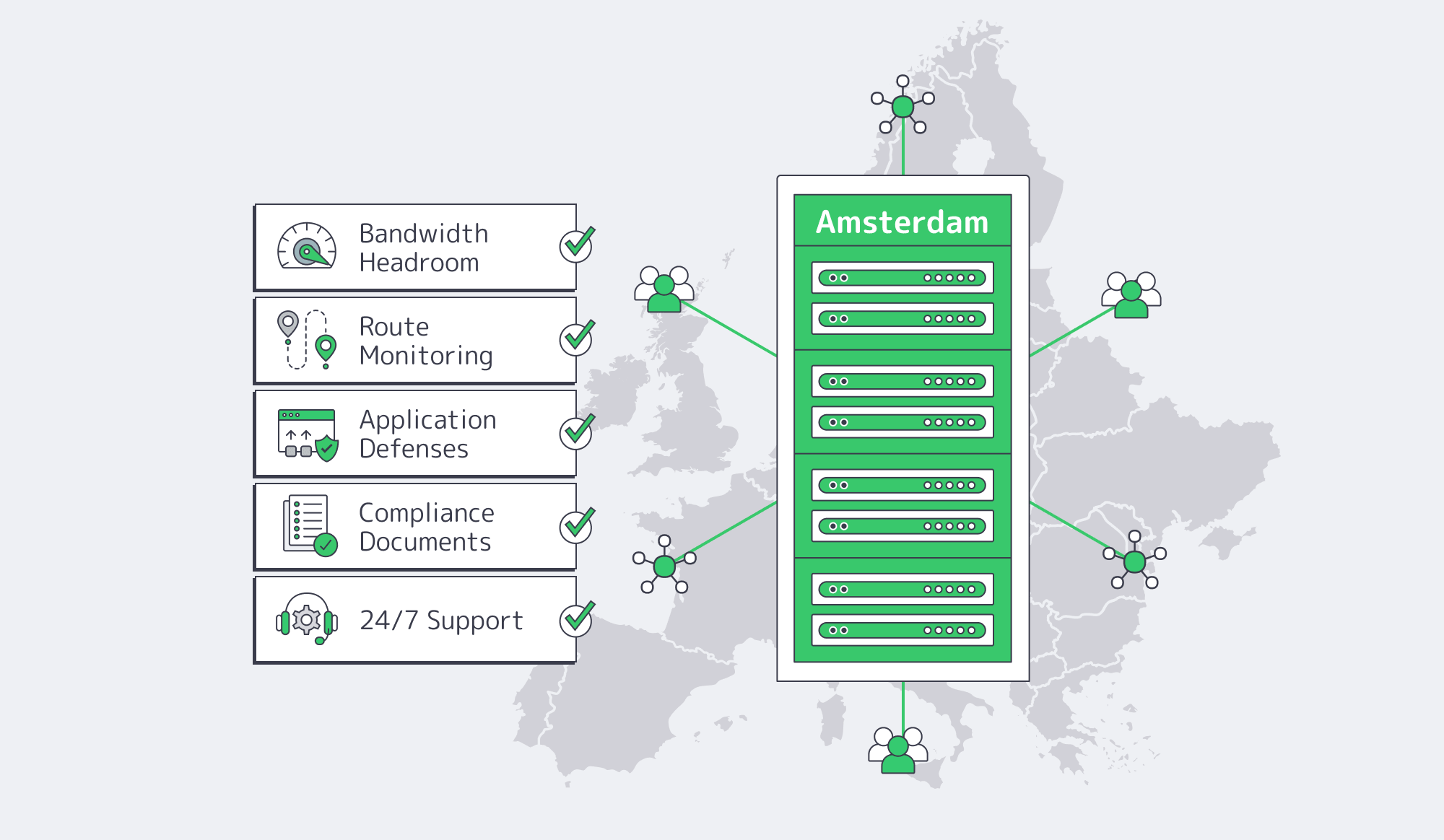
The Netherlands is attractive because Amsterdam places dedicated infrastructure near a dense interconnection ecosystem while preserving control over hardware, operating systems, storage, and network capacity. That advantage holds only when the route from users to server has been measured and the bandwidth, mitigation, compliance, and support terms are explicit.
A durable decision combines stable p95 latency, throughput headroom, understood billing, upstream DDoS handling, application defenses, documented processing responsibilities, and round-the-clock escalation. The final comparison should map each configuration to users, traffic peaks, outage cost, legal duties, and incident ownership.
Choose Netherlands Hosting That Holds Up
Compare Amsterdam server configurations by route, bandwidth, DDoS protection, and delivery needs.