
Blog
Why Indian Dedicated Servers Slash Cart Abandonment
The Indian e-retail market reached $65–$66 billion in gross merchandise value (GMV) in 2025, with 290–300 million online shoppers and sustained momentum into Q1 2026. [1]
For Indian ecommerce teams, slow mobile experiences remain a direct revenue risk: New Relic reports that 60 percent of surveyed Indian online shoppers would leave an app after more than 10 seconds of slow buffering, and 72 percent most often use mobile apps for online purchases in India.[2]
Choose Melbicom— Dozens of ready-to-go servers — Tier III-certified DC in Mumbai — 39 PoP CDN across 6 continents |
 |
An Indian dedicated server keeps latency-sensitive requests in-country, supports a more defensible DPDP compliance posture, and connects into India’s fast-growing metro data-center ecosystem. We outline the key dimensions CTOs are calculating now: performance, compliance, infrastructure depth, and peak-season resilience, and how Melbicom can turn them into revenue.
How Dedicated Servers in India Cut Latency
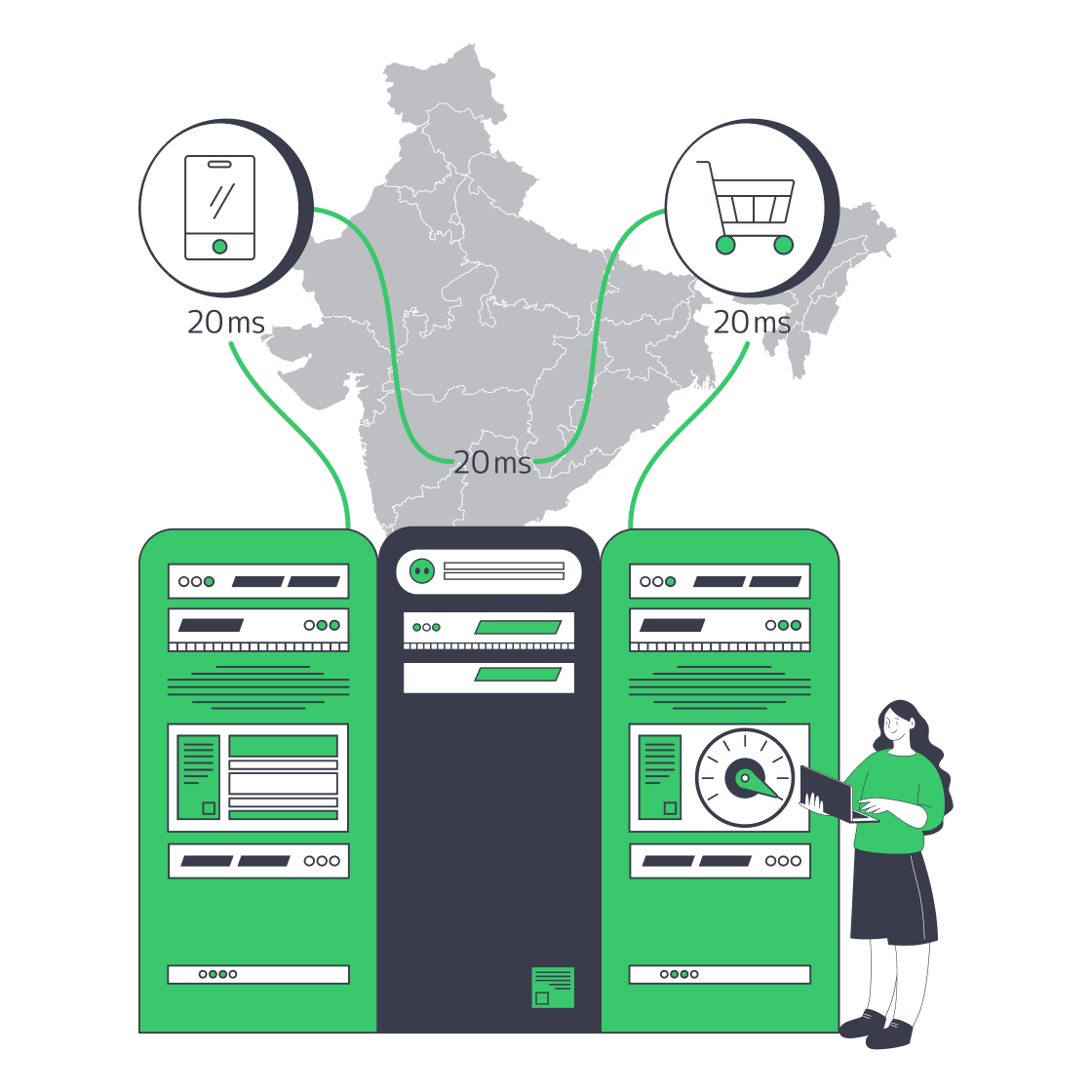
When an Indian customer clicks a checkout button and the request is routed to Europe or North America, the round-trip time often exceeds 150 ms. Mumbai hosting can reduce that path to roughly 20–50 ms for users near major Indian metros, clearing the last-mile drag that increases Time to First Byte and Largest Contentful Paint (LCP).
- Faster LCP & INP. Shorter transport means headers appear sooner, scripts start sooner, and checkout steps avoid distant round trips.
- More predictable tails. Single-tenant hardware removes “noisy neighbor” contention, so P95 and P99 latency can improve with the average.
- Bandwidth headroom. Melbicom’s Mumbai dedicated servers support up to 40 Gbps per-server network capacity, giving headroom for 4K product video, high-volume catalog traffic, or on-device AI inference streams.
Why India Hosting Beats Distant Clouds
Cloud regions outside India can mask static-asset latency behind CDN edges, but API calls for carts, business logic, and real-time inventory still cross long-haul routes when the origin is offshore. Proximity wins for revenue-risk requests such as checkout, payments, and personalization. Compared with shared instances, dedicated servers give engineers direct kernel-to-NIC control for TCP tuning, QUIC settings, and traffic shaping.
Meeting DPDP Act Compliance with Dedicated Server Hosting in India
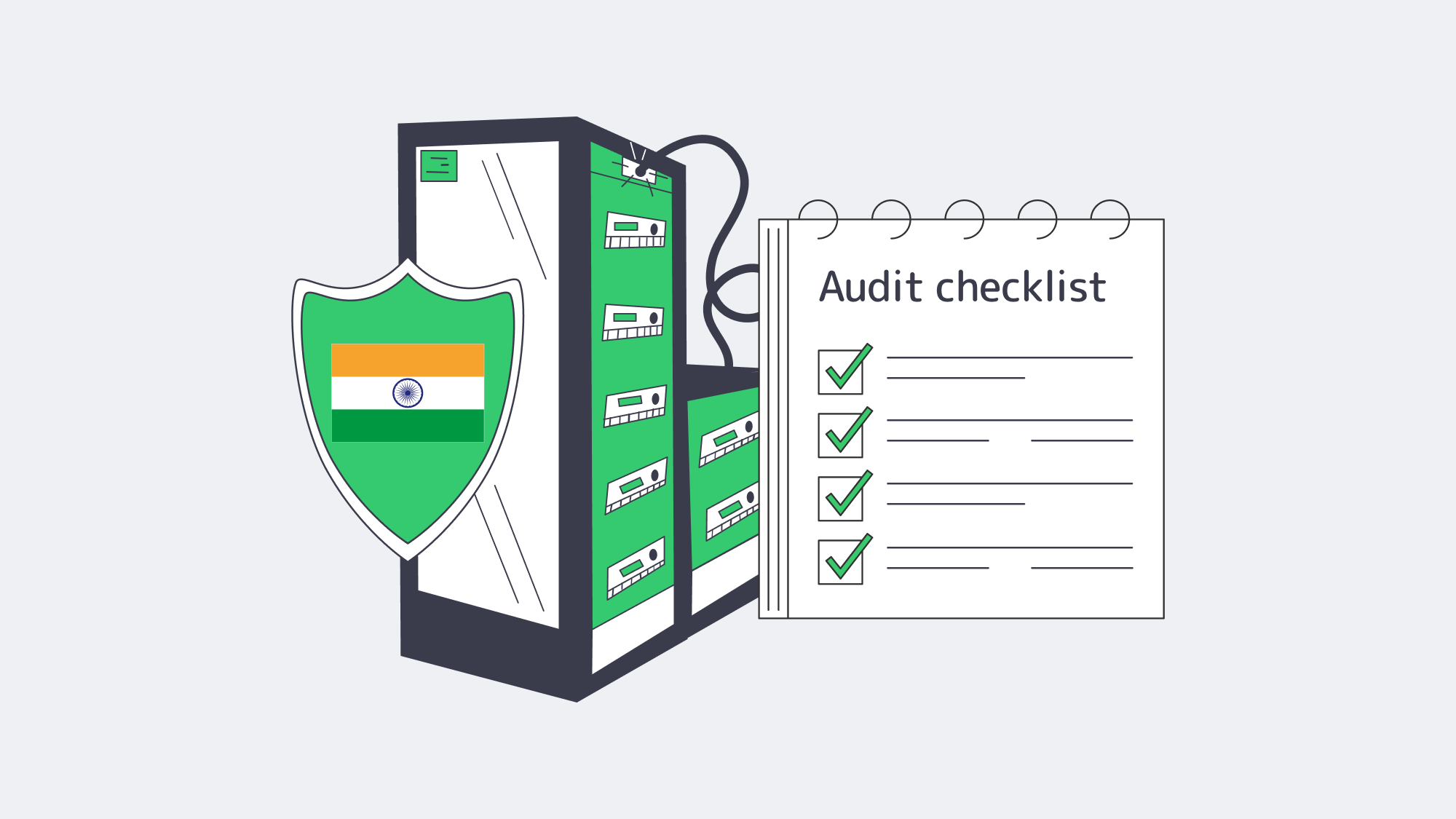
The Digital Personal Data Protection Act, 2023 (DPDP Act) does not impose a blanket data-localization rule or a whitelist of “trusted nations.” Instead, Section 16 lets the Central Government restrict transfers of personal data to notified countries or territories, while preserving stricter sector-specific transfer rules. Penalties under the Schedule can reach 250 crore rupees for failure to maintain reasonable security safeguards.[3] For retailers handling addresses, payment tokens, or behavioral profiles, keeping sensitive processing in India can still simplify evidence gathering and reduce transfer-risk reviews. A local dedicated server supports that position in three practical ways:
- Onshore processing. Customer records, session logs, and token-handling systems can remain in India unless a specific workload requires cross-border processing.
- Audit-ready visibility. Physical infrastructure, access logs, and backup locations are easier to document when production and evidence stay in the same jurisdiction.
- Consumer trust. Security and privacy are leading digital-payment concerns for Indian online shoppers, so local processing and clear audit trails support buyer confidence.[2]
By hosting servers in Indian Tier III data centers, Melbicom gives compliance teams infrastructure evidence without sacrificing performance.
Should You Deploy Dedicated Servers in Mumbai, Chennai, or Delhi-NCR?
For a dedicated server India deployment through Melbicom, Mumbai is the supported production location. Chennai and Delhi-NCR remain useful comparison points because they show how national capacity is distributed, but Melbicom’s India dedicated server inventory, Tier III certification, and local network configuration are centered on Mumbai.
India’s data-center landscape has leapfrogged legacy constraints. A March 2026 Press Information Bureau release from India’s Ministry of Electronics & IT says national data-center capacity grew from 375 MW in 2020 to more than 1,500 MW in 2025, led by Mumbai/Navi Mumbai, Chennai, and Delhi-NCR/Noida.[4]
| City | Operational Capacity (MW) | What It Means for Latency |
| Mumbai / Navi Mumbai | 790 | Largest operational footprint; useful for west-coast and national traffic aggregation |
| Chennai | 305 | Southern hub and comparison point for east-bound routes |
| Delhi-NCR / Noida | 76 | Northern edge close to government and banking hubs |
Unlike a decade ago, when diesel backups and brownouts scared CIOs, today’s facilities are built around redundant power, UPS designs, and carrier-neutral meet-me rooms. Redundant fiber rings allow tenants to multi-home without leaving the building.
Capacity trajectory
| Year | Installed Capacity (MW) |
| 2020 | 375 [4] |
| 2025 | >1,500 [4] |
| 2027 (est.) | 1,800 [5] |
| 2030 (est.) | 4,500 [6] |
Growth is propelled by AI workloads and e-commerce platforms aligning data placement with privacy rules. JLL reports that cloud service providers have pre-committed and reserved 800 MW for AI workloads, while Colliers expects USD 20–25 billion of investment over the next five to six years.[5][6] For CTOs, that means plentiful rack space, competitive pricing, and carrier diversity in every major zone.
400 G Peering Powers AI-Rich Commerce
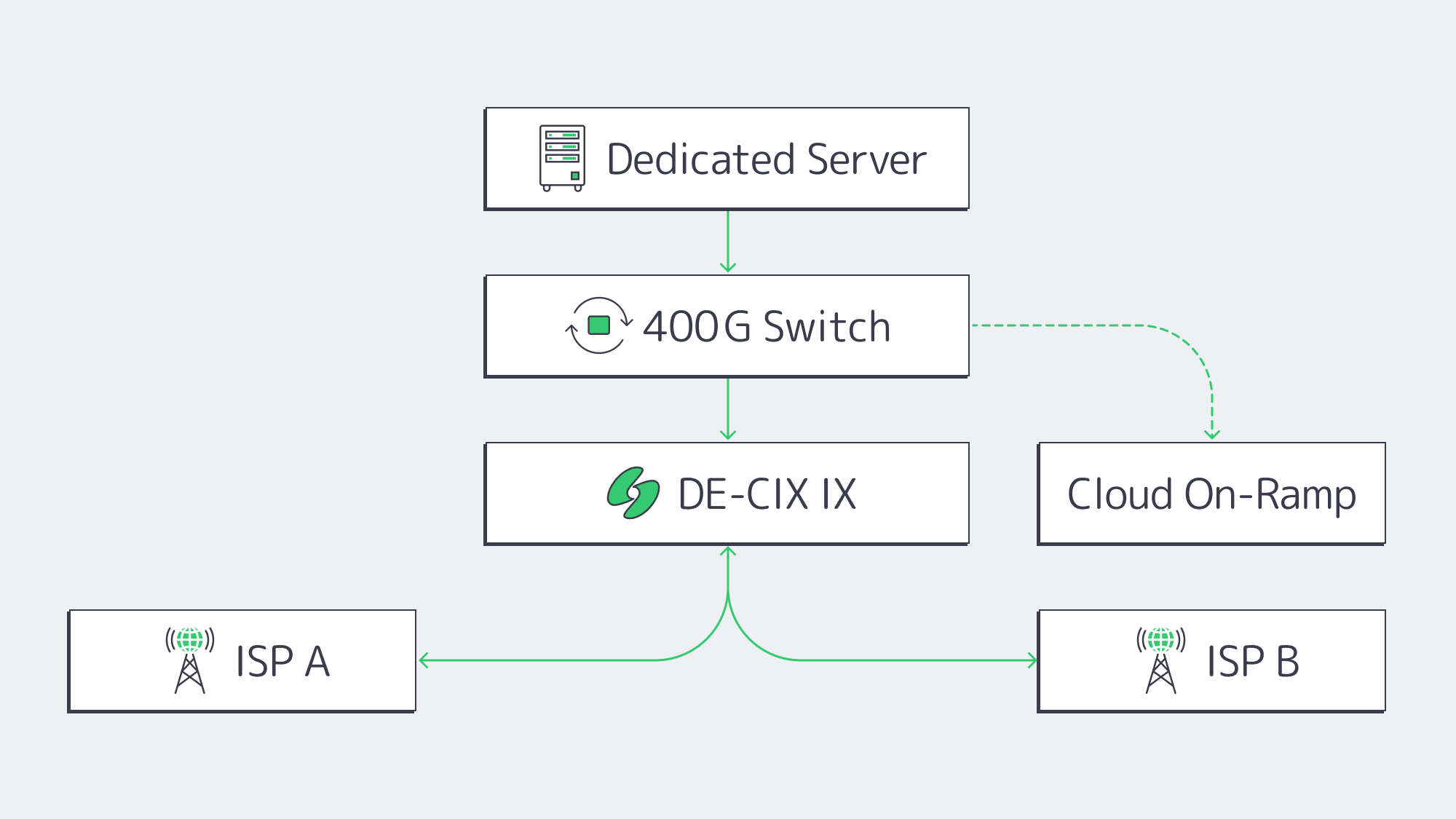
Closeness is irrelevant if packets queue at interconnection choke points. India’s leading IXPs are scaling capacity to keep up with AI, cloud, and commerce traffic. In its 2026 annual-report update, DE-CIX reported that Mumbai peak traffic grew 63 percent to 2.76 Tbit/s during 2025, alongside platform-wide growth in 400 GE ports and 800 GE-era upgrades.[7] The working result is this:
- Short metro paths among servers, ISPs, and CDNs that play a critical role in edge inference, live video, or AR try-ons.
- Cloud on-ramps when available in the same facility, so hybrid environments can burst to interconnects while avoiding distant public-internet routes.
- Lower transit cost curve. Dense peering can reduce bandwidth pressure and keep dedicated server hosting in India price-competitive without sacrificing throughput.
Preparing India Servers for Traffic Spikes
Diwali, Navratri, Big Billion Days—the festival pipeline is no longer a narrow marketing window. Bain’s 2026 India e-retail report says festive periods account for around one in four new shoppers, with nearly triple daily traffic during events such as Flipkart’s Big Billion Days versus business as usual.[1] A plain 99.9 percent uptime target is not enough when a short checkout or payment degradation can erase campaign gains.
Key practices we see winning teams adopt:
- Baseline on dedicated iron, burst elastically. Run mission-critical databases and checkout APIs on one or more Indian dedicated servers for latency and price predictability; spin up ephemeral cloud instances behind a load balancer when promotional banners go live.
- Run load simulations early. Four-week-ahead synthetic traffic helps right-size CPU, memory, and port speeds.
- Freeze non-essential maintenance. Define freeze windows, ticket owners, and escalation paths before sale traffic starts.
- Monitor tail latency, not just averages. Slow frames get abandoned before teams see a complete outage.
Avoid Last-Minute India Hosting Failures
Cheap capacity is useless when ports saturate or CPU cores are starved at peak load. Melbicom offers single-tenant systems in Mumbai with up to 40 Gbps per-server network capacity and 24/7 support. That gives ecommerce teams predictable festival-season headroom without moving checkout or database workloads back offshore.
Low-Latency Infrastructure Drives Growth
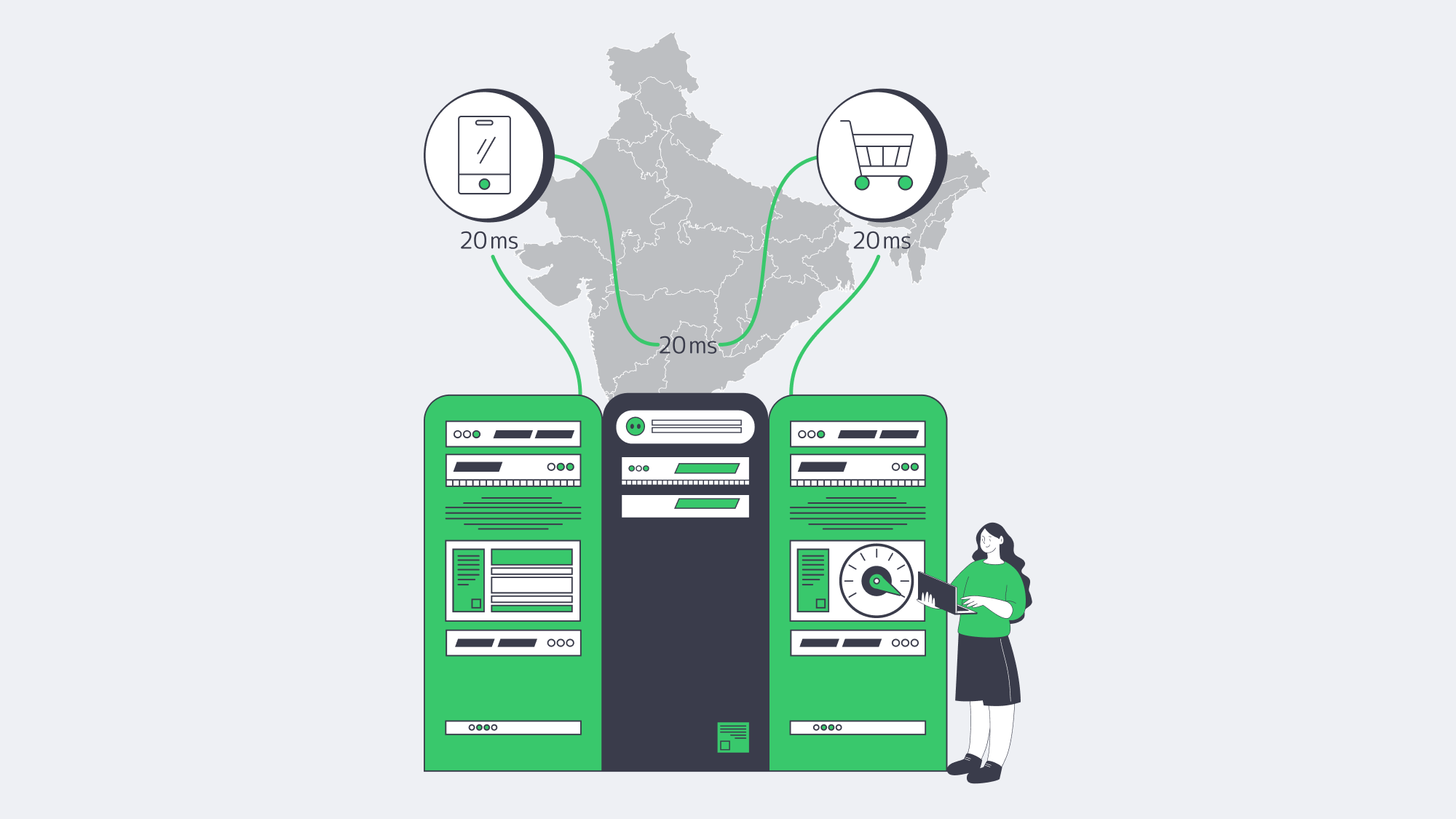
Regional geography, onshore data stewardship, and metro-edge density have come together to make dedicated servers in India a fast, practical path to scalable growth. CTOs who understand the latency revenue curve are treating Indian metros as prime deployment areas. The growing presence of Tier III and Tier IV facilities, high-capacity IXPs, and expanding data-center capacity gives the ecosystem the density needed for commerce, AI features, and cost-efficient delivery.
When a business migrates latency-sensitive workloads to Mumbai, it can reduce long-haul round trips, improve Core Web Vitals conditions, and simplify DPDP evidence collection. The infrastructure baseline is in place; the advantage goes to teams that move the highest-risk checkout, personalization, and inventory paths first.