
Blog
Dedicated Server Hosting Los Angeles: West Coast Performance Buying Guide
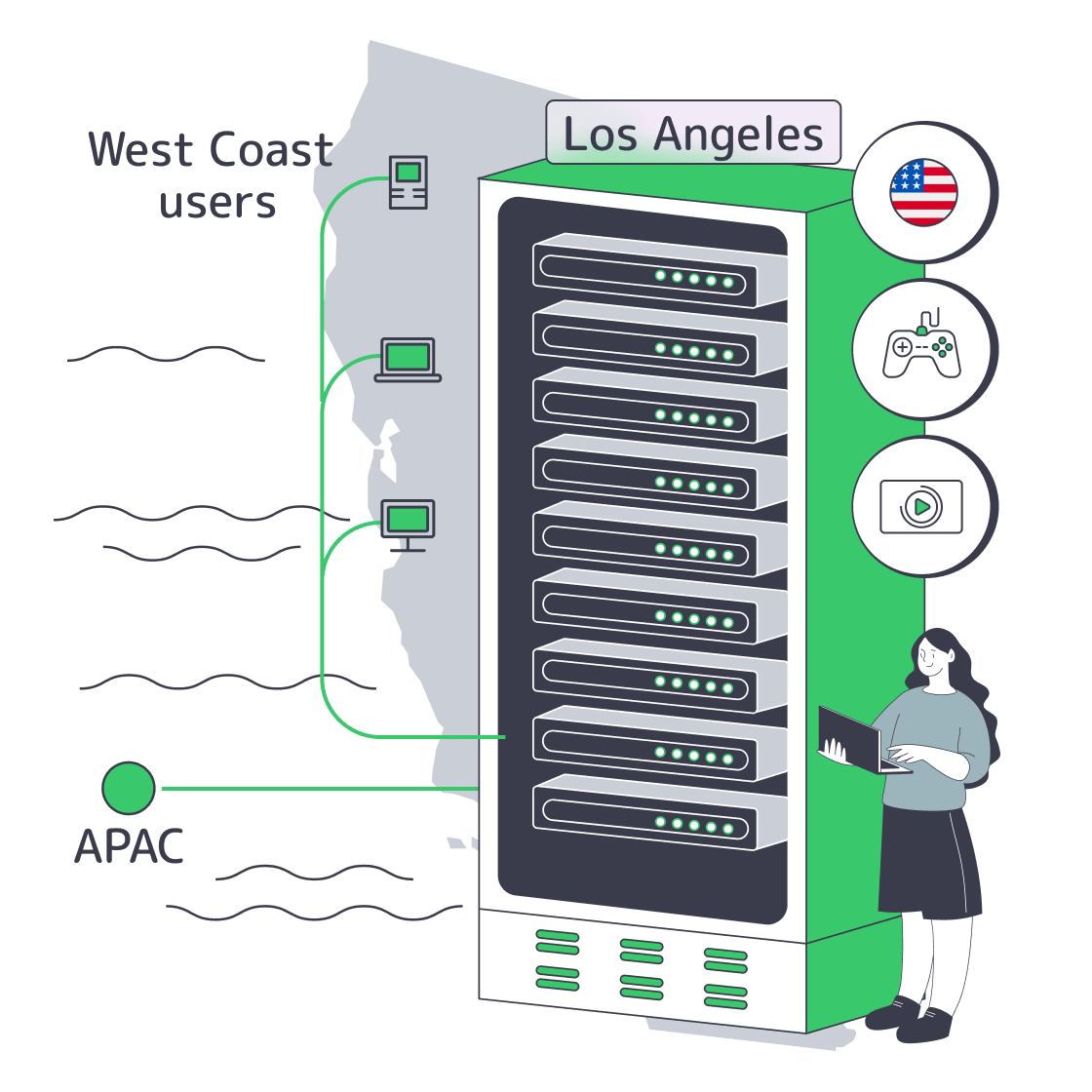
Dedicated server hosting in Los Angeles is a routing and workload-placement question, not a generic city-page topic. Los Angeles makes sense when Pacific users, media workflows, gaming sessions, APAC paths, and high-egress workloads are important enough that 20-60 milliseconds or a constrained port can change the product experience. The buying test is simple: prove the route, size the bandwidth, and know when LA beats central or eastern U.S. placement.
Deploy in LA Now– Tier III West Coast facility – 28 ready-to-go configs – Global Melbicom backbone |
 |
Why Dedicated Server Hosting Los Angeles Fits West Coast Traffic
Dedicated server hosting Los Angeles fits West Coast traffic when Pacific users dominate the session mix and every 20-40 milliseconds matters. Directional RTT data puts San Jose to Los Angeles near 10.5 ms, San Francisco to Los Angeles near 12.8 ms, Phoenix to Los Angeles near 11.2 ms, and Seattle to Los Angeles near 27.6 ms, which is materially lower than central or East Coast paths.
Those measurements come from WonderNetwork city-pair pages, which use 30 ICMP pings per pair, so they are buying signals rather than contract metrics. They still show the shape of the decision clearly. A Bay Area-heavy SaaS app, a Southern California media team, or a western gaming lobby starts with a smaller network tax in Los Angeles than it would from Chicago or New York. That matters because Google’s web performance guidance puts good Interaction to Next Paint at 200 ms or less and Largest Contentful Paint at 2.5 seconds or less at the 75th percentile. If the network path is 10-13 ms instead of roughly 47 ms to Chicago or 63 ms to New York, more of the budget remains for TLS, application logic, storage, and database time.
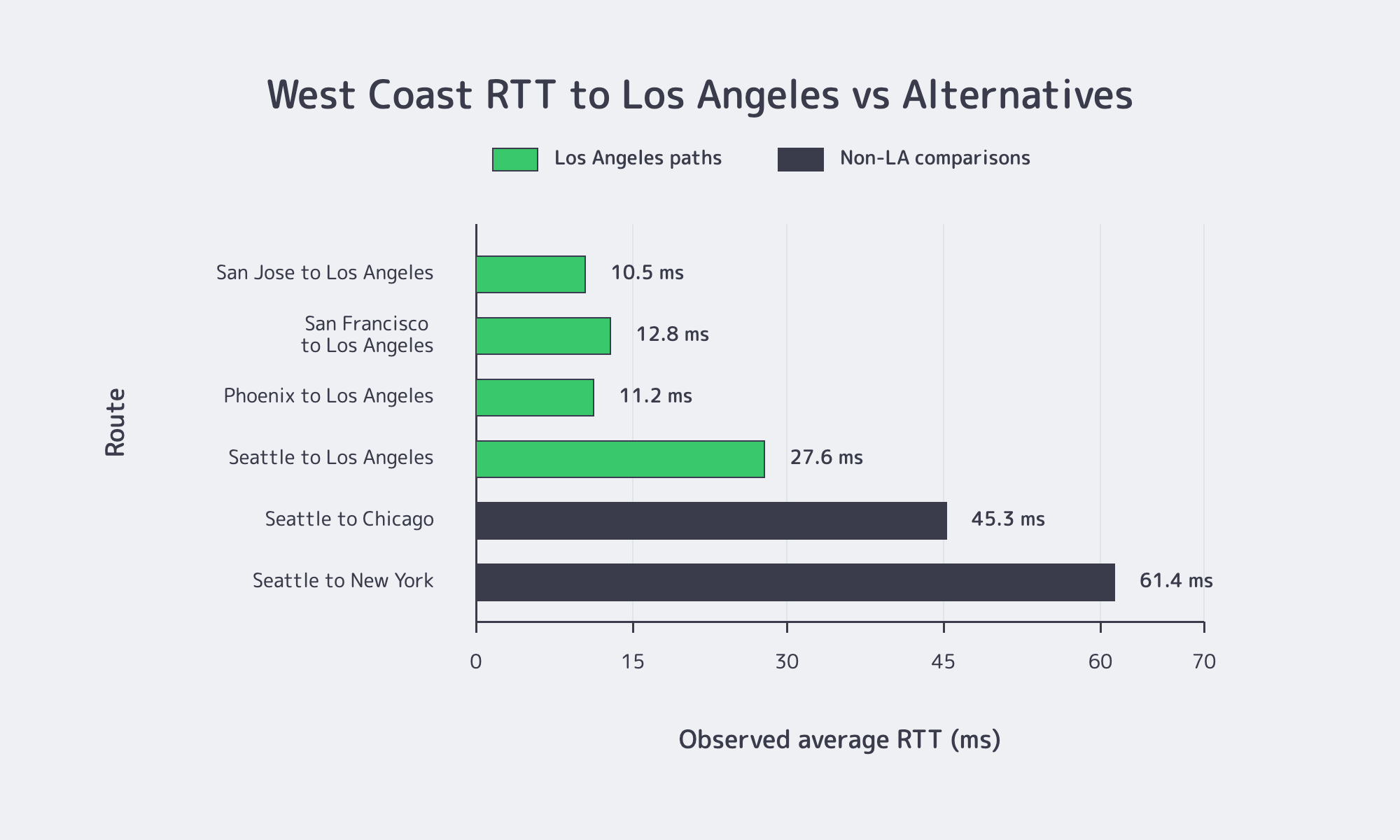
Los Angeles is not the default U.S. answer. If traffic is split evenly between coasts, central placement can win on average latency. In sample city-pair data, Seattle-to-Los-Angeles is about 27.6 ms and New York-to-Los-Angeles about 67.5 ms. Seattle-to-Chicago is about 45.3 ms and New York-to-Chicago about 19.0 ms. That tradeoff is the point: LA is for Pacific optimization, not symmetrical nationwide median latency.
How to Evaluate Dedicated Server Hosting Los Angeles for Media, Gaming, and SaaS
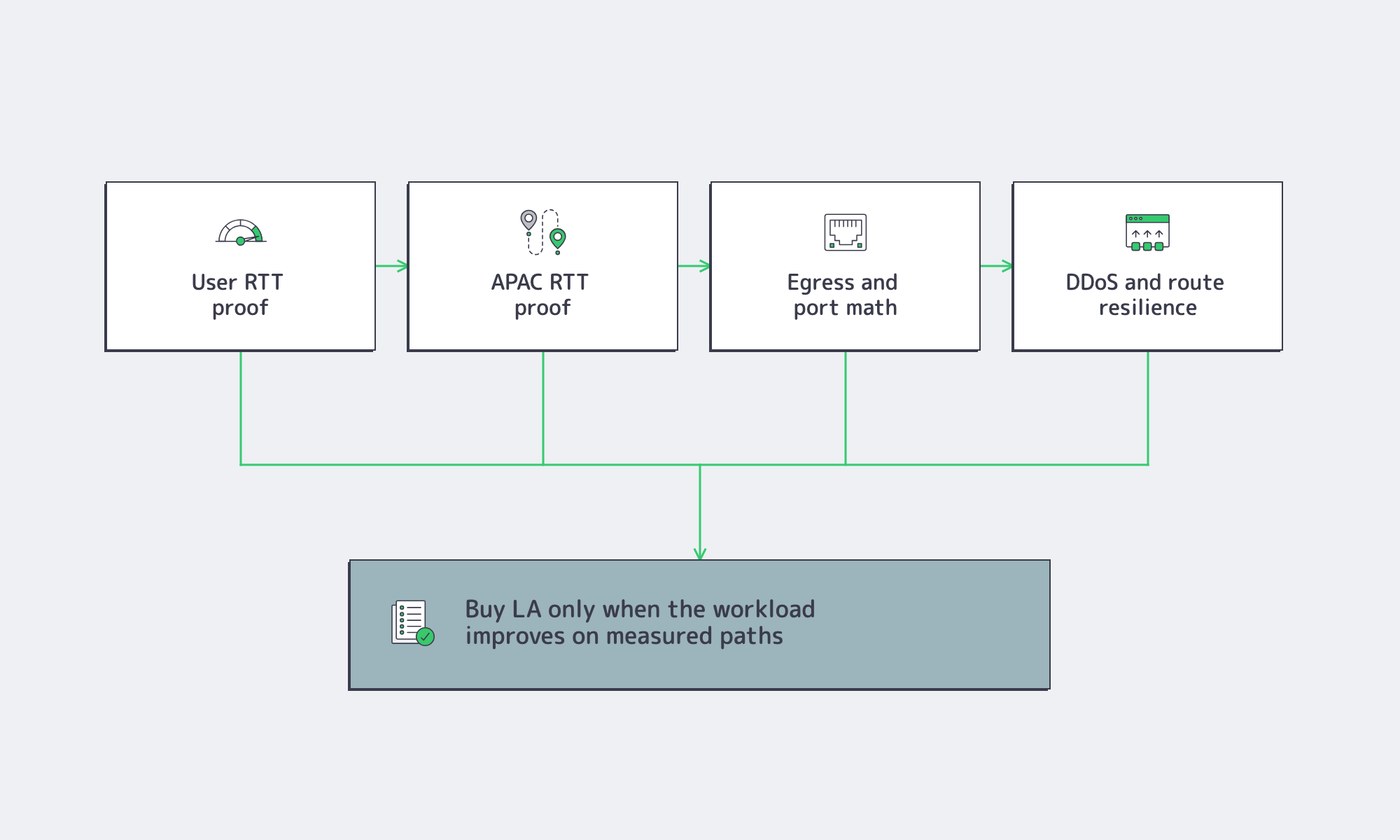
Dedicated server hosting Los Angeles should be evaluated on four proofs: user RTT, APAC RTT, burst-egress math, and attack-path resilience. A deployment that cannot show West Coast latency, high-bandwidth scaling, and route-testing options is a weak buy, even with strong CPU, RAM, and storage specs.
| City Pair | Observed Average RTT | Buying Implication |
|---|---|---|
| San Jose to Los Angeles | 10.5 ms | Strong fit for Bay Area-heavy SaaS and control planes |
| Seattle to Los Angeles | 27.6 ms | Usually workable for western gaming and live operations |
| Seattle to Chicago | 45.3 ms | Central U.S. adds visible delay for Pacific Northwest users |
| Tokyo to Los Angeles | 104.9 ms | Better for Japan-linked control paths than central or eastern U.S. |
| Singapore to Los Angeles | 167.4 ms | Viable for asynchronous APAC workflows, weaker for twitch loops |
Media teams should do bandwidth math before they buy a city. YouTube’s upload guidance recommends roughly 35-45 Mbps for 4K SDR uploads at standard frame rates and 8 Mbps for 1080p SDR. Melbicom’s streaming guidance recommends sizing around the top ladder rate multiplied by concurrency with headroom, and Melbicom offers server ports from 1 Gbps up to 200 Gbps per server. A 10 Gbps port with 20% headroom only covers about 180-225 simultaneous 4K streams at 35-45 Mbps. A 25 Gbps port moves into roughly 440-570. A 100 Gbps port reaches roughly 1,780-2,280. For origin, packager, or live-media roles, port planning often matters more than raw core count once codec and storage choices are right.
Gaming teams should care about location twice: geography and simulation cadence. Valve’s networking documentation describes a default Source engine simulation step of roughly 15 ms at 66.666 ticks per second. An avoidable 18-35 ms of extra RTT from choosing a farther region can cost one to two simulation ticks before client prediction and lag compensation help. For western lobbies or anti-cheat and matchmaking services, that is not an abstract difference.
For SaaS, the right question is not “is LA fast?” but “which users and dependencies get measurably better?” If login, dashboards, AI moderation, payments, media APIs, or websocket-heavy interfaces are concentrated in Pacific time zones, Los Angeles gives the application a better network starting point. If the user base is equally split between New York and California, a central U.S. node may be the better default.
LA vs. Central US for Media and Gaming
LA beats central U.S. hosting when the Pacific edge is the business-critical edge. Media teams gain when creators, encoders, origins, or viewers are concentrated on the West Coast. Gaming teams gain when lobbies, matchmakers, state services, or APAC-linked systems are western. Central U.S. wins when the primary goal is national balance rather than Pacific performance.
Demand trends make that distinction more important. Ericsson reported global mobile network traffic at 200 exabytes per month in Q4 2025, with video representing 76% of mobile data traffic. Media delivery is not a niche workload; it is one of the dominant traffic classes. That pushes buying decisions toward port size, route quality, CDN strategy, and provider transparency rather than generic “high performance” claims.
APAC Routes, DDoS Exposure, and Bandwidth Checks Before Deployment
APAC-linked stacks are where Los Angeles becomes easiest to justify. TeleGeography’s Submarine Cable Map lists Los Angeles and nearby Southern California landing points tied into major trans-Pacific systems, including Tata TGN-Pacific, Unity/EAC-Pacific, JUPITER, SEA-US, and JUNO. Cable geography does not guarantee the best route, but it helps explain why LA can be a strong trans-Pacific node.
Interconnection density also matters. PeeringDB shows large LA-area exchange and facility ecosystems, including Any2West and LA2. Treat those figures as topology signals, not a promise about one provider’s exact route. The buying move is to validate with RIPE Atlas pings and traceroutes from target eyeball networks and APAC vantage points, then compare those paths with the provider’s test files and network documentation.
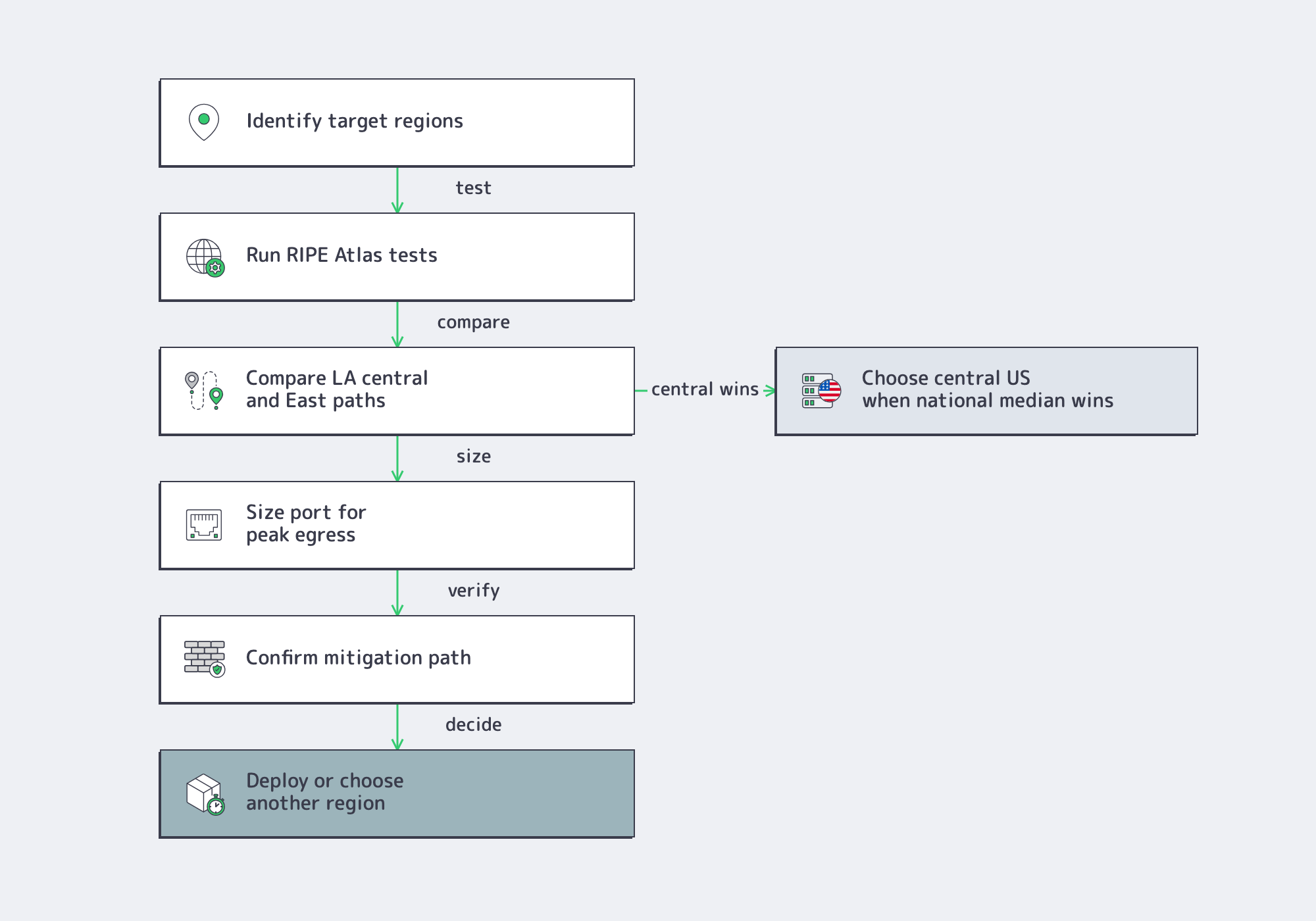
DDoS exposure belongs in the same checklist. Cloudflare’s Q4 2025 DDoS report said attack sizes grew by more than 700% in 2025 and included a 31.4 Tbps attack. Gaming was among the most-attacked industries. LA buyers should evaluate upstream diversity, exchange reach, mitigation pathing, and operational visibility before launch, especially for gaming, media, and public API workloads.
Where Melbicom Fits an LA Deployment
Melbicom is strongest here when it is evaluated as a published engineering surface. Its Los Angeles dedicated server and data center pages identify a Tier III LA site, 1–200 Gbps per server, and a downloadable LA test file. Melbicom’s network footprint includes redundant topology, 14+ Tbps of network capacity, 23 transit providers, 29 IXPs, 1000+ ready-to-go configurations, and 24/7 support.
For media-heavy deployments, Melbicom’s streaming servers and CDN products map cleanly onto the LA argument. Use Los Angeles for origin, packaging, stateful services, or western sessions; use CDN and object storage patterns to offload read-heavy delivery where edge fan-out is the better answer. That keeps LA from being overloaded with jobs that belong at the edge while preserving the low-latency control path where geography matters.
When Los Angeles Is the Right Call
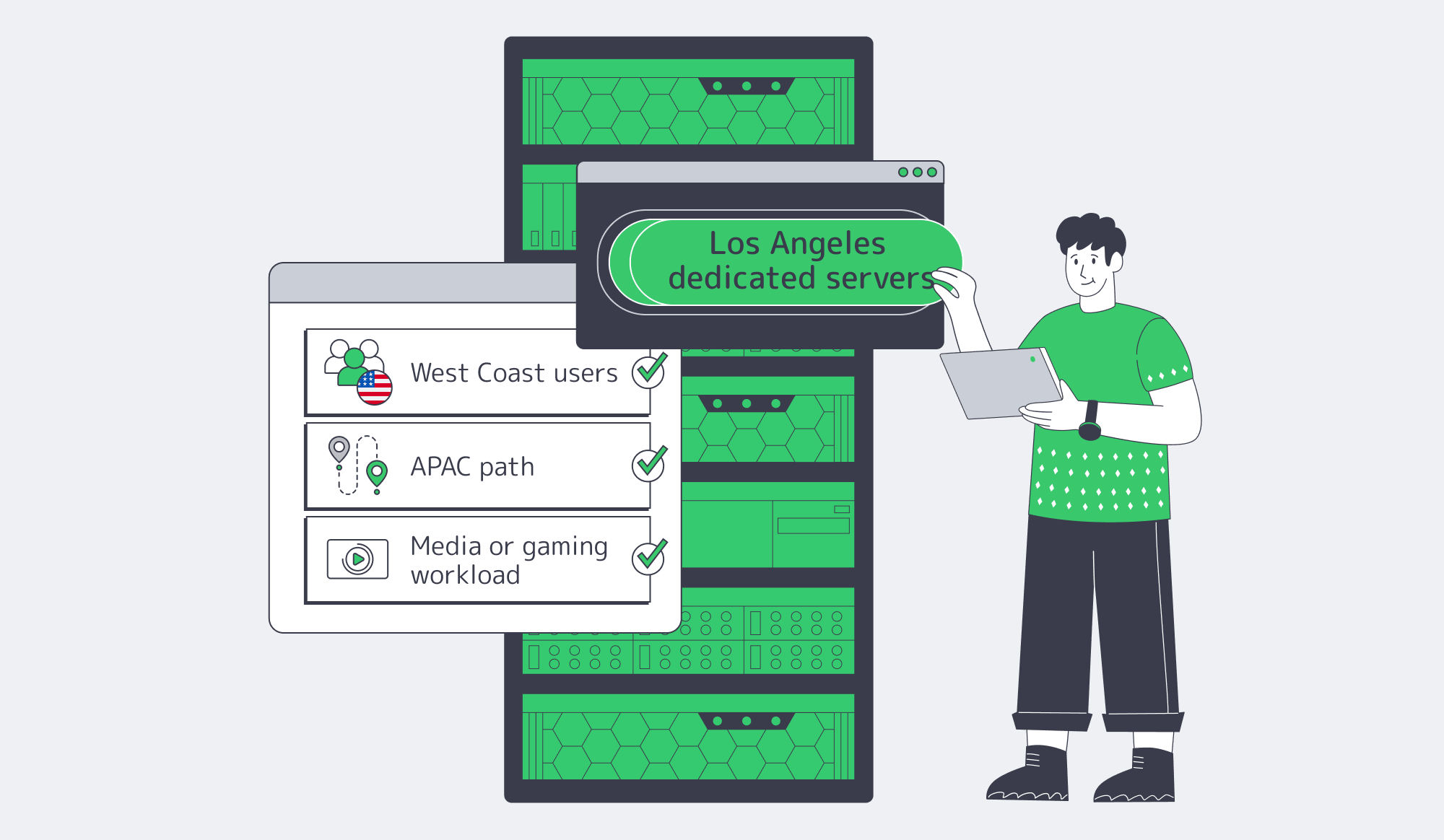
The cleanest way to buy dedicated server hosting in Los Angeles is to decide whether the workload is optimizing for Pacific performance or national averaging. Choose LA when West Coast user latency is a first-order metric, when Japan or Southeast Asia is part of the production path, or when live media and fast-twitch workloads make port size and route quality more important than generic hardware claims.
Reconsider LA when the workload is truly national and fairness between East and West matters more than Pacific optimization. In that case, central U.S. placement can produce a better median experience. The right region is the one that matches the traffic map, not the one that sounds largest on a sales page.
Explore Los Angeles Dedicated Servers
Use LA dedicated servers when West Coast latency, APAC routing, media delivery, or gaming response time matter.