
Blog
Dedicated Server Hosting Japan: When Tokyo Infrastructure Is Worth It
Tokyo is not a checkbox region. For APAC platforms, Japan is worth the spend only when Tokyo changes the live path: lower round-trip time for revenue-critical sessions, stronger routing into Japan and Northeast Asia, cleaner data-handling boundaries, or stronger failover than routing every scenario through another APAC metro.
Deploy in Japan Now– 14 ready-to-go configs – Custom configs in 3–5 business days – Tier III DC + 24/7 support |
 |
The placement decision should be technical, not symbolic. Backbone telemetry, Japan traffic signals, privacy guidance, and Melbicom’s Japan dedicated servers and Tokyo dedicated servers point to one rule: use Japan as the hot path when Tokyo materially improves latency, control, or recovery.
When Dedicated Server Hosting Japan Improves APAC User Experience
Dedicated server hosting in Japan improves APAC user experience when Tokyo sits within roughly 30 ms RTT of the users who drive conversions, trading activity, gameplay state, or authenticated session depth. At that distance, Tokyo behaves like a real application region, not a backup site, and the latency gain can change write latency and jitter.
Japan’s infrastructure value is Tokyo as a routing and cable node, not “Asia” as a label. A CSIS case study notes that 99% of Japan’s communications depend on subsea cables and that Japan has at least 20 international submarine cable landing stations connecting it to the United States, Australia, South Korea, Southeast Asia, Russia, and the Mediterranean.
The experience argument is no longer just ping. Cloudflare Radar’s Japan overview, crawled in June 2026, shows Japan traffic at 57.4% mobile, with IPv6 at 53.4% of observed traffic and HTTP/3 at 25.3%. If Japan is user-facing, the origin path must handle mobile networks, dual-stack delivery, and QUIC-heavy traffic.
Latency Map Beyond Geography
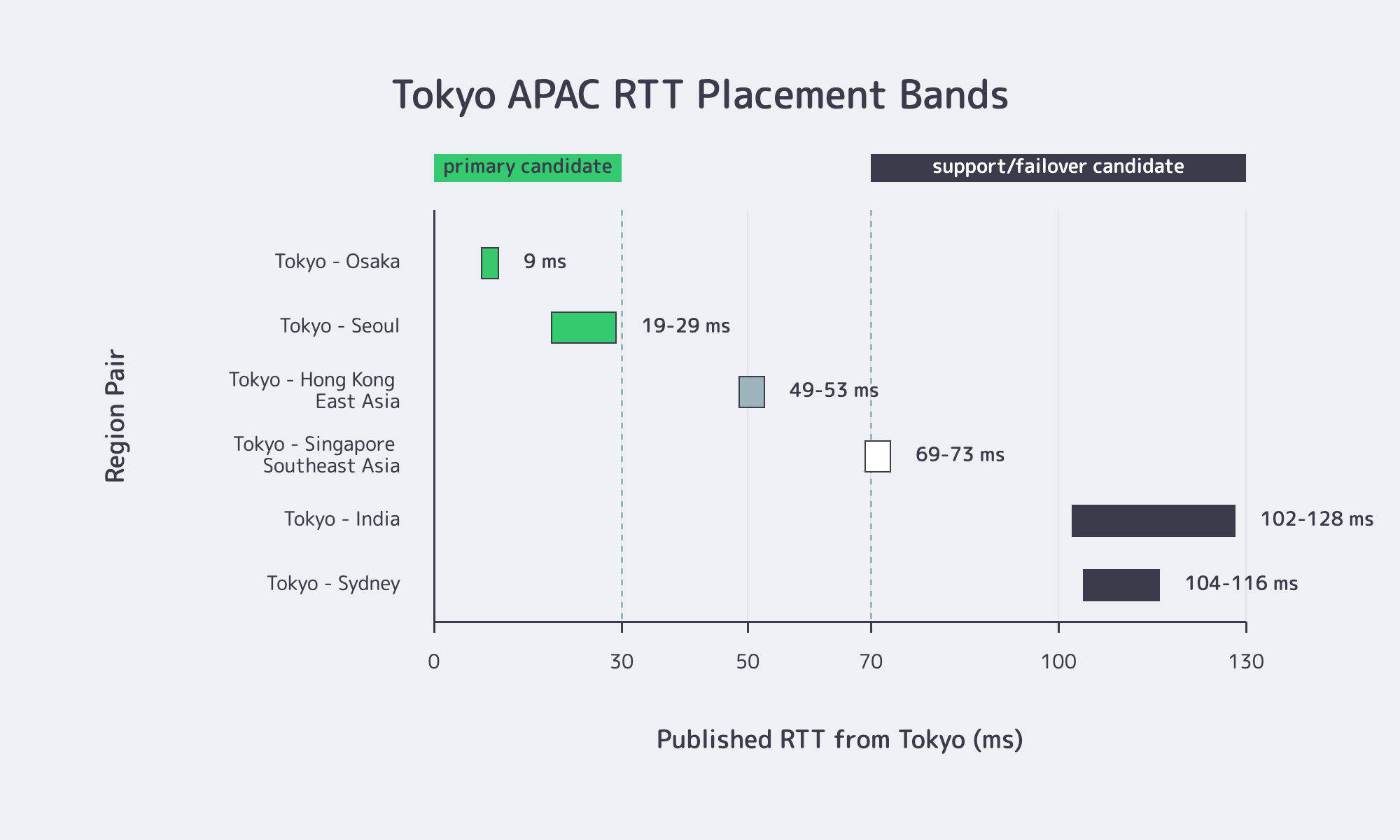
The table below uses IBM Cloud latency data and Microsoft Azure latency statistics. It shows where Tokyo belongs on the write path.
| Region Pair Involving Tokyo | Published RTT | What It Means |
|---|---|---|
| Tokyo ↔ Osaka | 9 ms | Same-country synchronous protection is realistic for many transactional workloads |
| Tokyo ↔ Seoul | 19–29 ms | Tokyo can be primary for Japan and Korea without a punishing write penalty |
| Tokyo ↔ Hong Kong or East Asia | 49–53 ms | Good for reads and many APIs; strong-consistency writes start to feel distance |
| Tokyo ↔ Singapore or Southeast Asia | 69–73 ms | Better for async replication and support services than SEA-first interactive writes |
| Tokyo ↔ India | 102–128 ms | Japan should rarely be the primary write region for India-first traffic |
| Tokyo ↔ Sydney | 104–116 ms | Viable as backup or data tier, not ideal as live write origin for Australia-first platforms |
Those ranges are why “closest on a map” is not enough. Tokyo can feel excellent for Japan and Korea, workable for Hong Kong-oriented traffic, and costly for Southeast Asia, India, or Australia. When user writes wait on the database, wide-area RTT compounds quickly.
Tokyo Latency, Routing, Storage, and Bandwidth Requirements to Compare
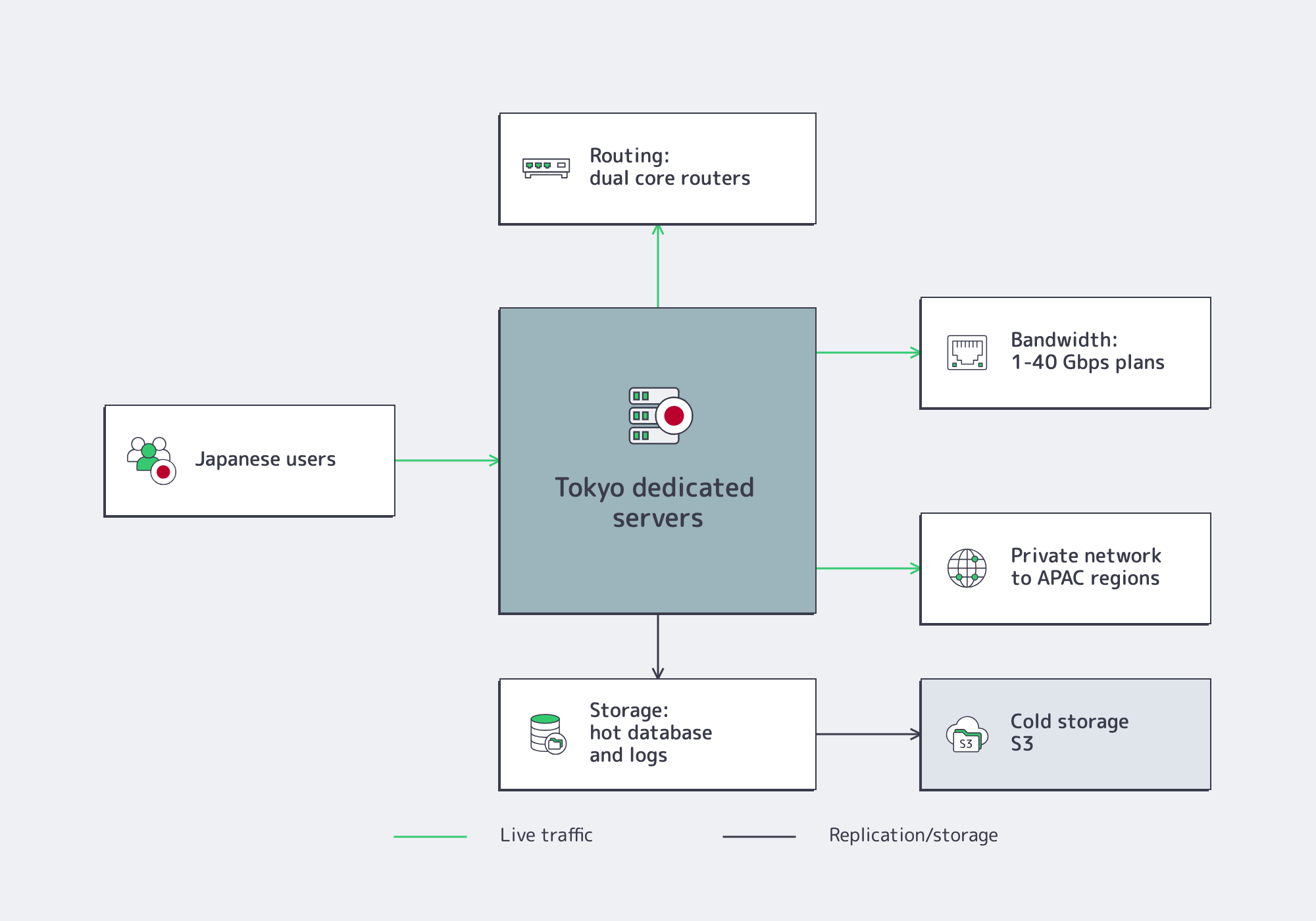
Tokyo latency, routing, storage, and bandwidth requirements should be compared as one system, not four separate line items. If Tokyo-to-user RTT stays under about 30 ms, Japan can justify a primary role for write-heavy applications; once paths approach 70 ms or more, replication design and port capacity usually decide whether Japan stays primary.
Start with routing, not hardware. TYO1 is a Tier III Tokyo site with 1–100 Gbps per server, while the network design uses redundant aggregation, dual core-router attachment, VRRP-protected L3, and private data-center networking. That lets Tokyo serve users and anchor multi-site topology.
Storage should follow the read/write path. If Japan hosts the live database, keep hot storage and the primary write log in Tokyo. If Japan is a support point, keep only hot Japanese-user data local and push colder objects to storage dedicated servers.
Bandwidth is where Japan designs often break quietly. Media origins, software distribution, exports, backups, and cross-region rehydration can turn a low-latency Tokyo server into a congested one. Tokyo dedicated server configurations include 14 ready-to-go options, including configurations built on Intel Xeon Scalable G3 CPUs, 128 GB DDR4 RAM, and 1–40 Gbps bandwidth plans with 50 TB or unmetered transfer. Japan unmetered dedicated server options map to 1 Gbps, 2 Gbps, 5 Gbps, 10 Gbps, and 40 Gbps use cases.
Storage Design Should Follow the Write Path
A simple rule holds: keep the authoritative write path where synchronous acknowledgement is still tolerable. PostgreSQL documentation is explicit that synchronous replication makes each write transaction wait for standby confirmation, and the minimum wait is the round-trip time between primary and standby. Tokyo-to-Osaka protection can fit transactional systems; Tokyo-to-Singapore or Tokyo-to-India synchronous commits are product decisions users may feel.
Primary Japan Deployment Versus Supporting APAC Region Strategy
Primary Japan deployment versus supporting APAC region strategy turns on where interactive writes originate. If more than half of latency-sensitive sessions come from Japan or nearby North Asia, Japan usually deserves the hot path; if revenue-critical traffic is concentrated in Southeast Asia or India, Japan more often works as compliance, cache-fill, analytics, or failover infrastructure.
A Tokyo-primary design makes sense when interaction clusters in Japan, Korea, and adjacent East Asia; when the platform depends on Japan-based partner integrations; or when tail latency matters more than average latency. Published RTTs such as Japan-West to Korea-Central at 18 ms and Japan-East to East Asia at 53 ms support Japan on the live path.
A Japan-supporting design is different. If most active users sit in Southeast Asia, published paths put Tokyo at roughly 69–73 ms before application processing or database waits. For India-oriented traffic, the range is roughly 102–128 ms. Japan still matters for local compliance posture, Japan-only APIs, customer data separation, analytics, cache fill, or failover for Japanese users.
Failover follows the same physics. Use synchronous or near-synchronous protection only where RTT leaves enough write budget for the product. Use asynchronous replication across longer APAC spans. PostgreSQL frames the tradeoff cleanly: synchronous replication raises response time because commits wait for standby confirmation, while asynchronous patterns expose data-loss risk proportional to replication delay at failover.
Melbicom’s topology supports both patterns. Private networking can extend across data centers, and the broader Asia dedicated servers footprint lets Japan participate in a multi-region design instead of forcing Tokyo to do every job.
Compliance Workloads for Japan Servers
Dedicated server hosting in Japan helps compliance-sensitive workloads when local infrastructure narrows data-handling, audit, access, and third-party-risk scope. Japan hosting does not replace legal analysis, but Japan-located dedicated infrastructure can simplify controls for data, backups, admin access, and recovery procedures.
Japan’s Personal Information Protection Commission separates location from control. The PPC’s English legal page references the current APPI consolidated text as of April 1, 2023. Its FAQ says storing personal data on a foreign server is not automatically a foreign third-party transfer if the foreign operator does not handle the data. It also says a server physically in Japan can still raise foreign-transfer issues when a foreign cloud operator handles the stored personal data.
That is why dedicated infrastructure in Japan remains attractive for audit-heavy workloads. Teams can define who accesses systems, where backups land, how admin paths are documented, and how recovery is executed. The Basel Committee’s 2025 third-party risk principles reinforce the same direction: due diligence, contracting, monitoring, continuity, and termination all matter across the provider lifecycle.
For most APAC platforms, Tokyo should be the hot path when:
- Japan or Northeast Asia accounts for most latency-sensitive sessions, and RTT stays in the sub-30 ms to low-50 ms range instead of the 70 ms-plus range seen into Southeast Asia and India.
- The workload is write-sensitive enough that one additional wide-area round trip per commit would be visible to users or downstream systems.
- The application needs strong routing into Japan, mobile-heavy network behavior, IPv6 readiness, and HTTP/3-friendly origin performance.
- Data handling, auditability, or customer requirements favor a Japan-located boundary, though APPI still depends on provider access.
- Failover needs Japan to remain independently serviceable, with private networking and enough port capacity to rehydrate data or absorb traffic.
A Practical Rule for Japan Hosting
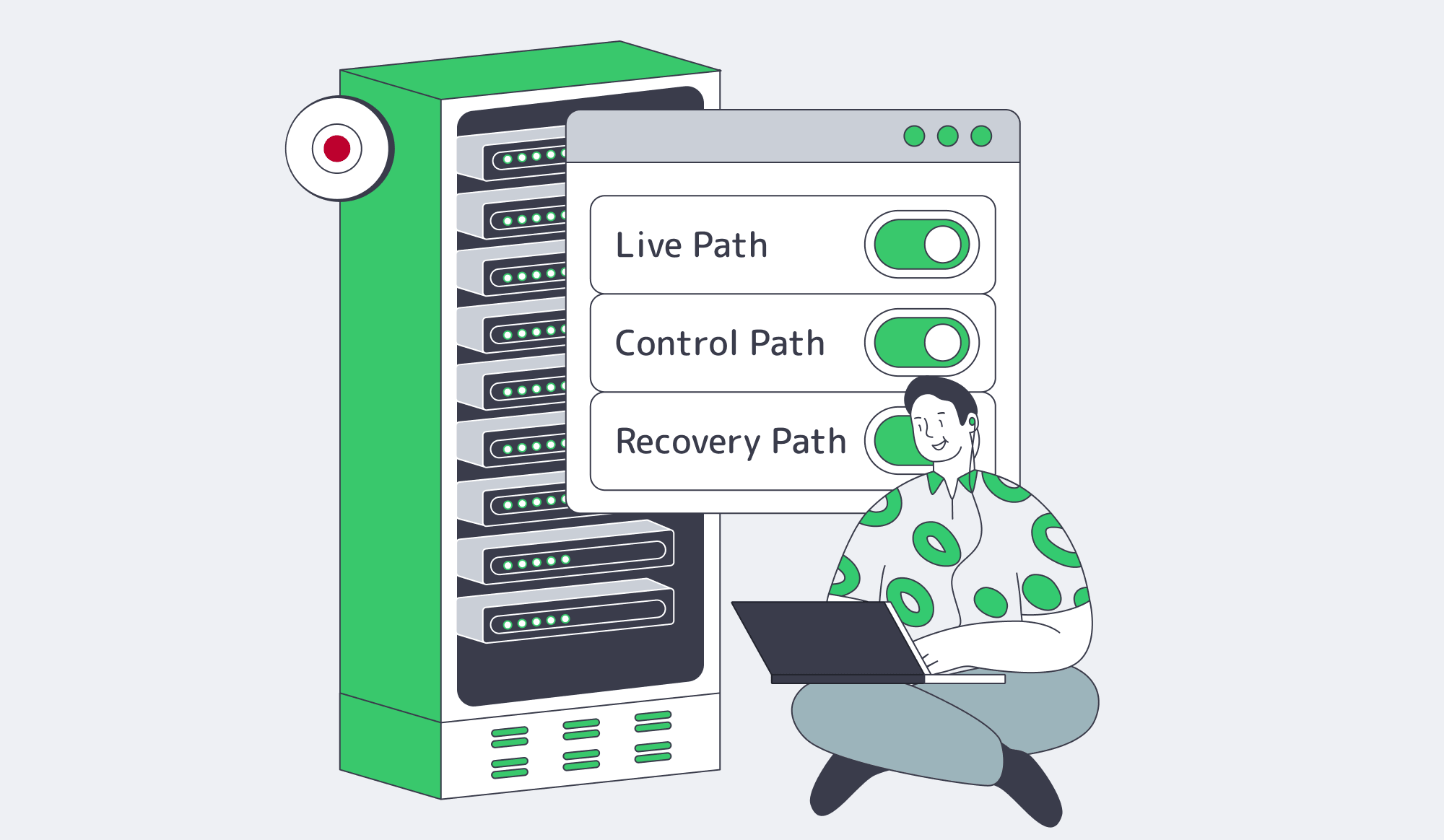
The cleanest rule for dedicated server hosting in Japan is this: pay for Tokyo when it changes the live path, control path, or recovery path enough to be more than another APAC box. If Tokyo does not improve one of those paths, keep Japan close to the user or regulator but off the synchronous write path.
That makes Japan a precision region. It should be primary when Tokyo lowers meaningful latency or protects Japan-centered transactions. It should support serviceability, compliance posture, cache fill, analytics, or recovery when another metro owns live writes. The wrong move is treating Tokyo as a generic APAC default; the right move is measuring whether Japan belongs on the hot path.
For teams deciding now, compare Tokyo against the real write path, data-control needs, and bandwidth profile.
Explore Japan Dedicated Servers
Deploy in Tokyo with high-bandwidth Japan dedicated servers, unmetered options, private networking, and a broader Asia footprint.