
Blog

Dedicated Server Hosting Bitcoin: A Buyer’s Guide for Production Infra
Crypto payment is no longer exotic in infrastructure buying. Visa reported that stablecoin supply grew by more than 50% in 2025 to $274 billion, and adjusted stablecoin transaction volume was on track to exceed $10 trillion.
For production buyers, the question is whether Bitcoin checkout sits on deterministic infrastructure: full hardware isolation, published bandwidth, renewal-safe billing, and support that can intervene before a server or invoice workflow becomes an outage.
Choose Melbicom– Clear BTC payment flow – Dedicated server capacity – 24/7 support |
 |
Why Is the Bitcoin Checkout the Easy Part?
Dedicated server hosting with Bitcoin is not hard because payment processors already support invoices, states, webhooks, confirmations, and refunds. The production test is stricter: dedicated server hosting with Bitcoin must also specify single-tenant hardware, sustained network capacity, renewal-safe billing, and 24/7 support, because a paid invoice does not prevent contention or downtime.
BitPay’s documentation shows the payment layer’s maturity. Invoice states include new, paid, confirmed, complete, expired, and invalid; webhooks notify merchants when status changes; and BitPay support documents 15-minute invoice windows plus refund paths for underpaid, overpaid, declined, or expired invoices.
That is payment maturity, not infrastructure maturity. A crypto invoice does not say whether a workload runs on a shared hypervisor, whether a port is guaranteed, or whether an engineer is available after midnight. At Melbicom, crypto payment is one control inside a larger model: Web3 server hosting on single-tenant servers with high-capacity bandwidth options, and payment methods that include crypto.
How Does Dedicated Server Hosting with Bitcoin Differ from Crypto VPS Hosting?
Dedicated server hosting with Bitcoin differs from crypto VPS hosting because dedicated server hosting with Bitcoin assigns a full physical server to one customer, while a VPS rents a virtual slice on shared hardware. The practical threshold is sustained heavy traffic, compliance isolation, or noisy-neighbor sensitivity; the tradeoff is higher monthly commitment and slower elasticity.
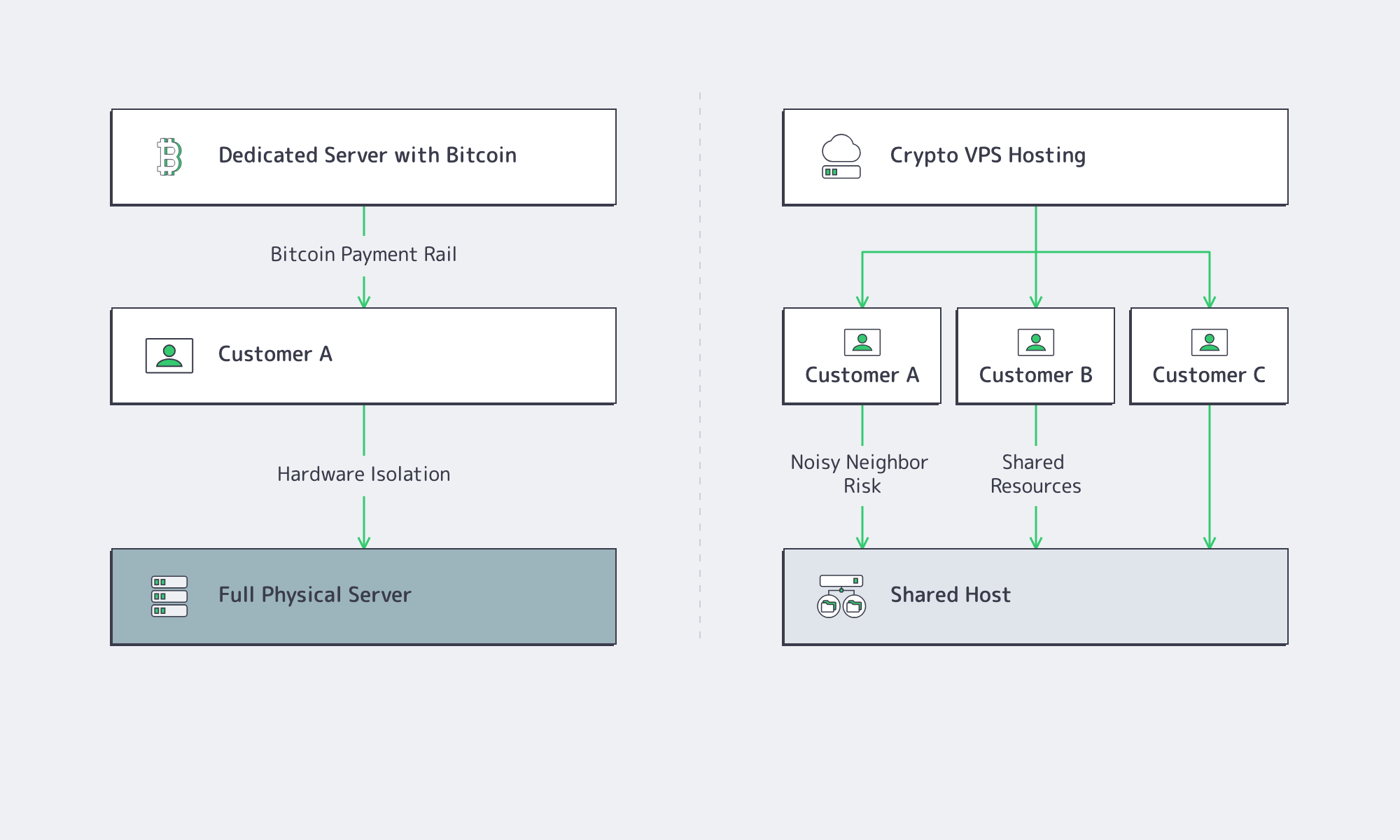
A VPS can be right for lightweight services, control planes, test environments, and bursty applications. It is optimized for fast provisioning and elastic economics. The risk appears when a workload is state-heavy, bandwidth-heavy, or latency-sensitive enough that shared CPU, disk, or network contention becomes a business event.
Dedicated servers change the procurement question. Instead of asking how cheaply a VM can launch, the buyer asks whether the machine, port model, and support path are predictable under load. That distinction is the useful line between “crypto VPS” and dedicated server hosting that accepts Bitcoin.
| Option | What the Buyer Is Actually Buying | Main Production Tradeoff |
|---|---|---|
| Dedicated server hosting with Bitcoin | A full physical server plus a crypto-friendly payment rail | Higher fixed commit; more deterministic capacity |
| Crypto VPS hosting | A virtualized slice on shared infrastructure | Easier scaling; more exposure to contention or fair-use limits |
VPS and dedicated servers solve different problems. For hot 24/7 workloads, sustained traffic, or large chain state, dedicated capacity reduces variance.
What Should Dedicated Hosting That Accepts BTC Make Visible Before You Buy?
Dedicated server hosting that accepts Bitcoin should make five things visible before ordering: tenancy model, network model, billing model, provisioning speed, and support path. A production-ready provider should connect those controls to the order itself, so buyers understand the hardware, port speed, renewal process, activation timeline, and escalation route before payment.
The practical procurement checklist is not long, but it is strict. The provider should define whether the server is single-tenant, whether bandwidth is metered or unmetered, whether the selected location supports the required port speed, and whether renewals can be handled before a crypto invoice expires.
Billing continuity belongs beside port speed because crypto invoices are not static bank wires. BitPay says invoices are valid for 15 minutes; production renewals should account for expiration, confirmation state, and escalation before a due date becomes a suspension risk.
How Do Payment Processors, Billing Continuity, and Support Affect Uptime?
Payment processors, billing continuity, and support affect uptime because crypto invoices are time-limited, confirmation-based, and stateful. Dedicated server hosting that accepts Bitcoin is safer when checkout links can be regenerated, status changes trigger webhooks, and support can intervene on renewals or hardware faults before capacity disappears or service is suspended.

BitPay advises merchants to fulfill against confirmed or complete invoice states, not merely paid, and its webhooks are meant to trigger verification rather than blind trust. BTCPay Server frames invoices similarly: they are payable within a defined time interval at a fixed exchange rate, with statuses that include expired, processing, settled, and invalid.
This matters because outages are expensive even when the root cause is procedural. Uptime Institute’s 2024 outage analysis found that 54% of respondents said their most recent significant, serious, or severe outage cost more than $100,000, and identified network-related issues as the largest single cause of IT service outages. A missed renewal caused by an expired crypto invoice is still downtime.
Support is therefore part of the control plane. For multi-server production environments, 24/7 support is the bridge between payment state, hardware state, and service continuity. It is also the operational backstop when a team needs help during reboots, OS reinstalls, network troubleshooting, or performance incidents.
When Is Bitcoin Hosting Production-Ready?
Bitcoin-accepting hosting is production-ready when it publishes physical tenancy, documented network capacity, renewal-safe billing, and 24/7 human support. The concrete test is whether a team can place, renew, expand, and restore a multi-server deployment without ambiguous invoices, fair-use limits, or after-hours gaps.
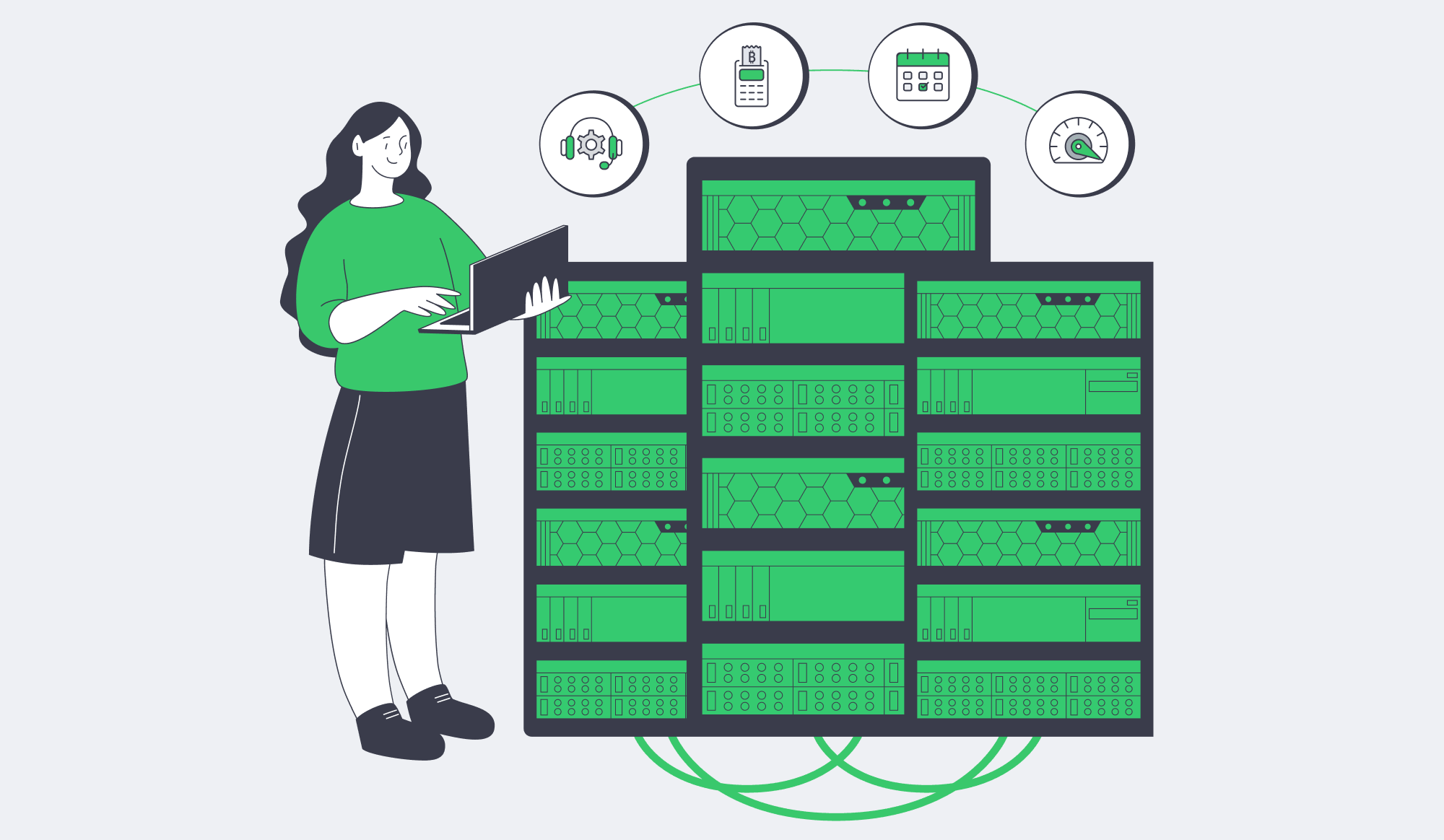
The procurement lesson is narrow but important. Dedicated server hosting that accepts Bitcoin is production-ready only when Bitcoin is the payment rail, not the entire value proposition. The infrastructure still has to stand on isolation, network capacity, renewal continuity, and support.
A production buyer should be able to clear this checklist without guesswork. Require a physical-tenancy answer, not a marketing answer; map port speed to workload documentation, not a generic “crypto hosting” label; design renewals around expiring invoices and confirmation states; confirm that human support can touch the infrastructure; and plan fleet growth across stocked systems, custom configurations, and multiple locations before the first renewal cycle.
For teams that need uptime, the right procurement is simple: pay with BTC where that helps finance operations, but evaluate hosting like any other production dependency.
Pay for Dedicated Servers with Bitcoin
Use Melbicom’s crypto-friendly payment flow with dedicated server capacity, global network reach, and 24/7 support.