
Blog
Dedicated Server Hosting Atlanta: When the U.S. Southeast Works Best
Atlanta is worth discussing as a network node, not as a civic branding exercise. Its value comes from the Southeast’s interconnection fabric, the 56 Marietta carrier corridor, fiber routes along the Florida–New York axis, and a growing inland path for subsea ingress from Myrtle Beach toward Atlanta and Northern Virginia. At the exchange layer, Community IX Atlanta has roughly 110–114 participating networks and about 15.9–17.9 Tbps of connected capacity, which is the kind of density that changes routing outcomes more than skyline photos ever will. 1
Deploy in Atlanta– Tier III DC in Atlanta – 64-128 GB RAM options – Up to 200 Gbps per server |
 |
That makes Atlanta especially relevant for platforms balancing three realities: low-latency reach into the Southeast U.S., credible East Coast access, and workable adjacency to Latin America without pretending Atlanta is the shortest Brazil-heavy route. The question is not “Is Atlanta central?” but “Is Atlanta the best blend of latency, peering depth, route diversity, and operating cost for this traffic mix?”
When Does Dedicated Server Hosting Atlanta Fit Southeast U.S. Traffic?
Dedicated server hosting Atlanta fits Southeast U.S. traffic when most user sessions land in Georgia, Florida, the Carolinas, Tennessee, Virginia, or the broader Eastern corridor, and the workload can accept roughly 100–125 ms to major South American metros. It is strongest when sub-20 ms U.S. regional reach matters more than trimming Brazil-bound paths.
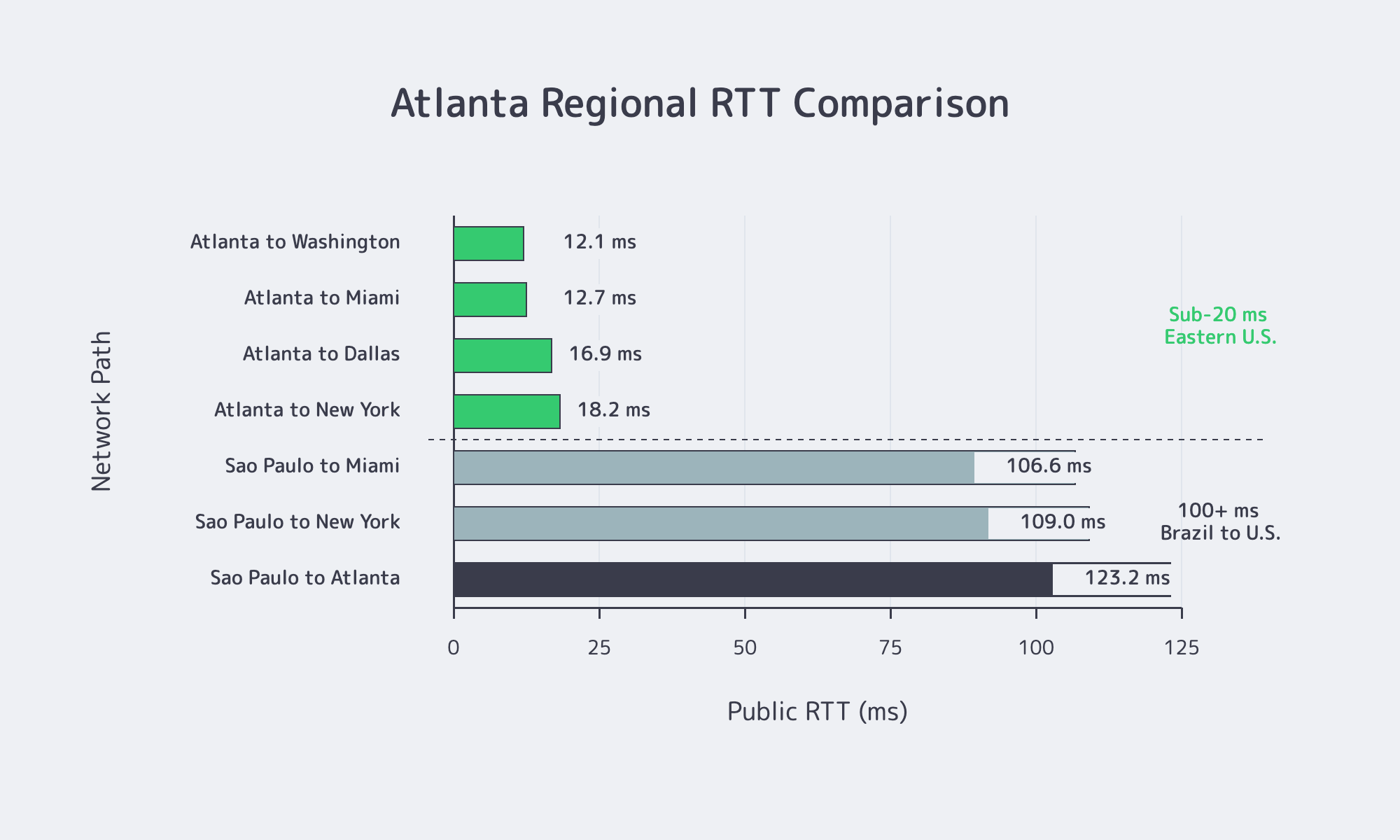
WonderNetwork’s city-to-city latency dataset is generated from 30-ping test runs between endpoints, so it should be treated as directional benchmarking rather than a delivery guarantee. Even with that caveat, it captures Atlanta’s core advantage: Atlanta is very close to the Southeast and Mid-Atlantic, still close enough to New York for dual-region design, and noticeably farther from São Paulo than Miami is. 2
| Path | Typical Public RTT | Deployment Read |
|---|---|---|
| Atlanta → Miami | ~12.7 ms | Strong for Florida reach and Southeast failover logic. 3 |
| Atlanta → Washington | ~12.1 ms | A practical benchmark for Mid-Atlantic and Northern Virginia corridor reach. 4 |
| Atlanta → New York | ~18.2 ms | Good enough for East Coast dual-node architecture without forcing everything into the Northeast. 5 |
| Atlanta → Dallas | ~16.9 ms | Useful when Southeast traffic also spills toward Texas or central U.S. integrations. 6 |
| São Paulo → Atlanta | ~123.2 ms | Fine for LatAm-adjacent control planes, origins, and replication; weaker for Brazil-primary interactive delivery. 7 |
| São Paulo → Miami | ~106.6 ms | Better if lowest Brazil-to-U.S. RTT dominates the architecture. 8 |
| São Paulo → New York | ~109.0 ms | Shows Atlanta is not the shortest LatAm path, but it is not dramatically worse than Northeast routes either. 9 |
That table translates into a simple architectural rule. If traffic is mostly Georgia, Florida, the Carolinas, Tennessee, Virginia, and the larger East Coast corridor, Atlanta is often the better first U.S. node than a more northerly location because it keeps the Southeast close without isolating the platform from the Northeast. If Brazil or other LatAm markets become the primary interactive audience, Atlanta should usually become the U.S. anchor in a two-node design rather than the only node.
The routing fabric around Atlanta supports that interpretation. Community IX says Atlanta is available to ISPs, content providers, and enterprises across many metro sites; Internet Society Pulse shows about 110 ASNs at CIX-ATL and notes 25 new ASNs joined over the prior 12 months as of May 2026. That is not background noise. It is evidence that Atlanta is an active peering market, which matters when the goal is to reduce avoidable transit hairpins for Southeastern eyeball traffic. 10
Atlanta and East Coast Redundancy
Atlanta versus East Coast hosting is usually a redundancy decision, not a winner-takes-all decision. Dedicated server hosting Atlanta gives very strong Southeast reach and keeps the Mid-Atlantic within roughly a dozen milliseconds, while also offering inland route diversity. The tradeoff is straightforward: Miami is the better single U.S. node for the shortest South America paths, while the Northeast still pulls closer to finance-heavy northern corridors.

Recent market data shows Atlanta is no longer a secondary market pretending to be strategic. CBRE said on March 4, 2026, that Atlanta ended 2025 with 1,459.2 MW of total inventory, up 458.8 MW year over year, making it the second-largest U.S. data center market. CBRE also put vacancy at 2% and under-construction capacity at 2,076 MW, which signals both scale and persistent demand rather than a speculative fringe buildout. 11
That scale matters because redundancy is not only about having a second site. It is about having a second site in a metro with enough interconnection gravity to sustain alternative transit, exchange participation, and routing choices when one path degrades. The downtown Atlanta corridor remains key here: 56 Marietta is described as a major interconnection point with network-neutral access to hundreds of carriers, and is positioned on fiber running from Florida to New York. The adjacent 55 Marietta property calls 56 Marietta the most connection-rich building in the Southeastern United States. 12
The inland-subsea story has also improved. Segra’s May 18, 2026, update describes a completed 600G path from the Myrtle Beach cable landing station into Charlotte and Raleigh, with access extending to Atlanta and Ashburn, and explicitly says Charlotte and Atlanta are emerging as inland subsea aggregation markets. Segra also says Myrtle Beach now serves as an international gateway between the U.S., South America, and Europe, with direct routes to Argentina, Spain, and Portugal. That does not turn Atlanta into Miami, but it strengthens Atlanta’s case as a resilient inland U.S. Southeast anchor. 13
For operators building resilient East Coast architectures, the practical play is often Atlanta plus one northern node, not Atlanta instead of every northern node. Atlanta handles the Southeast and a large share of the East Coast gracefully; the northern node protects region-specific dependencies, capacity spikes, or customer clusters that genuinely live closer to the Northeast. That is more defensible than forcing all Eastern U.S. traffic into one corridor and hoping the route map stays tidy.
Routing and DDoS Deployment Checks
Routing, DDoS, and cost-performance checks should determine dedicated server hosting Atlanta before hardware does. A viable Atlanta deployment usually means at least two credible upstream paths, visible IXP adjacency, and user RTT targets under 20 ms across the Southeast. If Brazil-facing latency must stay near the 105–110 ms band, dedicated server hosting Atlanta alone is usually the wrong answer.

Start with routing, because this is where Atlanta earns its keep. PeeringDB lists CIX-ATL at 114 peers, 135 connections, 85 open peers, 95% IPv6 participation, and 17.9 Tbps of total connected capacity as of its January 2026 update. Internet Society Pulse shows roughly the same exchange at 110 members and 15,900 Gbps of cumulative port speed, and also notes participation in the MANRS IXP program, which signals attention to routing-security hygiene rather than raw port count alone.
The DDoS side of the decision is about network ecosystem quality, not marketing adjectives. NIST SP 800-189 recommends practices such as BGP origin validation, source address validation, and Flowspec as part of resilient interdomain traffic exchange and DDoS mitigation. For teams evaluating Atlanta, that makes the checklist obvious: ask whether the network environment exposes real peering depth, supports routing control, and sits close enough to large upstream capacity to push mitigation toward the edge instead of backhauling pain to the server layer. 15
Then there is cost-performance. U.S. EIA data for year-to-date March 2026 puts average commercial electricity at 11.93 U.S. cents/kWh in Georgia, 11.52 in Virginia, and 22.67 in New York. Atlanta can tell a better power-cost story than much of the Northeast, but not automatically better than Northern Virginia. The stronger claim is “often better balanced” when power, network geography, and Southeast latency are priced together. 16
For Melbicom deployments, the Atlanta decision is location-specific rather than a generic U.S. placement. We operate in a Tier III Atlanta site with Intel dedicated server configurations, 64–128 GB RAM options, both metered and unmetered traffic plans, and per-server network options up to 200 Gbps. Atlanta also sits inside Melbicom’s broader network footprint of 23 transit partners and 29 IXP peering hubs, which matters when route diversity is part of the buying logic.
Workloads That Benefit Most from Dedicated Server Hosting Atlanta
The best Atlanta workloads are the ones that need broad Eastern U.S. efficiency more than the absolute shortest possible South America path. That usually includes API-driven applications, session-heavy platforms, ad delivery and decisioning layers, streaming origins, media processing tiers, game backends, e-commerce stacks, secure business portals, and regional databases or caches that serve Southeastern and East Coast users from one U.S. anchor point.
The traffic mix in Latin America also makes this architecture understandable. GSMA reported in October 2024 that more than 70% of mobile download traffic in Latin America was generated by just three platforms, and that social media, web browsing, and streaming constituted 41%, 29%, and 19% of traffic, respectively. For operators serving that kind of demand profile, Atlanta can work well as a U.S. origin, control-plane, logging, or high-bandwidth processing node while deeper in-region delivery is pushed closer to end users when volume justifies it. 17
This is also where a dedicated server can outperform a generic regional deployment strategy. Many of these workloads are bursty in network usage, sensitive to noisy-neighbor avoidance, or dependent on predictable throughput for ingest, encoding, replication, or bidstream handling. If the audience is geographically spread across the Southeast and East Coast, Atlanta’s latency shape is often more useful than chasing a single “closest” metro for one slice of the user base.
The main exception is straightforward: if the workload is truly Brazil-primary, highly interactive, or tied to in-country requirements, the right move is usually to add or prefer a São Paulo node. Melbicom’s LATAM infrastructure supports that distinction with São Paulo deployment options built around local routing control and very low São Paulo–Rio round-trip latency. That is not an argument against Atlanta. It is the precise boundary where “LatAm-adjacent” turns into “LatAm-local.”
Atlanta to LatAm Expansion Path
Atlanta should usually be treated as the first U.S. Southeast node in a broader Americas design, not as the final answer for every Latin American workload. A strong expansion pattern is Atlanta for Southeast and East Coast aggregation, then São Paulo once Brazil traffic, data-locality requirements, or product economics justify an in-region deployment. That sequence matches current routing realities better than pretending one metro can optimize every path at once.
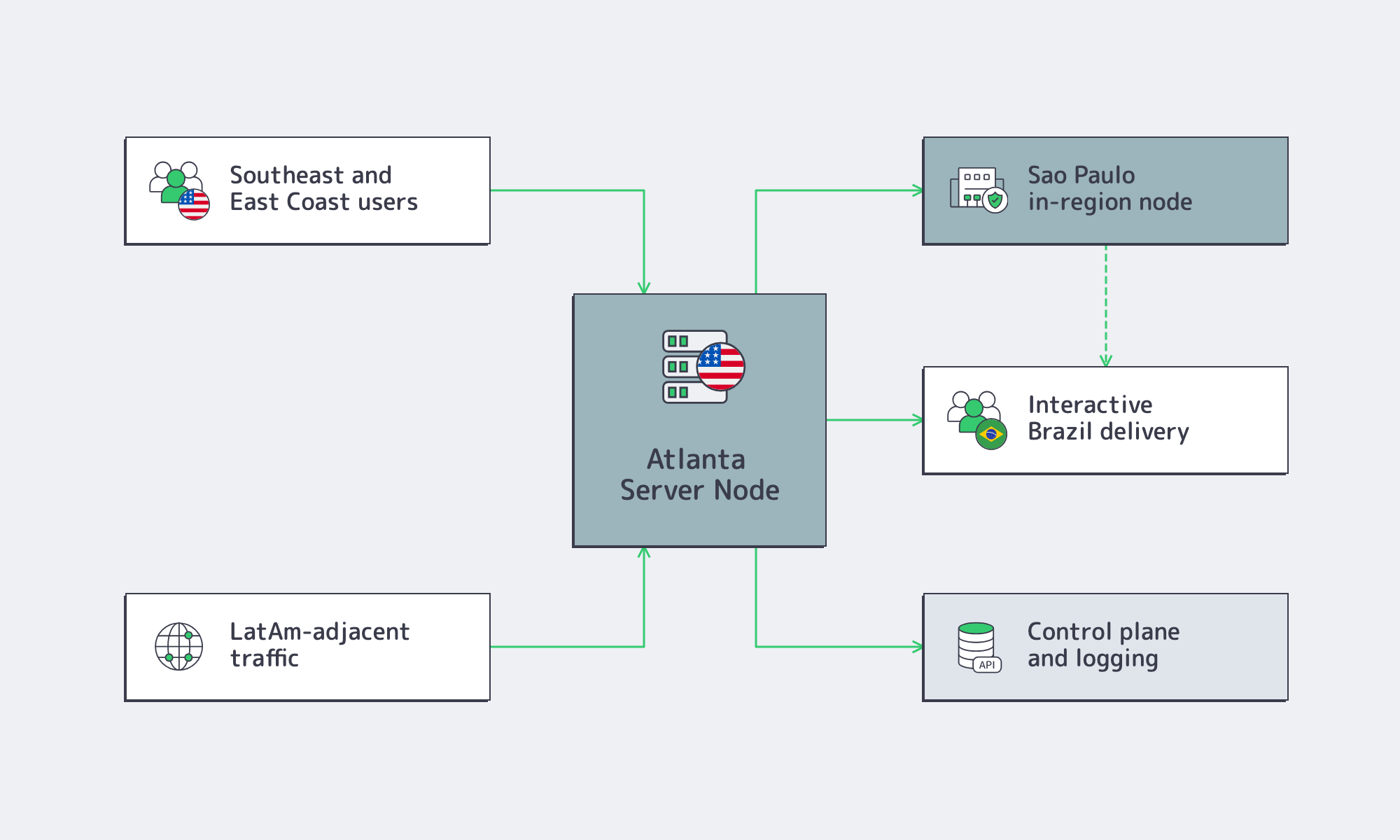
The in-region case for São Paulo is especially strong now. NIC.br said in March 2026 that IX.br reached 50 Tbit/s of aggregated traffic, with São Paulo alone hitting 32 Tbit/s and more than 2,500 directly connected networks. The expansion strategy is clear: use Atlanta for the U.S. Southeast and balanced Eastern U.S. reach, then add São Paulo when Latin America becomes a primary market. 18
Before committing to Atlanta as the next node, use the decision as an engineering exercise rather than a map exercise:
- Set a regional latency budget first. If Southeast and East Coast users need sub-20 ms regional RTTs, Atlanta deserves a serious test; if Brazil users need the lowest possible U.S. RTT, benchmark Miami and São Paulo paths before deciding.
- Separate LatAm adjacency from LatAm locality. Atlanta is a strong U.S. anchor for origins, processing, replication, and control planes; São Paulo is the better answer when interactive Brazil traffic becomes the product center of gravity.
- Treat peering depth as a procurement input. Check exchange density, upstream diversity, IPv6 readiness, and routing-security hygiene.
- Model power and bandwidth together. Georgia’s commercial electricity profile can help the cost case versus much of the Northeast, but the real decision is the combined cost of power, traffic volume, routing quality, and failover design.
Atlanta Is a Routing Decision
Atlanta makes sense when the workload needs a Southeast-first U.S. node that still behaves well across the East Coast and can support LatAm-adjacent architecture without pretending to be the lowest-latency Brazil option.
Its value is the blend: sub-20 ms Eastern U.S. RTTs, meaningful exchange density, inland redundancy, and practical cost balance.
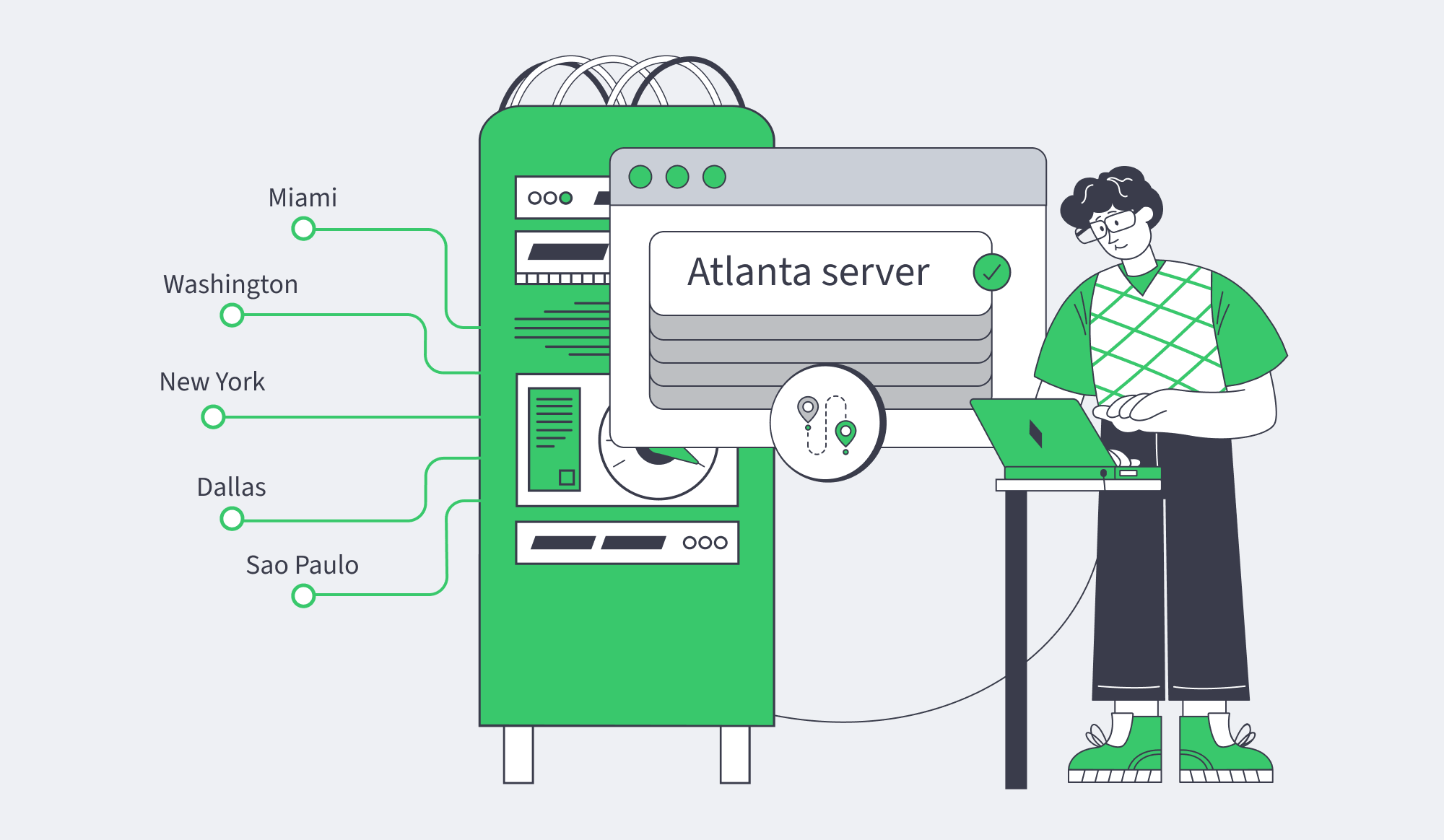
The decision threshold is practical. If traffic is primarily Southeastern and Eastern U.S., dedicated server hosting Atlanta can be the anchor. If Brazil becomes the main interactive market, add São Paulo beside it.
That is where Melbicom’s Atlanta footprint fits the expansion model.
Deploy Atlanta Dedicated Servers
Use Melbicom Atlanta dedicated servers for Southeast-first routing, East Coast redundancy, and LatAm-adjacent expansion paths.