
Blog

Dedicated Server France: Paris-First Performance & Data Sovereignty Guide
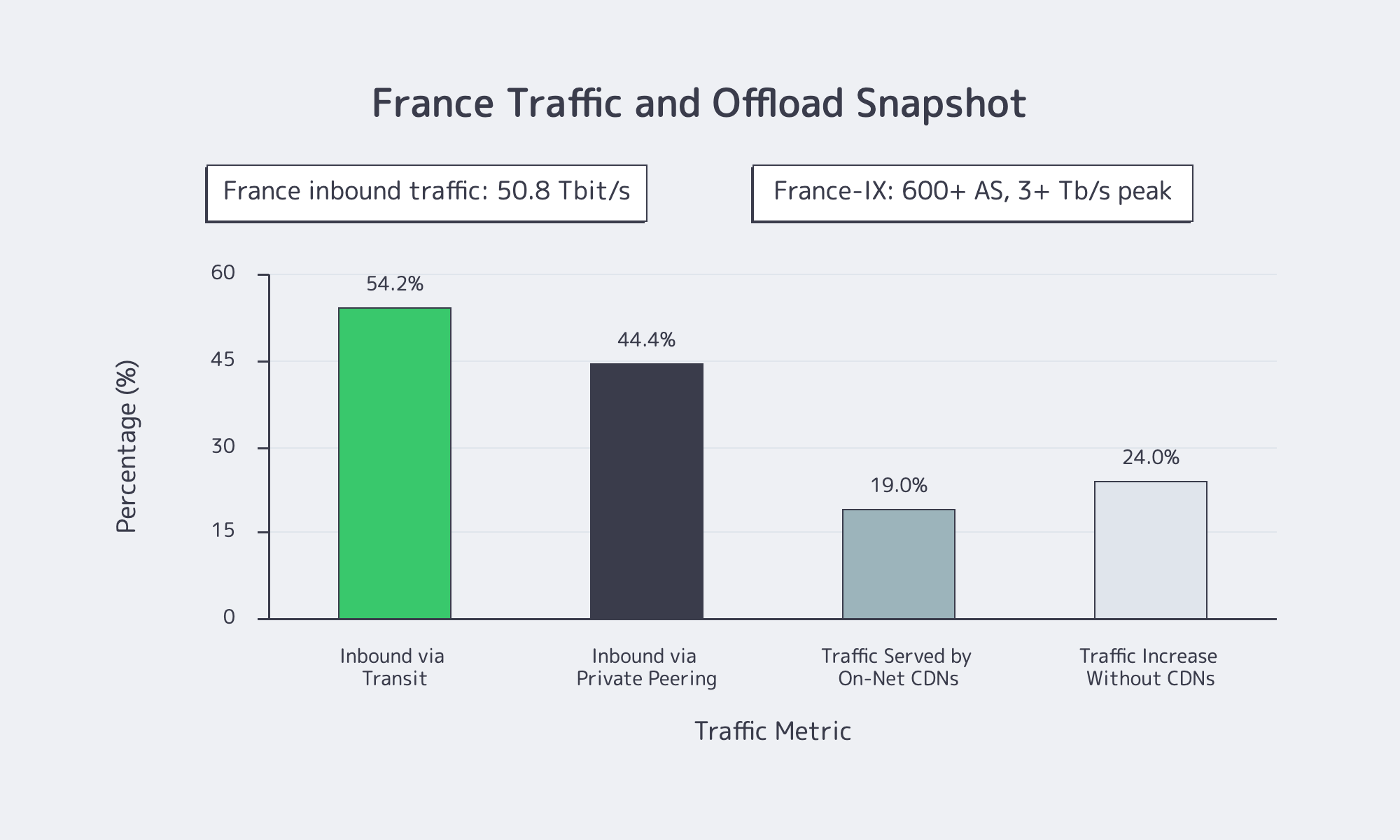
A strong France hosting decision is no longer “France versus Europe.” It is Paris as the performance anchor, sovereignty at the legal-and-operational layer, and redundancy in adjacent EU regions. ARCEP reports inbound traffic to France’s four largest ISPs reached 50.8 Tbit/s, up 9.2% year over year, with 54.2% over transit and 44.4% over private peering. That makes server specifications, origin placement, exchange reach, and cache strategy part of the same hosting decision.
Build in France— Paris dedicated servers — Adjacent-EU standby — CDN for France traffic |
 |
Why Paris-First Still Matters for a Dedicated Server in France
Paris matters because France’s user experience is shaped by interconnection as much as compute. Dense domestic peering can shorten paths for shoppers, staff tools, APIs, and media services; a Paris origin also gives teams a clearer latency baseline before CDN, failover, and cloud-adjacent pieces are added.
France-IX says it connects 600+ AS networks and sees 3+ Tb/s peak traffic. ARCEP adds that on-net CDNs account for roughly 19% of traffic to ISP customers in France and that, at identical end-user consumption levels, inbound interconnection traffic would rise by 24% without them. The right model is therefore not “Paris origin or CDN.” It is Paris for the latency-sensitive origin path, CDN for repeatable static delivery, and surge absorption before traffic becomes expensive origin load.
The business case is measurable. A cross-site performance study found that improving mobile speed metrics by 0.1 seconds increased conversion progression; in retail, that included a 9.1% lift from product detail to add-to-basket and a 9.2% uplift in spend. Network latency is only one factor, but for checkout, search, session, and API flows concentrated in France, Paris placement remains a clean controllable variable.
How to Choose a Dedicated Server in France for Paris-First Latency and Sovereignty
Choose the server by mapping who needs the fastest and cleanest path to stateful systems: users, payment processors, support teams, auditors, and data subjects. When those paths converge in France, Paris should host the primary origin; sovereignty then becomes a legal-control question, not just rack geography.
Buyers often confuse residency with sovereignty. Residency answers where data sits. Sovereignty asks who can compel access, which laws follow the operator, where onward transfers occur, and what supplementary controls are needed. CNIL warns that a European location alone does not resolve exposure to foreign-authority access, and for the most sensitive processing it recommends providers exclusively subject to European law.
For regulated data, the filter tightens. French digital-health guidance says outsourced personal health data requires HDS-certified hosting and EEA storage. ENISA says availability threats top the EU threat landscape, while Uptime Institute research found that 54% of respondents said their latest significant outage cost more than US$100,000 and one in five put the cost above US$1 million. A serious DDoS and uptime baseline is therefore architectural: filtered edge capacity, independent backups, tested failover, documented incident handling, and enough secondary capacity for runbook-led recovery.
France Dedicated Server vs. VPS Hosting for Regulated and Commerce Workloads
Dedicated infrastructure and virtualized hosting are not rivals; they are different control points. Keep stateful, revenue-critical, and throughput-sensitive services on dedicated servers when predictable capacity matters. Use VPS or other virtualized nodes for elasticity, orchestration, previews, and secondary-region functions where deployment speed matters more than sustained isolation.
Eurostat reports that 52.74% of EU enterprises now use paid cloud services and that 40.89% are already highly dependent on them. The practical question is not whether virtualized infrastructure belongs in the stack; it does. The question is which parts of the stack need dedicated capacity because contention, governance complexity, or sustained egress can become a cost problem.
Melbicom makes split concrete. The France VPS offer is KVM-based and built for quick deployment, with most plans listing up to 1 Gbit/s and possible reduction to 100 Mbit/s after a 5 TB monthly quota. By contrast, France dedicated servers offer higher per-server capacity for workloads that should not share the revenue path with bursty neighbors. A good hybrid keeps the authoritative database, checkout, search, and core API path in Paris, while smaller virtualized nodes handle workers, jump hosts, observability, previews, and standby roles for recovery.
France Plus Adjacent-EU Redundancy Planning Without Overspending on Infra
Redundancy gets expensive when the second region becomes a full copy of the first. For most France-first services, a leaner pattern works: Paris for active state, an adjacent EU region for warm standby, CDN for repeatable assets, and backups or replication sized to recovery targets, not vanity symmetry.
Current Melbicom Europe entry points show why the economics work:
| Location | Architecture Use |
|---|---|
| Paris, France | Primary France origin for latency-sensitive state, checkout, API, search, and regulated data paths. |
| Amsterdam, Netherlands | Cost-efficient adjacent-EU standby, route diversity, and high-capacity cache/origin overflow. |
| Frankfurt, Germany | Warm standby for SaaS control planes, finance-adjacent services, and Central/Western Europe reach. |
| Madrid, Spain | Southern-EU route diversity when France traffic also reaches Spain or wider southern routes. |
Amsterdam is the low-cost way to buy dense interconnection and route optionality. Frankfurt is the clean adjacent-region fit for SaaS control planes and Central or Western European reach. Madrid adds route diversity when France is paired with southern-European traffic. None require full dual-active complexity to be useful.
The first redundancy euro often belongs to edge offload, not duplicate origin servers. ARCEP’s CDN data shows how much traffic can be absorbed before it reaches interconnection links; Melbicom’s CDN footprint gives us a way to pair a Paris dedicated origin with distributed cache capacity, including 39 CDN PoPs across 35 countries and volume economics for bandwidth-heavy assets. For storefronts, portals, and media-heavy services, CDN plus warm standby usually beats keeping a fully mirrored second origin stack idle for rare failover.
Decision Trees for E-Commerce, SaaS, and Regulated Data
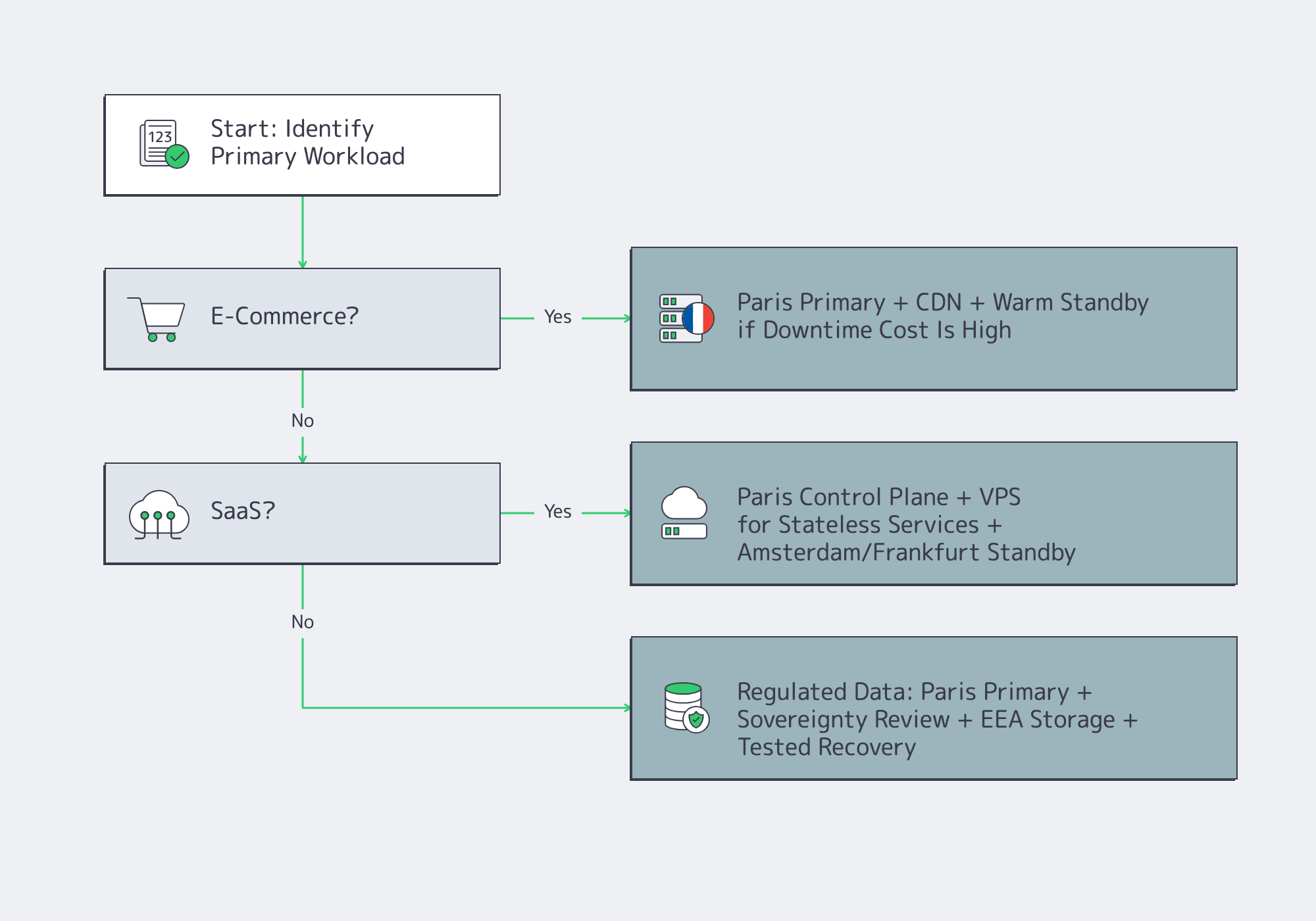
Use the decision trees below to decide what belongs in Paris, what can move to the edge, and what deserves adjacent-region standby. The point is not to buy more infrastructure; it is to separate revenue path, control plane, and regulated state so each receives the right level of locality.
E-commerce: if the conversion path, support workflow, and payment dependencies are concentrated in France, put origin, checkout, search, and sessions in Paris first. If the catalog is image- or video-heavy, add CDN before adding more origin servers. If one hour of downtime costs more than a secondary node, add adjacent-EU warm standby with asynchronous replication.
SaaS: if authentication, tenant metadata, billing, and support operations center on France, use a Paris dedicated primary for the control plane and stateful substrate. If the product is bursty, keep stateless services on virtualized nodes. If recovery targets matter more than always-on symmetry, add a warm app stack and replica DB in Amsterdam or Frankfurt.
Regulated data: start with classification, not infrastructure branding. If sensitive processing creates transfer-risk questions, map legal exposure and supplementary measures. If outsourced personal health data is involved, HDS-certified hosting and EEA storage become thresholds. If strict cyber or financial resilience rules apply, require tested recovery, third-party control evidence, and regional-event-resistant logging.
The Shortlist That Ages Well

The durable shortlist is simple: Paris for latency-sensitive origin services, sovereignty controls that withstand legal review, and adjacent EU redundancy that can actually be operated. Architectures that age well assume traffic gets noisier, audits get more specific, and resilience must be demonstrated rather than merely diagrammed.
That leaves a buyer checklist focused on architecture, not vendor theater:
- Put the latency-sensitive origin in Paris, and let CDN handle repeatable static traffic before it becomes origin load.
- Treat sovereignty as legal exposure, operating control, and transfer mapping, not just rack geography.
- Use dedicated servers for stateful, revenue-critical, and throughput-sensitive paths; use virtualized nodes where flexibility matters more.
- Prefer France plus adjacent-EU warm standby before paying for full dual-active duplication.
- For regulated workloads, design for evidence: required certifications, tested recovery, durable logs, and documented third-party controls.
Configure France Infrastructure
Build on Paris dedicated servers with adjacent-EU options, VPS, CDN, 1,400+ configurations across 21 data centers, 20+ transit providers, 25+ IXPs, and 39 CDN PoPs in 35 countries.