
Blog
Dedicated Server BTC: How to Buy Bare Metal with Bitcoin w/o Payment Friction
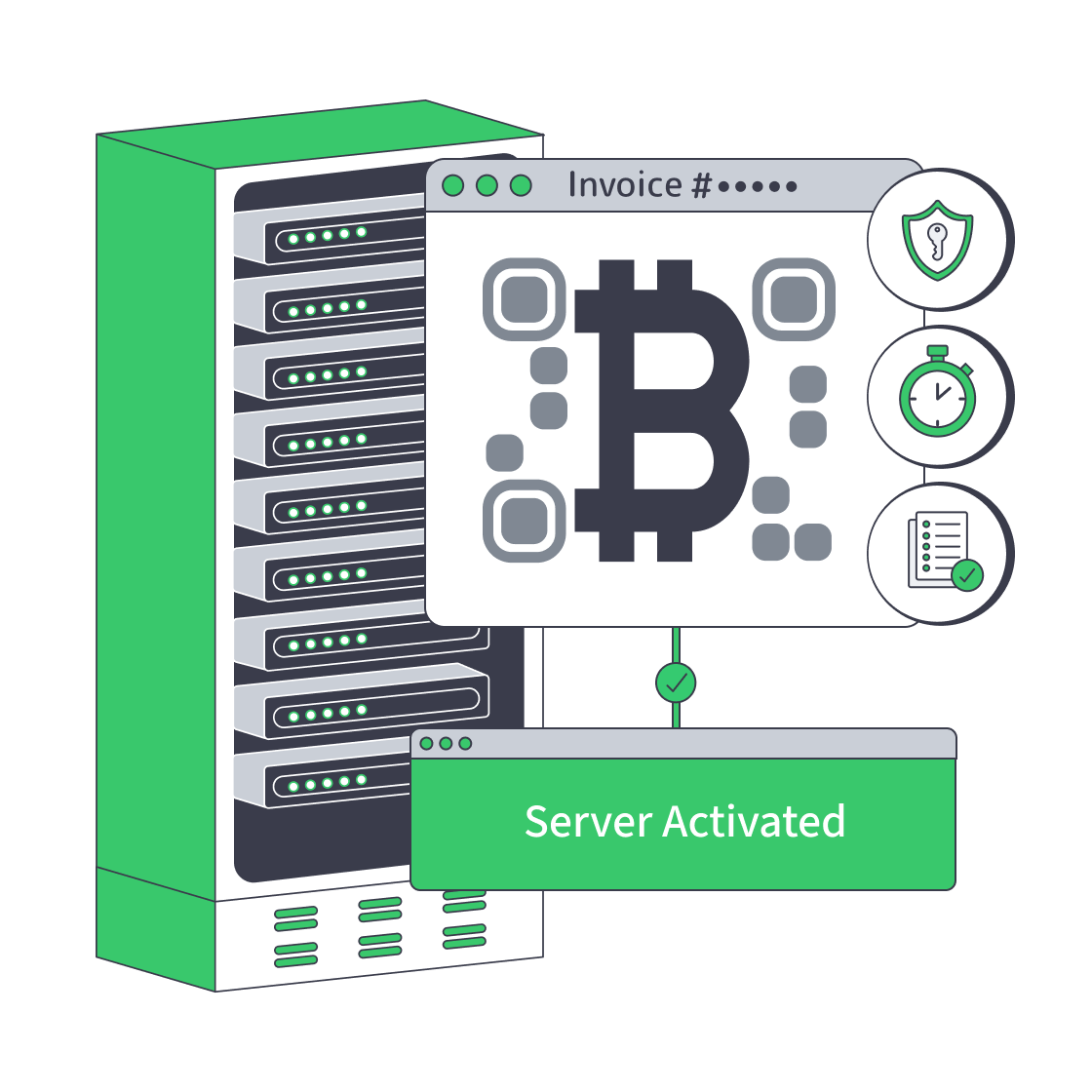
The hard part of paying for a production dedicated server with BTC is usually not Bitcoin. The hard part is the seam between treasury, billing, and provisioning: invoice timers, confirmation policy, identity checks, renewal handling, refund math, and the moment the hosting account actually shows funds available.
That distinction matters because Bitcoin payment status is layered. Bitcoin.org’s confirmation explainer says each confirmation can take from seconds to 90 minutes, with 10 minutes as the average, and the first confirmation can take much longer when the fee is too low. Invoice systems then add quote windows, underpayment states, overpayment states, and manual exceptions.
BTC Payments– Clear invoice flow – Dedicated server capacity – 24/7 support |
 |
How Dedicated Server BTC Payment Works
Dedicated server BTC payment works cleanly when invoice terms, confirmation thresholds, and account-credit timing are known before funds move. Treat “sent,” “confirmed,” and “posted to the hosting account” as separate states. For production orders, activation should begin only after the provider states which state unlocks provisioning.
In Web3 shorthand, “bare metal” often means a dedicated server: single-tenant hardware with predictable capacity. The payment workflow should be just as deterministic: choose stock versus custom hardware, confirm the invoice currency, BTC method, expiration window, confirmation policy, and provisioning trigger, then send funds.

Avoid BTC Invoice Drift
The lowest-friction way to buy dedicated server with BTC is to settle infrastructure details before payment details. Decide whether the order is stocked or custom, get the exact hardware scope priced, ask what confirmation threshold unlocks provisioning, ask who enables crypto billing, and only then request the invoice.
If the invoice expires, regenerate it. BTCPay’s invoice states include expired, paid late, paid partial, paid over, processing, invalid, and settled. For a server order, every exception can slow deployment.
Underpayment deserves special attention. Use a wallet flow that can send the exact invoice amount and choose a fee policy designed for timely confirmation.
Bitcoin Invoices, Confirmations, KYC, and Renewal Risks to Check
Bitcoin server invoices fail most often at five handoffs: quote expiry, slow confirmations, identity review, missed renewals, and refund handling. A buyer who verifies the invoice timer, required confirmations, renewal trigger, and refund basis before checkout removes most payment friction before hardware procurement starts.
| Procurement check | Good answer sounds like | Red flag sounds like |
|---|---|---|
| Invoice timer | “The quote is locked for this long; expired invoices must be reissued.” | “Send it if the address still works.” |
| Confirmation policy | “Activation starts at this status; account credit posts at this later status.” | “We’ll see it when it arrives.” |
| Identity requirements | “These billing details or documents are required before payment.” | “It depends after you pay.” |
| Renewal handling | “Invoices post here, due here, suspension starts here, restoration works like this.” | “Pay right at expiry and it should be fine.” |
| Refund basis | “Refunds follow this path, timing, method, and fee rule.” | “We’ll sort it out manually later.” |
Invoice risk is exchange-rate risk wearing a UX costume. Fixed-rate invoices preserve quoted fiat value for a limited window. That helps the seller, but it pressures teams using approvals, multisig coordination, or staged treasury workflows. Do not request a BTC invoice until the purchase order, signer availability, and fee policy are ready.
Confirmation risk is partly fee risk. Bitcoin.org’s 10-minute average is not a delivery guarantee; the first confirmation can run longer, especially at a low fee. Ask whether provisioning starts at transaction detection, one confirmation, six confirmations, or only after the balance is allocated to the hosting account.
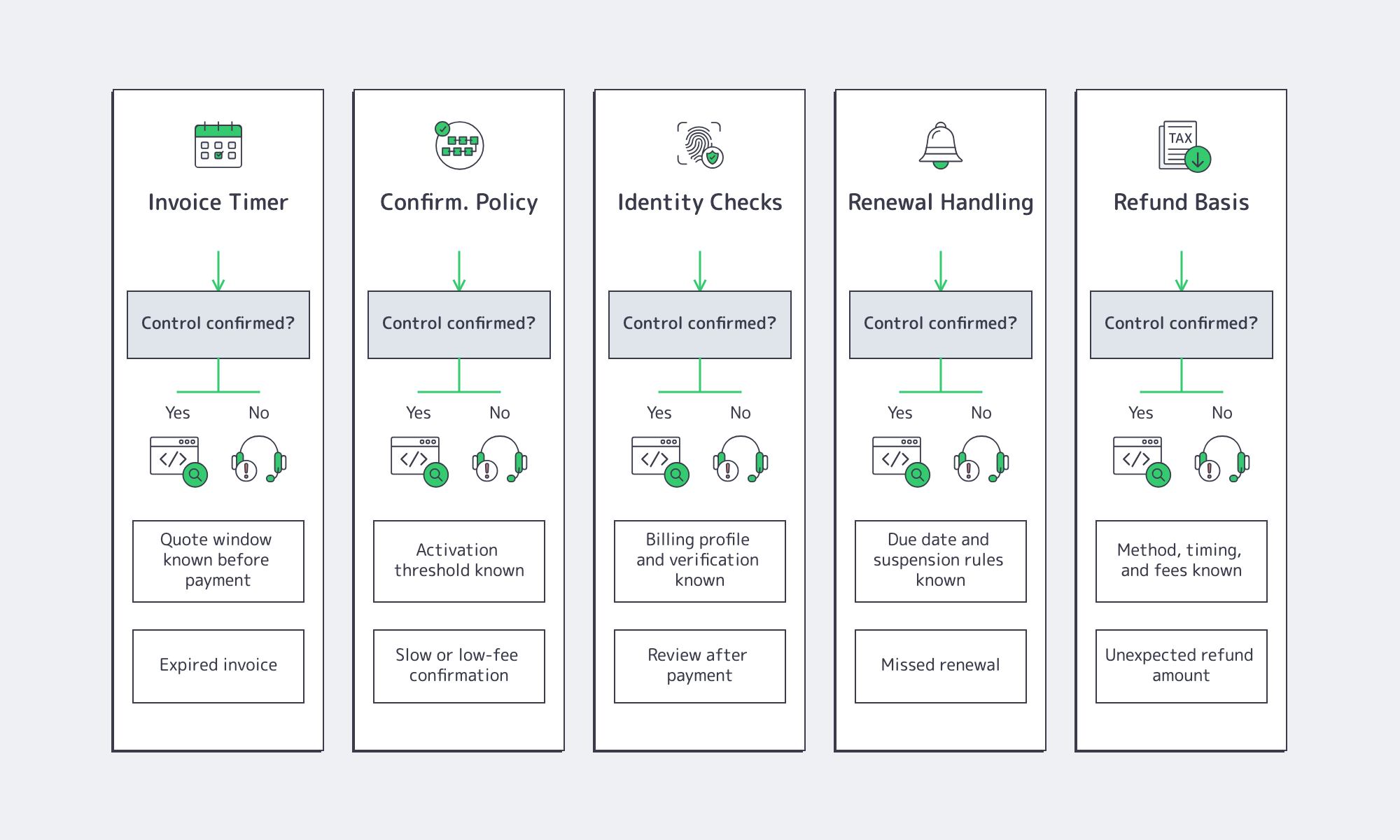
Identity risk is policy-driven, not protocol-driven. FATF’s updated virtual asset guidance says virtual-asset service providers must apply preventive measures such as customer due diligence and transfer-data obligations where applicable. Melbicom’s services agreement also requires accurate customer information and allows suspension or blocking when requested verification documents are not provided.
Renewals and refunds are where dedicated server BTC becomes operations. Melbicom invoices in advance through the Personal Account, and payment is complete only after funds are received and allocated there. If the next period is unpaid, service may suspend when the paid period ends. Data on physical servers may be retained for up to two days after suspension, restoration may take up to 24 hours after full payment is received and allocated, and refunds are processed within 30 days using the agreed payment method, with payment-system fees borne by the customer.
When Buying a Dedicated Server with BTC Makes Operational Sense
Buying a dedicated server with BTC makes operational sense when the workload has a real hardware floor and the billing path is explicit. If a workload needs multi-terabyte SSDs, 1–10 Gbps connectivity, or same-day deployment, payment ambiguity becomes a reliability risk rather than a back-office inconvenience.

This is why the dedicated server BTC decision belongs in infrastructure planning, not at checkout. Ethereum.org’s node guide recommends a fast 4+ core CPU, 16 GB+ RAM, a fast 2+ TB SSD, and 25+ Mbit/s bandwidth; full archive footprints range from about 2.2 TB to 12 TB+ depending on client. Agave validator requirements are steeper: 12 cores / 24 threads or more, 256 GB RAM or more, separate NVMe volumes, 1 Gbit/s for an unstaked node, at least 2 Gbit/s for a staked node, and 10 Gbit/s recommended for stable operation.
The takeaway is blunt: if storage layout, port speed, and deterministic performance matter, a vague BTC payment flow can become an outage vector.
When BTC Payment Makes Sense
Buy dedicated server capacity with BTC when the provider can state the invoice timer, confirmation threshold, payment-posting event, renewal trigger, and refund basis before the first satoshi moves. If those rules remain vague, BTC stops being a convenience and becomes an avoidable uptime risk.
For Melbicom, the best fit is a buyer that already knows its target region, hardware floor, port speed, expected renewal cycle, and deployment timeline. Melbicom’s 1,400+ ready-to-go configs, custom server builder, payment, and support paths make those checks part of the buying process.
Dedicated Server BTC Buyer Checklist
The clean BTC order is the one whose moving parts are explicit before finance signs anything. Use this as the final check against Melbicom’s payment methods, server builder, account-management flow, and support process.
- Confirm whether the order is a stocked configuration targeting about 2-hour activation or a custom configuration typically delivered in 3–5 business days.
- Ask which event marks successful payment for the order: network detection, one confirmation, six confirmations, or actual allocation inside the Personal Account.
- Get the invoice timer in writing and confirm what happens if payment lands after expiry, arrives under the quote, or arrives over the quote.
- Verify whether billing profile fields, account login steps, or verification documents are required before invoice issuance, renewal, or refund handling.
- Know the renewal path: Melbicom invoices in advance, may suspend service when the paid period ends, and may take up to 24 hours to restore service after payment is received and allocated.
- Ask how refunds are calculated and routed, because refund amount, timing, payment method, and fees may not mirror the original BTC amount sent.
Make the BTC Payment Rail Boring Before the Server Goes Live

The point of paying for a dedicated server with BTC is not to turn procurement into a crypto experiment. The point is to give treasury a payment rail that matches how the team already operates while keeping infrastructure delivery predictable. That requires boring details: invoice windows, confirmation policy, identity requirements, renewal timing, refund math, and account-credit rules.
Melbicom’s role in that workflow is practical. We give buyers a way to evaluate production infrastructure first—server availability, region, bandwidth, support path, and deployment timing—then route the payment conversation through the account-management and billing process. That is how dedicated server BTC procurement should feel: explicit before payment, traceable after payment, and unremarkable once the server is live.
Buy Dedicated Servers with Bitcoin
Use BTC billing with ready-to-go configs, custom builds, and 24/7 support.