
Blog
Why Choose a Netherlands Dedicated Server for EU Reach
If you run a digital business that needs reliable reach across Europe, hosting location matters. The Netherlands combines dense network connectivity, cost‑efficient bandwidth, EU data‑protection alignment, and a mature Dutch data center market. For workloads serving users in multiple European countries, a Dutch hosting location can often be more practical than keeping infrastructure only in a domestic market.
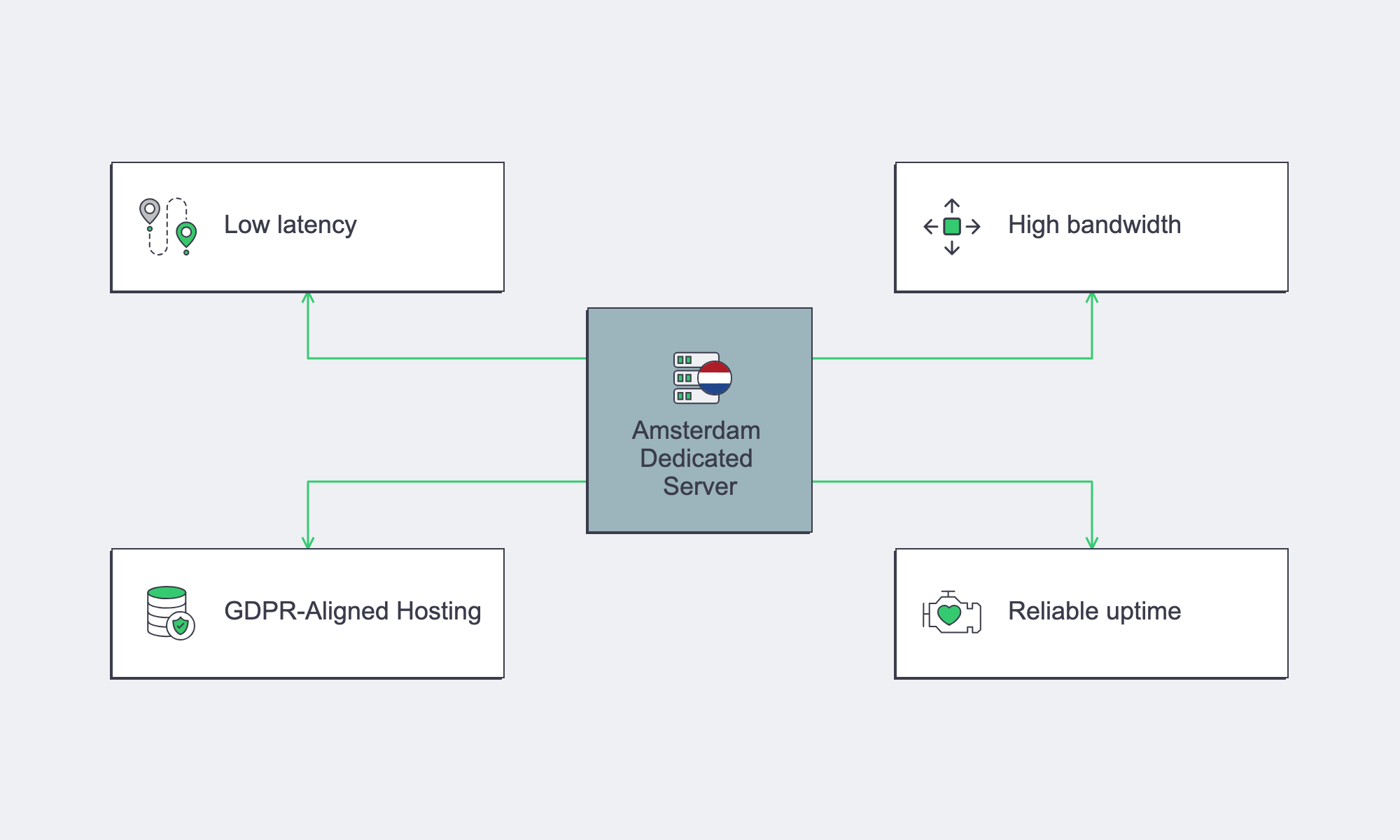
A Netherlands dedicated server can provide low‑latency pan‑European connectivity while keeping infrastructure inside an EU jurisdiction. To understand why, let’s look at how the country’s peering density, privacy framework, sustainability efforts, and bandwidth market can support growth across Europe.
How AMS‑IX Lowers Latency Across Europe
AMS‑IX supports pan‑European low latency by shortening the path between access networks, carriers, and content platforms in Amsterdam. For a Netherlands dedicated server, that routing density is most useful when the provider has strong peering and redundant transit, because nearby EU users can avoid unnecessary long‑haul hops.

Low latency is vital to application performance, and latency depends heavily on traffic routes. Amsterdam sits near the center of Europe’s network map and hosts AMS‑IX, one of the world’s major peering hubs. AMS‑IX’s 2026 Amsterdam figures list 915 connected networks and a 15.036 Tb/s traffic peak. Local exchange between carriers, ISPs, cloud platforms, and content providers can shorten cross‑border routes.
Round‑trip delay estimates from Epsilon’s city‑to‑city data show Amsterdam to Frankfurt at 10 ms, London at 13 ms, Paris at 16 ms, and Madrid at 40 ms. Carrier mix and access networks can still shift real results.
| Test Destination | Round‑Trip Latency Approximation |
|---|---|
| London, UK | ~13 ms |
| Frankfurt, DE | ~10 ms |
| Paris, FR | ~16 ms |
| Madrid, ES | ~40 ms |
Table. Round‑trip delay estimates from Epsilon Global Network.
For businesses consolidating EU delivery through a single point of presence in Amsterdam, the peering layer can reduce avoidable transit hops to nearby markets. That makes Amsterdam suitable for SaaS, e‑commerce, streaming, and other workloads that need predictable routes across multiple European countries.
At Melbicom, outbound and inbound traffic runs over high‑capacity, redundant fiber networks with 29 IXP peering hubs and 23 transit partners across the wider platform. That diversity helps reduce bottlenecks and keeps demanding workloads reachable as traffic patterns change.
Regulatory Compliance and Legal Assurance

The Netherlands is an EU jurisdiction, so providers and customers handling personal data there need to account for GDPR and Dutch supervisory oversight. Hosting in the Netherlands does not make an application compliant by itself, but it gives EU‑focused teams a clear legal framework for data residency, contracts, security controls, and breach‑response planning.
For enterprises operating in several European markets, that legal consistency can simplify vendor reviews and customer assurances. Instead of selecting a separate hosting country for every national market, teams can use Dutch infrastructure as an EU base while applying the same GDPR controls across processing records, access management, retention policies, and incident procedures.
Local hosting was once favored for meeting individual data mandates, but the combination of GDPR, mature Dutch facilities, and Amsterdam connectivity has changed the tradeoff. Businesses increasingly compare country‑level residency requirements against performance, routing, and operational control. At Melbicom, this environment is reinforced by strict security controls, ISO/IEC 27001:2022‑certified processes, and around‑the‑clock monitoring. Our Amsterdam data centers support secure, compliance‑sensitive workloads when paired with the customer’s own application, access‑control, and data‑governance practices.
Sustainably Powered Data Centers

Sustainability is now a practical infrastructure criterion for many EU‑facing businesses. The Dutch Data Center Association’s 2025 reporting shows that 99.9% of surveyed Dutch data centers already use green energy contracts, while 81% expect to run entirely on renewable energy by 2030.
Operators are also investing in heat reuse, advanced cooling, and efficiency improvements. The same 2025 reporting projects an average PUE of 1.25 for Dutch data centers, notes that 55% of data center operators report investing in heat reuse, and says 64% of new facilities comply with a maximum PUE standard of 1.30.
Enterprises can reduce the environmental impact of compute by choosing efficient data‑center infrastructure and matching capacity to workload demand. This helps sustainability reporting without forcing a tradeoff against performance. Melbicom’s footprint spans Tier III & IV DCs in Amsterdam, giving teams a Netherlands dedicated server location that can pair EU reach with the country’s mature energy‑efficiency practices.
1 Gbps Unmetered Server Bandwidth
Cost efficiency is another major factor that makes Netherlands dedicated servers attractive. Because Amsterdam is a major interconnection hub with high‑capacity bandwidth, carriers can compete on transit and peering economics. That higher transit capability supports generous unmetered or high‑limit data plans.
A 1 Gbps unmetered Netherlands dedicated server plan can be far more predictable than billing by transferred gigabyte, especially for traffic‑heavy workloads. For clients with demanding throughput, Melbicom’s Amsterdam location supports up to 200 Gbps network capacity per server, with ready‑to‑go bandwidth options from 1–100 Gbps, 50 TB or unmetered traffic models, and custom configurations for workloads that need a more specific setup. Whether the workload is streaming media, content delivery, or IoT telemetry, unmetered or high‑limit bandwidth can help prevent traffic growth from turning directly into egress‑fee growth.
Smaller markets operating from local data centers often cannot match Amsterdam’s mix of mature peering, low‑latency routes, and high‑bandwidth packages. The advantage is also accessible beyond hyperscale buyers: 5 Gbps and 10 Gbps server configurations are available for mid‑sized enterprises and can scale. Companies expecting growth that need to maintain continuity and deliver high‑quality experiences will find a dedicated server Netherlands arrangement useful for fast‑growing traffic demands across Europe.
Shifting the Historical Local‑Only Mindset
In the last decade, the shift from local‑only hosting to centralized Dutch infrastructure has accelerated. Historically, servers were fragmented across national borders because teams worried about performance, residency, and legal complexity. Those constraints have not disappeared, but modern fiber routes, peering, and EU‑wide privacy rules have made a single Netherlands location more viable for many pan‑European workloads.
With high‑speed fiber routes connecting major European cities, Amsterdam can deliver low and consistent latency to nearby markets. GDPR also creates a common baseline for personal‑data obligations across EU states, reducing the need to interpret a wholly separate privacy regime for each target market. Together, these factors have made dedicated servers in the Netherlands a practical hub for pan‑European operations.
In some smaller markets, traffic may still hairpin through larger hubs such as Amsterdam. Hosting the EU‑facing workload in Amsterdam can reduce that detour for users whose access networks already peer there, though teams should confirm real paths with traceroutes and monitoring. For teams consolidating with Melbicom, a single or clustered environment in our Amsterdam data center can simplify operations, support predictable performance, and reduce the cost of maintaining many small local deployments.
Conclusion: Achieve Pan‑European Reach Through the Netherlands
Amsterdam remains one of Europe’s most important internet hubs. AMS‑IX peering, the Netherlands’ EU legal framework, efficient data‑center practices, and competitive bandwidth economics make the country a strong anchor for pan‑European infrastructure. A Netherlands dedicated server strategy gives teams low‑latency access to multiple EU markets without automatically requiring a separate local deployment in every country. Choosing Amsterdam unifies high‑speed bandwidth, compliance planning, and sustainability‑conscious infrastructure in one location.
Order a Netherlands Dedicated Server
Deploy high‑performance, low‑latency servers in Amsterdam today and reach users across Europe with ease.