
Blog

Cheap Dedicated Server Hosting in the UAE: Hidden Risks
Cheap dedicated server offers in the UAE can reduce upfront cost, but the lowest monthly price may hide older hardware, constrained bandwidth, indirect routing, limited support, or rigid upgrade terms. Verify the exact components, facility design, network routes, transfer conditions, support scope, and replacement process before ordering.
A budget UAE server can still be reliable when its specifications match the workload and the provider documents the limits. The goal is to maximize value: choose the lowest-cost configuration that passes production-shaped latency and load tests, provides a clear growth path, and avoids vague fair-use or overage terms.
Choose Melbicom— 14 ready-to-go servers — Tier III facility in Fujairah — 39 CDN PoPs across 6 continents |
 |
The Evolution of UAE Hosting: Why Value Matters More Than Ever
The UAE data center market is projected to grow from $2.38 billion in 2025 to $6.7 billion by 2031, a compound annual growth rate of 18.8%. As capacity grows, buyers have more regional options, but affordable dedicated server hosting in the UAE still needs to be evaluated against hardware, facility, network, and support terms rather than price alone.
The Risks of Cheap Dedicated Servers in the UAE: What Isn’t on the Price Tag
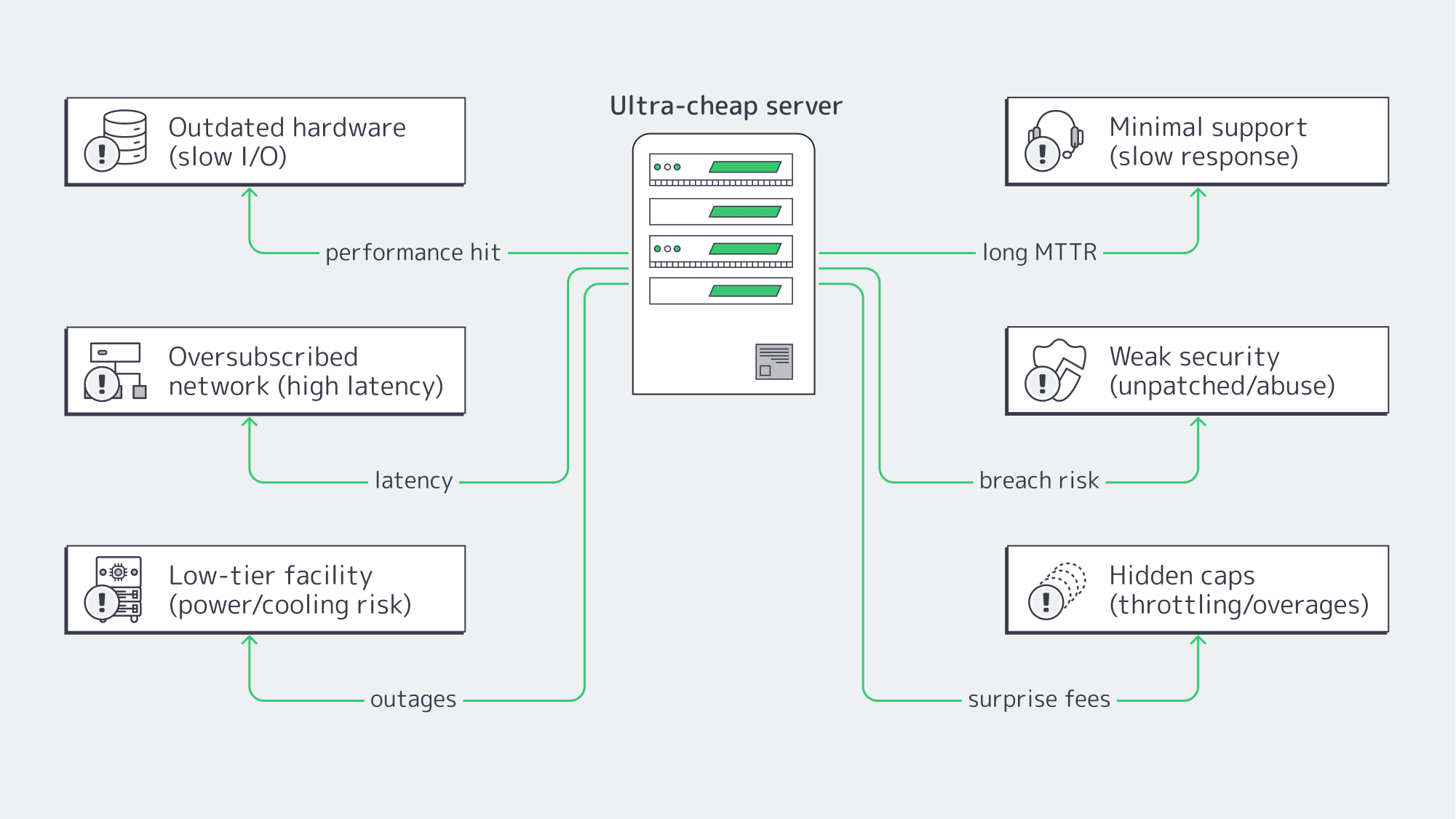
Outdated hardware is hindering performance
Often, ultra-low prices reflect retired or refurbished gear, which can mean older-generation CPUs, spinning HDDs instead of SSD/NVMe, or limited replacement stock. The business impact depends on the workload: underprovisioned CPU, memory, storage, or network capacity can increase response times and reduce concurrency. Judge a cheap server by its exact component models, benchmark results, drive health, and replacement terms rather than price alone.
Latency advantages quashed by thin networks
The main reason to host locally is to shorten round-trip times, but inadequate capacity or peering can erase much of that advantage. A UAE server can reduce path length for Gulf users, yet oversubscribed uplinks and indirect routes can still produce high or unstable latency. Test from the networks your users actually use, at peak and off-peak times, instead of treating geography as proof of performance.
Unreliable uptime forfeits the “discount”
Low-cost plans may rely on facilities with limited redundancy, increasing the risk that maintenance or equipment failures affect service. A Tier III data center is concurrently maintainable, so planned maintenance can occur without shutting down IT operations. Uptime Intelligence’s 2026 outage analysis found that 57% of respondents’ most recent major outages cost more than $100,000, while one in five exceeded $1 million. Those costs put the cheapest offers into perspective.
Support that makes “cheap” expensive
Response time matters during any incident; if you face kernel panics at 3 a.m., you need engineers available, not only a ticket intake line. Some low-cost plans limit support hours or scope, which can prolong outages and force teams to source emergency help. Melbicom provides 24/7 engineering support across dedicated servers for server reboots, OS reinstalls, network troubleshooting, and performance issues.
Accumulating security debt
Low-cost hosting can also shift security work onto the customer without making that boundary clear. The provider should maintain facility, firmware, network, and abuse-handling controls; the customer remains responsible for operating-system patching, access control, workload hardening, and backups unless a managed service explicitly says otherwise. Review IP reputation, DDoS handling, reinstall procedures, and abuse response before deployment.
Other hidden constraints
Other constraints can hide behind a low monthly price. Fixed hardware, limited upgrade paths, vague “fair use” clauses, throttled bandwidth, or high overage fees can turn growth into a forced migration. Organizations may then need a manual cutover and data resynchronization; the resulting service interruption can erase any initial “savings.” When searching for a dedicated server in the UAE, look for clear CPU, RAM, storage, port-speed, transfer, and upgrade terms.
Dedicated Server Hosting in UAE: What to Prioritize on a Budget
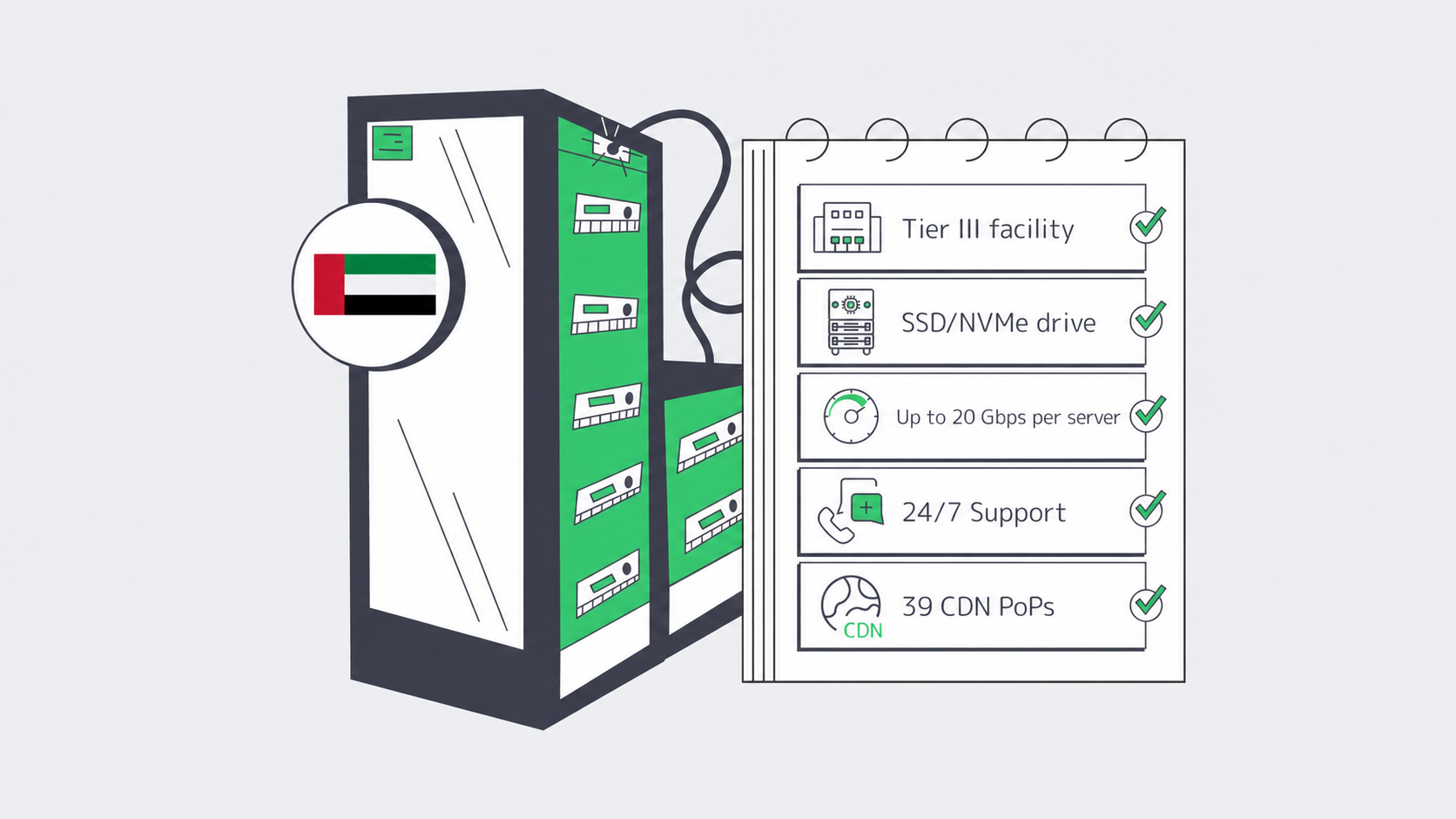
Facility tier and location: Look for redundant power and cooling, documented maintenance topology, and a network suited to the workload. Melbicom’s deployment in Fujairah is a Tier III facility, meaning planned infrastructure maintenance can occur without shutting down IT operations. If a provider will not document the facility tier or equivalent design, treat that as a red flag.
Trustworthy hardware: Compare the exact CPU generation, core count, memory type and capacity, storage media, drive health, and replacement terms. Workload-appropriate CPU capacity, sufficient memory, and SSD/NVMe storage may matter, but newer model numbers do not replace production-shaped testing. Melbicom has dozens of ready-to-go configurations to deploy, keeping costs aligned with the workload.
Network routes and real-world latency: The location is only part of your latency equation. Serving content from the UAE itself shortens path length in the Gulf region, but only if the provider peers and keeps headroom. Melbicom pairs its Fujairah offering with its CDN, which has 39 disclosed PoPs across 35 countries, so static assets can be cached closer to distributed audiences while dynamic requests continue to use the chosen origin.
Support for incidents: Choose a provider that clearly defines support scope and escalation paths. Melbicom engineers are available 24/7 for server reboots, OS reinstalls, network troubleshooting, and performance issues, so incidents can be raised without waiting for business hours.
Bandwidth transparency and growth path: Confirm the port-speed ceiling, included transfer, metered or unmetered terms, and custom upgrade options before deployment. Fujairah supports up to 20 Gbps per server; compare the exact order rather than treating the facility maximum as the default for every configuration.
How Do You Verify UAE Server Latency?
Verify a UAE server by testing production-shaped routes from actual user regions before and after cutover. Measure median and p95 network RTT separately from full transaction time, compare peak and off-peak periods, and confirm the path remains stable under load. A local IP alone does not guarantee a shorter or less congested route.
Test from networks that resemble real users, not only from the provider’s own test host. If your dedicated server is riding on contended links or lacks useful peering, hosting in-region may not improve the user path. Monitor end-to-end response time before and after cutover, and compare p95 application latency during peak and off-peak periods.
Balancing Costs and Quality in Fujairah

Keep things straightforward with the following tips:
- Insist on Tier III as a baseline for engineered resilience: Melbicom’s data centers include Tier III & IV DCs in Amsterdam and Tier III & IV DCs in Frankfurt, among others.
- Match the offered hardware to your expected workloads: SSD/NVMe is useful for I/O-bound apps, while CPU-bound services need sufficient cores, clock speed, and generation-specific performance, and analytics need enough RAM. Melbicom offers a variety of configurations that are ready to deploy, with custom options available.
- Design with low latency as a focus. Start from your users and engineer backwards; make Fujairah your origin, cache front-end static assets via the CDN, and keep latency-sensitive API calls close to Gulf users. Lower p95 latency by keeping stateful services in the UAE when the user distribution supports it and caching static assets globally.
- Don’t underestimate support: Cheap plans without engineering support can prolong incidents. Melbicom provides 24/7 engineering support, reducing the risk that an issue sits unresolved while your team searches for outside help.
- Check the fine print and avoid any lock-ins: Pricing and bandwidth terms should be clear. You should also make sure there are options for straightforward upgrades that don’t require replatforming. Avoid anything vague.
Conclusion: Affordable But Reliable
Choosing at the value end of the UAE dedicated hosting market requires careful comparison. Some “cheap” offers conceal outdated components, use networks that squander the local latency advantage, or rely on ill-equipped facilities. Support may be limited, and rigid plans can force migrations at the worst possible time. Focus on measurable performance, reliability, and growth rather than monthly price.
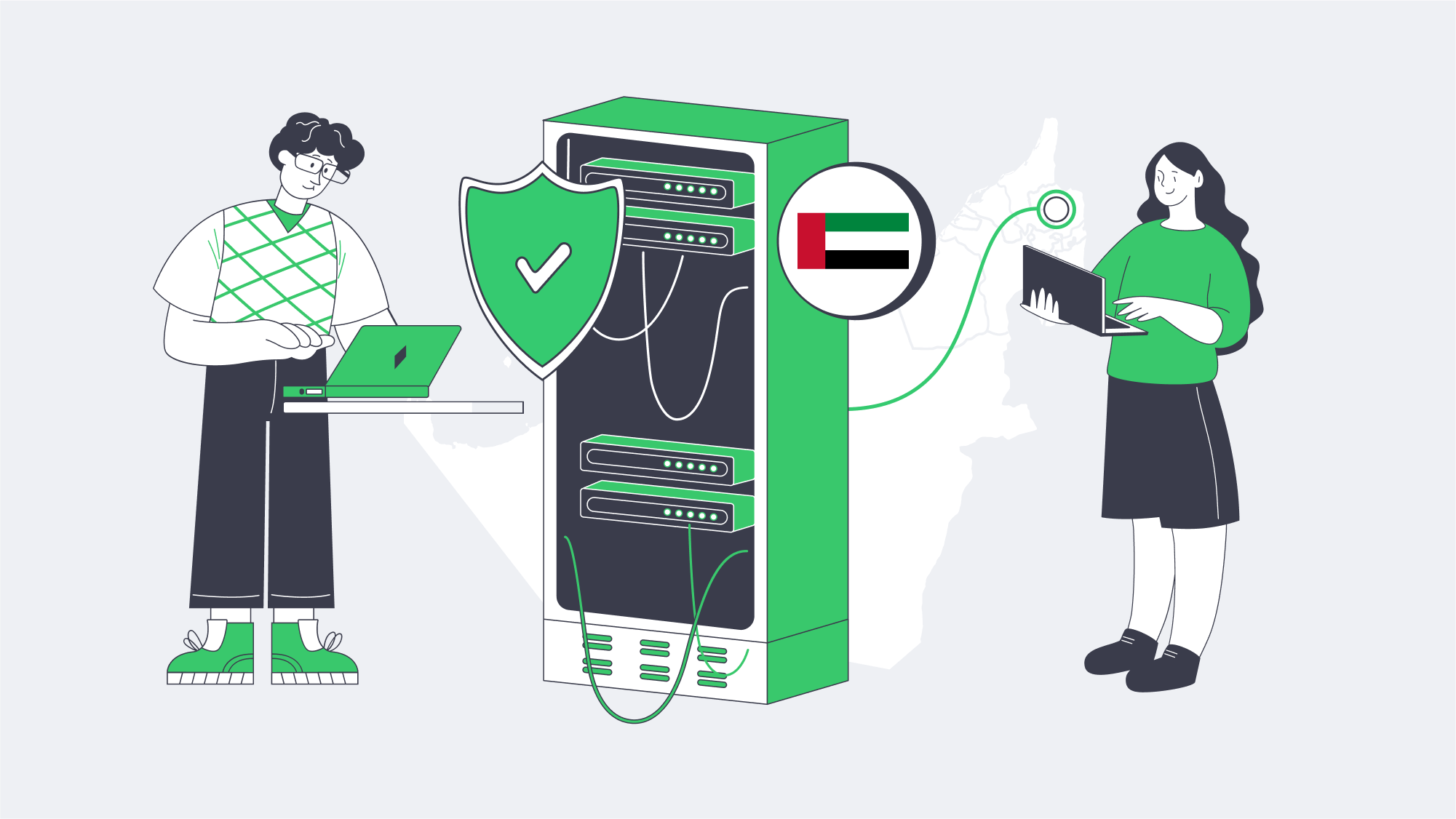
When budgets are low, spend where it matters most. By making facility tier, network, support, and hardware specifications your priorities, you can keep costs in check and protect your revenue and reputation. Melbicom’s Fujairah deployment combines a Tier III facility, up to 20 Gbps per server, and 24/7 engineering support. The wider footprint spans 21 data centers and 39 disclosed CDN PoPs, giving teams options to place origins and cached content closer to their audiences as they grow.
Deploy a UAE Dedicated Server Today
Launch a Tier III facility-hosted Fujairah server with up to 20 Gbps per server and 24/7 support.