
Blog

Blueprint: Brazil Hub, Regional PoPs, Smarter Routing
South America is no longer a “far edge.” Mobile internet users in Latin America almost doubled from about 230 million to nearly 400 million between 2014 and the mid-2020s. Most of the platforms looking at the region already run their main origins in Europe or the U.S. — and now need a CDN footprint in South America that doesn’t collapse under cross-continent latency.
For those teams, the strategy hinges on three levers: PoP placement across South America, inter‑country routing around a Brazilian hub, and origin consolidation with Europe/US as global cores and Brazil as the regional shield. The rest is plumbing.
South America CDN— Reserve origin nodes in São Paulo — CDN PoPs across 5 LATAM countries — 21 Tier III & IV DCs, including Brazil |
 |
Which South American PoP Layout Best Reduces Cross-Continent Latency?
A South America CDN layout should treat São Paulo as the regional hub for traffic coming from existing origins in Europe or the US (let’s use Madrid or Atlanta as examples), then fan out to edge PoPs in cities like Lima, Bogotá, Baires, and Santiago. The objective is simple: keep users in-region while long-haul flows ride the cleanest cables into Brazil.
IX.br’s trajectory explains the role of Brazil. In April 2025, the national IXP fabric hit 40 Tbps peak traffic, with IX.br São Paulo alone exceeding 25 Tbps. That makes SP the natural gravity well for an edge node: place a strong PoP where most of the packets converge.
Modern CDN planning for South America also has to factor in undersea routes. EllaLink’s direct connection between Brazil and Portugal delivers a latency reduction of up to 50% between Latin America and Europe, with RTT under 60 ms between Portugal and Brazil. That turns Brazil into both a regional hub and a clean bridgehead for Madrid‑hosted origins.
For a pan‑regional CDN rollout in South America, a pragmatic pattern looks like this:
- Anchor PoP in São Paulo – which can act as a consolidated regional shield pulling from Madrid or Atlanta origins and feeding the rest of the continent.
- Regional PoPs in Lima, Bogotá, Buenos Aires, and Santiago – existing Melbicom PoPs in these metros shorten last‑mile paths and reduce dependence on long‑haul routes for users outside Brazil.
- Optionally, cable‑adjacent PoPs near landing points (for example on the Brazilian coast) when your cross‑continent flows are especially latency‑sensitive.
The result: users almost always land on a local or near‑local PoP, and the PoPs maintain short, predictable paths into São Paulo and then out to origins in Madrid or Atlanta.
How Should Traffic Be Routed Between Countries Around Brazilian Origin Hubs?
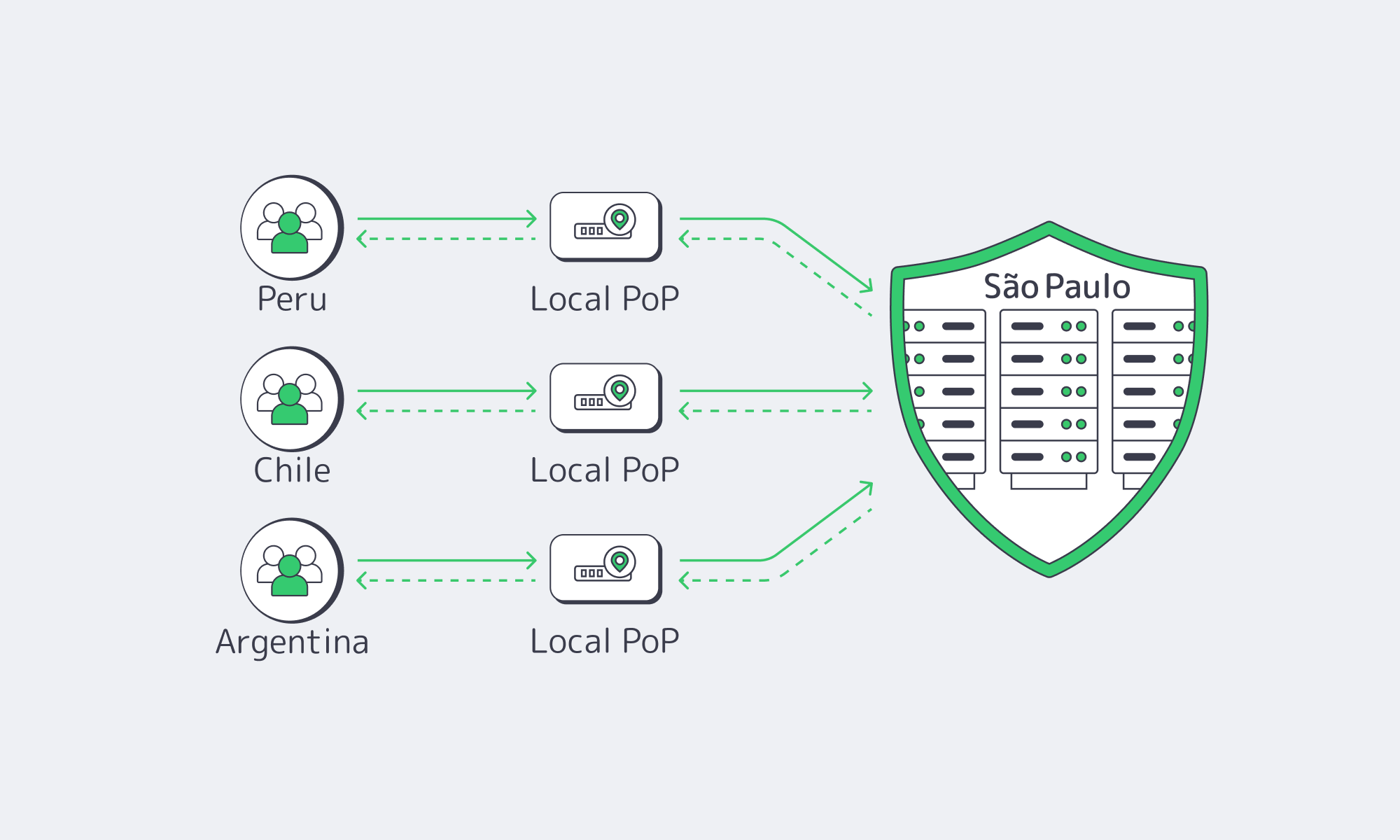
Inter‑country routing should keep packets on South American roads as long as possible. Users attach to the nearest anycast PoP; cache misses travel over regional links to a Brazilian shield in São Paulo, which in turn pulls from European or American origins. BGP policies prevent surprise trombones through distant transit hubs.
The failure mode you want to avoid is classic: a user in Argentina hits content hosted in Spain or the U.S. via a convoluted path that bounces through Miami or random Tier‑2s, turning every click into a 150 ms round‑trip. Properly run, a CDN service in South America does the opposite:
- Anycast on the edge so users in Chile, Peru, or Colombia hit the nearest regional PoP, not North America.
- Brazil as a regional origin hub from the CDN’s perspective: PoPs in Lima, Bogotá, Buenos Aires, and Santiago fetch from a consolidated shield in São Paulo, which in turn talks to Madrid and Atlanta origin clusters over optimized long‑haul.
- Local and regional peering across Latin American IXPs to keep inter‑PoP and PoP‑to‑Brazil traffic inside the continent wherever possible.
This is where routing control matters. A capable CDN provider for South America should expose enough knobs—BGP policies, local‑pref, MEDs—to bias traffic toward regional peers and away from noisy or congested upstreams. Melbicom’s BGP Session service provides free BGP sessions on dedicated servers, IPv4/IPv6, BYOIP, and support for full, default, or partial routes, available in every data center. That’s what allows you to pull Madrid/Atlanta origins into your own routing policy instead of letting transit pick arbitrary paths.
Brazil Deploy Guide— Avoid costly mistakes — Real RTT & backbone insights — Architecture playbook for LATAM |
 |
Resilience rides on multi‑origin thinking. Practically, that means:
- Maintaining at least two independent origin clusters (for example, Madrid + Atlanta) behind the South American shield.
- Using CDN origin pooling and health checks so PoPs fail over cleanly if one of the origin clusters has trouble.
- Defining BGP failover policies that favor alternative regional paths before crossing ocean borders unnecessarily.
From a South American user’s perspective, the priority is consistent, low‑variance RTT—whether the byte actually came from a cache in Santiago or an origin in Madrid via São Paulo is just an implementation detail.
Which KPIs and Traffic Forecasts Should Drive a South America CDN Strategy?

The KPIs that actually move the needle in South America are latency, cache hit ratio, throughput headroom, and availability, all tied to realistic cross‑continent traffic forecasts. Design for video‑heavy, mobile‑first demand, then add capacity and PoPs based on measured TTFB, cache offload, and how quickly long‑haul links saturate.
Latency. Inside Brazil, a realistic target is <50 ms RTT, and <100 ms across major LatAm metros when traffic stays on regional routes and hits a local PoP. With direct systems like EllaLink, Europe–Brazil RTT drops below 60 ms and latency improves by up to 50% versus indirect North American paths.
Cache and origin offload. For a modern CDN in South America, a 90–98% cache hit ratio is achievable on well‑tuned workloads; anything lower usually means TTLs, hierarchy, or routing need work. The practical metric: what % of bytes bound for South American users are served from regional PoPs versus being dragged from Madrid or Atlanta on every miss?
Capacity and per‑server bandwidth. That scale needs serious ports. In Madrid, Melbicom’s dedicated servers come with up to 40 Gbps of bandwidth per unit and 80+ ready-to-go configurations. Our Atlanta facility supports up to 200 Gbps per server with 28 stock builds, ideal as a U.S. Southeast origin anchor. Overall, Melbicom offers dedicated servers in 21 Tier III/IV data centers and CDN PoPs in 39 locations.
Availability and control. Finally, measure per‑PoP uptime, time‑to‑reroute during incidents, and how much routing control you actually have. BGP sessions with BYOIP in every data center let you keep consistent addresses and steer around degraded carriers without touching application code.
Key Metrics and Considerations for a South America CDN Strategy
| Metric/Factor | Target / Example | Strategic Impact |
| Latency (RTT/TTFB) | <50 ms within Brazil; <100 ms across LatAm | Direct regional paths and links like EllaLink cut cross‑continent delay by up to 50% and keep interactive apps usable. |
| Cache Hit Ratio | 90–98%+ | High hit ratios minimize Madrid/Atlanta origin load and long‑haul traffic; bad ratios surface immediately in origin bandwidth graphs. |
| Peak Throughput | At least 2× current peak as headroom | Protects UX during launches and events, especially for video‑heavy workloads; requires 10–100+ Gbps‑class ports at origin and key PoPs. |
| Traffic Mix & Growth | Video ~84% of traffic; IP traffic 18.8 EB/month by 2022 | Justifies deep caching and big pipes—Latin America is already video‑dominant and still growing fast. |
| Availability & Control | 99.9%+ regional availability; BGP + BYOIP everywhere | Lets you treat a CDN provider for South America as programmable network fabric rather than a black box, keeping flows regional and routes predictable. |
Key Design Takeaways for a Pan-Regional CDN South America Footprint
Once you map both infrastructure and demand, a few design patterns show up again and again for CDN South America deployments.
- Localize Aggressively and Peer in-RegionGet traffic onto South American IXPs as early as possible. Peer at IX.br and national exchanges so South America CDN flows don’t hairpin through Miami or random Tier‑2s. The payoff is often 100+ ms shaved off round‑trip times for cross‑border traffic.
- Use Brazil as the Regional Hub, Not the Only OriginKeep PoPs like Madrid and Atlanta as your global origin anchors while treating São Paulo as a regional shield for South America. The São Paulo PoP handles fan-in from long-haul and then fan-out to Lima, Bogotá, Buenos Aires, and Santiago, giving users “local” performance without forcing a full origin migration on day one.
- Design Inter-Country Routing DeliberatelyModel flows between neighbors, not just “user to origin.” Your routing policy should prioritize intra‑LatAm paths, use BGP communities to avoid bad upstreams, and keep return paths symmetric for latency‑sensitive apps.
- Size for Video and Peaks, Not AveragesLatin America’s IP traffic and video share are both on steep, long‑term ramps. Plan capacity around the worst case—launch days, finals, flash sales—backed by ports in the 10–200 Gbps range at origin and PoPs, rather than hoping averages will save you.
- Let KPIs Drive ExpansionTrack TTFB per country, cache hit ratio per PoP, and link utilization into Brazil. Add PoPs, or shift more workloads to forthcoming São Paulo dedicated capacity, when you see those metrics drift, not when users start complaining.
Operationalizing a South America CDN Strategy: Brazil Hub + PoPs
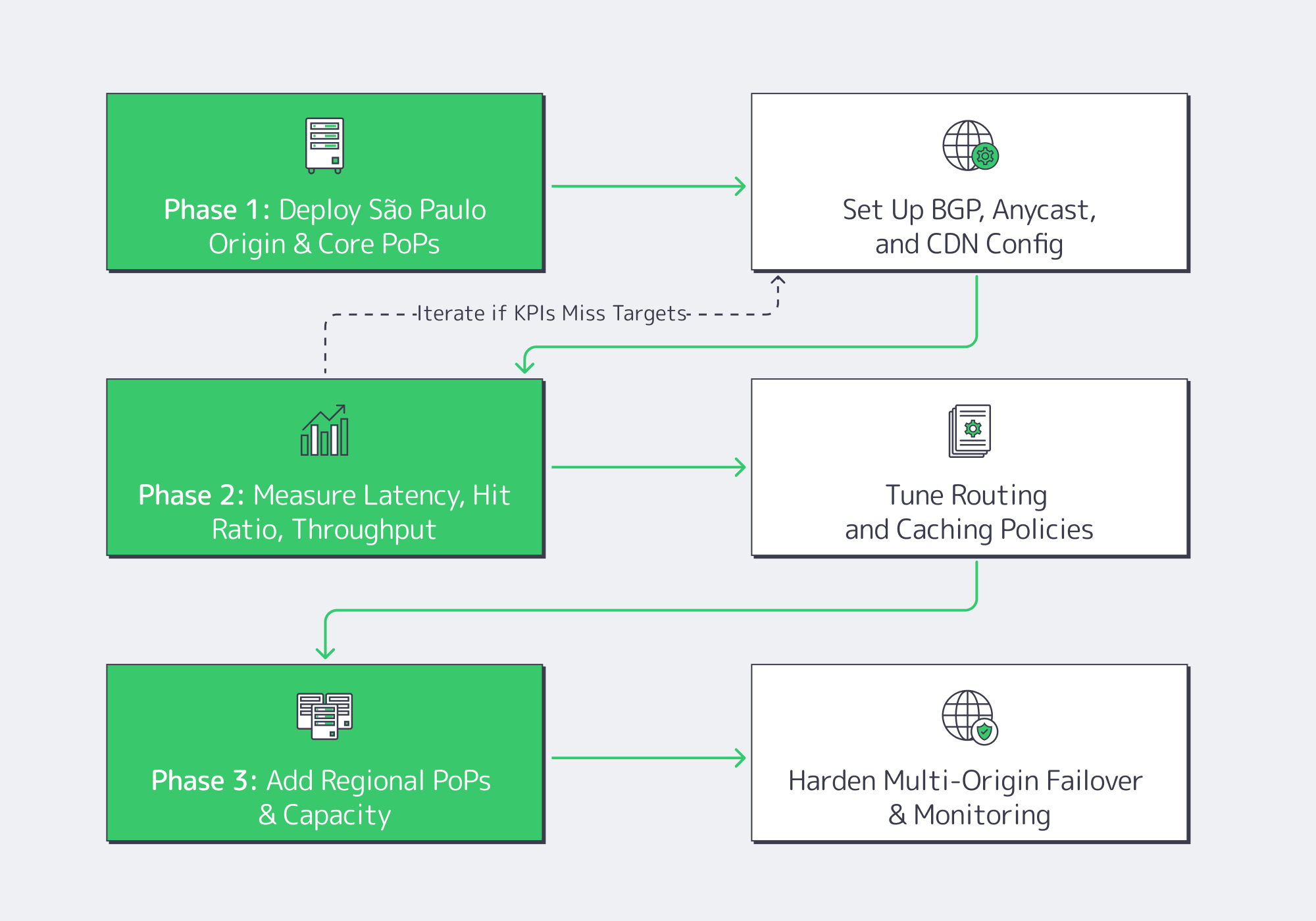
Putting this into practice usually follows a three‑step arc:
- Phase 1 – Core DeploymentStand up your primary origin cluster on dedicated servers in São Paulo, front it with an origin‑shielded CDN configuration, and establish BGP sessions plus BYOIP so routing is under your control. Start with a small ring of South America CDN PoPs that match your initial go‑to‑market countries.
- Phase 2 – Measurement and Policy TuningInstrument p95 latency, hit ratio, and per‑country concurrency. Tighten BGP policies where hairpinning still appears. Adjust cache TTLs and prefetching around traffic patterns (e.g., match‑day surges, trading windows, prime‑time streams).
- Phase 3 – Expansion and HardeningAs traffic grows, add PoPs and capacity in high‑growth markets, introduce secondary origins only where the risk profile justifies it, and harden multi‑origin failover. The result is a fabric that feels local across the continent but behaves like a single, coherent platform.
At that point, the distinction between “Brazil” and “the rest of South America” largely disappears from the user’s perspective — they just experience fast, consistent responses.
How Melbicom Helps You Deploy and Scale in South America
We at Melbicom built our platform for exactly this playbook: global origins plus a programmable edge.
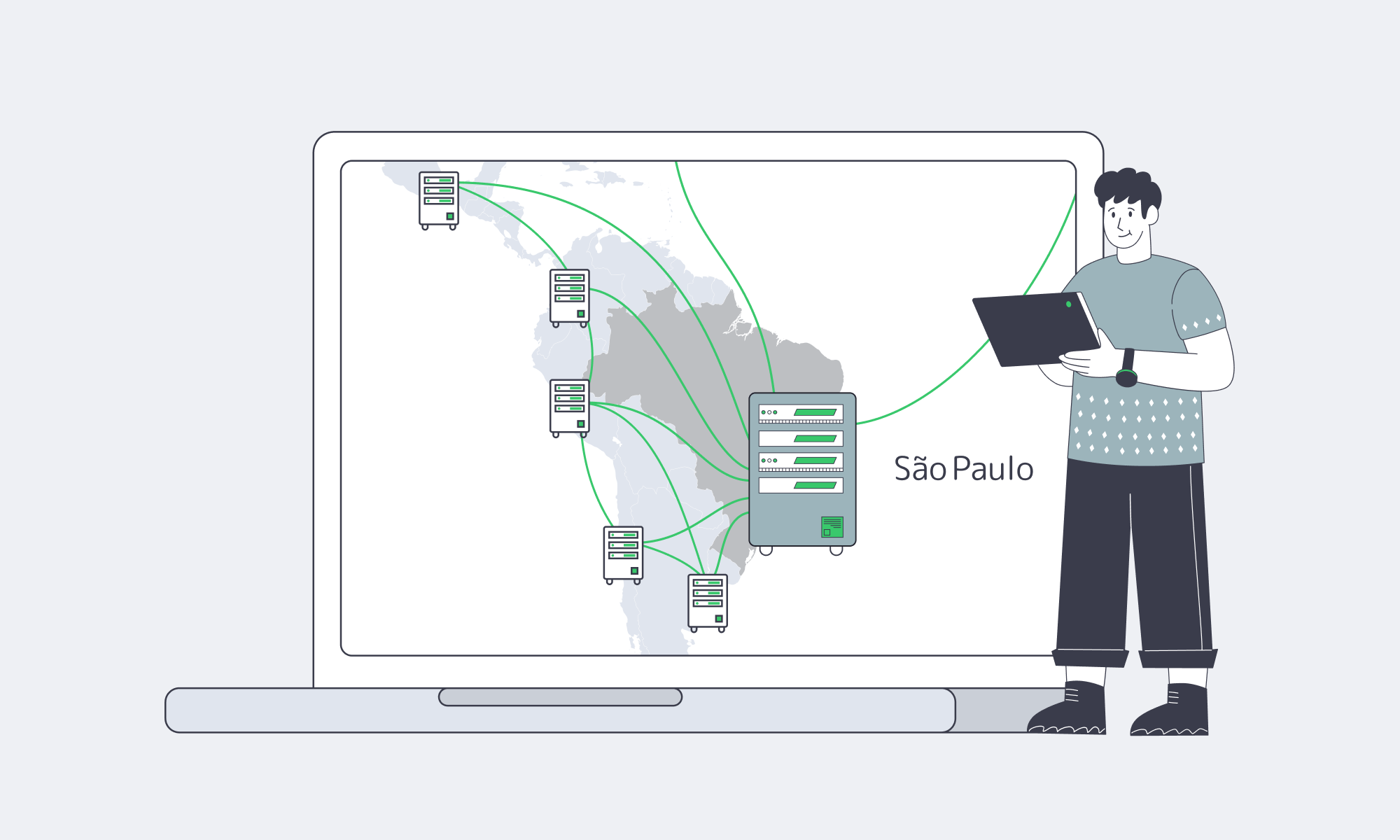
Melbicom operates single-tenant dedicated servers in 21 Tier III/IV data centers spanning Africa, Asia, Europe, North America, and South America, backed by a 14+ Tbps backbone, 23 transit providers, and 29 IXPs. We keep 1100+ ready-to-go configurations in stock and deliver custom servers in 3–5 business days, offering per-server ports up to 200 Gbps depending on location. On top of that, Melbicom’s CDN spans 39 PoPs in 35 countries, including São Paulo, Lima, Bogotá, Buenos Aires, and Santiago.
If you’re planning or refining your CDN service in South America and want to combine European/African/American origins with a South American edge that you actually control, contact us. We’ll help you translate traffic forecasts and KPI targets into concrete server reservations in existing data center locations and pre-reserved São Paulo capacity, wired directly into our regional CDN PoPs and global backbone.
Deploy Your South America CDN
Build a regional edge in Brazil with origins in Europe or the U.S. Our team can map PoPs, BGP policy, and capacity to your traffic targets across LatAm.