
Blog
Buy Dedicated Server with Crypto: Payment and Renewal Checklist
Buying infrastructure with crypto should make procurement faster only if the payment rail is treated like production infrastructure. The key question is not whether a provider accepts coins. It is whether invoice currency, quote timing, confirmation policy, account allocation, renewals, and refund handling are clear enough that a stocked dedicated server can move from order to activation without finance and ITOps waiting on each other.
Choose Melbicom– Clear crypto payment flow – 1,100 ready dedicated servers – 24/7 support |
 |
How Can Teams Buy Dedicated Server with Crypto Without Provisioning Delays?
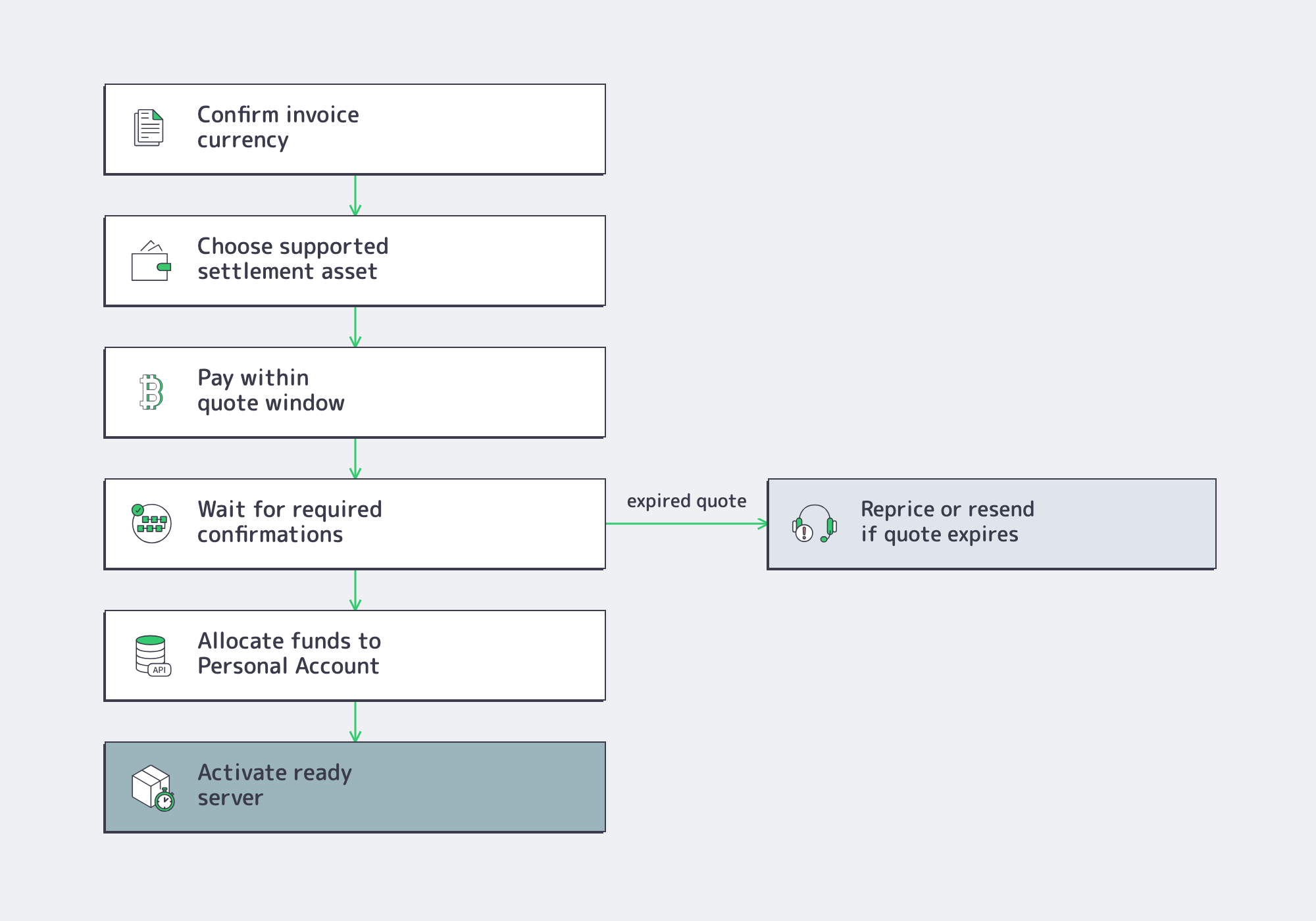
Teams can buy dedicated server with crypto without delays by fixing four variables before the order: invoice currency, settlement asset, confirmation threshold, and the event that marks the invoice paid inside billing. For stocked servers, payment should clear comfortably inside the provider’s activation window, not consume most of it.
Stablecoin and crypto payment volume is now large enough to belong in business procurement rather than novelty checkout. Visa reported adjusted stablecoin transaction volume of $10.2 trillion over the prior 12 months, up 63% year over year, with retail-sized transfers accounting for less than 1% of adjusted volume through March 2025. That pattern signals treasury settlement, not consumer spending.
The operational risk is that “transaction sent” and “server can be provisioned” are not the same state. Bitcoin developer guidance notes that fiat-pegged crypto invoices often expire after 10 to 20 minutes because exchange-rate drift complicates longer quote windows.
Melbicom’s Web3 hosting flow is designed around that kind of practical buying motion: crypto-native billing is available through an account manager, ready-to-go configurations are activated in two hours, and custom builds take 3-5 business days.
For finance, the buying rule is simple. Do not source coins after the invoice is issued. Keep the approved settlement asset ready, know the network fee policy, and make sure the provider’s billing system credits the Personal Account before the infrastructure team treats the order as live.
What Should Finance Confirm Before Paying Server Invoices in Crypto?
Finance should confirm the invoice currency, due date and timezone, supported coin and network, quote-lock window, refund route, and identity requirements before funds move. If any of those fields is informal, crypto payment adds an exception path instead of reducing procurement friction for dedicated server orders.
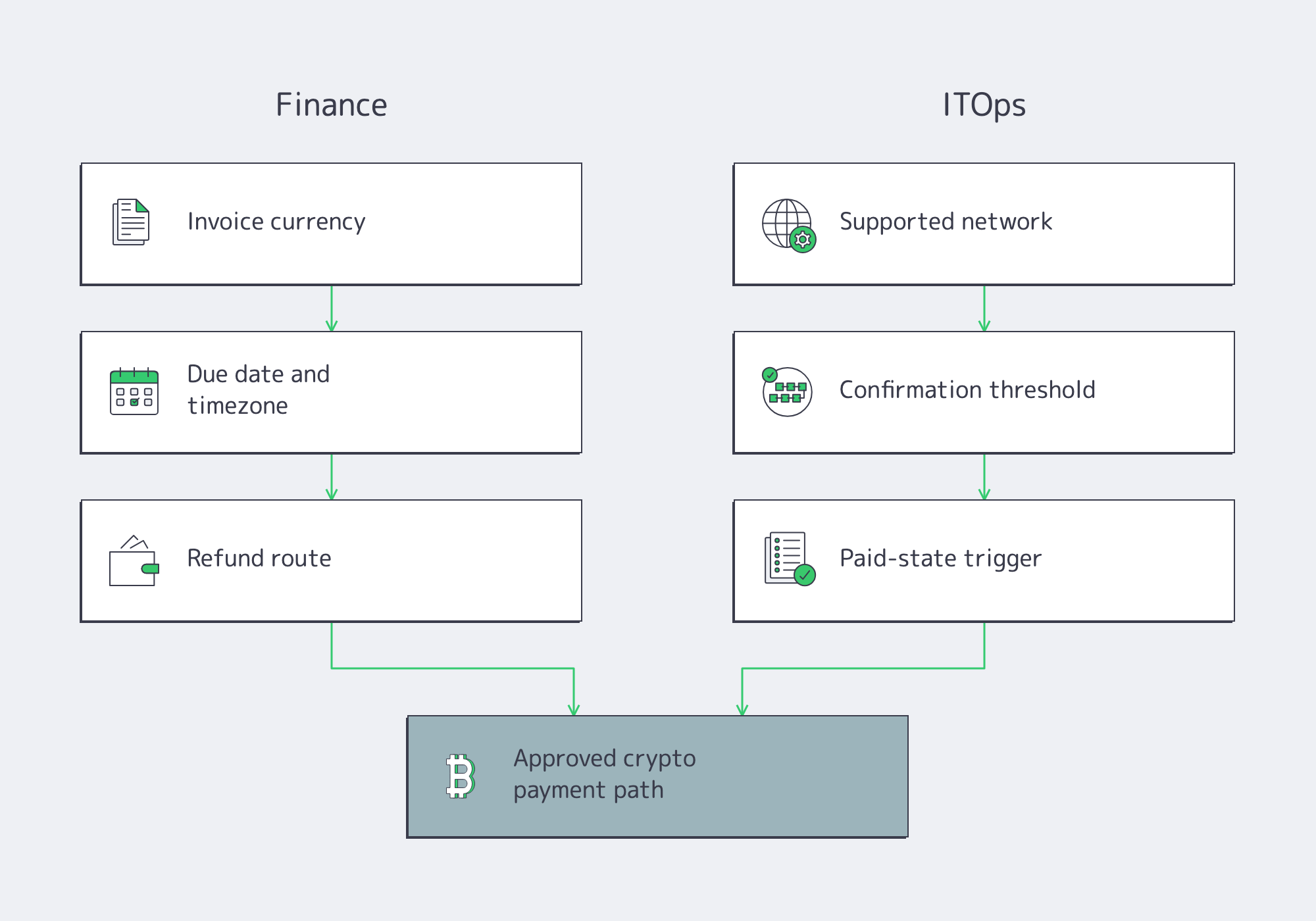
Melbicom’s current services agreement makes one point especially important: payment is completed only after funds are received and allocated to the customer’s Personal Account. That matters for multi-server procurement because the internal billing event, not the block explorer screenshot, is the trigger that protects provisioning and renewal workflows.
KYC belongs in the same checklist. The agreement requires accurate, complete, and current registration information, allows requested verification documents when identification, payment, or legal requirements apply, and prohibits false or anonymized contact details used to avoid identification requirements. Teams buying production infrastructure should clear verification before the first urgent order, not after crypto funds are already in flight.
Which Payment Rails Fit Server Orders?
The best payment rail is the one that matches the invoice clock and the workload urgency. BTC can work when treasury already holds it and confirmation policy is explicit. Stablecoins often fit repeat invoices better because they reduce exchange-rate noise. Faster block times still need provider-side paid-status rules.
| Rail to Compare | Timing to Watch | Procurement Implication |
|---|---|---|
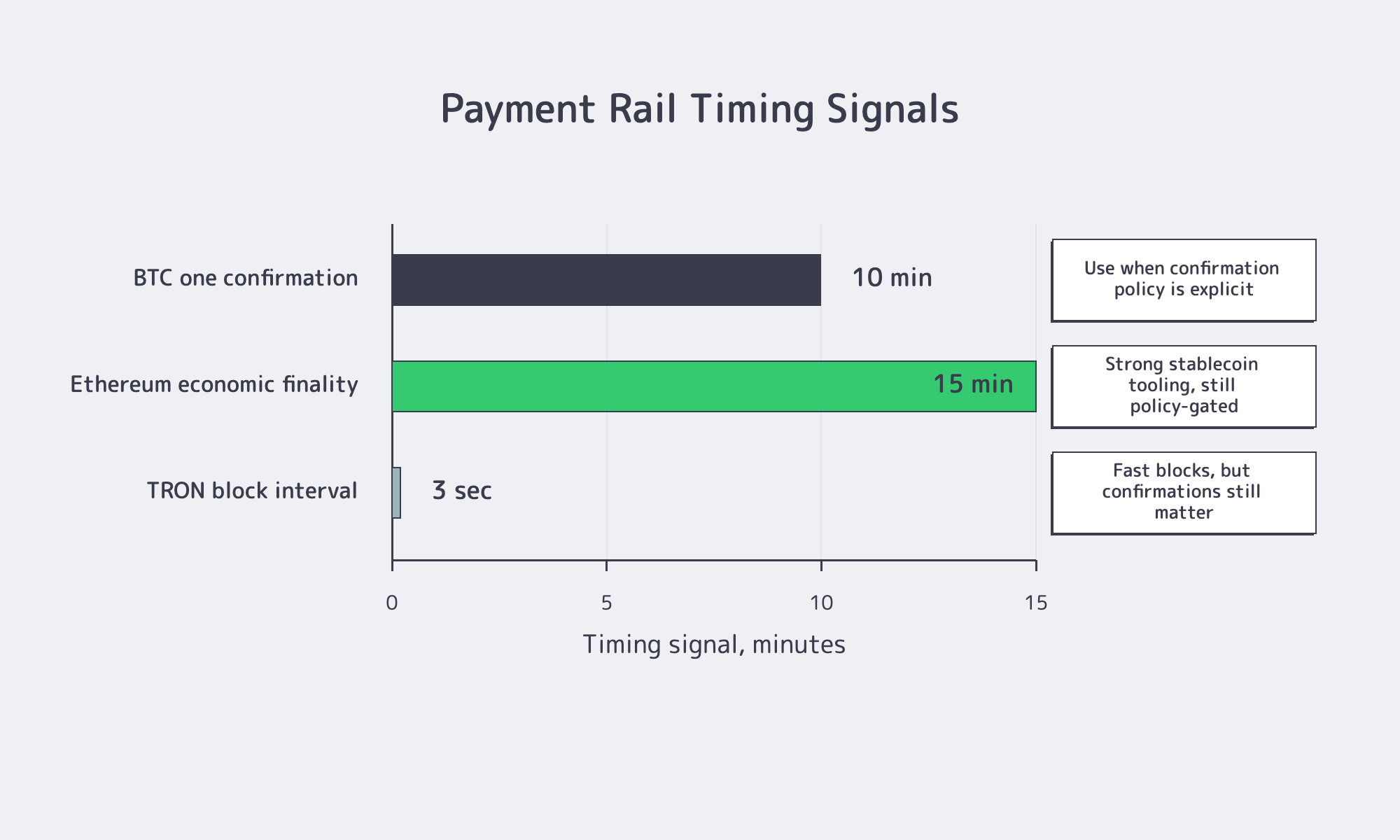
| BTC | One confirmation averages about 10 minutes; high-value acceptance may wait longer. | Works when treasury already holds BTC and the confirmation policy is compatible with the server activation window. |
| ETH or ERC-20 stablecoins | Ethereum blocks arrive about every 12 seconds, while economic finality is roughly 15 minutes. | Strong enterprise tooling, but merchant policy still decides when the invoice is credited. |
| TRON-based stablecoins | TRON’s average block interval is about 3 seconds. | Useful when supported and fee friction matters, but refund handling and confirmation counts still need written rules. |
Stablecoins usually win the operational argument because invoice language and settlement language stay close. Visa separately reported stablecoin supply rising from $186 billion in December 2024 to $274 billion in December 2025. That does not make every stablecoin rail equal, but it explains why finance teams increasingly prefer dollar-linked settlement for repeatable vendor payments.
The mistake is comparing coin menus instead of timing models. A long token list is less valuable than one supported asset that your treasury already holds, one network your controls understand, and one billing path where the provider can state exactly when an invoice becomes paid.
What Renewal, Refund, and Confirmation Checks Matter for Crypto Server Payments?
Crypto server payments stay predictable only when renewal, refund, and confirmation rules are explicit before launch. If service can suspend at period end, treasury should fund renewals before the due date, not on it, and ITOps should monitor invoice allocation like any other production dependency.
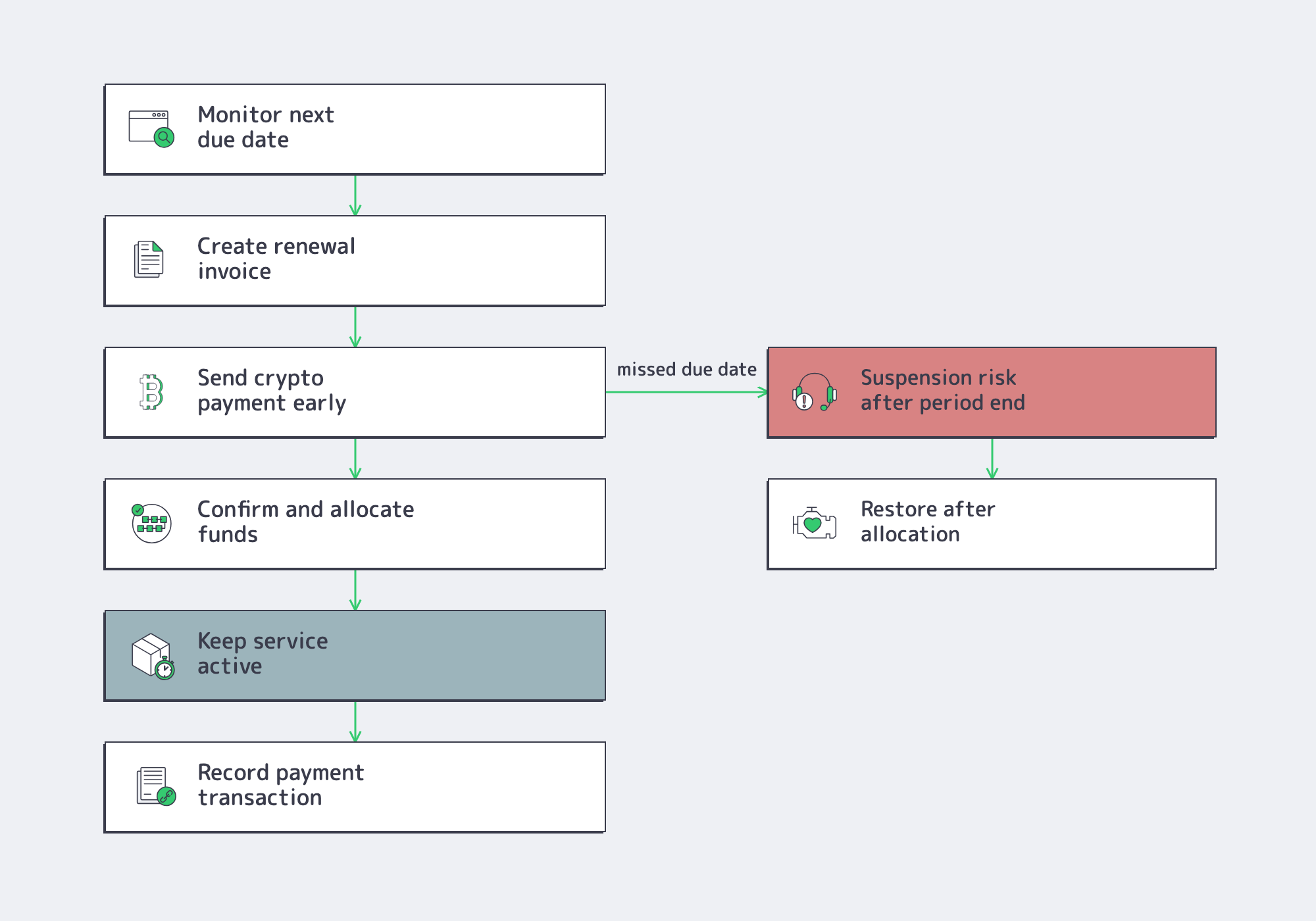
Melbicom requires each invoice must be paid by its due date. If payment for the next service period is not made, service may be suspended immediately after the paid period expires unless a grace period is specified. For physical servers, stored data may be retained for up to two days after suspension. After payment is received and allocated, service may be resumed within 24 hours, subject to technical availability. In production terms, a late crypto renewal is a recovery incident, not a harmless accounting delay.
Refund handling is also specific. Unused prepaid amounts may be refunded pro rata if Melbicom terminates without customer fault; if the customer terminates, refunds apply only to unused service periods and fees may be recalculated without discounts or bonuses tied to advance payments. Refund requests go through the Personal Account, refunds are processed within 30 days using the agreed payment method, and payment-system fees are borne by the customer.
Confirmation policy turns those legal terms into an operating schedule. Bitcoin documentation warns that zero-confirmation payments should generally not be trusted without risk analysis; one confirmation averages roughly 10 minutes; and higher-risk workflows may wait for six confirmations. That can fit custom builds, but it dominates stocked-server timing when finance waits too long.
How Does Melbicom Map Crypto Payment to Provisioning and Renewals?
Melbicom maps crypto-funded buying into a first-party billing and provisioning workflow: account-manager-enabled crypto invoicing, Personal Account allocation, two-hour activation for ready configurations, 3-5 business days for custom builds, and API-visible service and invoice states.
Mandatory KYC means identity is first verified through a secondary, validated funding source before crypto is enabled.
Melbicom’s infrastructure surface gives crypto-funded teams enough product context to plan the order. The platform includes 21 Tier III and Tier IV data centers, 1,100+ ready-to-go server configurations, per-server bandwidth options up to 200 Gbps, 20+ transit providers, 25+ IXP peering hubs, and 24/7 support. For buyers that standardize on repeat orders, those facts matter because the payment method is only useful if capacity, port sizing, and support can keep up with deployment demand.
The Melbicom API is especially relevant after the first server. Service objects include states such as Active, Suspended, Pending, Cancelled, and Terminated, along with billingCycle and nextDueDate. Invoice endpoints can be filtered by status and may include payment-transaction details; a billing endpoint exposes current account credit. That is the right shape for monitoring crypto renewals like infrastructure rather than managing them as one-off checkout events.
What Is the Final Checklist Before You Buy Dedicated Server with Crypto?
The final checklist is to prove payment compatibility before production urgency appears: confirm the supported asset, network, invoice currency, quote timing, confirmation policy, KYC status, renewal schedule, refund route, and billing API visibility. If those items are known, crypto becomes a controlled procurement rail instead of an outage risk.
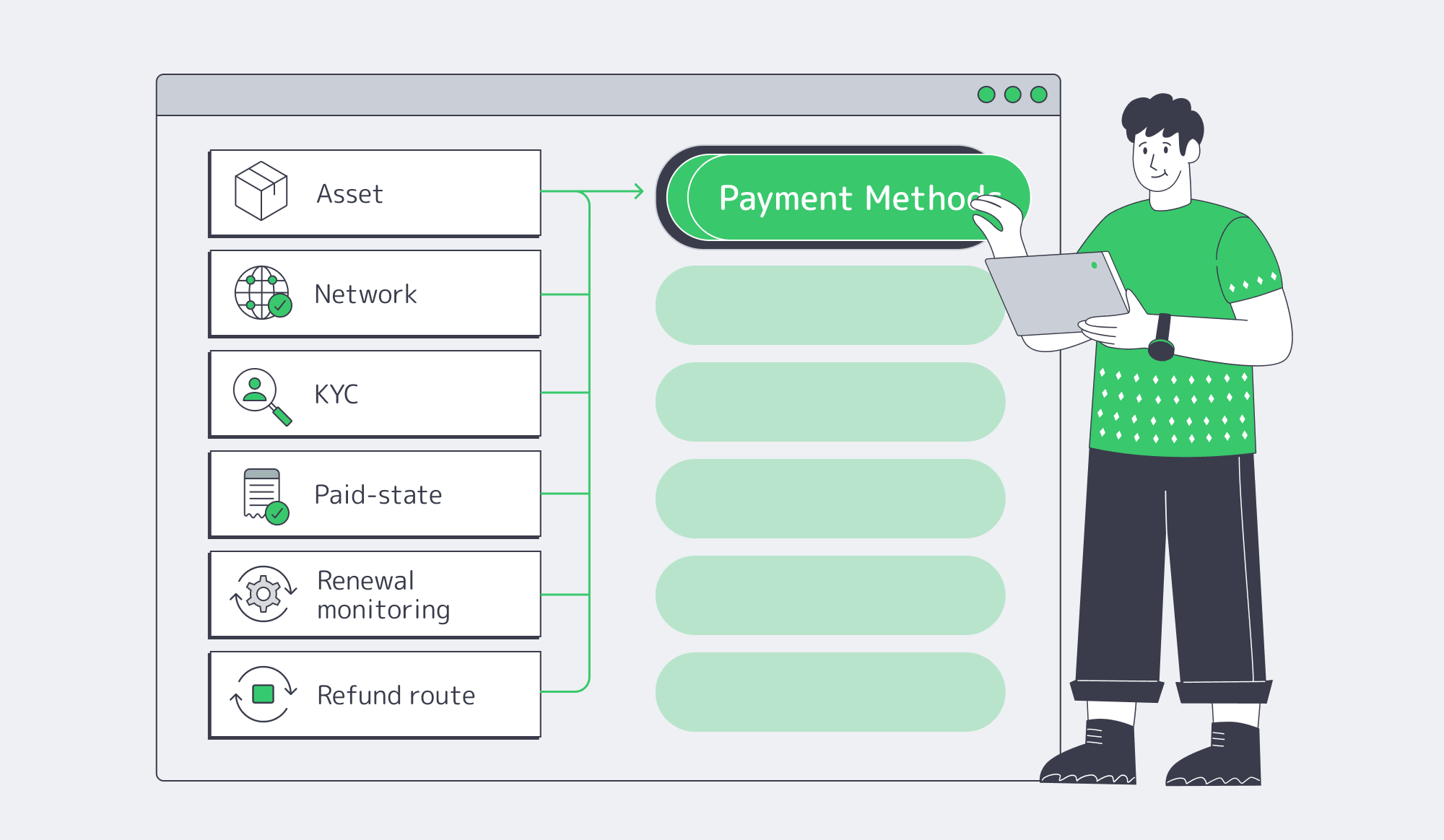
Use this sequence before the first production order:
- Confirm the exact settlement asset and network, not just that “crypto” is accepted.
- Match the confirmation policy to the activation window for ready stock or the build window for custom hardware.
- Pre-clear account verification and billing contacts before funds move.
- Record the paid-state trigger: funds received and allocated to the Personal Account.
- Monitor nextDueDate, invoice status, payment transactions, and account credit before every renewal.
- Document the refund route, timeline, and payment-system fee responsibility.
Teams that buy dedicated servers with crypto successfully are not chasing the widest coin menu. They reduce payment to an audited, schedulable input to provisioning. Once the invoice path is explicit, the technical decision becomes the normal one: choose the right data center, port, hardware profile, and support model for the workload.
Buy dedicated server with crypto
Plan crypto-funded server orders around explicit invoice, confirmation, provisioning, renewal, and refund rules.