
Blog

Dedicated Servers in Bulgaria: High Performance Without the High Price
Enterprise IT teams are pushing more compute to the edge of the EU core—not because it’s trendy, but because the workloads got heavier. AI-assisted apps, real-time analytics, large CI/CD pipelines, and storage-hungry platforms all punish shared infrastructure. IDC projects the Global Datasphere reaching 175 zettabytes by 2025, which is a nice way of saying: every system is now a data system.
Bulgaria sits in a useful sweet spot: close enough to Western and Central Europe for predictable latency, but priced more like an “efficient build” region. Pair that with modern Tier III facilities, dense multi-core CPUs, and NVMe-first storage options, and a dedicated server in Sofia becomes a practical answer to a current problem: how to scale performance without letting infrastructure spend become the product.
Choose Melbicom— Tier III-certified Sofia DC — 50+ ready-to-go servers — 55+ PoP CDN across 36 countries |
 |
What Makes Bulgarian Dedicated Servers Ideal for Performance
Bulgarian dedicated servers are performance-friendly because they combine low-latency access to Europe with modern Tier III data center infrastructure and high-throughput networking. In Sofia, you can provision current multi-core CPUs, SSD/NVMe storage, and high-bandwidth ports—so compute, storage, and network bottlenecks are solvable with configuration choices instead of architectural compromises.
Geography that helps the packet, not the pitch
Sofia is positioned for strong regional reach: the Balkans, Turkey, Greece, Central Europe, and the rest of the EU. In practical terms, it’s a good place to run latency-sensitive services that don’t need to live in Frankfurt or Amsterdam to feel “European.” Melbicom’s Sofia facility is Tier III-certified and designed for high-throughput connectivity, with 1–40 Gbps per-server bandwidth options and on-site operations.
Modern dedicated servers are built around two bottlenecks: I/O and parallelism
A decade ago, you could treat storage as “fast enough” and CPU as “one box runs the app.” That model dies under today’s operational reality:
- I/O is the floor: NVMe is the difference between a database that scales and one that gets slower as you add users.
- Parallelism is the ceiling: high core counts are now common, and real apps will use them—if your scheduling, caching, and storage can keep up.
In Bulgaria, this matters because you can build performance headroom without paying a premium for being inside the most expensive Western metros.
Performance Levers—What Changes When You Stop Sharing Hardware
| Domain | What modern dedicated servers deliver | Why it matters for performance |
|---|---|---|
| CPU | High sustained clocks + many cores | Predictable throughput for API, batch, and analytics workloads |
| Storage | SSD/NVMe-first tiers | Faster DB commits, lower tail latency, higher cache efficiency |
| Network I/O | Multi-gig to 40 Gbps ports | Keeps distributed systems from stalling on replication/egress |
| Isolation | No “noisy neighbor” contention | Stable p95/p99 under load, fewer mystery incidents |
| Ops control | OS/kernel/runtime tuning freedom | Better fit for containers, DB tuning, and specialized stacks |
Which Bulgarian Servers Support Resource-Intensive Workloads
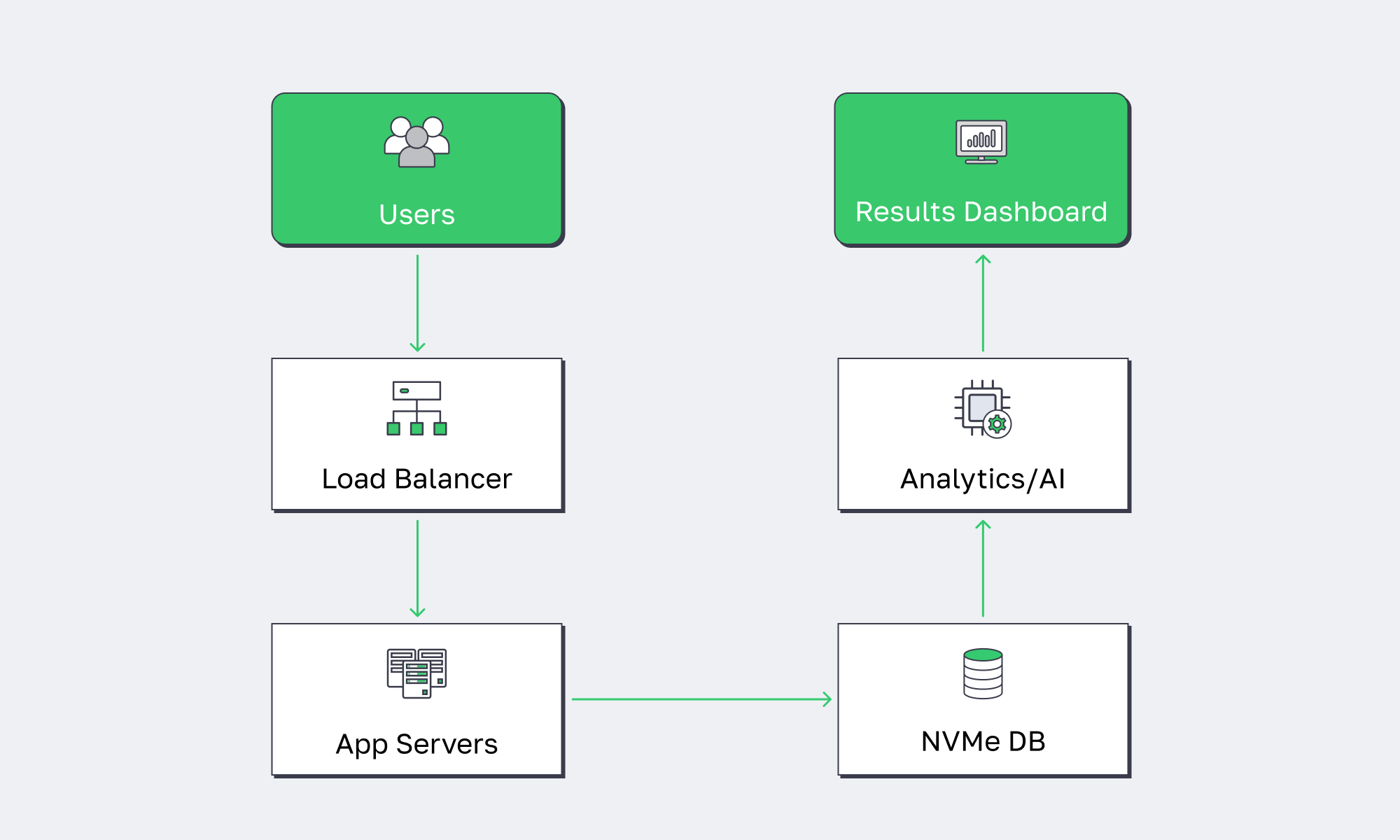
The best Bulgarian servers for heavy workloads prioritize core density, memory bandwidth, and NVMe storage, paired with high-throughput network ports. For resource-intensive stacks—large application hosting, AI inference, big data processing, and real-time pipelines—the goal is to keep your critical path on fast local storage and avoid variable performance from shared layers.
Workloads that actually benefit from “more metal”
Not every system needs a dedicated box. But the ones that do are the ones where variability costs money:
- Large application hosting: microservices clusters, API gateways, and session-heavy backends benefit from stable CPU scheduling and predictable I/O.
- AI inference + vector search: CPU-heavy embedding and retrieval pipelines prefer high clocks and fast NVMe for index storage.
- Big data + streaming analytics: ingestion, ETL, and columnar stores are storage- and network-bound when traffic spikes.
- CI/CD at scale: parallel builds/artifact storage punish slow disks and burstable CPUs.
Dedicated servers are also “future-proof” in a specific way: they are easier to scale horizontally without second-guessing whether the platform will throttle you.
Why NVMe storage becomes mandatory for modern data stacks
The storage story has shifted from capacity to throughput. It’s not just databases—object storage gateways, observability stacks, and ML feature stores all behave like write-heavy systems. The difference between SATA III (6 Gbit/s, 600 MB/s theoretical) and modern PCIe 4.0 NVMe drives (up to 7,000 MB/s sequential reads on mainstream models) is the difference between “scale works” and “scale breaks.”
AI and big data readiness is really “memory + storage + network”
Modern AI pipelines are not just GPUs. The unglamorous work—data preparation, feature engineering, embedding generation, and vector DB operations—often runs on CPU + RAM + fast disks. Bulgaria works here because high-memory, NVMe-backed machines can sit close to EU users and data, while still delivering the IOPS and bandwidth these pipelines need.
Where to Get Cost-Effective Enterprise Servers in Bulgaria
You should source enterprise-grade servers in Bulgaria from a provider that can deploy dozens of ready-to-go configurations in Sofia or deliver custom configurations in days (not weeks), keep per-server bandwidth high, and support non-standard builds quickly. Look for Tier III/IV facilities, fast provisioning, and an EU/US/Asia footprint for expansion—without rebuilding your network model from scratch.
Melbicom in Sofia
At Melbicom, we keep capacity ready: 50+ servers available for rapid provisioning, custom configurations delivered in 3–5 business days, and a 14+ Tbps network backbone behind the platform—backed by free 24/7 support.
Melbicom can then scale the same operating model beyond Sofia: 20 additional Tier III/IV global data centers and an enterprise CDN with 55+ PoPs, allowing core compute to remain in Bulgaria while content and static assets are delivered closer to end users.
Cost-effective connectivity without the speed trade-off
A common fear is that moving outside the Western core means trading performance for savings. In practice, Sofia is competitive for regional connectivity—especially when the provider has serious peering and transit diversity. Melbicom runs a 14+ Tbps backbone with 20+ transit providers and 25+ IXPs, and offers BGP sessions (including BYOIP) so network teams can control routing and keep IP space consistent across regions.
Why a Dedicated Server in Bulgaria Belongs in Your Infrastructure Strategy

The economics are shifting. Dedicated server hosting is projected to grow from ~$20.1B in 2024 to ~$81.5B by 2032, driven by performance workloads, compliance needs, and cost pressure. At the same time, the enterprise server market keeps climbing (IDC reported $112.4B in server revenue in Q3 2025), largely because compute demand isn’t slowing down—it’s just moving into more specialized shapes.
Bulgaria becomes strategically interesting in that environment: you can deploy modern dedicated infrastructure in the EU with strong regional latency characteristics, without paying the “premium geography tax.” It’s not a hedge against cloud—it’s a high-performance baseline for the parts of your stack that shouldn’t be burstable.
Key Takeaways: Bulgaria Is a Smart Performance Move
If your stack is CPU-, storage-, or bandwidth-bound—and you’re tired of paying premium-region prices—Bulgaria is increasingly a rational place to run production compute.
- Benchmark like an SRE, not a buyer. Compare p95 latency, IOPS, and replication throughput between Sofia and your current region before you migrate a tier.
- Treat bandwidth as a design constraint. Decide early whether you need unmetered throughput (and how much), because it shapes replication, ingest, and backup architecture.
- Separate hot data from cold artifacts. Keep the hot set on local NVMe; push snapshots, logs, and large objects to storage; front static reads with a CDN to protect origin CPUs.
- Standardize builds and automate ops. Predictable performance only matters if you can re-create it: immutable images, config management, and monitoring that catches storage and network saturation before users do.
Conclusion: Performance Is About Location, Hardware, and Ops Maturity

Bulgaria isn’t “cheap hosting.” It’s where performance infrastructure looks like modern Europe: Tier III facilities, multi-gig connectivity, and current-gen CPUs and storage—without the top-tier metro markup.
If you want dedicated performance without paying for prestige geography, the most effective move is to put predictable server infra in Sofia and keep your delivery layer global.
Deploy Dedicated Servers in Bulgaria
Get high-bandwidth dedicated servers in Sofia with fast provisioning and 24/7 support. Build a cost-effective EU footprint without sacrificing performance.