
Blog
Brazil Server Ports and CDN for Peaks
Brazil’s online economy is substantial: FecomercioSP’s July 2026 Radiografia do Comércio Eletrônico reported R$295.6 billion in Brazilian e-commerce sales for 2025. The high-traffic stores and video platforms are bandwidth‑heavy and subject to spikes, especially in the cases of flash‑sale checkouts and live premiere streams. When your site traffic multiplies in minutes, the infrastructure needs to be able to cope. An infrastructure blueprint for those demands combines dedicated servers at local Brazilian origins, unmetered ports where available, pre-provisioned nodes for scale-out, and edge caching via a CDN with PoPs in South America. If well executed, that design can support faster checkouts and video starts, helping reduce abandonment during traffic spikes.
Host in LATAM— Reserve servers in Brazil — CDN PoPs across 5 LATAM countries — 20 other data centers worldwide |
 |
Low Latency Dedicated Server Hosting in Brazil for Better Conversion Rates
Physical infrastructure distance adds delay. In conventional glass fiber, light travels at roughly 200,000 km/s—about 5 µs per kilometer one way. Round-trip propagation is approximately twice the one-way delay before routing and equipment overhead. Hosting your origins within Brazil can reduce round-trip times compared with serving São Paulo from North America or Europe; measure the actual improvement across your users’ ISPs and routes. Ray-Ban’s case study published in 2025 reported lower exit rates for prerendered product pages, while a large-scale on-demand video study published in 2012 found that viewer abandonment rises with longer startup delays. These findings support measuring page and playback speed, not a fixed revenue gain from Brazil hosting.
What Bandwidth Do Brazil Ports Offer?
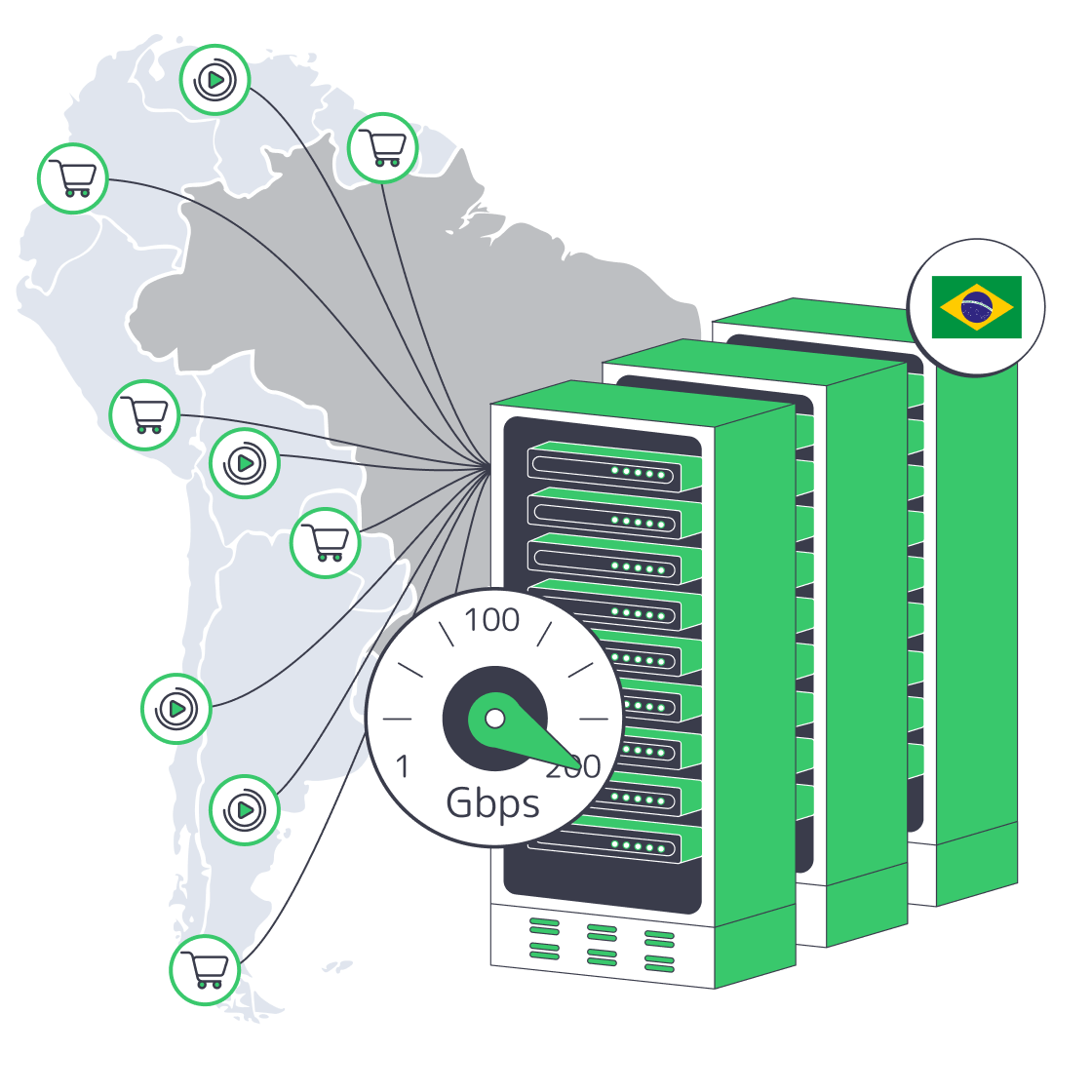
Unmetered bandwidth removes a monthly transfer quota, not the port-speed limit. A 1 Gbps port can theoretically transfer 324 TB in 30 days at continuous full utilization. Across Melbicom’s global dedicated-server range, illustrative ports span 1–200 Gbps; actual Brazil port availability, traffic billing, and sustained-use terms are confirmed in the quote.
The table below and the 1–200 Gbps labels in the article’s illustrations show Melbicom’s global dedicated-server bandwidth range for planning context; actual Brazil port availability is confirmed in the quote.
| Port speed | Theoretical transfer/30 days* | Theoretical concurrent 1080p streams* |
|---|---|---|
| 1 Gbps | ~324 TB | ~200 |
| 10 Gbps | ~3.24 PB | ~2,000 |
| 100 Gbps | ~32.4 PB | ~20,000 |
| 200 Gbps | ~64.8 PB | ~40,000 |
*Calculated using a 30-day month, 24×7 full utilization, decimal TB/PB, and an illustrative 5 Mbps per 1080p stream. These are line-rate ceilings before protocol overhead, other traffic, and operating headroom—not measured application throughput or guaranteed stream counts. Actual encoded bitrates vary.
An unmetered plan can make origin bandwidth costs more predictable, but the port can still saturate. Size capacity for measured peaks, leave operating headroom, and test the application and storage layers as well as the network. Confirm flat-rate bandwidth terms in the quote; CDN delivery and other separately billed services remain outside the origin’s unmetered allowance.
Planning Brazil Hosting for Revenue

When comparing cheap dedicated server offers in Brazil, you should look beyond the price alone and consider the total cost of performance:
- Place origins in‑region to minimize round‑trips for dynamic calls (cart, auth, APIs) and initial stream manifests.
- Provision ports sized to peak—size ports from measured peaks, confirm available Brazil port options and traffic-billing terms in the quote, and plan additional nodes when a single port is insufficient.
- Offload everything cacheable to a local CDN to free up the origin to focus on compute and cache misses.
- Autoscale horizontally with pre-provisioned spare capacity that can be added to the application pool as traffic climbs.
When Do Brazil Workloads Need Faster Ports?
Size bandwidth from concurrent sessions, actual bitrates, cache misses, and background transfers rather than a global traffic-share forecast:
- For OTT premieres and live events: Estimate concurrent FHD/UHD sessions from measured bitrates and CDN offload, leaving headroom below the port ceiling. Use AV1/HEVC where supported by target playback devices.
- High‑SKU storefronts with rich media: Consider higher-capacity ports when measured origin traffic from product images and video justifies that capacity during campaigns.
- Moving large data: Higher-capacity links can shorten nightly replication, object store rebalancing, and preload jobs when storage and the end-to-end path are not bottlenecks. For Melbicom S3 Storage, plan for a remote endpoint in Amsterdam.
Brazil Deploy Guide— Avoid costly mistakes — Real RTT & backbone insights — Architecture playbook for LATAM |
 |
Proving Revenue Impact
Financially speaking, two performance levers carry boardroom weight:
- Conversion and page speed: Ray-Ban observed roughly twice the mobile conversion rate for prerendered product pages versus standard page loads among users with browsers supporting the Speculation Rules API, in a case study published in 2025. This was a comparison between user groups, not a universal sales-per-millisecond rule or a Brazil-hosting benchmark.
- A slow start loses the viewer: Historical results from a large-scale on-demand video study published in 2012 show greater abandonment with longer startup delays. Measure startup time and abandonment for your audience without assuming a universal cutoff.
Tie local-origin plans to measured RTT, startup time, conversion, and engagement changes; validate the business impact rather than assuming a fixed uplift.
Autoscaling without Cloud Lock‑In
Autoscaling on dedicated servers requires both the right architecture and capacity that is already available:
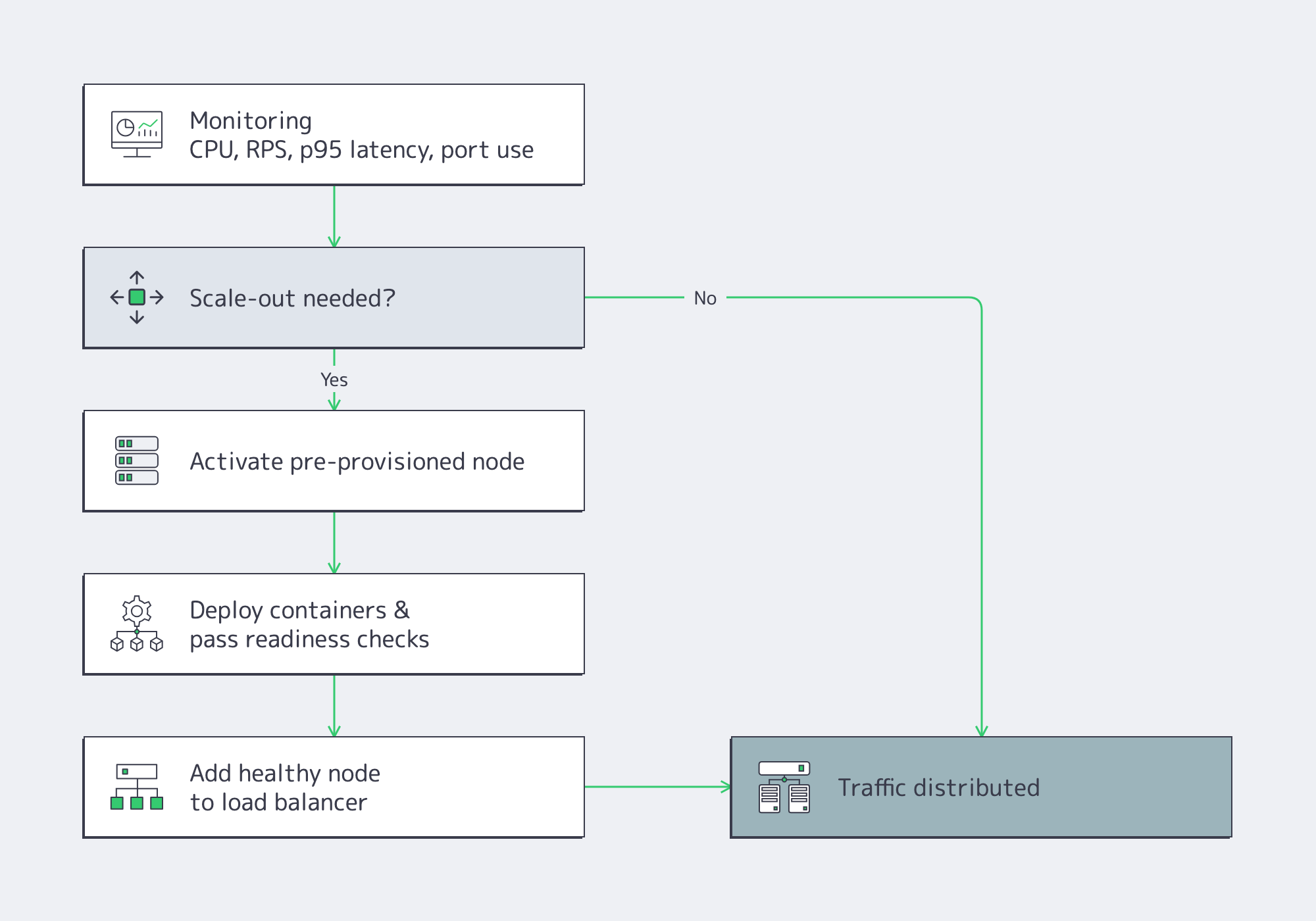
- To scale horizontally: Keep app tiers stateless behind a load balancer and prepare spare nodes before predictable peaks. Automation can configure containers and add healthy nodes to the pool, but it does not remove hardware procurement, provisioning, or application warm-up time. A Brazil preorder is not ready spare capacity.
- For traffic distribution: Use a health-aware load balancer to distribute traffic among application nodes. Anycast or geo-DNS can steer regional traffic, but neither inherently selects the least-loaded server or guarantees the geographically nearest destination.
- Scaling stateful layers: Leverage read replicas, partitioning, or distributed SQL for databases and segment writes where necessary.
- Automation & SLO‑based triggers: Monitor CPU, RPS, p95 latency, and port utilization. Set workload-specific thresholds from load tests, prepare capacity ahead of known peaks, and let telemetry trigger the addition of ready nodes.
CDN in Brazil: Why Edge Caches Matter
While a local origin can shorten dynamic-request paths, edge caching also plays a crucial role. Melbicom has an extensive CDN spanning 39 PoPs across 35 countries, with South American edges in Fortaleza, Rio de Janeiro, Buenos Aires, Bogotá, and Lima. That allows you to serve cacheable assets such as product images, JS/CSS, thumbnails, and HLS/DASH segments from a nearby edge, letting your origin handle dynamic requests and cache misses. Effective caching can improve page and playback starts and reduce origin egress/CPU—especially during flash crowds.
Moving playlists and segments to the CDN helps with video workloads, but live playlists need short cache lifetimes matched to their update cadence rather than the long lifetimes suitable for immutable assets. Bypass shared caching for carts, checkout, and private authenticated responses. Use Brotli for compressible text assets alongside HTTP/2 and TLS 1.3, keeping your origin focused on transactional logic.
Rollout Checklist for Hosting in Brazil
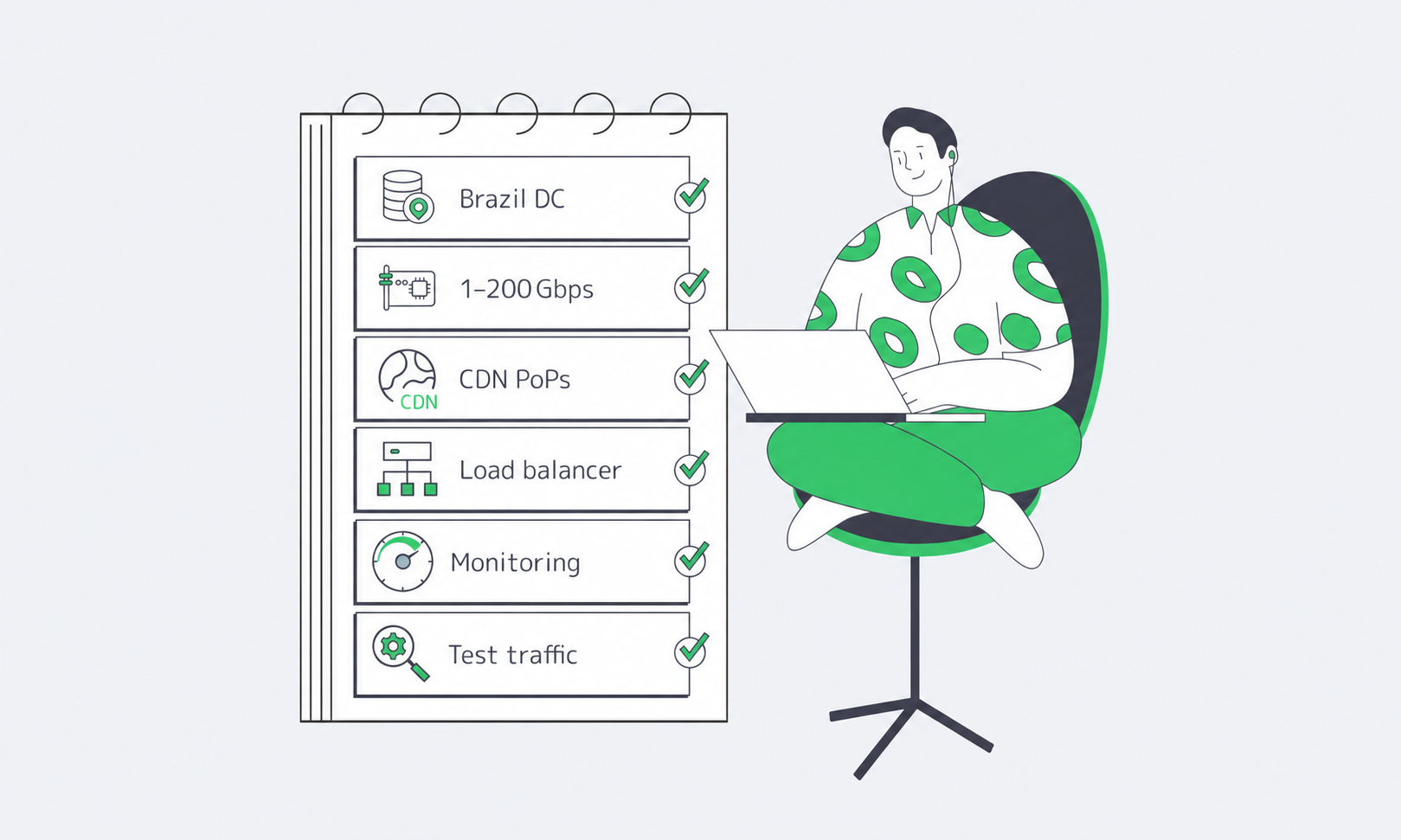
- Baseline measurement: Record current RTT from Brazilian metros to your existing origins and compute peak Mbps/Gbps needs for checkout and playback. Treat 1080p ~5 Mbps / 4K ~15 Mbps as illustrative sizing assumptions, then use actual encoding ladders, concurrency, and headroom for capacity planning.
- Choose the Brazil location: Confirm the São Paulo allocation and deployment date, with port availability, traffic billing, and any unmetered terms agreed in the quote.
- Deploy origins and harden: Tune latency, secure transport, and add observability.
- Wire up CDN PoPs in Brazil and across South America: Cache your static assets, thumbnails, and HLS/DASH segments. Confirm cache‑hit ratios before launching.
- Engineer to autoscale: Keep stateless app tiers behind load balancers and use a scripted add-node flow to activate pre-provisioned spare capacity, passing readiness checks before serving traffic.
- Optimize: Compress, minify, lazy‑load, and use adaptive bitrate ladders.
- Load‑test: Validate NIC utilization, CPU headroom, and CDN offload with Brazil-sourced traffic at peak, and pre-approve the required higher port tier or additional nodes if tests approach saturation.
- Instrument business KPIs: keep track of LCP/TTFB/startup time vs. conversion/engagement in Brazil and publish weekly infra‑to‑revenue dashboards.
Locality, Bandwidth, and Freedom
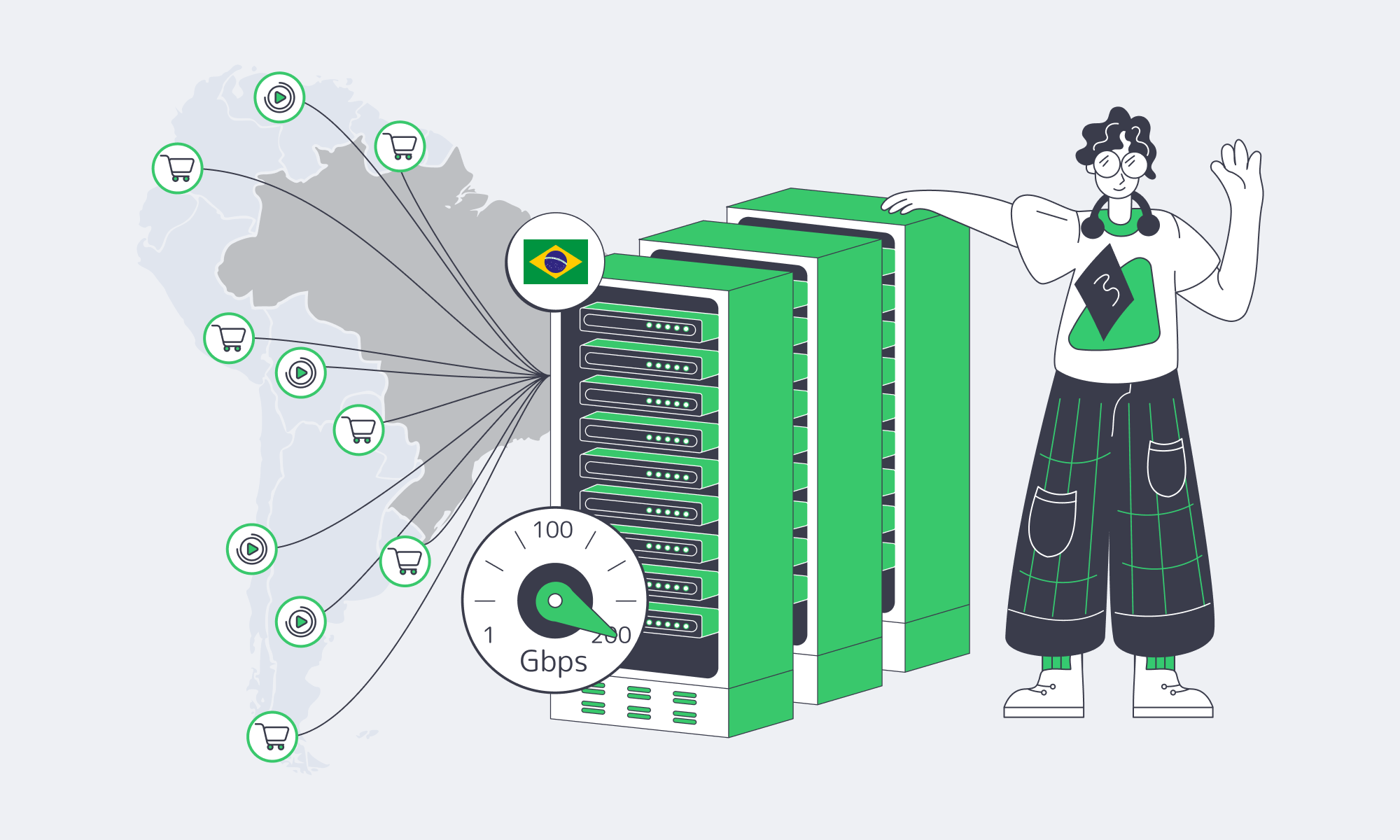
Brazil is best served by a plan that marries locality (origins in-country), capacity (ports sized to measured peaks, with unmetered terms agreed where available), and distribution (Brazil-centric CDN caches) with pragmatic autoscaling using pre-provisioned nodes. That combination can shorten round-trips and reduce saturation risk, supporting faster checkouts and video starts. While we finalize local dedicated-server capacity, stage the architecture in an active Melbicom location and front it with our South American CDN PoPs. Our 21-data-center footprint includes the coming-soon São Paulo and Marseille locations. Globally, dedicated-server ports range from 1 to 200 Gbps. Actual Brazil port availability, traffic billing, hardware, and deployment timing are confirmed in the quote. Prepare and test the migration rather than assuming an instant switch to local origins.
Melbicom is built around Infrastructure Freedom. In practice, that means deployment freedom (choose your software stack and deployment design), configuration freedom (tune hardware and network to your spec), operational freedom (own the stack end‑to‑end), and experience freedom (straightforward onboarding and clear controls). Share your targets; we’ll shape a build around your requirements and plan the move to local Brazil capacity once your allocation and deployment date are confirmed.
Be the first to host in Brazil on special terms
Tell us your peak traffic volumes, target port speeds, bitrate, cache rules, regions, and exact hardware/network specs—and we’ll return a tailored rollout plan with early‑placement options and South America CDN acceleration from day one.