
Blog

BGP Multi-Homing: Reliability, Control, and Speed
Uptime Institute’s 2026 outage analysis reports that 57% of respondents to its 2025 annual survey put the cost of their most recent major outage above $100,000. This is a per-incident finding, not a universal cost per minute. A single ISP outage can take entire application stacks dark, as seen during the August 30, 2020 CenturyLink/Level(3) incident, when Cloudflare observed a 3.5% drop in its global traffic during an outage lasting several hours. Multi‑homing with BGP reduces single-provider risk: connect to multiple ISPs, let the border gateway protocol select paths according to routing policy, and fail over automatically when a failed route is removed and another usable path remains.
Choose Melbicom— 1100+ ready-to-go servers — 21 global Tier IV & III data centers — BGP sessions with BYOIP |
 |
What Is BGP Multi‑Homing and Why Does It Matter for Reliability?
BGP multi‑homing connects a network to two or more upstream ISPs and advertises its IP prefixes through each. When a route is withdrawn or a failed session is detected, BGP can select a surviving path without changing DNS. Reliability still depends on path diversity, available capacity, and convergence time.
In steady state, you can use both links actively for load sharing by destination. Local‑pref controls outbound choices; AS‑path prepends and communities influence inbound paths, while MED normally compares entry points into the same neighboring AS. The result is resilience + control that single‑homed links simply don’t provide.
A core advantage over “backup‑only” designs: multi‑homed BGP needn’t be idle capacity. With the border gateway routing protocol, you can keep links hot—for example, prefer ISP‑A to western Europe while favoring ISP‑B to East Asia, using measured path quality to set destination-based policies. BGP does not measure latency or jitter itself; sending different applications to the same destination over different links requires additional traffic classification and forwarding policy. Policy lives on the router, not in ticket queues.
How Does Border Gateway Protocol Routing Make Multi‑Homing Work in Practice?
At the edge, you run eBGP to each provider, announce your public prefixes, and ingest either full tables or defaults (depending on router scale). For outbound control, you set local preference to favor one ISP or split by destination. For inbound control, you influence the outside world’s choice of path using AS‑path prepending, selective advertisement of more‑specifics (where registries and filters allow), and BGP communities that request provider‑side action (e.g., de‑prefer with certain carriers). Remote networks’ policies can override these inbound preferences. This is why multi‑homing with BGP is as much policy engineering as plumbing.
Can BFD make failover essentially instant?
Not necessarily. Bidirectional Forwarding Detection (BFD) can detect a failed monitored path in less than a second when both peers support suitable timers. Detection is only the first step: BGP route selection, forwarding-table updates, remote convergence, and application recovery can take longer. BFD does not guarantee uninterrupted sessions or detect every remote outage.
Cisco’s IOS XE 17.x references document BGP’s use of BFD notifications to accelerate convergence. Coordinate BFD support and timers with each provider and test under load; overly aggressive settings can trigger false failures.
How Does Multi-Homing Improve Uptime?
A dual-provider BGP design can reduce exposure to an ISP outage, but it has no universal uptime figure. Actual availability depends on independent paths, resilient edge equipment, spare capacity, and tested recovery. The table is a mathematical illustration of provider availability, not a measured deployment result or service guarantee.
Assume each ISP is available 99.9% of the time and their failures are statistically independent. The probability that both are unavailable is 0.001 × 0.001 = 0.000001, giving 99.9999% availability for at least one provider. Annual equivalents below use 365 days and exclude shared failures and failover time.
| Network Setup | Modeled Provider Availability | Equivalent Downtime/Year |
|---|---|---|
| Single ISP (assumed availability) | 99.9% | ~8.76 hours |
| Dual ISP BGP (independent failures) | 99.9999% | ~31.5 seconds |
Two caveats prevent treating this model as application uptime:
- Independence matters. Avoid shared last‑mile ducts, common meet‑me rooms, or the same carrier resold by two brands. Shared routers and power paths can still fail together.
- Failover speed matters. BFD can accelerate detection, but route propagation and application recovery still matter. The surviving link must carry the required traffic.
What Do You Actually Need to Deploy?
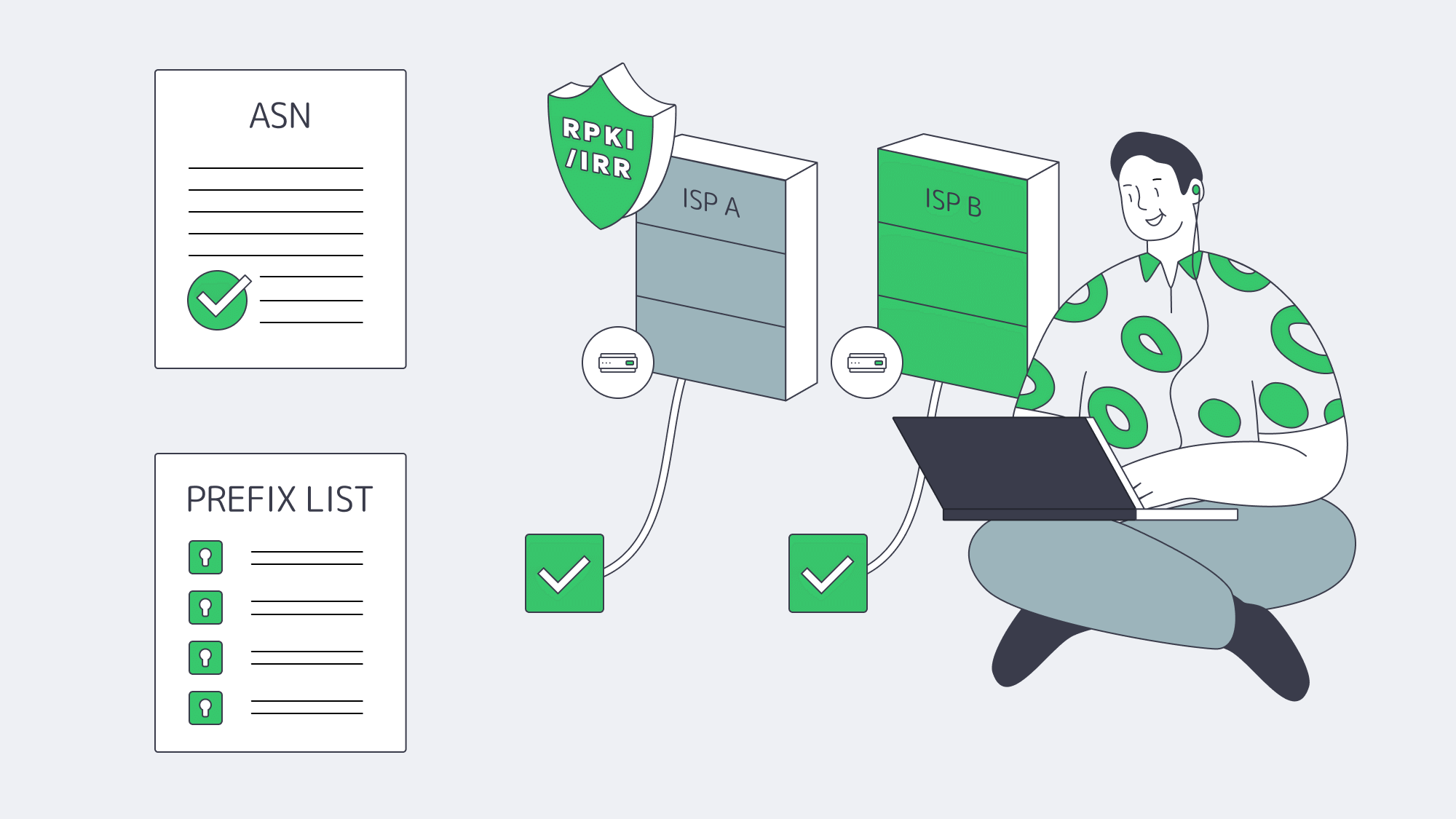
A basic border gateway protocol configuration for multi‑homing has a few prerequisites:
- Resources: Your ASN and routable prefixes accepted by both providers; examples include an IPv4 /24 or an IPv6 /48.
- Edge device: A router that can run eBGP (hardware or a hardened VM running BIRD/FRR) sized to the route load you’ll ingest. Add edge-device and power redundancy when a single router would otherwise remain a shared failure point.
- Two (or more) carriers: Contracts and cross‑connects to diverse ISPs, plus IRR/RPKI hygiene so they’ll accept and propagate your prefixes.
- Policy & safety rails: Local‑pref for outbound, a simple inbound plan (prepending/communities), strict prefix‑limits and import/export filters, and BFD where both peers support it.
Where Melbicom’s Multi‑Carrier Network Adds Practical Value
Melbicom operates a multi‑homed backbone with transit from multiple carriers and broad IXP reach across the US and EU. That upstream diversity provides alternative routes when a carrier fails. Our network combines 14+ Tbps aggregate capacity, 23 transit providers, and 29 IXPs, plus 40 CDN PoPs across 35 countries to cache static assets closer to users.
From a deployment standpoint, we at Melbicom make BGP multi‑homing straightforward:
- BGP sessions anywhere: Free BGP on dedicated servers and available for a nominal add‑on on VPS, with BYOIP, IPv4/IPv6, and full/default/partial route options.
- Inbound control that scales: Predefined BGP communities and passthrough communities toward upstream providers support routing-policy control. Request the current community list before designing specific announcements.
- Route integrity by default: RPKI‑validated routing rejects origin-invalid announcements, while strict IRR filtering requires valid route-registry entries.
- Capacity when you need it: Per‑server bandwidth up to 200 Gbps—useful when a failover concentrates traffic on the surviving path.
- Faster time to value: With 1100+ dedicated servers in stock and 24×7 support, Melbicom’s team can raise your session, validate IRR/RPKI entries, and help with policy tuning so BGP does what you intend—before you hit production.
If you prefer starting smaller, VPS with BGP delivers the same peering semantics—use a virtual router (BIRD/FRR), ingest defaults or partial routes, and announce your prefixes via a paid VPS BGP session; upgrade to dedicated later as traffic grows.
A session to Melbicom uses our multi‑carrier backbone; it does not by itself provide two independent customer uplinks.
Multi-Homed vs. Single-Homed Connectivity

Single‑homed Internet links are both simpler and brittle: one circuit, one provider, one control plane. Mean‑time‑to‑repair is outside your control, and even “five‑nines” promises don’t help if a control‑plane blunder propagates bad routes or a fiber cut isolates your facility far from your data center.
By contrast, multi‑homed border gateway protocol routing gives you two levers:
- Availability: If ISP‑A fails and a usable alternative remains, automatic failover can restore traffic through ISP‑B. Existing flows may suffer packet loss or interruption.
- Performance economics: Prefer lower‑latency or lower‑cost paths by policy; shape inbound traffic using communities and prepends.
Quick Answers to Common Questions
- Is BGP difficult? The concepts are simple; the risk is in sloppy filtering. That’s why RPKI + IRR and strict prefix‑limits matter.
- Do I need full tables? Not necessarily. Many edge routers run default‑only or partial routes from each ISP and achieve excellent results with far lower memory/CPU.
- Will I need vendor‑specific wizardry? No. While syntax differs, border gateway protocol configuration principles are consistent across stacks.
- What about brownouts (congestion/packet loss) rather than hard failures? BGP reacts to reachability. You can layer telemetry‑driven policies (or scheduled community changes) to steer around soft faults.
Key Takeaways Before You Architect
- Multi‑homing reduces single-provider risk. Two diverse ISPs improve path resilience but do not remove shared router, power, or access-path failures.
- BFD accelerates failure detection. Sub‑second detection is possible, but end-to-end recovery also depends on routing convergence and application behavior. Coordinate timers and test under load.
- Use policy, not hope, to shape flows. Local‑pref for outbound, communities/prepends for inbound; keep it simple and measurable.
- Design for diversity. Separate carriers, paths, and POPs. The 2020 incident shows why relying on a single upstream is risky.
- Leverage providers that “speak BGP.” Melbicom offers free BGP on dedicated servers + BYOIP, RPKI/IRR, and communities passthrough for simpler deployment.
Improve Uptime with BGP Multi-Homing

The Internet is resilient in aggregate but fragile in parts. A fiber cut or routing misconfiguration far from your data center can still remove your sole path to users. BGP multi‑homing replaces hope with engineering: multiple providers, policy‑driven border gateway protocol routing, and BFD‑assisted detection that can shorten recovery from monitored failures. Compare the cost of a second ISP with the outage losses your own services could incur.
If you’re modernizing connectivity for globally distributed apps in the US and EU, start with architecture, not vendors: diverse carriers, simple policies, tight filters, and failure-detection timers tested with your devices and providers. Then choose a platform that makes those choices easy to implement—and easy to run at scale.
Run BGP multi‑homing with Melbicom
Get carrier‑grade reliability with multi‑homing. Free BGP on dedicated servers, BYOIP support, RPKI/IRR filtering, and communities passthrough. Our team helps you configure sessions and tune policies fast.