
Blog

Audit-Ready Dedicated Servers in São Paulo for Compliance
Brazil is now an always‑on market: over 84% of the population is online, and IX.br has hit traffic peaks above 31 Tb/s (with São Paulo alone exceeding 22 Tb/s). For regulated teams expanding into Brazil, that scale collides with a harder requirement: proving—continuously—that sensitive data stays in‑country, access is attributable, and retention is enforceable.
São Paulo’s role as Brazil’s digital core—home to IX.br and a dense fintech/telecom ecosystem—makes it the practical anchor for compliance‑first infrastructure. Keeping compute, logs, and backups local reduces cross‑border legal friction and makes audit evidence simpler to produce.
Choose Melbicom— Reserve dedicated servers in Brazil — CDN PoPs across 6 LATAM countries — 20 DCs beyond South America |
 |
Dedicated Server in São Paulo: The Compliance Roadmap
A dedicated server in São Paulo only becomes a compliance asset when “local” is true across the full lifecycle: ingest, storage, processing, logging, backups, and deletion.
Residency is the first constraint. LGPD doesn’t impose blanket localization, but it restricts cross‑border transfers unless safeguards apply. Treat residency as an engineering requirement: map every outbound path (monitoring, analytics exports, default cloud regions, support tooling), then eliminate or formally justify each one.
Retention is the second constraint. Brazil’s Marco Civil sets statutory minimums for connection logs (providers) and application access logs (online applications). Longer windows (for fraud, AML, incident response, dispute handling) should be explicit and automated—because audits punish ambiguity, not just incidents.
Marco Civil Log‑Retention Minimums (Baseline)

Key custody is the multiplier. Encrypting data is table stakes; controlling keys makes sovereignty durable. “Region‑locked” key approaches—where key material and key operations stay inside the jurisdiction—are becoming the default recommendation for multinational risk programs.
Backups must obey the same borders. Cross‑border geo‑redundancy can silently violate residency and complicate deletion guarantees. Prefer Brazil‑only redundancy, disciplined rotation, and (when required) cryptographic deletion via key destruction.
Which Dedicated Servers Ensure São Paulo Data Residency
A dedicated server in São Paulo ensures residency only if compute, primary storage, logs, and backups are physically in Brazil—and if contracts and architecture prevent silent replication elsewhere. When location is enforced end‑to‑end, LGPD transfer risk drops, regulator access becomes clearer, and “where does the data live?” is answered with evidence, not assumptions.
Residency is easier to defend when performance and compliance point to the same place. São Paulo plugs directly into IX.br’s dense peering fabric (2,400+ networks) and can deliver 2–3 ms round‑trip latency within the São Paulo–Rio corridor—useful for auth flows, payment steps, fraud signals, and incident response.
Regulatory posture matters too. For institutions using external providers, Brazilian regulators have required guarantees of regulator access if customer data is stored overseas—via approvals, arrangements, or other controls.
Penalties can be material: LGPD allows fines up to 2% of Brazilian revenue, capped at R$50 million per infraction (≈ $9.6M / €8.0M at recent rates) (source).
Brazil Deploy Guide— Avoid costly mistakes — Real RTT & backbone insights — Architecture playbook for LATAM |
 |
São Paulo vs. Overseas Hosting: Why the Workaround Fails
| Factor | São Paulo Dedicated Server | Overseas Hosting (US/EU) |
|---|---|---|
| Data residency | Data stored and processed in Brazil (residency by design). | Data leaves Brazil; transfers require legal basis under LGPD. |
| Latency | In‑region routing and peering in São Paulo’s ecosystem. | ≈100+ ms typical from the US/EU to São Paulo (often ~105 ms from the US East Coast). |
| Backup & recovery | Local backups remain feasible without violating residency. | Geo‑redundant backups often land outside Brazil, risking residency violations. |
Melbicom’s São Paulo dedicated servers are still in the launch phase, with early capacity reservations available ahead of general availability. For teams standardizing globally, Melbicom offers 1,400+ servers in stock across the ready‑to‑deploy catalog. Custom configurations are delivered in 3–5 days.
What Configurations Enable Audit Ready Logging Controls

Audit‑ready logging is a system: immutable event trails with defined retention, plus access controls that prove only authorized identities touched production. On a São Paulo dedicated server, that means OS auditing, application event logs, centralized Brazil‑resident log storage, and privileged access that’s role‑based, MFA‑enforced, and attributable—so audits become evidence retrieval, not archaeology.
Start with logs that survive scrutiny: authentication events, privilege changes, configuration changes, and access to sensitive datasets. OS audit frameworks provide the baseline; applications must log high‑risk actions such as approvals, exports, and admin overrides.
Retention is the trap door. Treat Marco Civil as the baseline, then encode longer windows as control objectives—automated, consistent, and reviewable. (Source: Privacy International)
Tamper‑resistance matters because privileged users are part of the threat model. Centralize logs to a dedicated log host or SIEM pipeline located in Brazil and use immutable/append‑only storage where possible. If you archive to cloud storage in São Paulo, treat archives as regulated data: encrypt them, and keep key custody local.
Access control should be designed for attribution. Avoid shared admin accounts. Enforce MFA for any path that can modify production. Funnel privileged access through a chokepoint (bastion/jump host) so sessions are attributable and reviewable.
KMS: Keep the Keys as Local as the Data
Auditability gets sharper when encryption is paired with local key control. A Brazil‑bound KMS means keys are generated and stored in São Paulo, with rotation and revocation governed by your change controls. “Region‑locked keys” are increasingly used to prevent encrypted artifacts from becoming accessible under foreign jurisdiction.
Which Vendor MSAs Guarantee Local Data Retention
Vendor MSAs guarantee local retention when they commit—in writing—to Brazil‑based handling, define retention and deletion responsibilities (including backups and support artifacts), and support audits through certifications and transparency. The strongest MSAs lock service location to São Paulo unless you approve changes, preserve your right to export data, and require secure deletion on defined timelines.
Vendor review should connect three layers: the questionnaire (what the vendor claims), the architecture (what the platform does), and the MSA (what’s enforceable). Focus on (1) data‑location commitments that prevent unilateral relocation, (2) retention/deletion language that covers backups and support artifacts, (3) audit evidence and incident/legal‑request handling, and (4) flexibility to adapt when your posture changes.
Here’s a compact due‑diligence checklist to keep MSAs aligned with reality:
- Data center & network: São Paulo facility standards, physical security, and local connectivity via Brazil’s peering ecosystem.
- Data sovereignty: Brazil‑only storage and processing for dedicated hosting in Brazil, including backups and operational telemetry.
- Retention & deletion: policy, automation, and evidence (including backup media).
- Audit evidence: what reports/logs you can access, and the practical path to retrieve them fast.
- Contract controls: location lock, change approvals, and clear data ownership and export rights.
Melbicom’s model is built around operational freedom: Melbicom enables customers to deploy, customize, and scale infrastructure wherever they operate. While São Paulo dedicated servers are still rolling out, Melbicom’s CDN spans 55+ PoPs in 36 countries. In LATAM, CDN PoPs are already live in Brazil, Chile, Colombia, Argentina, Peru, and Mexico—so regulated teams can keep São Paulo as the compliance boundary while delivering regionally.
Conclusion: Make São Paulo Residency Audit‑Proof
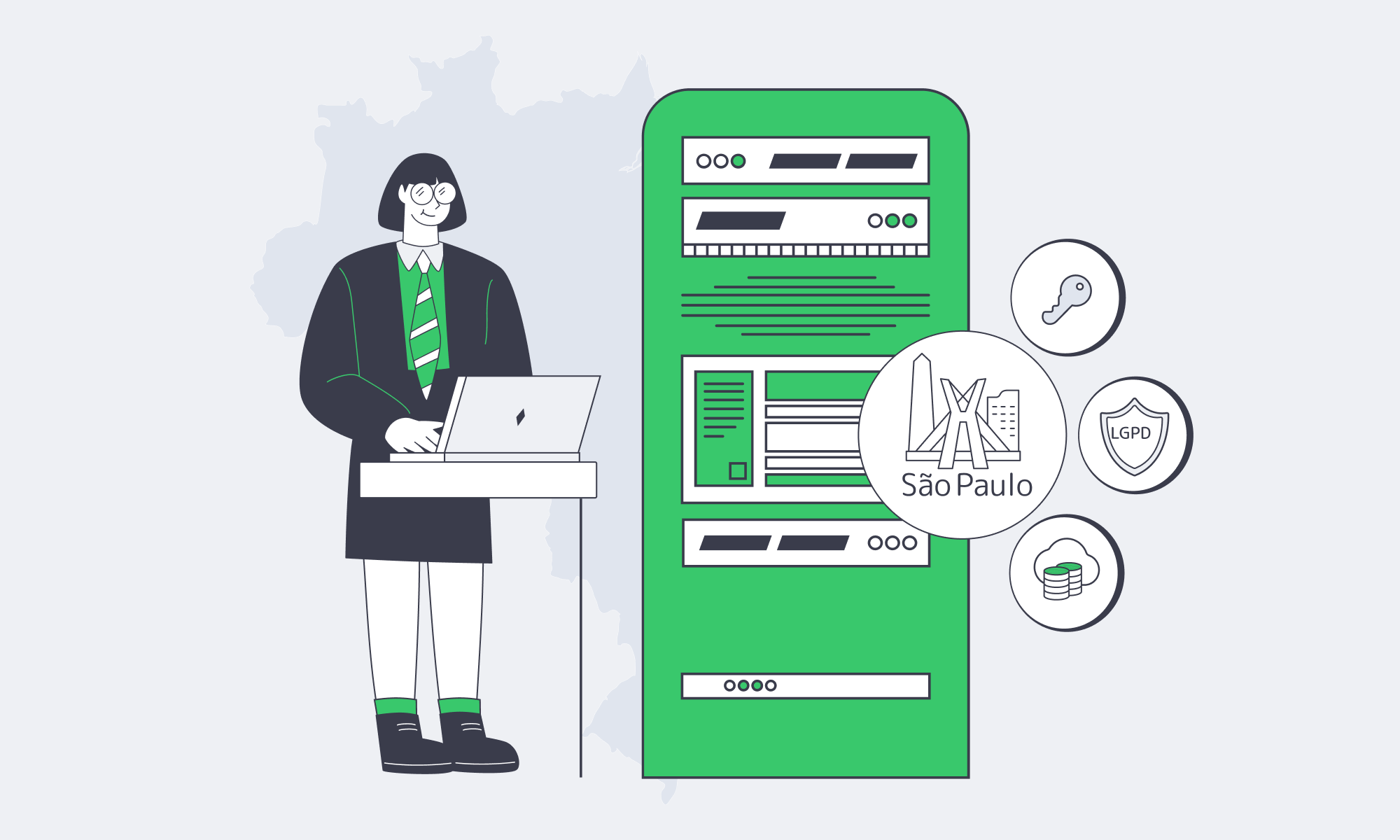
A São Paulo dedicated server isn’t compliant by default; it’s compliant when the whole lifecycle stays local: Brazil‑bound data flows, retention that matches legal and control objectives, keys that never leave São Paulo, and backups that don’t export regulated data. The goal is evidence‑driven ops—prove location, access, logging, and deletion on demand.
Practical close‑out checks for regulated teams:
- Treat “Brazil‑only” as an architecture property: block non‑Brazil endpoints for telemetry, exports, and admin tooling unless there’s a documented exception.
- Make retention measurable: define minimums, automate deletion, and run recurring evidence pulls (log samples, deletion proofs, restore tests).
- Put key custody under change control: separate key admins from system admins, rotate on schedule, and rehearse revocation.
- Design for privileged‑user accountability: no shared admin identities, MFA everywhere, session recording on chokepoints, and immutable logs.
- Align legal and technical truth: vendor questionnaires, MSAs, and your data‑flow diagram should describe the same system.
If these checks feel heavy, that’s the point: compliance in Brazil is less about a single control and more about operating a system that can produce proof on demand—without heroic manual work.
Reserve São Paulo Dedicated Capacity
Secure early access to São Paulo dedicated servers built for data-residency-first workloads. Reserve capacity now and pair it with our live LATAM CDN for compliant, low-latency delivery.