
Blog

Asia Dedicated Server Buying Guide for Low-Latency APAC Growth
Choosing an Asia dedicated server is not a map exercise. A workload that feels local from Singapore can feel distant from Tokyo, Mumbai, or Fujairah. Start with measured user paths: where sessions originate, which networks carry the traffic, what latency budget the product can tolerate, and where regulated data is allowed to live.
The practical question: should the first deployment land in Singapore, Tokyo, Mumbai, or a multi-site design using Asia dedicated servers?
Asia Servers– Singapore, Tokyo, Mumbai – High-bandwidth capacity – 24/7 support |
 |
How Should You Choose an Asia Dedicated Server for APAC Workloads?
Choose an Asia dedicated server by setting a per-market latency target first, then testing routes from real user networks before buying. For interactive SaaS traffic, keep P95 round-trip latency under roughly 80 ms where possible. Above 150 ms, design the workload as regional, asynchronous, or read-heavy instead of pretending one site serves all APAC users equally across markets.
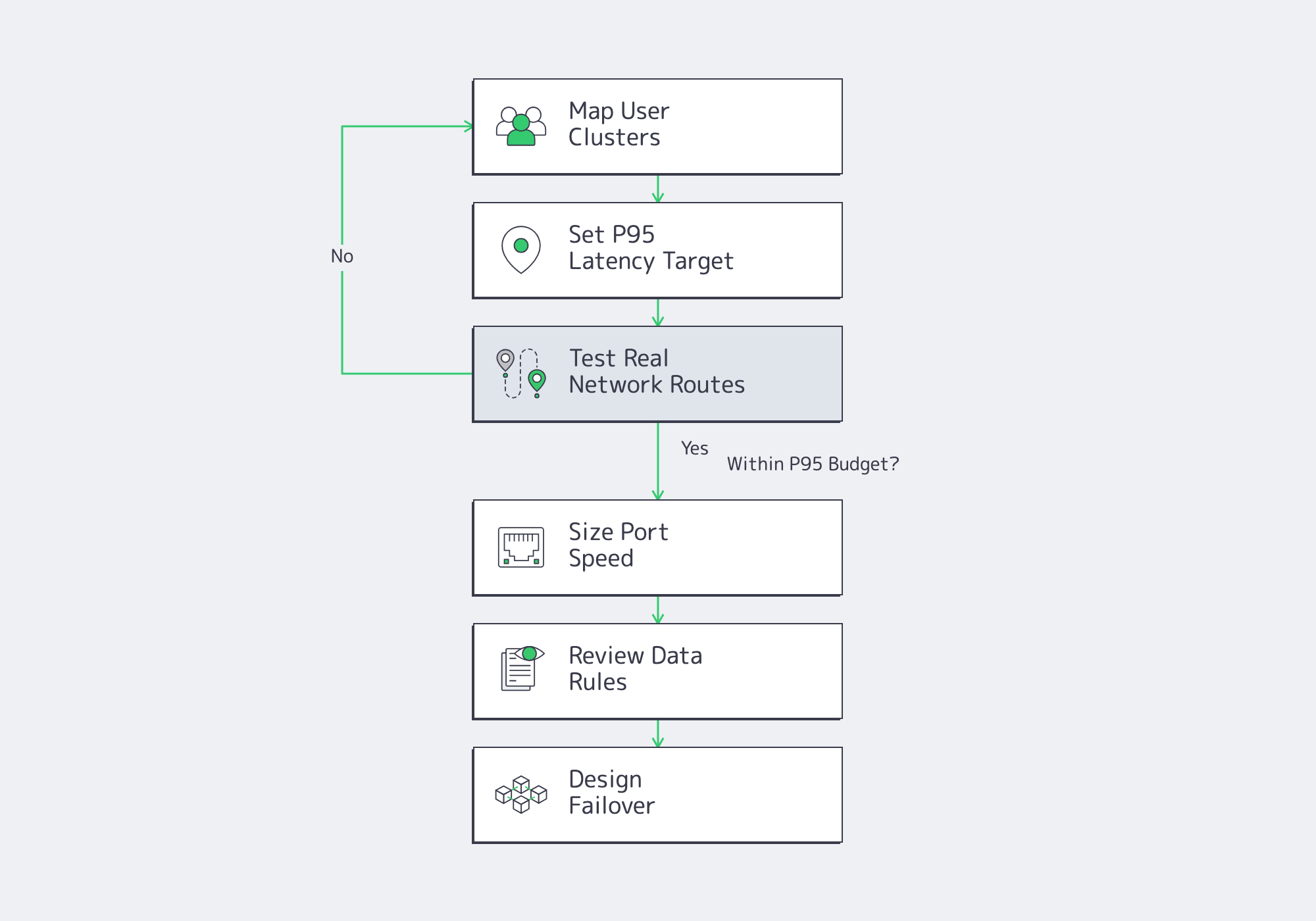
The practical sequence is user clustering, route testing, port sizing, compliance review, and failover design. That order matters. A 10 Gbps port in the wrong city still gives users the wrong path. A compliant data location with weak peering still creates tickets. A failover site that shares the same upstream risk is not meaningful resilience.
Melbicom’s Asia footprint, network backbone, 25+ IXP peering hubs, 20+ transit partners, and dedicated server bandwidth options up to 200 Gbps help match workloads to routes.
Where an Asia Dedicated Server Should Be Placed for APAC Users
An Asia dedicated server should be placed closest to the largest latency-sensitive user cluster, not necessarily at the geographic center of APAC. Put write-heavy application tiers within roughly 50–80 ms RTT of core users, then use secondary sites for failover or read replicas when cross-region paths exceed about 100 ms.
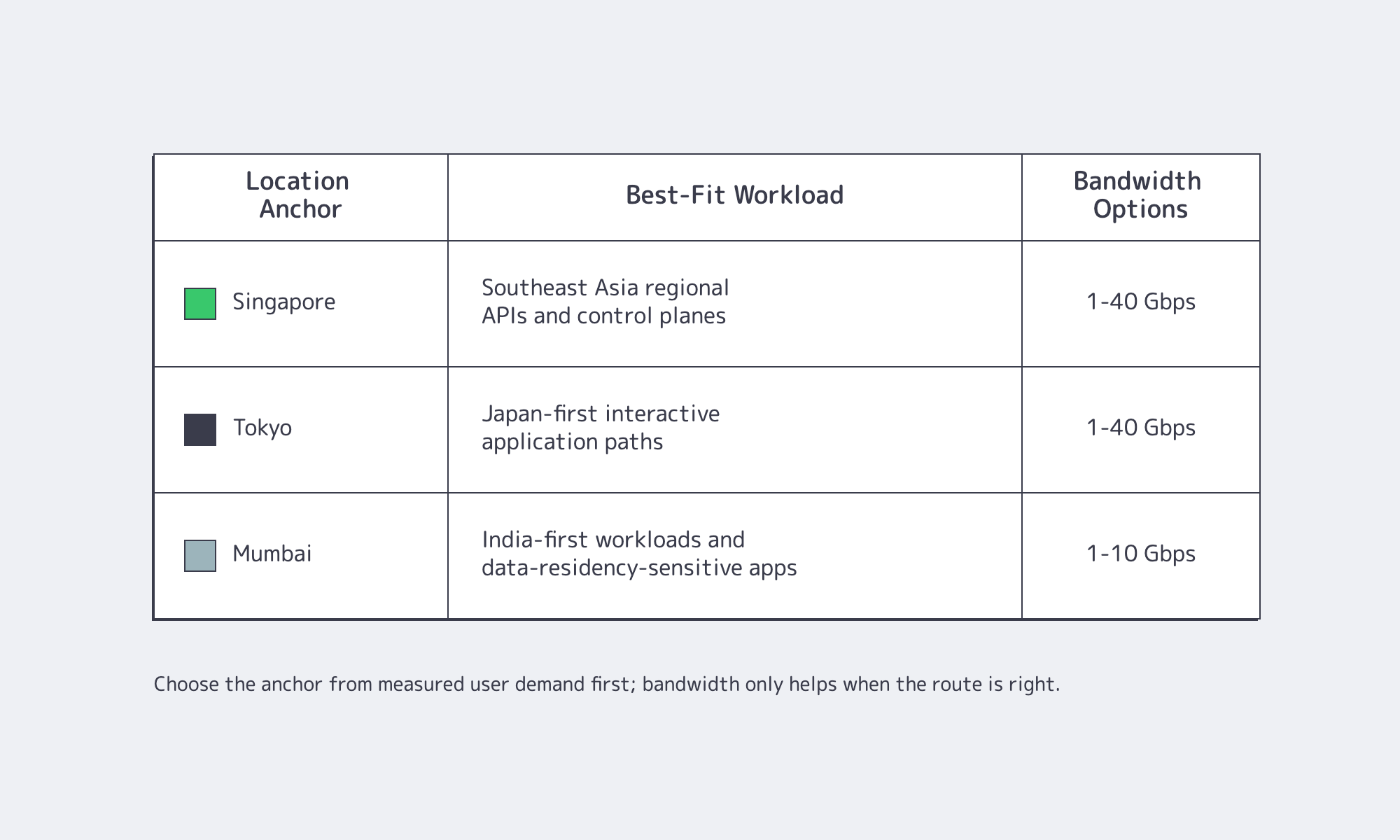
The first split is usually Southeast Asia, North Asia, and South Asia. Singapore works well for regional APIs, authentication, dashboards, analytics collection, and control planes. Tokyo is the right first choice when Japanese users need native-feeling latency. Mumbai is the better anchor when Indian users, payment flows, or Indian data expectations dominate. Fujairah can be relevant when APAC expansion overlaps with Middle East traffic or cross-region continuity requirements.
| Primary Anchor | Best-Fit User Geography | Buying Trigger |
|---|---|---|
| Singapore | Singapore and Southeast Asia-oriented workloads | Choose when Southeast Asia is the largest active base or peering diversity matters more than one-country proximity. |
| Tokyo | Japan-first workloads and North Asia-oriented read paths | Choose when Japanese users need low interactive latency and Japan-specific data handling is part of the roadmap. |
| Mumbai | India-first workloads and nearby South Asia-oriented traffic | Choose when India is a primary revenue market, data locality is expected, or Singapore tests above the product’s P95 budget. |
Use public measurement platforms such as RIPE Atlas and Globalping for preflight tests, then verify from the access networks that matter: mobile carriers, broadband ISPs, corporate VPN exits, and payment or identity provider endpoints.
Singapore, Tokyo, or Mumbai: Comparing APAC Server Locations
Singapore for Regional Server Placement
Singapore is the pragmatic default when a workload must serve many APAC markets before the demand curve is obvious. On Melbicom, teams can start with Singapore dedicated servers, where more than 120 ready-to-go configurations support 1–40 Gbps bandwidth options, 50 TB or unmetered plans, and Tier III data center placement. The tradeoff is distance: Singapore will not make Tokyo feel local, and it will not always satisfy India-first latency or policy expectations.
Tokyo for Japan-First Application Paths
Tokyo should be treated as a performance location, not an afterthought. If Japan contributes a meaningful share of interactive sessions, moving the application tier to Tokyo dedicated servers can reduce the gap between a usable product and a product that feels native. Melbicom’s Tokyo configurations run in Tier III facilities with 1–40 Gbps bandwidth options and unmetered plans available.
Japan’s Personal Information Protection Commission maintains APPI. That makes Tokyo placement a compliance design choice as much as a latency decision.
Mumbai for India-First Growth
Mumbai is the right first question when India is not merely “included in APAC” but central to the workload. Indian access networks can behave differently by carrier and region, so teams should test from the Indian networks their customers actually use before assuming Singapore is close enough. A Mumbai dedicated server can also simplify data-residency expectations for Indian customers. Melbicom’s Mumbai footprint includes dozens of configurations in Tier III data centers, with 1–10 Gbps bandwidth options and unmetered plans available.
India’s Digital Personal Data Protection Act received assent in 2023, and privacy rules putting the framework into practice were reported as implemented in 2025 by Reuters. Treat India as a jurisdiction with explicit personal-data controls, not only as a latency zone.
How Should Teams Test Latency Before Buying an Asia Dedicated Server?
Teams should test an Asia dedicated server with multi-network probes, not a single office ping. Run TCP, HTTPS, and traceroute tests from user-heavy markets, compare P50, P95, packet loss, and route changes for at least seven days, and reject locations where peak-hour P95 exceeds the application budget by 20% or more.

- Build a market list from product analytics, billing country, support tickets, and authentication logs.
- Test Singapore, Tokyo, Mumbai, and Fujairah when relevant from several last-mile networks per target market.
- Measure HTTPS time-to-first-byte, not only ICMP ping.
- Record P50, P95, packet loss, jitter, AS path, and peak-hour variance.
- Repeat after provisioning, then keep lightweight RUM or synthetic monitoring as production guardrails.
For buying, the threshold is not “lowest average latency.” It is predictable tail latency. A location with a 45 ms median and 220 ms evening P95 can be worse than a 65 ms median with a tight tail.
How Much Port Speed Does an Asia Dedicated Server Need?
An Asia dedicated server needs port speed sized to peak sustained egress, not monthly traffic averages. Use 1 Gbps only when P95 traffic stays comfortably below 500–700 Mbps; move to 10 Gbps or higher when replication, media, analytics export, or multi-tenant bursts can saturate the port for minutes at a time.

The math is unforgiving: 1 Gbps is about 125 MB/s before overhead; 10 Gbps is about 1.25 GB/s. That bandwidth disappears quickly during database snapshot shipping, log export, large customer imports, or video-heavy application paths. Melbicom’s dedicated server bandwidth range—up to 200 Gbps globally, with 1–40 Gbps options in Singapore and Tokyo and 1–10 Gbps options in Mumbai—matters most when the architecture has real burst demand or regional replication windows.
Network, Compliance, and Failover Requirements for Asia Dedicated Hosting
Peering quality is the hidden buying criterion. Ask where traffic exits, which IXPs and transit paths are in play, and whether the provider can show route diversity into the user networks you care about. Melbicom’s network backbone is relevant because peering hubs and transit diversity help reduce dependence on a single path across APAC.
Compliance should be designed as a placement constraint. Singapore’s PDPA includes a transfer-limitation concept documented by the Personal Data Protection Commission. Japan has APPI. India has DPDP. The infrastructure decision is deciding which data classes can replicate, which must stay regional, and which can be cached without creating a new regulatory problem.
Failover is the same discipline. Use Singapore–Tokyo for regional continuity when Southeast Asia and North Asia both matter. Use Singapore–Mumbai when India is business-critical but some regional services can remain outside India. Use Tokyo–Mumbai only when the product is already multi-region; the latency between North Asia and South Asia is usually too high for synchronous writes. Use Fujairah as a nearby regional option when Middle East reach or APAC-adjacent continuity is part of the architecture.
FAQ: Asia Dedicated Server Buying
Can One Asia Server Cover APAC?
One location is enough for a first regional control plane or read-heavy service, but not for latency-sensitive coverage across all APAC markets. If Japan and India both matter, plan for at least two anchors.
Compliance or Latency First?
Compliance wins when regulated personal data or customer contracts require locality. Otherwise, measured P95 latency should decide. Keep regulated data regional while serving static or low-risk assets from broader edge locations.
When Should Failover Become Active-Active?
Use active-active when the product cannot tolerate regional downtime or when failover latency would break the user experience. Use active-passive when the main need is recoverability and the secondary site can run degraded workloads.
Build the APAC Footprint Around Measured Latency, Not Map Distance
The best Asia dedicated server strategy is specific: place the first server where the most latency-sensitive users are, validate routes from the networks they actually use, size ports for peak egress, and keep compliance boundaries visible in the architecture. APAC is too fragmented for one-size-fits-all infrastructure.
Key buying recommendations:
- Choose the first region from measured P95 latency, not headquarters location or generic APAC coverage.
- Keep synchronous writes inside a tight latency envelope; use replicas, queues, and regional reads once cross-region RTT becomes unpredictable.
- Test during local peak hours before committing; tail latency and packet loss are stronger buying signals than clean daytime averages.
- Separate data placement decisions from application placement decisions when privacy rules, customer contracts, or operational recovery requirements diverge.
- Treat failover as workload design: define normal, degraded, and later-recovery services under NIST SP 800-34 Rev. 1-style continuity planning rules.
That is where Melbicom fits into the decision: not as a generic Asia checkbox, but as infrastructure you can place, size, and expand around actual APAC traffic patterns using data center coverage, network reach, and dedicated server configurations.
Deploy Dedicated Servers in Asia
Place APAC workloads on dedicated infrastructure with measured latency and predictable expansion paths.