
Blog
AMD EPYC, Ryzen and Intel Xeon Hosting Providers: Compare Available Builds and Workload Fit
Choosing between AMD EPYC, Ryzen, and Intel Xeon dedicated servers requires more than comparing core counts and advertised clock speeds. The meaningful comparison is between complete configurations: processor generation, socket topology, installed memory, storage, network capacity, and deployment region.
The difference matters. A high-frequency Ryzen system might suit a latency-sensitive API, while a memory-intensive analytics engine could benefit from EPYC’s wider memory subsystem. A multi-socket Xeon configuration introduces NUMA considerations that can change application performance substantially.
This guide compares those architectural tradeoffs using Melbicom’s regional offerings and a reusable provider-selection framework. The goal is to identify which CPU and server configuration fits a workload’s actual bottleneck, then validate that choice before standardizing it across regions.
Compare CPU Builds– Ryzen, EPYC and Xeon – Memory and storage options – Regional configurations |
 |
Which Dedicated Server Providers Offer AMD EPYC, Ryzen, and Intel Xeon Builds?
AMD Ryzen Xeon dedicated server providers should be evaluated by processor generation, regional availability, and complete hardware configuration. Compare exact CPU models, DIMM topology, storage, network specifications, and location-specific availability. Melbicom offers these CPU families across our infrastructure, with location-specific builds.
EPYC Ryzen Xeon Hosting Comparison: Dedicated Server CPU Generations
The matrix below compares complete Melbicom catalog configurations with regional processor options that require a configuration request. Catalog examples preserve the CPU, memory, storage, and network combination offered together. Regional SKU entries identify processor choices without implying a complete available build. Core and thread figures are per processor; actual socket population requires confirmation.
| Region and Evidence | CPU Generation and Build | Memory, Storage, and Network |
|---|---|---|
| Singapore | AMD Ryzen 9 9950X, Ryzen 9000, Zen 5, 16C/32T, 4.30 GHz base | 128 GB RAM; 2 × 3.84 TB NVMe; 10 Gbps, 50 TB allowance |
| Amsterdam | AMD Ryzen 9 7950X, Ryzen 7000, Zen 4, 16C/32T, 4.50 GHz base | 128 GB RAM; 15.36 TB advertised NVMe total across two drives; 10 Gbps, 50 TB allowance |
| Frankfurt | AMD EPYC 7402, EPYC 7002, 24C/48T, 2.80 GHz base | 128 GB RAM; 2 × 960 GB NVMe; 10 Gbps, 50 TB allowance |
| Frankfurt or Paris | Intel Xeon E-2356G, Xeon E-2300, 6C/12T, 3.20 GHz base | 32 GB RAM; 1 × 480 GB SSD; 10 Gbps, 50 TB allowance |
| Amsterdam and Riga | AMD EPYC 9575F, EPYC 9005, Zen 5 | RAM capacity and DIMM topology; storage; network port; availability |
| Singapore | AMD EPYC 9354P, EPYC 9004, Zen 4 | RAM capacity and DIMM topology; storage; network port; availability |
| São Paulo | Ryzen, Xeon, and EPYC family options | DDR5, NVMe, and 1/10/25/40 GbE options; exact build and reservation status to establish |
A configuration request specifies DIMM layout, memory speed, socket population where applicable, usable storage capacity, and delivery needs.
The processor generations matter because they expose different memory architectures. The EPYC 7402 supports eight DDR4 channels and can operate in one- or two-socket configurations. The EPYC 9354P is a single-socket processor with 32 cores, 64 threads, and 12 DDR5 channels.
The EPYC 9575F belongs to the Zen 5 generation, with 64 cores, a 3.3 GHz base frequency, and up to 5.0 GHz boost.
For a regional deployment, the useful question is which CPU SKU, memory population, storage layout, and network configuration can be supplied in the required city.
When an existing configuration does not meet those requirements, Melbicom offers custom dedicated-server configurations delivered and deployed in 3–5 business days.
Comparing Regional Offers Against Single-Thread Performance, Memory Bandwidth, and NUMA Requirements
CPU selection should follow the workload’s limiting resource. Ryzen is worth evaluating for sustained single-thread performance, while EPYC and suitable Xeon platforms offer different memory-bandwidth and scaling characteristics. Compare theoretical memory interfaces only after confirming installed DIMMs, then validate application throughput, tail latency, and NUMA locality using identical, documented test conditions.
Single-Thread Performance and Boost Clocks
AMD’s Ryzen 9 9950X has 16 cores, 32 threads, a 4.3 GHz base, and up to 5.7 GHz boost.
The Ryzen 9 7950X has 16 cores, 32 threads, a 4.5 GHz base, and up to 5.7 GHz boost.
Intel’s Xeon E-2300 platform includes the E-2356G: 6 cores, 12 threads, up to 5.0 GHz.
These frequencies describe processor capabilities, not sustained application performance. Cache behavior, instruction mix, sustained frequency, and compiler optimizations can change the outcome.
For event-loop services, game simulation, or latency-sensitive APIs, compare application throughput at the required p95 and p99 latency. A processor with a higher advertised boost frequency is useful only if it benefits the workload under sustained load.
Calculate the Memory-Bandwidth Ceiling
Memory capacity and memory bandwidth are different constraints.
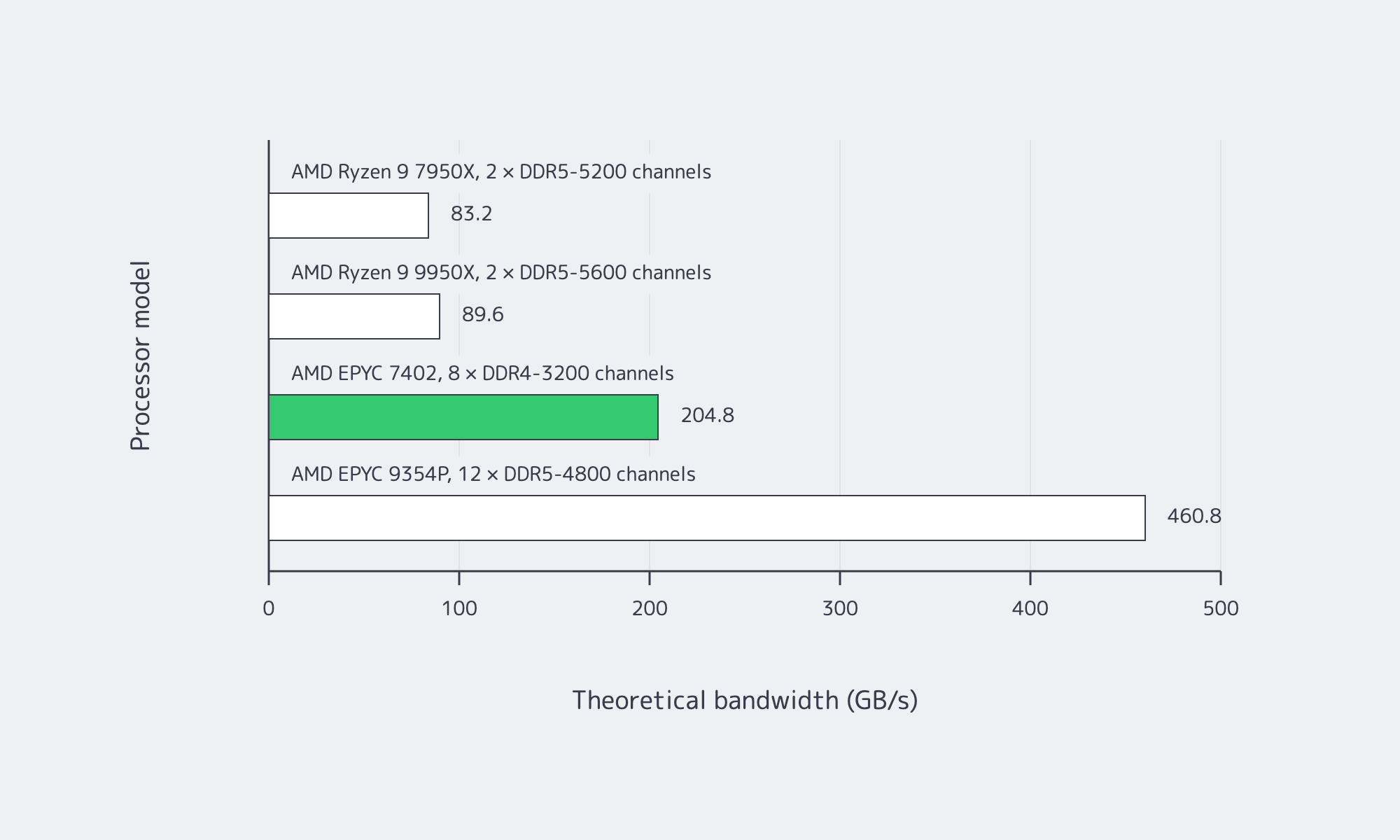
The Ryzen 9 9950X provides two DDR5 channels. At its specified DDR5-5600 rate for supported two-DIMM configurations, theoretical memory-interface bandwidth is:
2 channels × 5,600 MT/s × 8 bytes ÷ 1,000 = 89.6 GB/s
The Ryzen 9 7950X supports DDR5-5200 in specified two-DIMM configurations, producing a theoretical 83.2 GB/s.
The EPYC 7402 supports eight DDR4-3200 channels, giving a theoretical per-socket ceiling of 204.8 GB/s.
EPYC 9354P: 12 DDR5-4800 channels, with a theoretical 460.8 GB/s per socket.
For EPYC 9005, 12 channels operating at DDR5-6000 would provide 576 GB/s per socket. AMD also documents DDR5-6400 support for targeted customers and configurations; that higher rate should not be assumed for a particular server.
These figures are theoretical memory-interface ceilings, calculated from channel count × transfer rate × 8 bytes ÷ 1,000. They assume all specified channels are populated and operating at the stated rate. Sustainable bandwidth depends on DIMM population, configured frequency, memory-controller behavior, and access patterns.
AMD’s EPYC memory-population guidance explains why channel population matters. A server with sufficient total RAM may still provide less bandwidth than its processor’s theoretical interface ceiling if channels are not fully populated.
For memory-intensive applications, compare installed channel topology and measured sustainable bandwidth rather than total RAM alone. Ryzen ECC operation also depends on motherboard support and the actual configuration.
NUMA Testing: Topology Changes Results
NUMA matters when threads access memory outside the local domain.
A dual-socket Xeon system can incur cross-socket memory-access costs. EPYC platforms can expose multiple NUMA domains within a socket, depending on configuration.
AMD’s EPYC BIOS tuning guide documents NPS1, NPS2, and NPS4 configurations, corresponding to one, two, or four NUMA nodes per socket when LLC-as-NUMA is disabled.
Linux provides explicit NUMA memory-placement policies. Local versus remote allocation can materially affect memory-sensitive applications.
Single-socket systems should not automatically be assumed to expose one NUMA domain. Inspect the operating-system topology and determine whether the application keeps frequently accessed memory close to the threads using it.
Use Reproducible Workload Tests to Validate the Quoted CPU Configuration
A reproducible CPU qualification protocol must record exact hardware, software versions, memory topology, NUMA placement, and UTC timestamps before measuring performance. Use pinned single-thread and memory-bandwidth tools, followed by production workload replay. Acceptance thresholds should come from application requirements and validated baselines, not universal benchmark percentages or unverified processor specifications.
Proposed CPU Qualification Protocol
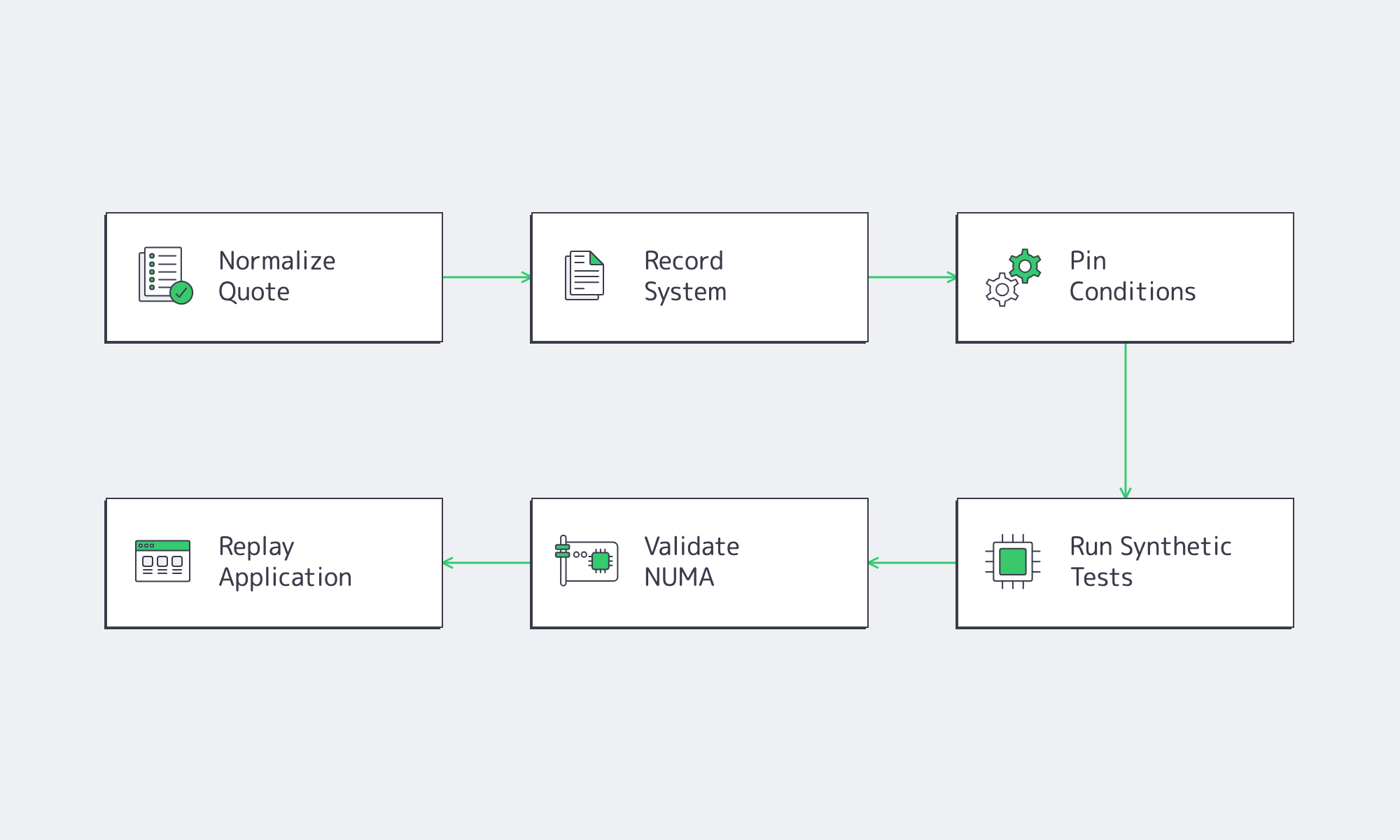
The proposed procedure separates hardware validation from application acceptance. Synthetic tests help identify configuration or performance anomalies; application replay determines whether a candidate meets production requirements.
Capture the processor SKU, socket count, physical core and logical thread count, BIOS, microcode, SMT status, operating system, kernel, frequency policy, DIMM layout, storage, and network configuration.
Record lscpu and numactl --hardware output plus relevant data from /sys/devices/system/node.
For single-thread validation, use a pinned sysbench 1.0.20 build, bind one worker with taskset, perform a warm-up, and collect ten fixed-duration runs as an initial sample. Preserve the command, binary checksum, frequency telemetry, and events per second.
For bandwidth, use the STREAM reference benchmark. Record the source checksum, compiler version, flags, array size, thread count, and affinity. Use arrays larger than aggregate cache and collect Copy, Scale, Add, and Triad results across at least five scored passes initially.
If run-to-run variability prevents a stable comparison, investigate changing host conditions and collect additional samples before drawing conclusions.
For NUMA systems, repeat STREAM with local-memory placement, remote-memory placement where supported, and the intended production policy. Record NPS settings on applicable EPYC configurations.
Keep storage from distorting CPU results; a pinned fio release can provide a separately controlled storage sanity check.
The proposed timestamp record should contain:
Protocol ID | City | Quote timestamp UTC | Test start/end UTC | CPU | DIMMs | NUMA/NPS | OS/kernel | Tool version/hash | Affinity | Duration | Median | Variability | Application buildDerive investigation triggers from repeated measurements of a validated, equivalent configuration. Establish the baseline’s normal variation under controlled conditions, account for measurement noise, and investigate deviations large enough to exceed that variation or threaten the application’s acceptance requirements.
The decisive test remains application replay with identical binaries, datasets, concurrency, warm-up conditions, and memory limits. Record throughput, p50/p95/p99 latency, and errors against workload-owned acceptance criteria.
Where standardized published CPU results are considered, SPEC CPU2017 run rules provide a separate methodology. Published controlled results should not be confused with processor specifications or results from the proposed workload tests.
From Quotes to Acceptance Criteria
A Ryzen 9 9950X configuration with 128 GB RAM cannot be assumed to deliver the same bandwidth as another 128 GB configuration without knowing its DIMM population and operating speed.
Likewise, an EPYC system with 512 GB DDR5 does not establish how many memory channels are populated.
A normalized provider request should connect the hardware specification to a workload-owned acceptance target: requests per second at an acceptable p99, jobs completed per hour, scan throughput, or concurrent workers without unacceptable contention.
The result is a configuration that can be evaluated against a specific production requirement rather than a processor-family label.
Match Workloads and Regional Builds
A practical EPYC Ryzen Xeon hosting comparison starts with workload profiles rather than processor rankings.
Single-thread-sensitive applications should shortlist high-frequency Ryzen and suitable Xeon configurations, then compare sustained application latency and throughput.
Memory-bandwidth-intensive applications, including analytical scans and in-memory processing, should compare STREAM results alongside actual application throughput. EPYC’s wider memory interface makes it a relevant candidate, not an automatic winner.
NUMA-sensitive databases and virtualization workloads need locality-aware tests. A higher core count is valuable only when additional threads can use memory without unacceptable remote-access penalties.
Independently partitionable workers may benefit from distributing processes across NUMA nodes, keeping their working sets local.
For regional fleets, qualify the CPU class first, then qualify each location’s actual build. Equivalent production outcomes matter more than identical processor labels.
Final Selection Rules for AMD Ryzen Xeon Dedicated Server Providers

A defensible CPU decision combines confirmed configuration evidence, memory topology, and reproducible workload validation. Provider comparisons should preserve missing fields rather than treating processor-family availability as proof of a deliverable build.
The essential rules are:
- Verify exact builds before ranking offers. A CPU, DIMM, storage, and network configuration prevents regional differences from becoming hidden variables.
- Use workload-specific metrics. Single-thread-sensitive services need latency and throughput validation; memory-intensive services need sustained bandwidth and application replay.
- Treat memory topology as part of the CPU decision. Total RAM capacity alone does not establish channel population, configured speed, or NUMA behavior.
- Reproduce the test environment. Pin software versions, workload inputs, affinity, memory placement, and run conditions before comparing results.
- Standardize on accepted outcomes. Regional hardware can differ while meeting the same application-level performance contract.
The strongest dedicated-server CPU choice is the one whose delivered configuration meets the workload’s measurable requirements—not the one with the most impressive specification sheet.
Explore Melbicom Dedicated Servers
Use our dedicated server catalog to shortlist suitable CPU models, memory capacities, storage layouts, and deployment locations.