
Blog

Managing Traffic Spikes on Adult Sites with Dedicated Servers
A newly trending performer, a live cam marathon, or an outage on a major platform can drive a sudden traffic spike that floods your origin without warning. During the COVID-19 lockdowns, for example, Pornhub made premium access free, and global traffic rose 18.5% in a single day. Although that kind of demand can be a “good problem,” an under-provisioned stack can fail quickly. This matters at the category’s scale: Pornhub claims more than 100 million daily visits. Downtime is also expensive: ITIC’s 2024 survey found that hourly downtime costs exceeded $300,000 for 90% of mid-size and large enterprises.
Choose Melbicom— 1,100+ ready-to-go configs — 21 Tier III/IV data centers — 39 CDN PoPs, 35 countries |
 |
How to Prevent Downtime During Surges
Prevent downtime during traffic surges by distributing requests across multiple dedicated servers, caching reusable content through CDN edge caching, keeping warm capacity available, and scaling application replicas automatically. Geographic distribution, health checks, load shedding, and capacity alerts help keep a flash crowd from exhausting one server, region, or network path.
Building Scalable Adult Hosting Infrastructure That Copes With Spikes
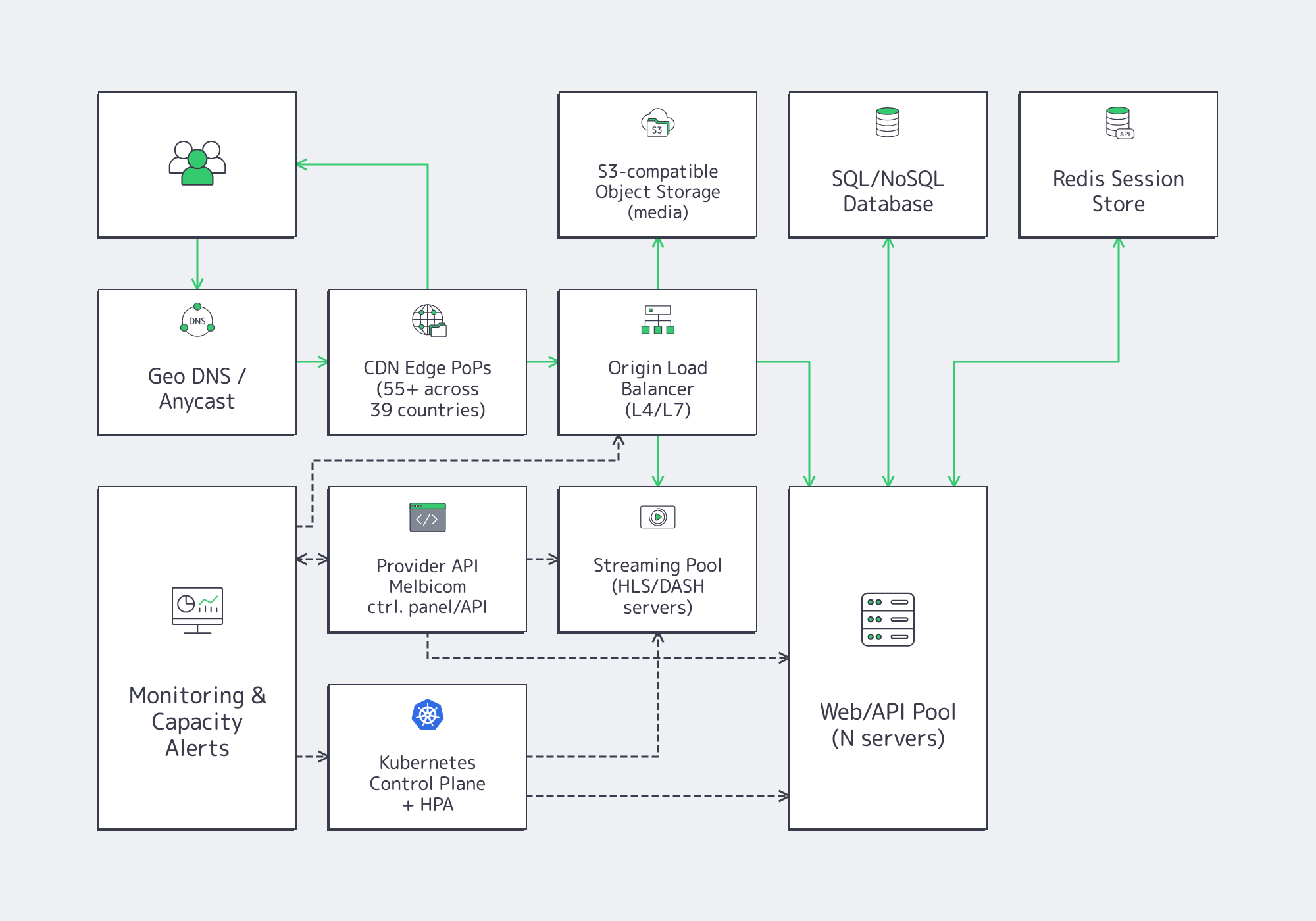
Load balancing and web tiers
One origin creates a single point of failure. Place an L4/L7 load balancer in front of multiple dedicated web, API, and streaming nodes, use least-connections or EWMA routing, and run continuous health checks. Use active-active clusters only where the application and data layer support them. Separate frontend HTML/API pools from HLS/DASH segment servers so video surges do not starve logins, searches, or payments. For global delivery, combine regional load balancers with geo-DNS or Anycast so users reach the nearest healthy path.
Bandwidth also needs explicit headroom because streaming spikes are egress-heavy and an undersized network can become the bottleneck. Use high-capacity per-server NICs and a multi-terabit backbone. Melbicom can provision a dedicated server with up to 200 Gbps per server, while the 14+ Tbps backbone gives multi-origin clusters room to absorb sustained traffic growth.
Provisioning on‑demand to handle climbing traffic
Demand can change by the minute. A physical server cannot scale at pod speed, so use two different tactics: warm capacity for immediate response and API-driven provisioning for anticipated or sustained demand:
- Maintaining warm standby nodes: Provision several nodes in advance and keep them idle or running preemptible batch or auxiliary workloads. They can be drained and added to the production pool quickly during a surge.
- Rapid hardware turn-ups: Connect provider APIs to capacity alerts so an operator or automation can request additional dedicated servers after a threshold is crossed. Melbicom offers 1,100+ ready-to-go server configurations that can be activated in 2 hours, plus 24/7 support, a control panel, and an API.
Pair new nodes with a stateless application design: externalize session state in Redis, centralize authentication tokens, and use immutable images or Ansible so nodes join consistently. Move cold objects to S3-compatible storage while hot subsets remain on local cache nodes. Melbicom’s S3 Cloud Storage helps decouple media libraries from origin compute, with NVMe-accelerated storage and EU-based data residency.
CDN caching for adult traffic spikes
CDN cache management reduces the number of repeat requests that reach the origin. Adult platforms commonly see demand concentrate on thumbnails, JavaScript/CSS, and especially HLS/DASH segment files. Focus the cache strategy on those reusable objects and account for two operational realities:
- Small cache-hit gains make a significant difference: At the same request volume, raising the cache-hit ratio from 90% to 95% halves cacheable origin requests because misses fall from 10% to 5%.
- Keep delivery close to viewers: Users should fetch segments from nearby edges in locations such as Paris, Dallas, and Tokyo. Melbicom’s CDN provides 39 CDN PoPs across 35 countries and supports adaptive video delivery, reducing repeat traffic to origin infrastructure.
Additional notes for implementation:
Use segment-aware cache keys, normalize query strings, tune TTLs, and avoid per-user cache fragmentation.
Micro-cache anonymous HTML responses for 30–120 s to flatten short-lived demand on front pages and searches.
Use tiered caching (edge → regional → origin) to shorten fetch paths when an object is cold in one region but hot in another.
Container orchestration: Rapid horizontal scaling for high‑traffic adult sites
Managing containerized services on dedicated servers with Kubernetes (or Nomad) provides three scaling advantages:
- Horizontal Pod Autoscaling can add replicas in response to CPU, QPS, queue depth, or custom metrics when spare cluster capacity exists.
- Rolling updates can limit deployment risk, while pod disruption budgets constrain voluntary evictions; they do not protect against every outage.
- If a node fails, a workload controller can replace affected pods on healthy nodes after the failure is detected and capacity is available.
Map node groups to dedicated clusters by region or data center, and use capacity thresholds to trigger provider API requests for additional physical nodes. Melbicom’s global Tier III/IV data centers let teams place clusters closer to users and shift traffic between regions as demand changes.
Core components and surge risk mitigation
| Component | What it mitigates | Actionable configuration |
|---|---|---|
| Multi‑origin + L4/L7 LB | Single-origin overload; node failure | Least‑connections/EWMA, health checks, per-role pools, geo‑DNS/Anycast |
| CDN + origin shields | Origin saturation; long-haul latency | Normalize cache keys, set segment TTLs, micro‑cache HTML, tiered caches |
| Orchestrated containers | Slow/manual application scaling; fragile deployments | HPA on CPU/QPS/custom metrics, PDBs for voluntary disruptions, API-provisioned nodes |
Effort to Impact: A 30‑day hardening checklist
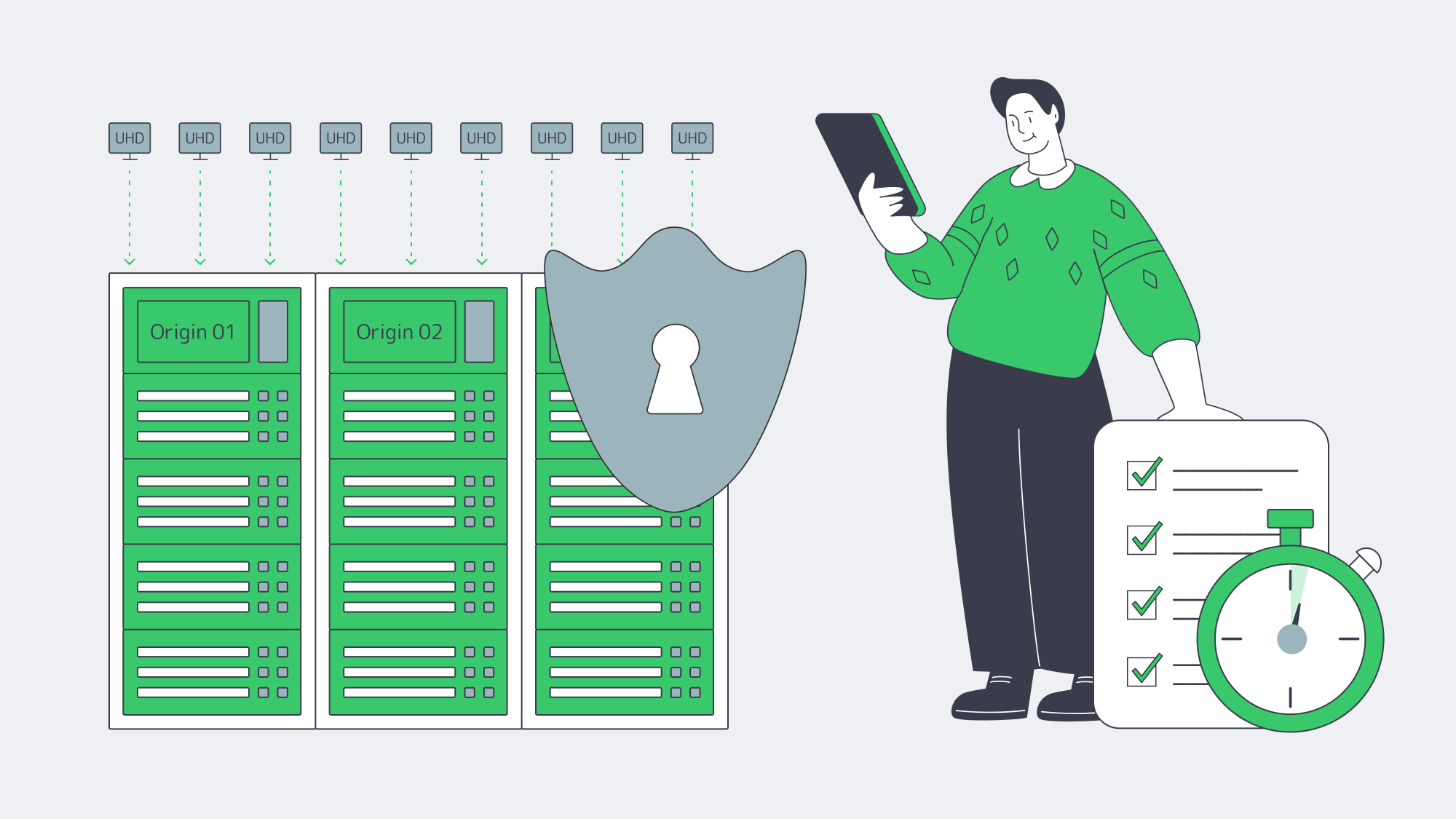
- Start with CDN fronting: Cache eligible HLS/DASH segments and thumbnails, and add an origin shield tier.
- Organize different roles into isolated pools: Keep web/API and streaming on separate load-balanced backends to prevent cross-starvation.
- Micro-cache anonymous hot HTML endpoints with a 30–120 s TTL.
- Identify and contain the busiest microservices: Define HPA policies and test surges from 1× to 3×.
- Set up capacity alerts: Maintain warm standby nodes for immediate response and use provider API requests for sustained demand.
- Migrate asset libraries to object storage and pre-warm regional caches.
Why these four pillars work
Together, the four pillars mitigate a surge at every layer of the request path:
- Concurrent distribution: Load balancers distribute requests and isolate node failures, reducing single-origin choke points.
- Flexible capacity: Warm dedicated servers provide immediate headroom. API-driven provisioning adds sustained capacity without keeping every node online.
- Offloading to the edge: Cached content no longer sends every repeat request to origin. At the same request volume, a cache-hit increase from 90% to 95% halves cacheable origin requests.
- Safe rapid redeployment: Container orchestration can add replicas when spare node capacity exists and roll out changes without replacing the full fleet.
Combined, these measures form layered guardrails during third-party outages and demand spikes, reducing the chance that one overloaded component forces emergency recovery.
Planning Your Team’s Next Moves

Scaling vertically and hoping for spare headroom is not a reliable virality plan. Traffic surges often arrive during external outages or cultural moments. During the 2019 Facebook and Instagram outage, for example, Pornhub traffic reached as much as 19% above average. Distribute traffic across multiple dedicated origins, cache reusable content near users, scale application replicas while cluster capacity remains available, and request physical nodes before sustained demand pushes p95 latency beyond its budget. The investment can be lower than the cost of an outage: ITIC’s 2024 survey found that hourly downtime costs exceeded $300,000 for 90% of mid-size and large enterprises.
Melbicom supports that blueprint with dedicated infrastructure in 21 Tier III/IV data centers, 39 CDN PoPs across 35 countries, and 1,100+ ready-to-go server configurations that can be activated in 2 hours. Teams can combine 24/7 support, a control panel and API, and object storage for media catalogs to build a platform that is more resilient to traffic surges.
Scale dedicated capacity fast
Activate ready-to-go high-bandwidth dedicated servers in 2 hours. Use 24/7 support and flexible configurations to add capacity early.