
Blog
1Gbps Unmetered Dedicated Server Netherlands with Measured Proof
“Unmetered” is useful only when it describes an operating model, not a slogan. For a Netherlands dedicated server unmetered plan, the question is not whether the invoice avoids per-terabyte overage fees. The question is whether the 1 Gbps port, upstream paths, traffic policy, and upgrade options can support the workload once traffic becomes constant, bursty, or hostile. The UK ASA’s May 2025 guidance on “unlimited” claims is a good sanity check: material restrictions on speed, traffic management, or fair use must be clear, not hidden behind a friendly adjective.
Melbicom’s 1 Gbps unmetered dedicated server Netherlands configuration gives buyers concrete artifacts to test: guaranteed bandwidth without ratios, an Amsterdam test IP, a 1000 MB test file, and visible paths to higher-bandwidth Netherlands plans. Those details matter because unmetered bandwidth is not proved by copy. It is proved by sustained throughput, clear rules, and route quality under real demand.
Choose Melbicom– 300+ ready-to-go servers – Tier III & IV DCs in Amsterdam – 1 Gbps unmetered bandwidth |
 |
What 1Gbps Unmetered Dedicated Server Netherlands Plans Should Guarantee
A one-gigabit unmetered dedicated server in the Netherlands should guarantee a dedicated 1 Gbps port, no per-GB transfer billing, and enough path quality to sustain real throughput. At line rate, 1 Gbps can move about 324 TB in 30 days, so the practical benchmark is sustained load, not “unlimited” copy.
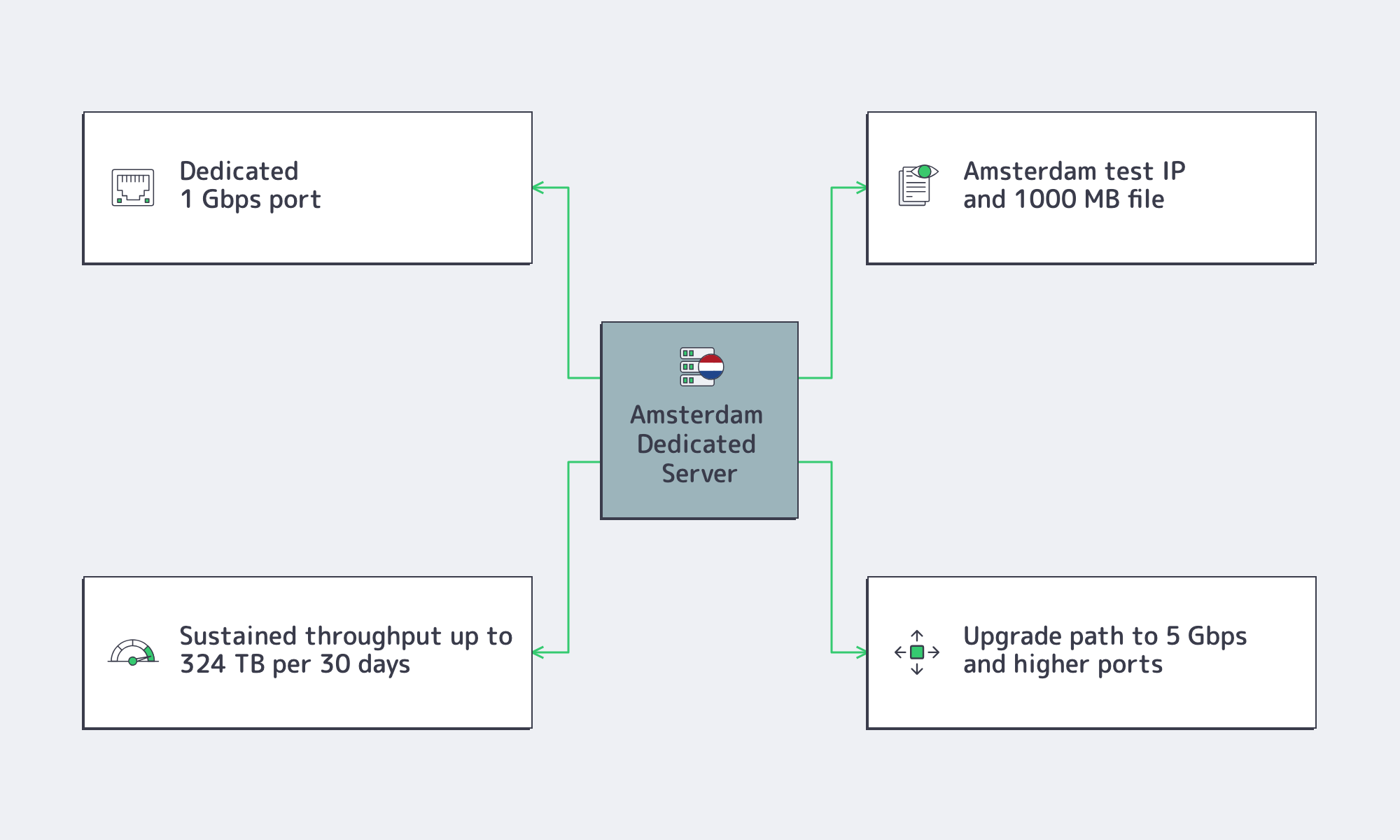
Start with the difference between bandwidth and throughput. Microsoft’s networking documentation separates bandwidth from latency because a large pipe does not automatically deliver fast application performance. Throughput is what remains after congestion, packet loss, TCP behavior, host limits, and routing are accounted for. Cisco’s Gigabit Ethernet interface documentation also shows standard Gigabit Ethernet as full-duplex 1000 Mbps, which is a reminder that the buying question is technical: Is the port dedicated, shaped, shared, or ratio-based?
| Proof Point | What to Verify | Why It Matters |
|---|---|---|
| Port commitment | Dedicated 1 Gbps port; guaranteed bandwidth rather than ratio-based wording. | Separates a serious Netherlands dedicated server unmetered offer from a shared best-effort uplink. |
| Test artifacts | Public IP, file, or path test from Amsterdam; the Netherlands 1Gbps plan includes both an IP and 1000 MB file. | Lets buyers test before purchase instead of trusting an unmetered claim. |
| Sustained usage | Evidence that the port can carry the planned daily traffic shape, not only a peak transfer. | Shows whether the workload has headroom or is living at the cap. |
| Growth path | Higher Netherlands ports, including a 5 Gbps Netherlands option and broader high-port families. | Keeps scaling from becoming a location migration. |
Unmetered Versus Unlimited Bandwidth in Netherlands Dedicated Hosting
In Netherlands dedicated hosting, unmetered should mean transfer is not billed by volume; unlimited is trustworthy only when speed limits, traffic management, and fair-use rules are clear before purchase. If a provider can shape, throttle, or review sustained saturation, the trigger should be explicit enough to model operating risk.
The ASA’s 2025 guidance is aimed at advertising, but infrastructure buyers can apply the same standard. “Unlimited” is not credible if a fair-use clause materially changes speed, quality, or availability after an unspecified threshold. The FTC’s settlement over unlimited data promises made the disclosure point in another market: customers were promised unlimited usage while speed restrictions were not made clear enough, and the agency emphasized that limits on speed or amount must be disclosed. For dedicated servers, the lesson is narrower and sharper: read for fair use, traffic management, abuse-prevention, sustained saturation, shared uplink, reasonable use, and best effort. If the trigger exists, it should be measurable.
Traffic and Fair-Use Checks
Traffic, peering, and fair-use checks should happen before choosing a Netherlands port because the same 1 Gbps label behaves differently under video delivery, SaaS APIs, backups, and multi-tenant hosting. The concrete test is stable throughput on real user paths, with no hidden fair-use trigger that turns sustained use into degraded service.
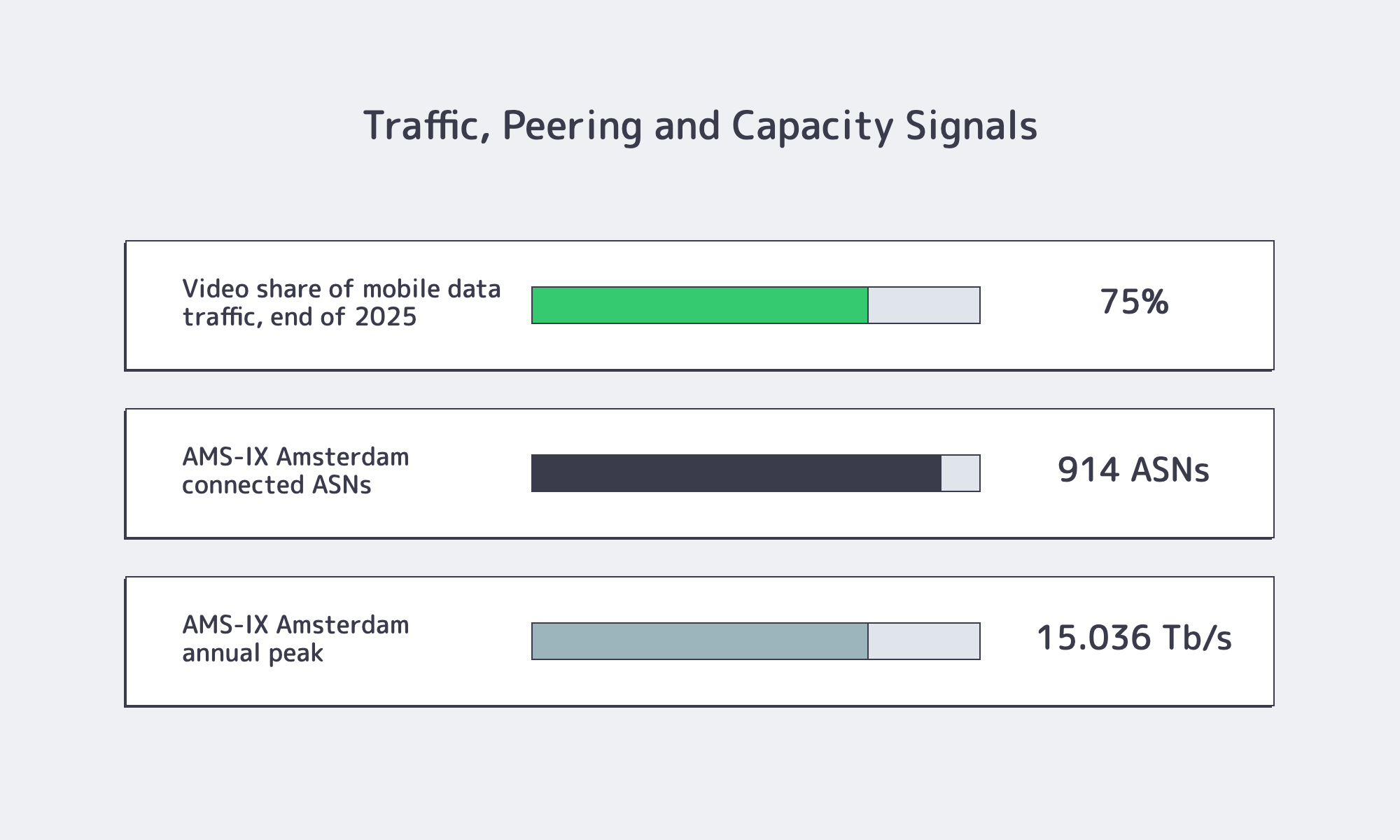
Long downlink traffic is the obvious pressure test. Ericsson’s Q1 2026 Mobility Report update says video represented about 75% of mobile data traffic at the end of 2025. Model video, software downloads, backups, and cached objects as sustained throughput, not burst-speed buying.
Small-packet and mixed traffic need a different lens. APNIC’s October 2024 packet-size analysis notes that public-Internet packets are pragmatically constrained between 20 and 1,500 bytes. Mbps can look healthy while packet processing, queues, retransmits, or loss struggle under many concurrent sessions.
Amsterdam’s interconnection depth is the reason many buyers start in the Netherlands. The current AMS-IX Amsterdam statistics show 914 connected ASNs and a 15.036 Tb/s annual peak; an April 17, 2026 AMS-IX update also reported 65% year-over-year growth in 400G ports. Melbicom’s Amsterdam footprint fits that context: the Netherlands location has 300+ ready-to-go server configurations, Tier III & IV DCs in Amsterdam, 1–200 Gbps per server at the facility level with 50 TB or unmetered traffic options.
How to Verify That a 1Gbps Port Supports Real Workloads in the Netherlands
To verify that a one-gigabit port supports real workloads in the Netherlands, test from your actual regions, use repeatable multi-stream transfers, and inspect sustained utilization, loss, and retransmits during busy windows. A useful pass criterion is a 95th-percentile profile that leaves operational headroom instead of camping at line rate.
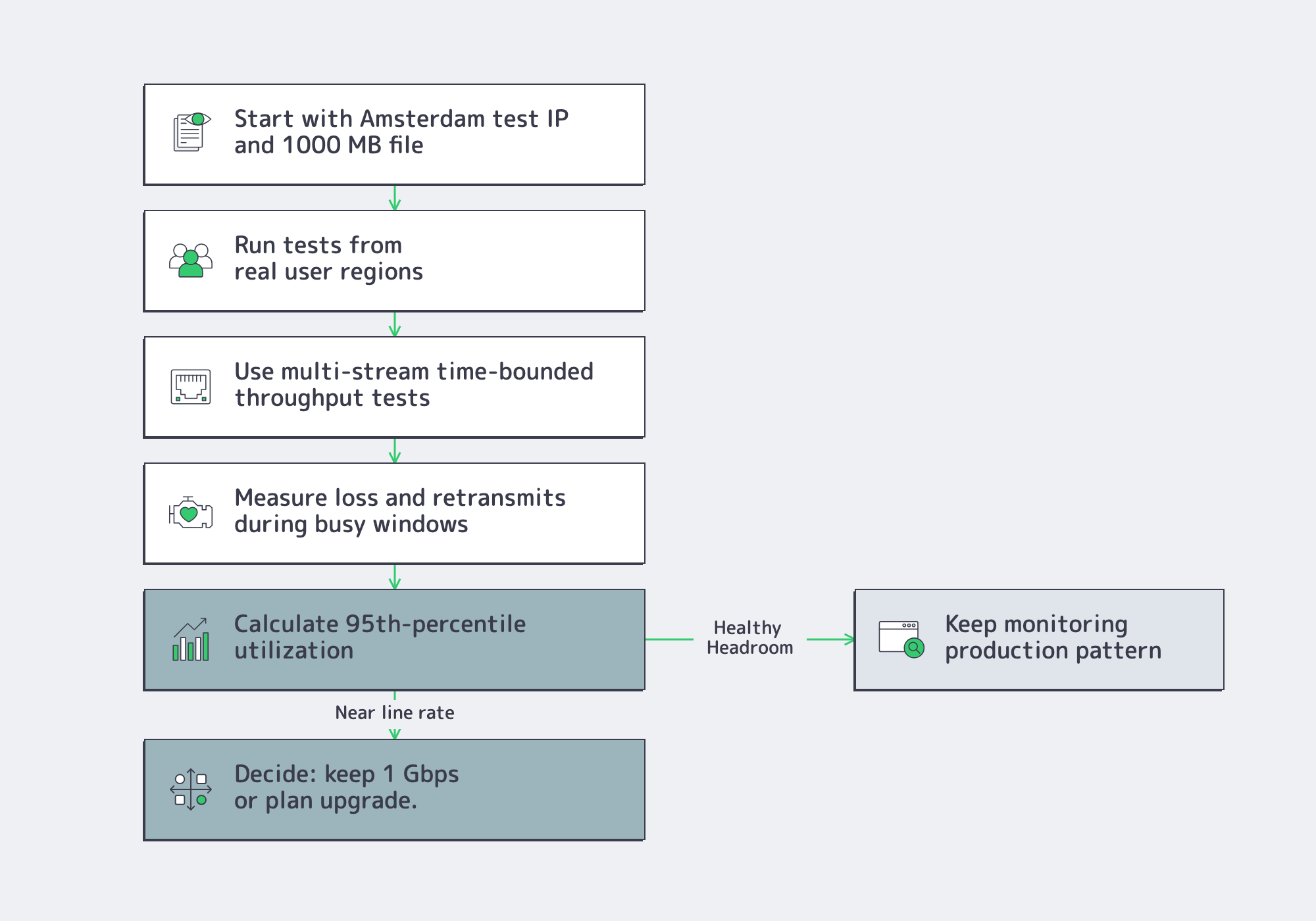
Start with the provider’s own test artifacts. The Netherlands 1 Gbps plan includes the Amsterdam test IP and 1000 MB download file, which gives buyers a quick way to check path behavior before a deployment. Then run deeper tests from the regions where users, customers, or upstream systems actually live. ESnet’s Fasterdata iperf guidance, last edited in January 2025, shows why multi-stream, time-bounded tests are useful: a single short transfer can be dominated by TCP ramp-up, buffer settings, or one-thread limits.
Use 95th-percentile thinking even when the server is sold as unmetered. Cloudflare’s bandwidth-measurement method samples every five minutes, discards the top 5% of samples, and treats the highest remaining value as sustained usage. If your 95th percentile is already close to 1 Gbps, you do not have much headroom for releases, cache misses, backup windows, or traffic spikes. The service may still be unmetered, but it is no longer comfortably provisioned.
When to Move Past a 1Gbps Port
Move past a one-gigabit port when sustained usage crowds line rate, peak windows clip throughput, or launch plans leave no room for mistakes. The cleanest upgrade keeps the workload in the same Netherlands geography and network context, because changing port speed is usually simpler than requalifying a new location.
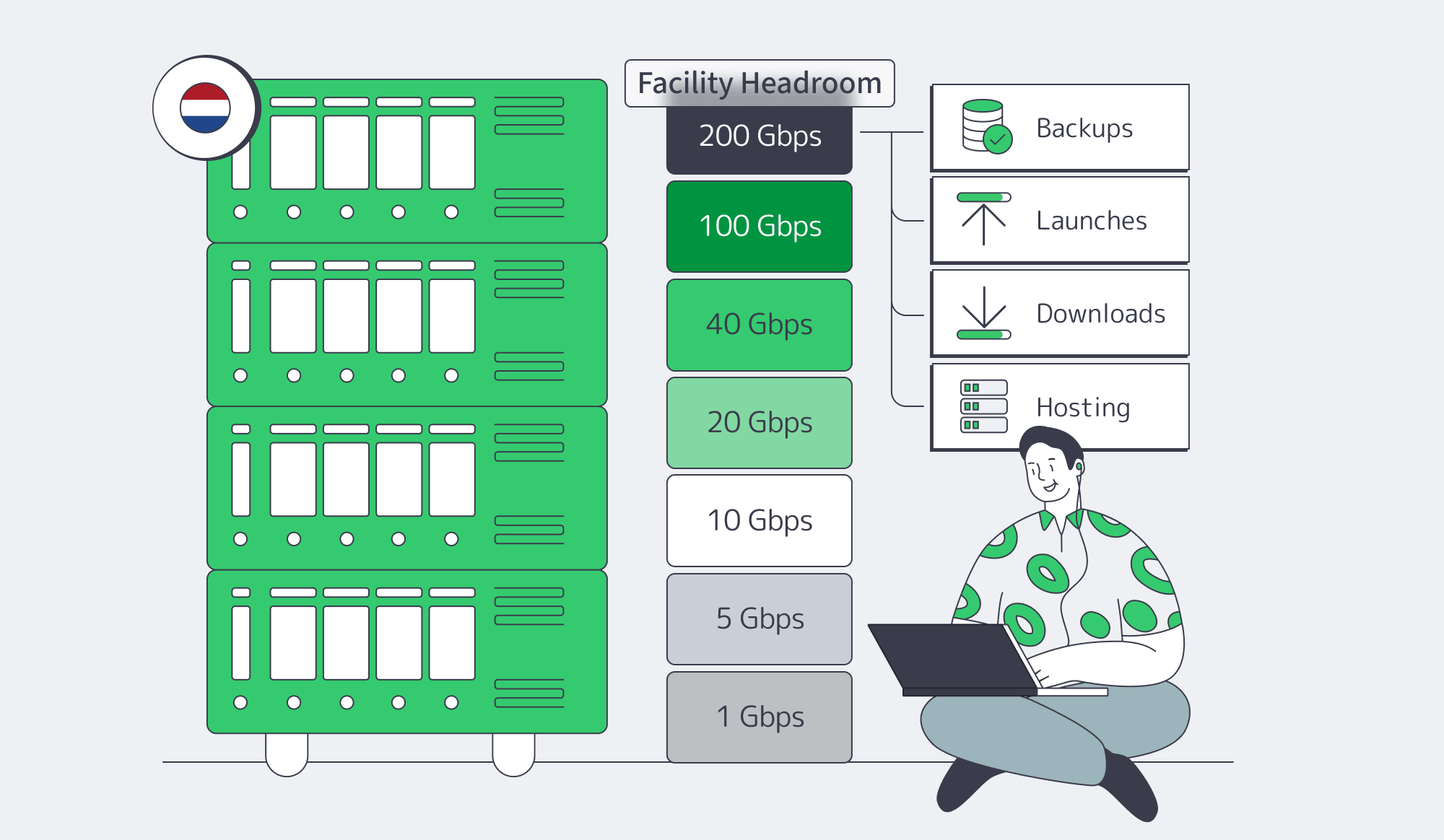
This is where portfolio structure becomes part of risk management. Melbicom offers a Netherlands 1 Gbps unmetered server options alongside broader 2 Gbps, 5 Gbps, 10 Gbps, 20 Gbps, 40 Gbps, and 100 Gbps unmetered families. The Amsterdam location supports up to 200 Gbps per server at the facility level with 50 TB or unmetered traffic options. That matters because an upgrade path is not only about more traffic; it is about keeping backups away from user traffic, absorbing launches, avoiding queue pressure, and preserving service quality for multi-tenant workloads.
Near the buying decision, use this shortlist:
- Treat “unmetered” as credible only when the provider gives you a test target, readable traffic-management language, network evidence, and an obvious upgrade path.
- For throughput-heavy workloads, model the port against the theoretical monthly ceiling and sustained utilization, not a burst screenshot.
- For interaction-heavy workloads, check packet loss, retransmits, route quality, and packet-processing stability, not only Mbps.
- For Amsterdam-based delivery, validate exchange presence, transit depth, and route quality into your real user regions.
Those checks turn “unmetered” from a marketing promise into an engineering decision. A serious 1gbps unmetered dedicated server Netherlands plan should make the port testable, the traffic rules readable, and the next upgrade predictable.
Compare Netherlands Server Ports
Melbicom’s Netherlands unmetered dedicated servers give buyers the right starting evidence: guaranteed bandwidth without ratios, Amsterdam test artifacts, and Tier III & IV DCs in Amsterdam.