
Blog

Video hosting vs CDN: Which streaming components do you need?
“Video hosting” and “video CDN” sound interchangeable. They aren't. A streaming platform combines storage, video preparation, playback, access controls, and delivery. Buying one component doesn't automatically solve the others.
An integrated platform can bundle multiple streaming functions. A CDN distributes prepared content while leaving other components under your control. The right decision depends on which responsibilities your team wants to retain.
Melbicom CDN– 40 Premium CDN PoPs – HLS and DASH delivery – Cache controls and raw logs |

|
Video Hosting vs. CDN: Five Layers
A streaming platform has five functional layers, each with different infrastructure requirements and ownership boundaries.
Storage retains authoritative media files. Preparation encodes and packages them for streaming. The player manages buffering, adaptive bitrate selection, and rendering. Access controls determine who may watch. Delivery distributes media to viewers.
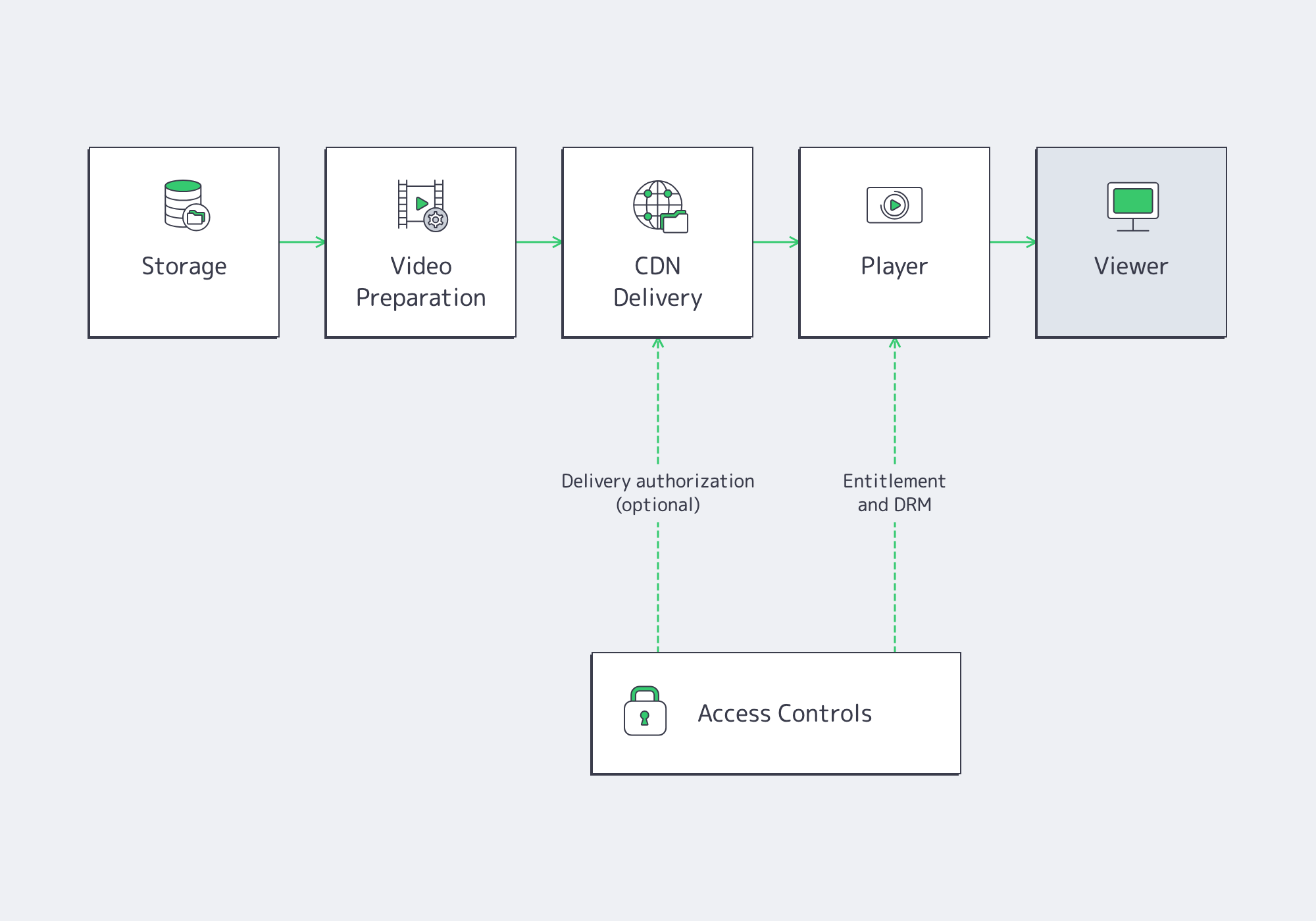
These layers scale differently. Storage follows library size and retention; encoding follows processing complexity; authorization follows sessions; and CDN demand follows delivered traffic and cache efficiency.
Storage and Video Preparation
For video on demand, storage may hold masters, transcoded renditions, captions, and manifests. Live services may also retain recordings and DVR windows. CDN caches aren't authoritative storage: objects can expire or be purged.
Preparation converts source media into playable formats. Apple's HLS architecture separates encoding and packaging from distribution. Multivariant playlists let players select suitable renditions.
Preparation and player behavior also affect playback latency. Encoding, packaging, and buffering decisions influence how quickly viewers can watch new media, regardless of CDN performance. The component-selection decision is which system owns each responsibility.
The CDN Delivery Boundary
A CDN starts working when viewers request addressable media objects: manifests, segments, subtitles, or other eligible assets.
Under HTTP caching rules in RFC 9111, fresh cached responses can avoid additional origin requests. But cache misses still reach the source.
Origins must withstand cold caches, expiration, purges, and concurrent fills. When sizing Melbicom CDN origin deployments, account for the requests that reach the origin during those conditions rather than relying exclusively on average cache-hit ratios.
When selecting a CDN, the relevant delivery controls include origin configuration, cache purge, geographic routing, HTTP-header control, and logs. These determine how the delivery layer integrates with the origin and how operators diagnose delivery failures.
Which Streaming Components Are Included in Video Hosting Versus CDN Services?
Video hosting can combine storage, transcoding, packaging, playback, access tooling, and delivery. A video CDN primarily handles distribution and caching. When comparing services, verify ownership of all five components rather than assuming a product label guarantees functionality. Anything not explicitly included remains an integration or operational responsibility for your team.
| Component | Integrated Video Hosting | Separate Services With CDN |
|---|---|---|
| Storage | May manage masters, outputs, and retention | Team selects authoritative storage; CDN caches copies |
| Preparation | May handle ingest, encoding, packaging, and manifests | Team selects and integrates encoding and packaging |
| Player | May supply maintained players and analytics | Team owns player selection, compatibility, and telemetry |
| Access controls | May integrate entitlement and DRM workflows | Application owns entitlement and license orchestration |
| Delivery | Usually bundled; degree of independent control varies | CDN selected for origins, caching, geography, and economics |
“May” is important. Integrated platforms don't necessarily include every function.
Assign an owner to each handoff: upload, encoding completion, manifest publication, authorization, license request, segment retrieval, and playback failure.
Separate services introduce integration contracts. Storage and encoding must agree on naming, metadata, completion events, and retries. Players must support the intended codecs, manifests, encryption, and captions.
DASH-IF interoperability guidelines make modular designs practical through standardized interfaces, but standards don't eliminate integration work.
When Is an Integrated Platform Preferable to Assembling Separate Video Services?
An integrated streaming platform is preferable when standard workflows fit the product and fewer operational boundaries matter more than customization. Separate services become attractive when a particular layer needs independent control, such as custom encoding, existing entitlement systems, specialized playback, or delivery economics. The tradeoff is lower integration effort versus greater architectural flexibility.
An integrated workflow can connect upload, transcoding, storage, playback, and delivery without requiring teams to maintain every interface.
That is valuable for predictable VOD catalogs, conventional authorization, and standard adaptive-bitrate playback.
A modular architecture becomes more compelling when content or application requirements diverge. Sports, animation, screen recordings, and premium video can require different encoding strategies. Existing identity infrastructure may need to remain authoritative. Playback may require specialized analytics or interactivity.
Cost transparency also changes. Separate components expose storage, processing, origin, and CDN expenses independently. Bundled delivery should still be evaluated against total effective cost, including engineering and operational overhead.
The drawback is fragmented troubleshooting. A playback failure might originate in packaging, authorization, the origin, the CDN, or the player.
ITU-T Recommendation J.1630 identifies startup failures, initial buffering, rebuffering, and stalls as relevant video-service indicators.
The practical question isn't simply which architecture costs less. It's whether the control gained over individual components justifies the integration and observability burden.
What Playback and Access Responsibilities Remain With the Application Team?
With CDN-only delivery, the application team remains responsible for player integration, adaptive-bitrate behavior, session management, entitlement decisions, DRM license orchestration, and playback telemetry. A useful test is whether failure can occur after successful segment delivery. If playback still fails because of buffering, decoding, or authorization, CDN delivery alone cannot resolve it.
Player Behavior Remains Application-Side
The CDN delivers resources; the player turns them into continuous playback.
Apple's HLS specification assigns playlist interpretation, variant selection, and media reconstruction to the client. The W3C Media Source Extensions specification defines browser APIs for managing media segments and adaptive playback.
Production applications must account for buffering, seeking, subtitles, codec compatibility, recovery, and live-edge behavior. Browser and device support for particular playback capabilities must be validated separately.
Low latency makes these decisions more consequential. DASH-IF player guidance explains that reducing live delay can weaken buffer stability.
Faster delivery cannot offset a player configured far behind live.
Access Controls Stay With the App
Entitlement and encryption solve different problems.
The application decides whether a viewer's subscription, purchase, territory, or account status permits playback. DRM governs protected-media access and decryption.
The W3C Encrypted Media Extensions specification defines application-controlled license and key exchange through content-decryption systems.
Authorization also affects caching. RFC 9111 restricts shared reuse of responses associated with Authorization headers unless suitable cache directives permit it. RFC 9213 defines CDN-Cache-Control for CDN-specific cache instructions.
Design access policies, cache keys, URLs, and response headers together.
Delivery logs and client telemetry answer different questions. Edge logs help identify request failures and cache behavior; client telemetry identifies decoding errors, DRM rejection, and stalls. ITU-T P.1203 incorporates media quality, startup delay, and rebuffering into streaming-quality assessment.
Make Every Handoff Explicit
A modular VOD architecture can be represented as:
Source → Encode → Package → Origin → CDN → Player
Cache policy governs the origin-to-CDN boundary, while application entitlement and DRM govern access to protected playback.
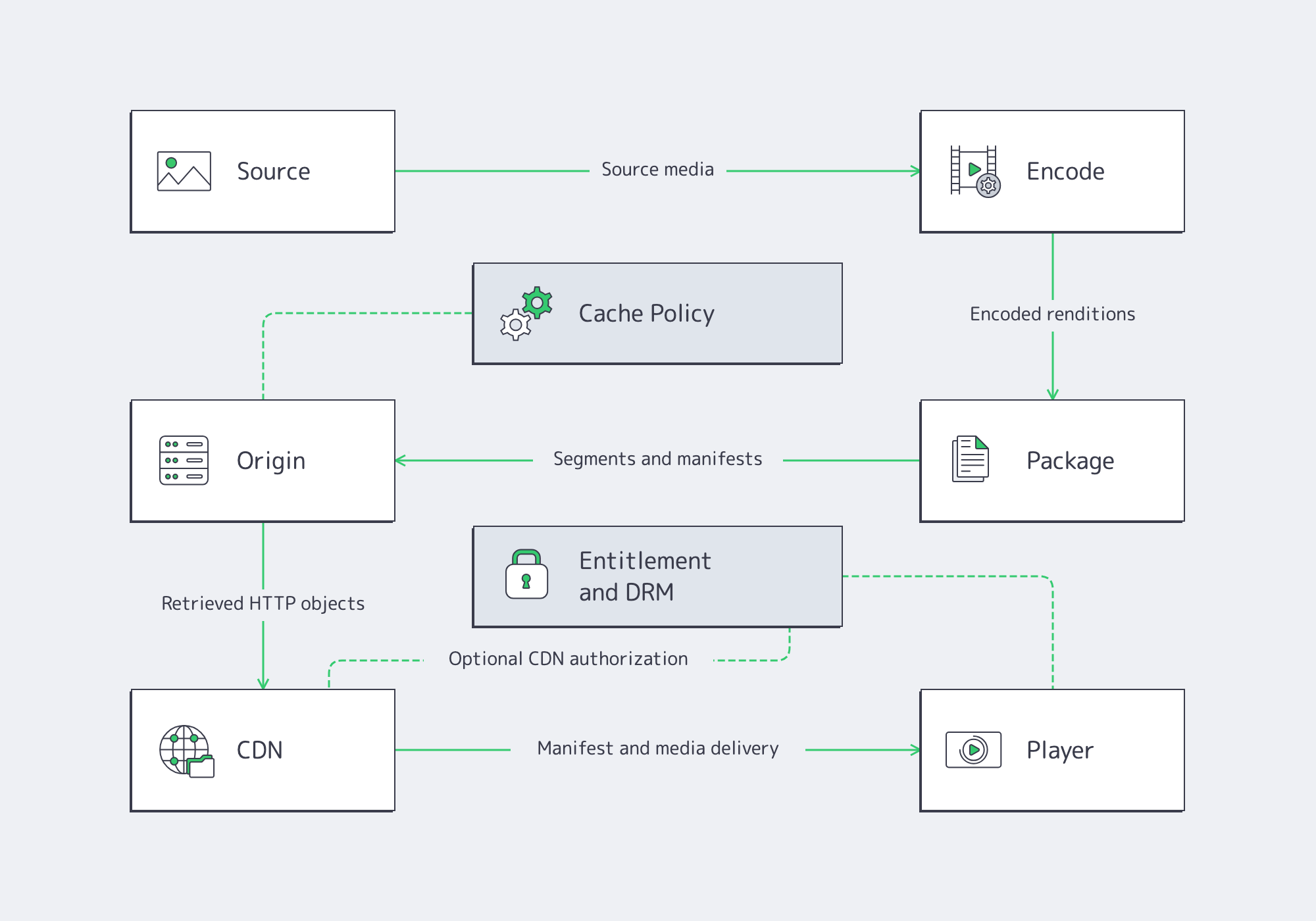
For live streaming, encoding and packaging operate continuously while the player tracks updated manifests and the live edge.
Every boundary needs testing. Validate renditions and manifests before delivery; exercise cache hits, misses, and origin recovery; measure startup, stalls, and bitrate switching on actual clients; and verify unauthorized sessions fail without harming cache efficiency.
Melbicom's streaming servers, S3-compatible storage, and CDN can occupy separate parts of this architecture. Customers operate the media software and application logic: encoding, packaging, player software, recording workflows, and application-level access controls. Our support covers hardware and in-data-center connectivity.
Scale components independently, with observable and reliable interfaces.
Choosing What to Buy and What to Own
Video hosting vs. CDN isn't a choice between two interchangeable products. It's a decision about how much streaming infrastructure your organization wants to operate.

Choose integration when a predefined media workflow meets your requirements. Choose separate services when encoding, storage, access policy, playback, or distribution needs independent control.
The essential takeaways are:
- Assign ownership before selecting products. Map storage, preparation, player, access controls, and delivery to accountable teams or service providers, including responsibility for failures between components.
- Verify bundled capabilities against actual workflows. Test whether ingest, encoding, DRM, analytics, and playback requirements are supported rather than assuming they come with video hosting.
- Compare complete operating costs. Model storage, processing, delivery, licensing, integration, and incident response against realistic traffic and retention assumptions.
- Keep entitlement and playback responsibilities explicit. Before launch, assign ownership of player compatibility, DRM licenses, and viewing permissions.
- Test the complete viewer path. Correlate origin and CDN behavior with player startup, rebuffering, authorization failures, and playback errors.
For teams retaining control of their video stack, distribution is a natural infrastructure boundary to outsource.
Build Your Delivery Layer With Melbicom
Melbicom CDN delivers prepared HLS and DASH content with caching controls, multiple origins, and delivery analytics.